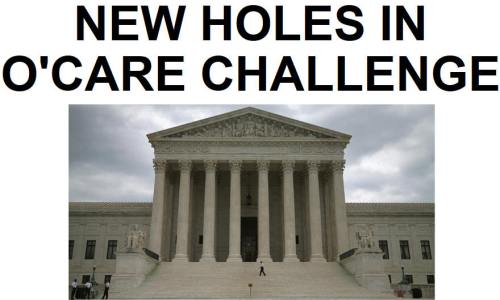
Obamacare faces its strangest challenge yet when the Supreme Court takes up the law for the third time Wednesday, but the oddity of the lawsuit shouldn’t obscure the cataclysm that a loss for President Barack Obama would provoke.
The Supreme Court case is the latest legal effort by political opponents of the Affordable Care Act to ruin Obama’s signature domestic achievement. If successful, the suit would tarnish Obama’s legacy, foment infighting among Republicans, aggravate bitter partisanship between the GOP Congress and the White House, and threaten chaos in the health insurance market. But the worst consequences would fall on the estimated 9.6 million people who would lose their health insurance.
The lawsuit, King v. Burwell, isn’t like the previous two Obamacare cases that came before the Supreme Court. Three years ago, in National Federation of Independent Business v. Sebelius, Chief Justice John Roberts joined the court’s four liberals in upholding the constitutionality of the Affordable Care Act’s individual mandate that most Americans obtain health insurance. The Supreme Court last year weakened Obamacare’s birth-control coverage rule in Hobby Lobby v. Burwell, a case with religious-freedom implications.
Officials in several Republican states that balked at participating in President Obama’s health-care initiative are now revisiting the issue, amid mounting panic over a possible Supreme Court decision that would revoke federal insurance subsidies for millions of Americans.
The discussions taking place in state capitals around the country are part of a flurry of planning and lobbying by officials, insurance and hospital executives, and health-care advocates to blunt the possible impact of a court ruling.
The justices hear arguments about the matter next week. And if the court sides with the plaintiffs, who argue that subsidies are not allowed in the 34 states that opted against setting up their own insurance marketplaces, the ruling could spark an immediate crisis. People could see their insurance bills skyrocket or be forced to abruptly cancel their insurance.
One of the plaintiffs in the Supreme Court case against the Affordable Care Act listed a short-term-stay motel as her address when she joined the lawsuit, potentially calling into question her basis for suing.
Rose Luck is among four plaintiffs suing the Obama administration to eliminate tax credits under the law that make health insurance cheaper for millions of Americans. They say the wording of the 2010 law allows consumers to tap the credits only in states that run their own insurance exchanges, and not their home state of Virginia, which is one of as many as 37 states that use the federal enrollment system.
The plaintiffs say that, by making their insurance more affordable, the tax credits subject them to the law’s requirement that they carry insurance or pay a fee, which they oppose.
The U.S. Supreme Court’s move on Monday to allow gay marriage to proceed in Alabama is the strongest signal yet that the justices are likely to rule in June that no state can restrict marriage to only heterosexual couples.
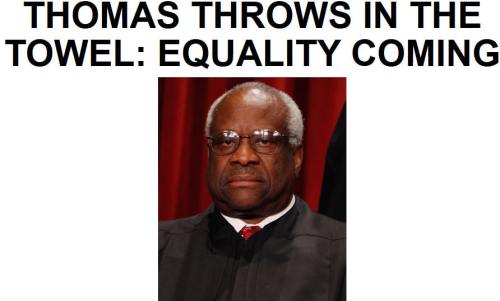
Of the nine justices, only two – conservatives Clarence Thomas and Antonin Scalia – dissented from the court’s refusal to block gay weddings from starting in Alabama. Gay marriage is now legal in 37 states.
Thomas acknowledged in a dissenting opinion that the court’s move to allow gay marriages to go ahead “may well be seen as a signal of the court’s intended resolution” as it considers cases from four other states on whether same-sex marriage bans are permitted under the U.S. Constitution. Although only two justices publicly dissented, the court order did not reveal whether any other justices voted to grant the stay.
In the first Affordable Care Act case three years ago, the Supreme Court had to decide whether Congress had the power, under the Commerce Clause or some other source of authority, to require individuals to buy health insurance. It was a question that went directly to the structure of American government and the allocation of power within the federal system.
The court very nearly got the answer wrong with an exceedingly narrow reading of Congress’s commerce power. As everyone remembers, Chief Justice John G. Roberts Jr., himself a member of the anti-Commerce Clause five, saved the day by declaring that the penalty for not complying with the individual mandate was actually a tax, properly imposed under Congress’s tax power.
I thought the court was seriously misguided in denying Congress the power under the Commerce Clause to intervene in a sector of the economy that accounts for more than 17 percent of the gross national product. But even I have to concede that the debate over structure has deep roots in the country’s history and a legitimate claim on the Supreme Court’s attention. People will be debating it as long as the flag waves.
The U.S. Supreme Court may rule once and for all this year whether the constitutional guarantee of equal protection under the law gives gay and lesbian Americans the right to marry.
Meeting behind closed doors on Friday, the nine justices decided to review a 2-1 decision by the U.S. Court of Appeals for the 6th Circuit that upheld bans on same-sex marriage in Ohio, Michigan, Kentucky and Tennessee. The decision by two judges on the Cincinnati-based court, both appointed by President George W. Bush, marked the first time a federal appeals court backed a same-sex marriage ban after other appellate courts had found similar bans unconstitutional. That split among the circuit courts likely drove the justices to pick up the case.
The Supreme Court will hear arguments and probably rule by June.
Nearly a week has gone by since the Supreme Court’s unexpected decision to enlist in the latest effort to destroy the Affordable Care Act, and the shock remains unabated. “This is Bush v. Gore all over again,” one friend said as we struggled to absorb the news last Friday afternoon. “No,” I replied. “It’s worse.”
What I meant was this: In the inconclusive aftermath of the 2000 presidential election, a growing sense of urgency, even crisis, gave rise to a plausible argument that someone had better do something soon to find out who would be the next president. True, a federal statute on the books defined the “someone” as Congress, but the Bush forces got to the Supreme Court first with a case that fell within the court’s jurisdiction. The 5-to-4 decision to stop the Florida recount had the effect of calling the election for the governor of Texas, George W. Bush. I disagreed with the decision and considered the contorted way the majority deployed the Constitution’s equal-protection guarantee to be ludicrous. But in the years since, I’ve often felt like the last progressive willing to defend the court for getting involved when it did.
Although the U.S. Supreme Court was “once a leader in the world” in the battle for racial equality, recent decisions by the high court undermine its role in solving a “real racial problem” in America, Justice Ruth Bader Ginsburg explained in an interview with The National Law Journal on Wednesday.
Citing recent events in Ferguson, Missouri, and racially biased stop-and-frisk policies, Ginsburg reflected on the perpetuation of racial segregation in America, comparing the challenges with those of the lesbian, gay, bisexual and transgender community.
.
Supreme Court Justice Ruth Bader Ginsburg said recent decisions by the high court undermine its role in solving a “real racial problem” in America. (Photo by Nikki Kahn/The Washington Post via Getty Images)
President Barack Obama received a hug from a sobbing woman while working the rope after a campaign event in Sandusky, Ohio, on Thursday. Stephanie Miller, whose 37-year-old sister, Kelly Hines, died of colon cancer four years ago, got a chance to personally thank the president for passing the health care law that the Supreme Court upheld last week.
Film and Writing Festival for Comedy. Showcasing best of comedy short films at the FEEDBACK Film Festival. Plus, showcasing best of comedy novels, short stories, poems, screenplays (TV, short, feature) at the festival performed by professional actors.

 .
.

 .
.
 .
. .
.
 .
.

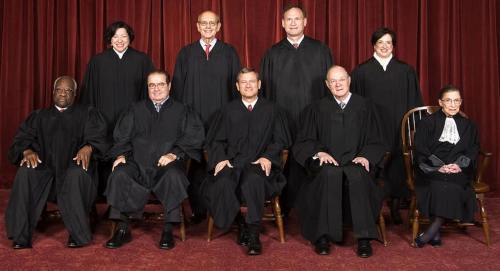 The Supreme Court


 James' World 2