A snowstorm can’t stop it. A blazing fire can’t stop it. And even getting run over by a car is no problem for this squishy little bot.
.
Researchers from Harvard University have developed a soft robot that not only can stand up and walk on its own, but also withstand tough elements all while carrying the equipment it needs on its back — from its microcompressors to control systems to batteries. Just check it out in the video above, which was recently posted to the university’s YouTube account.
.
Even a New England winter storm can’t stop this soft robot, which was recently developed by Harvard researchers.
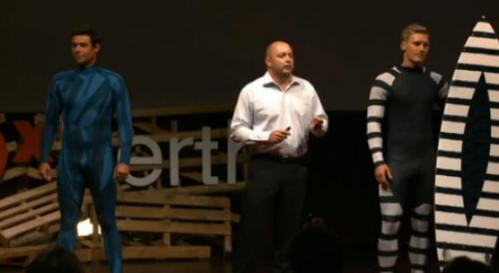
Ocean swimmer Hamish Jolly wished there was a wetsuit that could keep sharks at bay — so he invented one. Find out how he did it, and how you could apply the same techniques to create an innovation of your own.
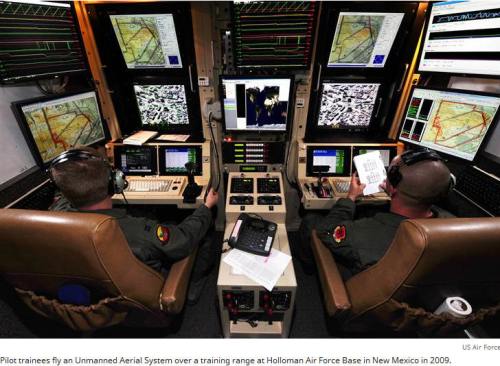
The Air Force is looking for a few good drone pilots, but not enough are lining up to fill those spots, claims a new report from an Air Force pilot who researches recruitment issues. One reason is trouble with the selection and training problems. But the other reason: Young pilots who join the military see the drone track as a dead-end career.
Colonel Brad Hoagland, who’s spent 23 years in the Air Force, took year-long break to study the system from the outside as part of a fellowship at the Brookings Institution. Hoagland went back to flying C-130s this summer, but in a newly released report — the result of his year-long study — he explains a few reasons why top brass in the Air Force need to give their Remotely Piloted Aircraft program a closer look.
The Air Force’s drone program has been growing quickly — it’s staffed by a little over 1,300 pilots as of this year, and is due to take in about 350 new pilots by 2017. “We’ve been building the platform faster than we can fill them with operators,” Hoagland previously told NBC News.
Early one morning a couple of months ago, as I was rushing around trying to get my act together in time to catch a train to New York, I filled a thermos with coffee, reached into the fridge, grabbed an unopened half-gallon of milk — one of those fancy, bottled-in-glass-like-the-good-old-days kinds — and promptly dropped the entire thing on the kitchen floor.
Here’s what happened next. The glass shattered upward and outward, in spectacular, slow-motion-film-worthy fashion; I later found shards in the cat’s dish, the salad bowl, and the blender, two shelves up. The half-gallon of milk set about demonstrating some principle of physics involving volume and surface area, or maybe some principle of religion involving loaves and fishes. Either way, in under three seconds, vast, improbable quantities of it were everywhere: soaking one leg of my jeans, running in lewd streams down the oven, flowing through a gap under a closed door and into the next room. As I stood there missing my train, I had a flash of insight. The reason we are instructed not to cry over spilled milk is that, if you spill enough of it, crying (or its adult analog: cursing) is the only natural response.
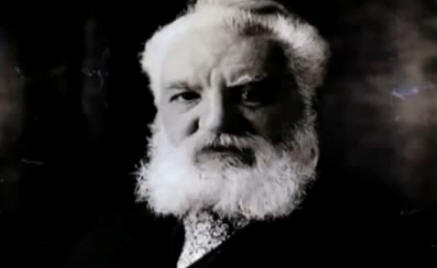
Researchers have identified the voice of Alexander Graham Bell for the first time in some of the earliest audio recordings held at the Smithsonian Institution.
The National Museum of American History announced Wednesday that Bell’s voice was identified with help from technicians at the Library of Congress and the Lawrence Berkeley National Laboratory in California. The museum holds some of the earliest audio recordings ever made.
Researchers found a transcript of one recording signed by Bell. It was matched to a wax disc recording from April 15, 1885.
“Hear my voice, Alexander Graham Bell,” the inventor said.
.
.
.Click link below for story, video, and slideshow:
Looking at photos from the November spill, so eerily similar to the photos from BP’s April 2010 spill in the Gulf of Mexico, it’s clear we are still looking for energy in risky places, and largely unprepared to deal with the consequences of failure. One year after the BP spill (which workers soaked up, in large part, with straw bales), the X Prize Foundation announced winners of a million-dollar incentive to develop new tools to clean up oil spills: And many others are looking at this problem too, including one of TED’s Senior Fellows, Cesar Harada. Harada is an inventor — of a staggering number of kinds of things. One of them is the Open_Sailing project, a group of inventors and scientists building open-source hardware and software to explore and study the ocean.
Watch game developer Kevin Slavin’s TEDTalk above and then explore his thoughts in this companion essay.
Back at TEDGlobal, the most difficult aspect of preparation was the editing process, chipping away at three hours of material to cut it down into 14 live minutes.
Of all the darlings that were killed, the ones I missed most were a few minutes about genetic algorithms. Like everything I presented, it’s a subject for which I have interest and passion, not training or expertise. It’s going to seem very dull. But stay with me for a few of the missing minutes.
Forget transferring files via email, flash drives or services like Dropbox. Researchers at the Massachusetts Institute of Technology (MIT) are working on a project that will allow you to move files from one device to another with nothing more than a swipe of your finger.
Film and Writing Festival for Comedy. Showcasing best of comedy short films at the FEEDBACK Film Festival. Plus, showcasing best of comedy novels, short stories, poems, screenplays (TV, short, feature) at the festival performed by professional actors.








 James' World 2