Woolly mammoths won’t be trouncing through the Arctic tundra anytime soon.
Contrary to recent headlines, which herald the extinct beast’s coming resurrection, scientists are still a long way from figuring out how to revive the elephant ancestor.
Woolly mammoths roamed the planet for hundreds of thousands of years before they vanished about 4,000 years ago. Paleontologists say the culprit for the die-off was possibly overhunting, or changes in mammoth’s food supply after the last Ice Age.
A camp of scientists — known as “revivalists” — are dedicated to bringing mammoths back in the modern era for environmental and biological reasons. Some researchers have made important early progress, although nothing is close to leaving the lab.
The conundrum has stumped doctors for years. Why do neurodegenerative diseases such as Alzheimer’s affect only the elderly? Why do some people live to be over 100 with normal brain functioning while others develop dementia decades earlier?
Now, a new study by Harvard scientists points to a possible answer, one that could spark further research that — ultimately — could lead to new drugs and treatments for dementia.
Researchers have found that a protein active during fetal brain development, called REST, switches back on later in life to protect aging neurons from various stresses, including the toxic effects of abnormal proteins. But in those with Alzheimer’s and mild cognitive impairment, the protein — RE1-Silencing Transcription factor — is absent from key brain regions.
Our planet is warm. Outer space is cold. Can we take that heat difference and turn it into electricity?
Physicists at Harvard University may have found a way to do just that. They’ve proposed in a new study how to harvest the Earth’s thermal infrared radiation, and convert it into direct-current (DC) power.
“It’s not at all obvious, at first, how you would generate DC power by emitting infrared light in free space toward the cold,” study co-author Dr. Federico Capasso, a professor of applied physics and senior research fellow in electrical engineering at the university, said in a written statement. “To generate power by emitting, not by absorbing light, that’s weird. It makes sense physically once you think about it, but it’s highly counterintuitive. We’re talking about the use of physics at the nanoscale for a completely new application.”
.
Physicists at Harvard University may have found a new way to capture the Earth’s radiation and turn it into energy. | Ozgurmulazimoglu | Flickr
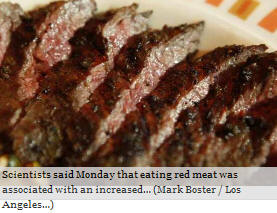
On Monday, researchers at the Harvard School of Public Health released study results showing that red meat consumption was associated with a higher risk of early death. The more red meat — beef, pork or lamb, for the purposes of the research — study participants reported they ate, the more likely they were to die during the period of time that data collection took place (more than 20 years). So what is it in red meat that might make it unhealthy?
A few years ago, we learned that too much TV might kill you sooner. Now, a new Harvard study is telling us excessive TV-watching could slash men’s sperm count, too.
The Harvard School of Public Health’s sperm study, published this week in the British Journal of Sports Medicine, determined that guys glued to the tube more than 20 hours per week had 44 percent less sperm than those who watched no TV.
.
A new study on sperm counts suggests that excessive
TV-watching could slash men’s sperm count.
.
.Click link below for story, slideshow, and video:
Several Harvard students received a racist pamphlet on Friday advertising a club to which ‘no f***ing jews’ were allowed but “coloreds” were “ok” the Harvard Crimson reported.
The pamphlets, which were delivered in sealed envelopes under students’ dorm room doors, advertised “Harvard’s Newest Final Club” i.e. one of Harvard’s 14 single sex social clubs. The club, called the “Pigeon” (perhaps a play on the Final Club propensity to name their establishments after animals) was ostensibly promoting a party situated in a local frozen yogurt shop. The attire was dubbed “Semi-bro.”
How do you raise two sons who will make enough money by age 30 to ensure you have a very comfortable retirement? Tell them their youth is no barrier to achieving. Take them on vacations to developing countries where their imaginations can run wild with ideas for solving the planet’s greatest problems. And teach them to rebel in the right ways.
MY wife and I attended my 30-year college reunion a couple of weekends ago, but the partying was bittersweet. My freshman roommate, Scott Androes, was in a Seattle hospital bed, a victim in part of a broken health care system. Strip away the sound and fury of campaign ads and rival spinmeisters, and what’s at stake in this presidential election is, in part, lives like Scott’s.
Talk about flashbacks. New research suggests that LSD–a mind-altering drug known to cause recurrent hallucinations–may find new popularity not as a recreational drug but as a treatment for alcoholism.
Film and Writing Festival for Comedy. Showcasing best of comedy short films at the FEEDBACK Film Festival. Plus, showcasing best of comedy novels, short stories, poems, screenplays (TV, short, feature) at the festival performed by professional actors.









 James' World 2