Using NASA’s Kepler space telescope, astronomers have witnessed an unprecedented event: a miniature celestial body getting ripped apart by the white dwarf star it orbits.
According to NASA, it confirms one of the more gruesome theories of the universe: that white dwarfs — small, dense stars that form when a star burns out or collapses — can “cannibalize” other planets still hanging around them.
“We are for the first time witnessing a miniature ‘planet’ ripped apart by intense gravity, being vaporized by starlight and raining rocky material onto its star,” said Andrew Vanderburg, graduate student at the Harvard-Smithsonian Center for Astrophysics and lead author of the paper published in Nature, according to the NASA press release.
.
Real-Life Death Star Ripping a Planet Apart With Gravity
When a black hole swallows a star, things get violent. Very violent.
At least, that’s what scientists found in a new study when they used computer simulations to mimic the destruction of a star as it falls into a giant black hole. Just check it out in the video.
The simulations show that when the gravitational force of a supermassive black hole pulls in a star, the star is stretched into a long blob before it’s destroyed. About half of the star’s mass may get ejected as a stream of debris and the other half eventually may spiral into the black hole, forming what’s called an “accretion disk.”
.
Illustration of a star distorted by supermassive black hole.
In the next five years or so, scientists are poised to discover proof that space and time can wrinkle in the form of gravitational waves. These waves were predicted almost 100 years ago by Albert Einstein’s general theory of relativity, but have yet to be seen.
That could change soon when the latest, most sensitive experiments hunting gravitational waves come online. “There’s so much activity and excitement in the field right now,” said Mansi M. Kasliwal, an astronomer at the Observatories of the Carnegie Institution for Science in Pasadena, Calif. “The momentum is really building.”
Kasliwal is the author of a paper published online today (May 2) in the journal Science describing the burgeoning field of gravitational wave studies.
.
3D visualization of gravitational waves produced by two orbiting black holes.
.
.Click link below for story, slideshow, and video:
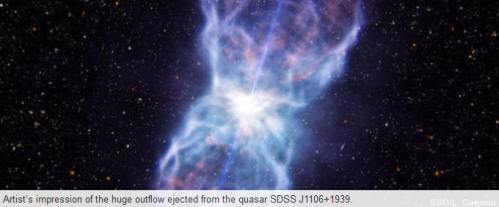
Astronomers have seen a distant galaxy that blasts away material with two trillion times the energy the sun emits — the biggest such eruption ever seen. That ejection of matter could answer an important question about the universe: why are the black holes in the centers of galaxies so light?
Computer models of the early universe usually produce a virtual cosmos that looks like ours except for one thing. The ratio of the mass of black holes in galaxy centers to the rest of the matter in galaxies is larger in the simulations than in the real universe.
.
.
.Click link below for story, slideshow, and video:
Neil deGrasse Tyson is one of the most celebrated science communicators and popularizers alive today. He is the Frederick P. Rose Director of the Hayden Planetarium and hosts NOVA ScienceNOW on PBS. He has also written several popular texts about astronomy, including his most recent book, Space Chronicles: Facing the Ultimate Frontier.
Film and Writing Festival for Comedy. Showcasing best of comedy short films at the FEEDBACK Film Festival. Plus, showcasing best of comedy novels, short stories, poems, screenplays (TV, short, feature) at the festival performed by professional actors.




 James' World 2