June 1, 2013
Mohenjo
Science
amazon, aviation, biology, business, climate, Daily Discovery, Environment, evolution, Flightless Birds, Flying Penguins, gaming, Hotels, huffingtonpost, Murres, nature, Penguins, Penguins Fly, Penguins Flying, research, Science, Science News, Slideshow, technology, Technology News, transportation, travel, vacation, Video, videogames, Zoology
FROM

Click link below picture
.
Humans spent centuries conspiring to fly, so it might be hard to imagine that any creature would give up the skill, and yet penguins waddle among us. A new study helps confirm that these seabirds traded flight to become better swimmers.
Penguins have a litany of physical features that make them energy-efficient underwater. For instance, their shortened wingspans lessen drag; their dense wing bones make them less buoyant; and their bulky bodies help them stay insulated and dive deeper. Unlike other aquatic birds that paddle underwater with their webbed feet, penguins beat their wings to propel themselves far below the surface. Emperor penguins can even go to depths greater than 1,500 feet (450 meters), lasting 20 minutes on a single breath.
.

Murres, which resemble flying penguins, have the highest wing-loading of any bird, which results in exceptionally high flight costs and could explain why Antarctic penguins have evolved flightlessness.
.
.Click link below for story, slideshow, and video:
http://www.huffingtonpost.com/2013/05/22/penguins-flying-ability-birds-swim-better-murres_n_3318799.html?ref=topbar
.
____________________________________________________
May 26, 2013
Mohenjo
Science
amazon, business, climate, developmental biology, evolution, Fertility And Intelligence, Future, General Intelligence, genetic selection, Hotels, huffingtonpost, Human Intelligence, Human Intelligence Research, intelligence, Intelligence Decline, Iq, Iq Tests, medicine, mental-health, organizational psychology, People Getting Dumber, reaction time, research, Science, Science News, Slideshow, Stanford University, technology, Technology News, travel, university of amsterdam, vacation, Victorian England, Video
FROM
Click link below picture
.
Our technology may be getting smarter, but a provocative new study suggests human intelligence is on the decline. In fact, it indicates that Westerners have lost 14 I.Q. points on average since the Victorian Era.
What exactly explains this decline? Study co-author Dr. Jan te Nijenhuis, professor of work and organizational psychology at the University of Amsterdam, points to the fact that women of high intelligence tend to have fewer children than do women of lower intelligence. This negative association between I.Q. and fertility has been demonstrated time and again in research over the last century.
But this isn’t the first evidence of a possible decline in human intelligence.
“The reduction in human intelligence (if there is any reduction) would have begun at the time that genetic selection became more relaxed,” Dr. Gerald Crabtree, professor of pathology and developmental biology at Stanford University, told The Huffington Post in an email. “I projected this occurred as our ancestors began to live in more supportive high density societies (cities) and had access to a steady supply of food. Both of these might have resulted from the invention of agriculture, which occurred about 5,000 to 12,000 years ago.”
.

.
.Click link below for story, slideshow, and video:
http://www.huffingtonpost.com/2013/05/22/people-getting-dumber-human-intelligence-victoria-era_n_3293846.html?utm_hp_ref=mostpopular
.
_____________________________________________________
May 26, 2013
Mohenjo
Science
amazon, ambystoma mexicanum, aquatic salamander, biology, business, climate, Daily Discovery, Environment, Hotels, huffingtonpost, human-rights, Immune Cells, immune system, Limb Regeneration, monash university, Ocean Science, research, Salamander Regeneration, Salamanders, Salamanders Regrow, Science, Science News, Slideshow, technology, Technology News, travel, vacation, Video, Weird Science
FROM
Click link below picture
.
Salamanders can regrow entire limbs and regenerate parts of major organs, an ability that relies on their immune systems, research now shows.
A study of the axolotl (Ambystoma mexicanum), an aquatic salamander, reveals that immune cells called macrophages are critical in the early stages of regenerating lost limbs. Wiping out these cells permanently prevented regeneration and led to tissue scarring. The findings hint at possible strategies for tissue repair in humans.
“We can look to salamanders as a template of what perfect regeneration looks like,” lead study author James Godwin said in a statement. “We need to know exactly what salamanders do and how they do it well, so we can reverse-engineer that into human therapies,” added Goodwin, of the Australian Regenerative Medicine Institute (ARMI) at Monash University in Melbourne. [Ready for Med School? Test Your Body Smarts]
.

The axolotl, an aquatic salamander, can regenerate lost limbs.
.
.Click link below for story, slideshow, and video:
http://www.huffingtonpost.com/2013/05/21/limb-regeneration-salamanders-immune-cells-axolotl_n_3311704.html?ref=topbar
.
____________________________________________________
May 26, 2013
Mohenjo
Science
Agriculture, amazon, aviation, business, cars, climate, Crop Production, Drones, Drones Agriculture, Drones Farming, Engineering, Farming, Future, gadgets, Hotels, huffingtonpost, Maker Faire Bay Area, pesticide treatment, Pesticides, research, Satellites, Science, Science News, Slideshow, Smarter Ideas, soil productivity, technology, Technology News, transportation, travel, vacation, Video
FROM
Click link below picture
.
The word “drone” tends to conjure up images of planes that kill terrorists or of creepy surveillance tools.
But tiny drone airplanes made of foam may be more useful in rural environments, one researcher says. There, the fliers could revolutionize agriculture, reducing the need for pesticides and improving crop production.
Because drones can fly cheaply at a low altitude, they can get highly detailed images of cropland, said Chris Anderson, the CEO of 3D Robotics and former editor-in-chief of Wired, here on Saturday (May 18) at this year’s Maker Faire Bay Area, a two-day celebration of DIY science, technology and engineering. Drone-captured close-ups of fields could help farmers tailor their pesticide treatment and identify subtle differences in soil productivity. [Rise of the Drones: Photos of Unmanned Aircraft]
.

Unmanned Aerial Vehicle (UAV) filming vineyards.
.
.Click link below for story, slideshow and video:
http://www.huffingtonpost.com/2013/05/20/drones-agriculture-unmanned-aircraft-farming_n_3308164.html?ref=topbar
.
___________________________________________________
May 21, 2013
Mohenjo
Science
amazon, Astronomy, business, climate, Environment, environment office, Hotels, huffingtonpost, looking at the moon, Lunar Reconnaissance Orbiter, mare imbrium, Meteorite Crash, Meteorites, Meteors, Moon, Moon Explosion, Moon Meteorite, myaol, NASA, nasa scientists, research, Science, Science News, Slideshow, Space, Space Rocks, technology, Technology News, travel, vacation, Video
FROM
Click link below picture
.
The moon has a new hole on its surface thanks to a boulder that slammed into it in March, creating the biggest explosion scientists have seen on the moon since they started monitoring it.
The meteorite crashed on March 17, slamming into the lunar surface at a mind-boggling 56,000 mph (90,000 kph) and creating a new crater 65 feet wide (20 meters). The crash sparked a bright flash of light that would have been visible to anyone looking at the moon at the time with the naked eye, NASA scientists say.
“On March 17, 2013, an object about the size of a small boulder hit the lunar surface in Mare Imbrium,” Bill Cooke of NASA’s Meteoroid Environment Office said in a statement. “It exploded in a flash nearly 10 times as bright as anything we’ve ever seen before.” [The Greatest Lunar Crashes Ever]
.

This artist’s illustration shows a meteor crashing into the surface of the moon. Scientists say hundreds of space rocks impact the lunar surface every year.
.
.Click link below for story, videos, and slideshow:
http://www.huffingtonpost.com/2013/05/18/moon-explosion-meteorite-crash-lunar-surface-nasa_n_3294710.html?icid=maing-grid7|myaol|dl12|sec1_lnk3%26pLid%3D315221
.
___________________________________________________
May 21, 2013
Mohenjo
Science
1998 QE2, amazon, Asteroid 1998 QE2, Asteroid Flyby, Asteroids, Astronomy, business, climate, current-events, distance between earth and the moon, Environment, goldstone radar, high resolution images, Hotels, huffingtonpost, jet propulsion laboratory, Jpl, NASA, Near-Earth Asteroids, Near-Earth Objects, radar telescopes, research, Science, Science News, Slideshow, Space, Space Rocks, technology, Technology News, travel, vacation, Video
FROM
Click link below picture
.
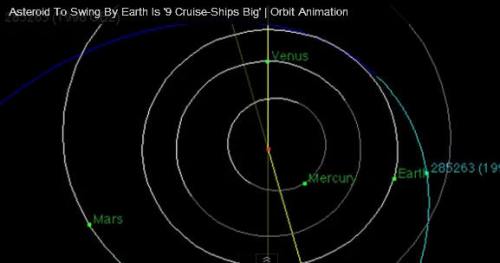
A gigantic asteroid will fly by our planet at the end of this month, making its closest approach for at least the next two centuries on May 31. But, don’t worry, it won’t get closer than about 3.6 million miles, which is around 15 times the distance between Earth and the moon.
Astronomers plan to use radar telescopes to get a good look at the space rock, named Asteroid 1998 QE2, between May 30 and June 9.
“Asteroid 1998 QE2 will be an outstanding radar imaging target at Goldstone and Arecibo [observatories] and we expect to obtain a series of high-resolution images that could reveal a wealth of surface features,” radar astronomer Lance Benner, the principal investigator for the Goldstone radar observations from NASA’s Jet Propulsion Laboratory, said in a written statement.
.
.
.Click link below for story, video, and slideshow:
http://www.huffingtonpost.com/2013/05/18/asteroid-1998-qe2-earth-video_n_3294388.html?ref=topbar
.
____________________________________________________
May 16, 2013
Mohenjo
Science
amazon, Anatomy, biology, business, Corkscrew Esophagus, Endoscopy, england journal of medicine, Esophageal Motility Disorders, Esophagus, Esophagus Spasm, Gastroesophageal Reflux, Health, Hotels, huffingtonpost, medicine, mental-health, myaol, new england journal, New England Journal of Medicine, research, Science, Science News, Slideshow, Spiraling Esophagus, swiss woman, technology, Technology News, travel, university hospital zurich, vacation, Video, Weird Science
FROM
Click link below picture
.
An 87-year-old Swiss woman who suffered painful spasms in her chest turned out to have an esophagus that twisted itself into a corkscrew shape whenever she swallowed, according to a report of her case.
The woman had lost 11 pounds in the past several months, and told doctors she had cramplike spasms shortly after eating.
Her doctors performed an endoscopy and found that, when she swallowed, her esophagus had the same helical shape as a playground twisty slide.
X-ray images revealed the startling, corkscrew shape taking form.
“The magnitude of this finding was extraordinary,” said Dr. Luc Biedermann, of the University Hospital Zurich, who treated the woman and reported the case in this week’s New England Journal of Medicine.
.

Doctors say an 87-year-old woman had an esophagus that twisted itself into a corkscrew shape when she swallowed. Above, image of the esophagus.
.
.Click link below for story, slideshow, and video:
http://www.huffingtonpost.com/2013/05/10/spiral-esophagus-swiss-woman-corkscrew-gullet_n_3253439.html?icid=maing-grid7|myaol|dl2|sec1_lnk3%26pLid%3D311635
.
__________________________________________________
May 16, 2013
Mohenjo
Science
amazon, aviation, business, creator gene roddenberry, Environment, Faster Than Light, Faster Than Light Travel, Future, gaming, General Relativity, Hotels, huffingtonpost, human-rights, mass energy equivalence, Physics, research, Science, Science News, Slideshow, Star Trek, Star Trek Warp Drive, technology, Technology News, transportation, travel, U.S.S. Enterprise, vacation, Video, videogames, Warp Drive, Warp Speed
FROM
Click link below picture
.
In the “Star Trek” TV shows and films, the U.S.S. Enterprise’s warp engine allows the ship to move faster than light, an ability that is, as Spock would say, “highly illogical.”
However, there’s a loophole in Einstein’s general theory of relativity that could allow a ship to traverse vast distances in less time than it would take light. The trick? It’s not the starship that’s moving — it’s the space around it.
In fact, scientists at NASA are right now working on the first practical field test toward proving the possibility of warp drives and faster-than-light travel. Maybe the warp drive on “Star Trek” is possible after all. [See also: Warp Drive: Can It Be Done? (Video)]
According to Einstein’s theory, an object with mass cannot go as fast or faster than the speed of light. The original “Star Trek” series ignored this “universal speed limit” in favor of a ship that could zip around the galaxy in a matter of days instead of decades. They tried to explain the ship’s faster-than-light capabilities by powering the warp engine with a “matter-antimatter” engine. Antimatter was a popular field of study in the 1960s, when creator Gene Roddenberry was first writing the series. When matter and antimatter collide, their mass is converted to kinetic energy in keeping with Einstein’s mass-energy equivalence formula, E=mc2.
.

In the “Star Trek” TV shows and films, the U.S.S. Enterprise’s warp engine allows the ship to move faster than light, an ability that is, as Spock would say, “highly illogical.” However, there’s a loophole in Einstein’s general theory of relativity that could allow a ship to traverse vast distances in less time than it would take light.
.
.Click link below for story, slideshow, and video:
http://www.huffingtonpost.com/2013/05/14/warp-drive-possible-star-trek-special-relativity_n_3273422.html?ref=topbar
.
___________________________________________________
May 16, 2013
Mohenjo
Science
amazon, Antigravity, Antimatter, antimatter counterpart, Antimatter Gravity, berkeley national laboratory, business, climate, Environment, experimental measurements, Gravity Antimatter, Hotels, huffingtonpost, Large Hadron Collider, Lawrence Berkeley National Laboratory, Particle Physics, Physics, research, Science, Science News, Slideshow, strange cousin, technology, Technology News, travel, vacation, Video, Weird Science
FROM
Click link below picture
.
When it comes to antimatter, what goes up doesn’t necessarily come down. In a new study, physicists weighed antimatter in an effort to determine how this strange cousin of matter interacts with gravity.
Ordinary matter atoms fall down due to the pull of gravity, but the same might not be true of antimatter, which has the same mass as matter, but opposite charge and spin. Scientists wondered whether antimatter atoms would instead fall up when pulled by gravity, and whether such a thing as antigravity exists.
“In the unlikely event that antimatter falls upward, we’d have to fundamentally revise our view of physics and rethink how the universe works,” Joel Fajans, a physicist at the Lawrence Berkeley National Laboratory in California, said in a statement.
Fajans and his colleagues at the Alpha experiment at Switzerland’s CERN physics lab made the first experimental measurements of the gravitational mass of antihydrogen — the antimatter equivalent of hydrogen, made of an antiproton and a positron (the antimatter counterpart to an electron). [Whoa! The Coolest Little Particles in Nature]
.

This illustration of antimatter shows antiparticle beside its particle mirror-image.
.
.Click link below for story, slideshow, and video:
http://www.huffingtonpost.com/2013/04/30/antimatter-gravity-alpha-experiment-cern-force-atoms_n_3187289.html?ref=topbar
.
____________________________________________________
May 9, 2013
Mohenjo
Science
Albert Einstein, amazon, Astrophysics, black holes, business, Calif, Carnegie Institution for Science, climate, Cosmology, Einstein, einstein general relativity, Future, gadgets, General Relativity, general relativity theory, general theory of relativity, gravitational waves, gravity, Gravity Waves, Hotels, huffingtonpost, Mansi M. Kasliwal, Pasadena, Physics, research, Science, Science News, Slideshow, Space, technology, Technology News, theory of relativity, travel, vacation, Video
FROM
Click link below picture
.
In the next five years or so, scientists are poised to discover proof that space and time can wrinkle in the form of gravitational waves. These waves were predicted almost 100 years ago by Albert Einstein’s general theory of relativity, but have yet to be seen.
That could change soon when the latest, most sensitive experiments hunting gravitational waves come online. “There’s so much activity and excitement in the field right now,” said Mansi M. Kasliwal, an astronomer at the Observatories of the Carnegie Institution for Science in Pasadena, Calif. “The momentum is really building.”
Kasliwal is the author of a paper published online today (May 2) in the journal Science describing the burgeoning field of gravitational wave studies.
.

3D visualization of gravitational waves produced by two orbiting black holes.
.
.Click link below for story, slideshow, and video:
http://www.huffingtonpost.com/2013/05/03/gravity-waves-found-einstein-general-relativity-theory_n_3203364.html?ref=topbar
.
___________________________________________________
Older Entries
Newer Entries

