
Click the link below the picture
.
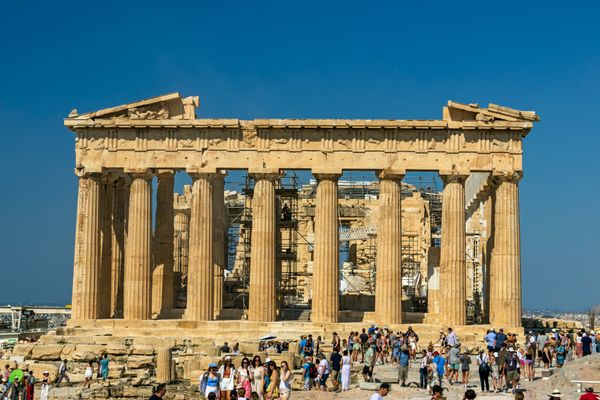
The Parthenon is a stunning example of ancient Greek architecture—but it is also the site of an optical mystery. If you look closely, the platform on which the columns of the Parthenon stand, called the stylobate, is subtly curved, forming a parabola shape. A long-standing theory for this architectural quirk is that it creates an optical illusion that makes the Parthenon appear to stand straighter; it would look saggy otherwise.
But now a mathematician is making the case for why that theory just can’t be true.
In a new paper published in Royal Society Open Science, mathematician Alain Goriely shows that even though the stylobate really is curved, the illusion doesn’t hold up. According to existing research on how the eye perceives illusions, humans can detect about 1.5 to five centimeters of curve in a straight line from about 25 meters away. The stylobate’s curve reaches a maximum of six centimeters of change, so it would be perceptively curvy when viewed at that close of a distance. But when it is much farther than that, the average human eye is no longer capable of seeing it.
In fact, the ability to see the curve from 25 meters away may only hold in perfect theoretical conditions—such as a single high-contrast line on a two-dimensional surface. But in real life, when one is looking at the Parthenon, the noise in the image—the three-dimensional elements of the structure that exist in the background and foreground of the 2D lines—obscures our ability to notice the stylobate curve, even from 25 meters.
As a result, any illusory effects would likely be lost on a viewer. And even when looking up close, the stylobate would look curved, not straight.
“We’re not that easily fooled in the real three-dimensional world by visual illusion,” says Goriely, an applied mathematician at the University of Oxford.
“People sometimes are brought to the corner of the Parthenon, and that really amplifies the curvature,” he says. “And [they] say, ‘Aha, you see it’s curved. And why is it curved? Because the Greek made it so that it appears straight.’ But if it appears straight, why is it curved?”
Goriely also outlines how a straightening illusion might work—and why it doesn’t make sense for the Parthenon.
The Hering and Wundt illusions are examples of how straight lines can appear curved if intersecting lines cross them at a certain angle. The Parthenon’s columns famously have a slight inward tilt toward the roof and bulge at the center, which some people theorize balances out the curved stylobate. But the columns are much too perpendicular to the stylobate for that.
Goriely says other explanations, such as that this architectural style improved drainage or simply that the ancient Greeks liked it, hold more weight than any illusion.
Certainly, the ancient Greeks appreciated symmetry and precision in their architecture; it’s even been hypothesized that this symmetry was considered divine and thus represented religious dedication to the space. Mark Wilson Jones, an architectural historian and a visiting professor at the University of Cambridge, points out that there’s “a very satisfying proportion” in the Parthenon’s architecture: an exact 2:1 relationship between the width of the stylobate platform and the height of the structure, including both the columns and the entablature. That ratio’s “sweetness” depends on the curve of the stylobate, according to Wilson Jones.
Still, Wilson Jones doesn’t think the theory that the ancient Greeks were attempting an optical illusion should be ditched entirely. “In classical antiquity, as in most traditional cultures, partial explanations could operate at the same time, overlapping and reinforcing each other in ways that are not entirely logical to us,” he says. “The Greeks may have convinced themselves or suspended their disbelief… They didn’t have modern methods to prove or disprove theories such as this.”
.
.
.
Click the link below for the complete article:
.
__________________________________________


Leave a Reply