October 12, 2013
Mohenjo
Science
A Brief History Of Time, Alok Jha, amazon, Animated Video, animation, Black Hole, business, Business News, Cartoon, Cartoon Videos, celebrities, Hawking, Hotels, huffingtonpost, human-rights, mental-health, Physics, Physics Animated, Physics Of a Black Hole, Physics Theory, research, Science, Science News, Stephen Hawking, technology, Technology News, Theoretical Physics, Theories, Theory, travel, vacation, Video
FROM

Click link below picture
.
What’s at the center of a black hole? And what happens at the edge of a black hole?
Stephen Hawking has some big ideas that answer these big questions. Called one of the most influential physicists of our time, you might assume that his theories are too complicated for the layperson to wrap his or her mind around.
But in some ways, his ideas are easier to understand than you might think. Through animation and narration, The Guardian’s science correspondent Alok Jha explains them all in a two-and-half-minute cartoon in a way that everyone can easily grasp. Check it out above.
And why give Hawking’s theories the cartoon treatment?
“I suppose the incredible thing is that he came up with all these profound, provocative insights without the convenience of being able to write anything down,” Jha says in the video. Hawking, who authored A Brief History of Time, is paralyzed as a result of motor neuron disease.
.
.
.
Click link below for story, video and slideshow:
.
______________________________________________________________________________
October 6, 2013
Mohenjo
Science
Albert Einstein, amazon, Astronomy, business, Business News, current-events, Curved Space-Time, Environment, Future, Gravitational Lensing, gravity, Hotels, huffingtonpost, Hui Liu, light rays, Mathematics, Microchips, path of light, Physics, research, Science, Science News, Slideshow, solar eclipse, Space, Space Time, Space-Time On Chip, Spacetime, technology, Technology News, theory of relativity, travel, vacation
FROM
Click link below picture
.
It took two major expeditions charting the solar eclipse of 1919 to verify Albert Einstein’s weird prediction about gravity — that it distorts the path of light waves around stars and other astronomical bodies, distorting objects in the background. Now, researchers have created the first precise analogue of that effect on a microchip.
Any large mass distorts the geometry of space around it, for instance making parallel light rays diverge or converge. One consequence, described by Einstein’s general theory of relativity, is that objects behind a body such as the Sun may look magnified or distorted as the optical path of light goes through the region of warped space.
Metamaterials scientist Hui Liu of Nanjing University in China and his colleagues mimicked this ‘gravitational lensing’ — which affects light in the vacuum of space — by making light travel through solid materials instead. Different transparent media have different indexes of refraction, causing light to bend. One example is at the interface between water and air, a familiar effect that makes a pencil look broken when it is half-dipped in water. But if a medium has an index of refraction that varies gradually rather than abruptly, it will make the the paths of light rays curve as they travel through it.
.

The warping of the empty space around a massive star means that the shortest path of light around a star is a ‘curved’ one — but the bending of light rays in a medium can mimic the same effect. | Nature Photonics
.
.
Click link below for story and slideshow:
.
______________________________________________________________________________
October 6, 2013
Mohenjo
Science
Alaska, Alaska Walrus, amazon, Animal, animals, Arctic Ocean, Bureau of Ocean Energy Management, business, Business News, climate, Climate-Change, current-events, Cute Animals, Environment, Green News, Green Summer, Hotels, huffingtonpost, National Oceanic and Atmospheric Administration, research, Science, Science News, Slideshow, technology, Technology News, travel, vacation, Video, Walrus, Walrus Alaska, Walrus Exodus
FROM

Click link below picture
.
An estimated 10,000 walrus unable to find sea ice over shallow Arctic Ocean water have come ashore on Alaska’s northwest coast.
Scientists with the National Oceanic and Atmospheric Administration on Friday photographed walrus packed onto a beach on a barrier island near Point Lay, an Inupiat Eskimo village 300 miles southwest of Barrow and 700 miles northwest of Anchorage.
The walrus have been coming to shore since mid-September. The large herd was spotted during NOAA’s annual arctic marine mammal aerial survey, an effort conducted with the Bureau of Ocean Energy Management, the agency that conducts offshore lease sales.
An estimated 2,000 to 4,000 walrus were photographed at the site Sept. 12. The U.S. Fish and Wildlife Service, the agency that manages walrus, immediately took steps to prevent a stampede among the animals packed shoulder to shoulder on the rocky coastline. The agency works with villages to keep people and airplanes a safe distance from herds.
Young animals are especially vulnerable to stampedes triggered by a polar bear, a human hunter or a low-flying airplane. The carcasses of more than 130 mostly young walruses were counted after a stampede in September 2009 at Alaska’s Icy Cape.
.
.
.
Click link below for story, video and slideshow:
.
______________________________________________________________________________
October 1, 2013
Mohenjo
Science
amazon, business, Business News, Curiosity, Curiosity Rover, Earth, Future Mars explorers, Health, Hotels, huffingtonpost, human-rights, Jake Matijevic, Laurie Leshin, Mars, Mars Curiosity Rover, Mars Rock, Mars Rocks, Mars Rover, Mars Rover Curiosity, Mars Water, medicine, mental-health, NASA, politics, Rensselaer Polytechnic Institute, research, Science, Science News, Search for E.T., Slideshow, Space, Space Program, technology, Technology News, the Red Planet, travel, vacation, Video, Water Mars, Water On Mars
Click link below picture
.
Future Mars explorers may be able to get all the water they need out of the red dirt beneath their boots, a new study suggests.
NASA’s Mars rover Curiosity has found that surface soil on the Red Planet contains about 2 percent water by weight. That means astronaut pioneers could extract roughly 2 pints (1 liter) of water out of every cubic foot (0.03 cubic meters) of Martian dirt they dig up, said study lead author Laurie Leshin, of Rensselaer Polytechnic Institute in Troy, N.Y.
“For me, that was a big ‘wow’ moment,” Leshin told SPACE.com. “I was really happy when we saw that there’s easily accessible water here in the dirt beneath your feet. And it’s probably true anywhere you go on Mars.”
.

Curiosity in a mosaic of photos taken by the rover’s Mars Hand Lends Imager on Sol 85, the rover’s 85th Martian day, as Curiosity was sampling rocks at a stop dubbed Rocknest in Gale Crater. Image released Sept. 26, 2013. | NASA/JPL-Caltech/Malin Space Science Systems
.
.
Click link below for story and slideshow:
.
______________________________________________________________________________
October 1, 2013
Mohenjo
Science
amazon, Brain Science, Brains Copied To Computer, Brains Stephen Hawking, business, Business News, Hawking, Health, Hotels, huffingtonpost, human-rights, medicine, mental-health, research, Science, science fiction, Science News, Slideshow, Stephen Hawking, Stephen Hawking Brains, Stephen Hawking Heaven, Stephen Hawking Life After Death, technology, Technology News, travel, vacation, Video
FROM
Click link below picture
.
Could your brain keep on living even after your body dies? Sounds like science fiction, but celebrated theoretical physicist Stephen Hawking recently suggested that technology could make it possible.
“I think the brain is like a program in the mind, which is like a computer,” Hawking said last week during an appearance at the Cambridge Film Festival, The Telegraph reported. “So it’s theoretically possible to copy the brain on to a computer and so provide a form of life after death.”
He acknowledged that such a feat lies “beyond our present capabilities,” adding that “the conventional afterlife is a fairy tale for people afraid of the dark.”
Hawking, 71, made the remarks in conjunction with the premiere of a new documentary about his life.
.
.
.
Click link below for story, video and slideshow:
.
______________________________________________________________________________
September 25, 2013
Mohenjo
Science
amazon, business, Business News, climate, getty images, hay on wye, Hotels, huffingtonpost, Is Time Travel Possible, light particle, particle physicist, Physics, research, Science, Science News, Slideshow, technology, Technology News, Time Machine, Time Machine Possible, Time Travel, Time Travel Brian Cox, Time Travel British Physicist, Time Travel Physicist, Time Travel Possible To Future, Time Travel To Future, time travel to the future, travel, vacation, Weird Science
FROM
Click link below picture
.
We may be able to book our ticket to the future someday — it’ll just be a one-way trip.
In a presentation at the British Science Festival, particle physicist Brian Cox said that time travel is possible but only in one direction.
“The central question is, can you build a time machine? The answer is yes, you can go into the future,” the University of Manchester professor told the audience during his hour-long speech on Tuesday, according to The Telegraph. “You’ve got almost total freedom of movement in the future.”
Cox detailed how time travel to the future is possible under Albert Einstein’s general theory of relativity. Traveling hundreds, or even thousands of years into the future, could be accomplished if someone was traveling at an incredibly fast pace, close to the speed of light.
.

Particle physicist Brian Cox speaking in Hay-on-Wye, Wales on May 28, 2011. (Photo by David Levenson/Getty Images)
.
.
Click link below for story and slideshow:
.
______________________________________________________________________________
September 25, 2013
Mohenjo
Science
Afar Rift, amazon, business, Business News, climate, cubic kilometers, Daily Discovery, Earth, Earth Science, Environment, Ethiopia, Geology, Hotels, huffingtonpost, lava bubbles, Magma, Magma Blob, Magma Ethiopia, research, Science, Science News, Slideshow, technology, Technology News, travel, Underground Magma, University of Edinburgh, vacation, volcanic ridges
FROM
Click link below picture
.
The Afar Rift in Ethiopia is marked by enormous gashes that signal the breakup of the African continent and the beginnings of a new ocean basin, scientists think.
The fractures appear eerily similar to seafloor spreading centers, the volcanic ridges that mark the boundaries between two pieces of oceanic crust. Along the ridges, lava bubbles up and new crust is created, slowly widening the ocean basin.
But a look deep beneath the Afar Rift reveals the birth announcements may be premature. “It’s not as close to fully formed seafloor spreading as we thought,” said Kathy Whaler, a geophysicist at the University of Edinburgh in Scotland.
Whaler and her colleagues have spotted 120 cubic miles (500 cubic kilometers) of magma sitting in the mantle under the Afar Rift. Hot liquids like magma like to rise, so the discovery is a conundrum.
.

Erta Ale, active volcano in the Afar Region of northeastern Ethiopia, at dawn. | Getty
.
.
Click link below for story slideshow:
.
______________________________________________________________________________
September 25, 2013
Mohenjo
Science
alexander weigand, amazon, animal specimens, animals, business, Business News, cave systems, Croatia Snails, empty shells, Environment, goethe university, Green News, Hotels, huffingtonpost, research, Science, Science News, See Through Snail, See Through Snail Photo, See Through Snail Picture, See Through Snails, Slideshow, Snails, Snails Croatia, technology, Technology News, Translucent Snail, Transparent Snail, Transparent Snail Photo, Transparent Snail Picture, travel, vacation
FROM
Click link below picture
.
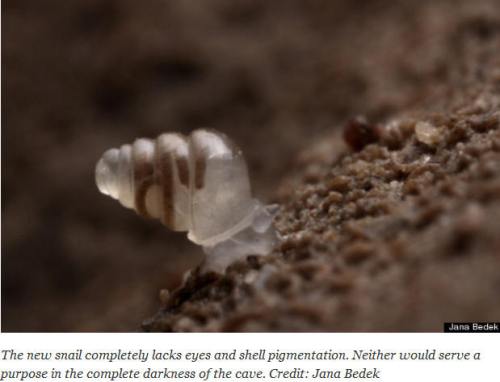
A new snail species with a beautifully translucent shell was recently discovered more than 3,000 feet (914 meters) underground in a Croatian cave.
A team of cavers and biologists with the Croatian Biospeleological Society discovered Zospeum tholussum in the Lukina Jama-Trojama cave systems of western Croatia — one of the 20 deepest cave systems in the world — on an expedition to determine the cave’s depth. The team collected all animal specimens found along the way, since deep cave crevices are often promising places to find new species, and happened upon one live sample of the new snail, along with eight empty shells.
The team presented the elegant snail to taxonomist Alexander Weigand at Goethe-University in Frankfurt, Germany, for help in identification. Weigand determined that this particular species had never before been found, but that it is related to other known species.
.
.
.
Click link below for story and slideshow:
.
______________________________________________________________________________
September 19, 2013
Mohenjo
Science
amazon, business, Business News, climate, computer model, Direction Earths Core Rotates, Direction Earths Core Spins, Earth Center Rotates, Earth Center Spins, Earth Core, Earths Core Direction, Earths Core Rotates, Earths Core Spins, Earths Core Spins Directions, Earths Core Spins Eastward, Earths Core Spins Two Direction, Hotels, huffingtonpost, inner core, liquid outer core, magnetic field, research, s center, Science, Science News, Slideshow, technology, Technology News, travel, university of leeds, vacation
FROM
Click link below picture
.
Researchers may have just solved a 300-year-old riddle.
As part of a study to determine the direction in which Earth’s core spins, scientists in the United Kingdom and Switzerland analyzed seismic readings from earthquakes from the past few decades.
But, instead of finding out whether the planet’s center rotates eastward or westward, the team discovered a surprising answer to the question that’s evaded scientists for centuries: It’s both.
“The link is simply explained in terms of equal and opposite action,” lead researcher Dr. Philip Livermore, of the University of Leeds, said in a released statement. “The magnetic field pushes eastwards on the inner core, causing it to spin faster than Earth, but it also pushes in the opposite direction in the liquid outer core, which creates a westward motion.”
.

A team of researchers used a computer model to determine that the Earth’s core spins in not one direction, but two. (Illustration via Getty)
.
.
Click link below for story slideshow:
.
______________________________________________________________________________
September 19, 2013
Mohenjo
Science
amazing science, Amazing Science Facts, amazon, Awesome Science Facts, business, Business News, climate, Cool Science Facts, Cosmos, everyday problems, farthest reaches, Hotels, huffingtonpost, Particles, particles science, research, Science, Science Facts, Science News, science photos, Slideshow, subatomic, Subatomic Particles, technology, Technology News, The Third Metric, travel, Universe, vacation
FROM

Click link below picture
.
From the farthest reaches of the cosmos to the curious behavior of subatomic particles, science helps us understand our universe. But science can console as well as explain.
How does it do that? By helping us realize that some of our everyday problems are actually pretty puny.
.
.
.
Click link below for story, list of 10 science facts and slideshow:
.
______________________________________________________________________________
Older Entries
Newer Entries