August 3, 2022
Mohenjo
Business, Enthralling, Human Interest, Photographs
amazon, business, Business News, current-events, Future, Hotels, human-rights, medicine, mental-health, research, Science, Science News, technology, Technology News, travel, vacation

Click the link below the picture
.
Olympic National Park is a United States national park located in the State of Washington, on the Olympic Peninsula. The park has four regions: the Pacific coastline, alpine areas, the west-side temperate rainforest, and the forests of the drier east side.] Within the park, there are three distinct ecosystems, including subalpine forest and wildflower meadow, temperate forest, and the rugged Pacific coast.
President Theodore Roosevelt originally designated the park as Mount Olympus National Monument on March 2, 1909. The monument was re-designated a national park by Congress and President Franklin D. Roosevelt on June 29, 1938. In 1976, Olympic National Park was designated by UNESCO as an International Biosphere Reserve, and in 1981 as a World Heritage Site. In 1988, Congress designated 95 percent of the park (1,370 square miles (3,500 km2)) as the Olympic Wilderness, which was renamed Daniel J. Evans Wilderness in honor of Governor and U.S. Senator Daniel J. Evans in 2017. During his tenure in the Senate, Evans co-sponsored the 1988 bill that created the state’s wilderness areas. It is the largest wilderness area in Washington.
The purpose of Olympic National Park is to preserve for the benefit, use, and enjoyment of the people, a large wilderness park containing the finest sample of primeval forest of Sitka spruce, western hemlock, Douglas fir, and western red cedar in the entire United States; to provide suitable winter range and permanent protection for the herds of native Roosevelt elk and other wildlife indigenous to the area; to conserve and render available to the people, for recreational use, this outstanding mountainous country, containing numerous glaciers and perpetual snow fields, and a portion of the surrounding verdant forests together with a narrow strip along the beautiful Washington coast.
The coastal portion of the park is a rugged, sandy beach along with a strip of adjacent forest. It is 60 miles (97 km) long but just a few miles wide, with native communities at the mouths of two rivers. The Hoh River has the Hoh people and at the town of La Push at the mouth of the Quileute River live the Quileute. Wikipedia
.
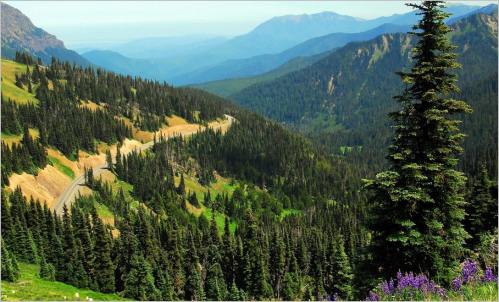 An image from Olympic National Park
.
.
Click the link below for article:
.
__________________________________________
August 3, 2022
Mohenjo
Business, Food For Thought, Human Interest, Political, Science, Technical
amazon, business, Business News, current-events, Future, Hotels, human-rights, medicine, mental-health, research, Science, Science News, technology, Technology News, travel, vacation

Click the link below the picture
.
In the film Phantom Thread, Daniel Day-Lewis plays the crotchety yet brilliant designer Reynolds Woodcock. A man so tightly wound he yells at his muse for audibly consuming toast, Reynolds is not concerned with keeping with the times. When he learns from his sister Cyril (Lesley Manville) that a major client has switched to a new fashion house, he feigns confusion. “All I’ve done is dress her beautifully,” he says. To which Cyril replies, “I don’t think that matters to some people. I think they want what is fashionable and chic.” Reynolds loses it. “Chic! Whoever invented that ought to be spanked in public. I don’t even know what that word means! What is that word? Fucking chic! They should be hung, drawn, and quartered. Fucking chic.” Sub out chic for core, and you’ve just glimpsed my inner monologue for the past few months. You either die a Cyril or live long enough to see yourself become a Reynolds.
I’ve been guilty of using the word core in place of style, and the phrase that has become common parlance almost overnight. But I’m here with contrition: It’s time to retire the expression. Over the past month, Barbiecore has become the trend of the summer. This magazine has published several articles on the style and its history, and I’ve received 18 P.R. pitches outlining ways to bring Barbie style to the beach, your bar cart, and your underwear drawer. The items cover everything from a utility jacket to a sapphire necklace to a Telfar bag. The aesthetic through line is the color—that’s it. Depop informed me on July 8 that they had seen a 93% increase in searches for “Barbie pink.” I have nothing against the color pink, but what’s with the deep desire to label a trend with an entirely new word, to elevate it from a series of garments into a fully-fledged phenomenon?
.
.jpeg) TheImageDirect.com
TheImageDirect.com
.
.
Click the link below for the article:
.
__________________________________________
August 3, 2022
Mohenjo
Business, Food For Thought, Human Interest, Medical, Political, Science, Technical
amazon, business, Business News, current-events, Future, Hotels, human-rights, medicine, mental-health, research, Science, Science News, technology, Technology News, travel, vacation

Click the link below the picture
.
I’m not willing to admit how many years ago this was now, but when I turned 15, I became a vegetarian. Predictably, because I was a teenager, I was sanctimonious about it, chastising everyone around me for not caring about animals or the earth or whatever else I could think of that they should care about in my extremely informed opinion. Being vegetarian and caring about the world thank you very much was a very outsized part of my personality.
Back then, especially because I was 15 years old with little income and worldliness, I defaulted to what I thought were the best options for a vegetarian to eat. Namely, fake chicken nuggets and hot dogs, with the occasional chickpea dish thrown in for health. I didn’t know where to find these things — nor did I know there were any other places — besides my local Acme, a grocery chain in Philly that is basically fine. My hot dog choices back then were Smart Dogs and MorningStar Farms Veggie Dogs. And out of necessity, I loved them both.
Fast forward [redacted] number of years and the landscape for vegetarians has completely changed. The breadth and availability of products means that it feels easier than ever to forgo meat, even if the taste of meat is still your thing. Developments in mushroom-based meats, vegetarian burgers that “bleed,” and brands getting into plant-based products of all kinds means that the hot dog section of the freezer or fridge aisle is no longer a sad, lonely place where bossy teenagers get their kicks. For a number of years now, barbecues haven’t been the same.
.
:format(webp)/cdn.vox-cdn.com/uploads/chorus_image/image/70979217/VeggieHotdogs1.0.jpg) Nicole Miles/Eater
Nicole Miles/Eater
.
.
Click the link below for the article:
.
__________________________________________
August 2, 2022
Mohenjo
Business, Enthralling, Human Interest, Photographs
amazon, business, Business News, current-events, Future, Hotels, human-rights, medicine, mental-health, research, Science, Science News, technology, Technology News, travel, vacation
Click the link below the picture
.
Aberdeenshire (Scots: Aiberdeenshire; Scottish Gaelic: Siorrachd Obar Dheathain) is one of the 32 council areas of Scotland.
It takes its name from the County of Aberdeen which has substantially different boundaries. The Aberdeenshire Council area includes all of the area of the historic counties of Aberdeenshire and Kincardineshire (except the area making up the City of Aberdeen), as well as part of Banffshire. The county boundaries are officially used for a few purposes, namely land registration and lieutenancy.
Aberdeenshire Council is headquartered at Woodhill House, in Aberdeen, making it the only Scottish council whose headquarters are located outside its jurisdiction. Aberdeen itself forms a different council area (Aberdeen City). Aberdeenshire borders onto Angus and Perth and Kinross to the south, Highland and Moray to the west, and Aberdeen City to the east.
Traditionally, it has been economically dependent upon the primary sector (agriculture, fishing, and forestry) and related processing industries. Over the last 40 years, the development of the oil and gas industry and associated service sector has broadened Aberdeenshire’s economic base and contributed to a rapid population growth of some 50% since 1975. Its land represents 8% of Scotland’s overall territory. It covers an area of 6,313 square kilometers (2,437 sq mi).
Aberdeenshire has a rich prehistoric and historic heritage. It is the locus of a large number of Neolithic and Bronze Age archaeological sites, including Longman Hill, Kempstone Hill, Catto Long Barrow, and Cairn Lee. The area was settled in the Bronze Age by the Beaker culture, who arrived from the south around 2000–1800 BC. Stone circles and cairns were constructed predominantly in this era. In the Iron Age, hill forts were built. Around the 1st century AD, the Taexali people, who have left little history, were believed to have resided along the coast. The Picts were the next documented inhabitants of the area and were no later than 800–900 AD. The Romans also were in the area during this period, as they left signs at Kintore. Christianity influenced the inhabitants early on, and there were Celtic monasteries at Old Deer and Monymusk. Since medieval times there have been a number of traditional paths that crossed the Mounth (a spur of mountainous land that extends from the higher inland range to the North Sea slightly north of Stonehaven) through present-day Aberdeenshire from the Scottish Lowlands to the Highlands. Some of the most well-known and historically important trackways are the Causey Mounth and Elsick Mounth.
.
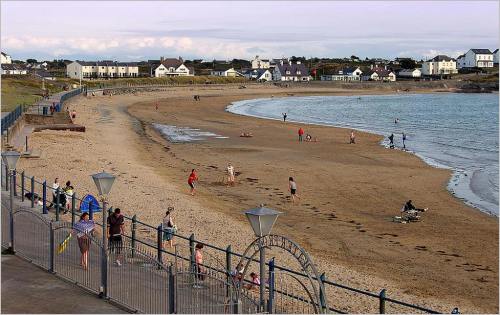 An image from Tremuda Bay Aberdeenshire Scotland
.
.
Click the link below for images:
.
__________________________________________
August 2, 2022
Mohenjo
Business, Food For Thought, Human Interest, Medical, Political, Science, Technical
amazon, business, Business News, current-events, Future, Hotels, human-rights, medicine, mental-health, research, Science, Science News, technology, Technology News, travel, vacation

Click the link below the picture
.
If you are looking for a delicious appetizer, look no further than this delicious grilled halloumi! Quick and easy to prep and grill, this cheese has a wonderful creamy texture with just the right amount of saltiness.
What is Halloumi?
Halloumi is a non-melting cheese that is similar to Queso Para Frier, and in flavor is somewhere in between feta and mozzarella. It is made with a mixture of goat and sheep’s milk and is semi-hard and brined. It originates from Cyprus and is very popular in Lebanon, where my parents are from.
.

.
.
Click the link below for the article:
.
__________________________________________
August 2, 2022
Mohenjo
Business, Food For Thought, Human Interest, Medical, Political, Science, Technical
amazon, business, Business News, current-events, Future, Hotels, human-rights, medicine, mental-health, research, Science, Science News, technology, Technology News, travel, vacation

Click the link below the picture
.
According to its evangelists, pickleball is America’s fastest-growing sport (it depends on how you measure). According to Architectural Digest, it’s the perfect amenity for new luxury real estate development (it might be). According to your grandmother, it’s blowing up at her retirement home (it definitely is). The last few years are probably the first time you’ve ever heard of the sport if you have at all, and you may be wondering what is going on.
Fear not, an avalanche of recent pickleball press can answer all of your questions. This year, The New York Times declared the sport “ready for prime time.” NPR bemoaned the mere 10,000 places to play across the country. Town and Country called it the “preferred sport of the one percent.” The New Yorker asked, “Can pickleball save America?”
Most of the recent articles on pickleball follow a predictable rubric, beginning by explaining how the game works: Players use composite or wooden paddles to whack a plastic ball back and forth over a short net until it bounces twice or out of bounds—like a game of ping-pong where you can stand on the table. Then, as if it follows naturally from the game’s simplicity, they trace the game’s meteoric rise in popularity, from invention in the ‘60s by a quirked-up Republican congressman to its rapid ascent to the mainstream over the last few years.
The only thing moving faster than this venture capital-backed gold rush are pickleball’s haters, of which there are many. No one wants to be told to like something, after all. To detractors like us, it’s a senior citizen’s idea of something youthful and hip—the Pete Buttigieg of sports, if you will.
.
 Illustration by Michael Houtz
.
.
Click the link below for the article:
.
__________________________________________
August 1, 2022
Mohenjo
Business, Enthralling, Human Interest, Photographs
amazon, business, Business News, current-events, Future, Hotels, human-rights, medicine, mental-health, research, Science, Science News, technology, Technology News, travel, vacation
Click the link below the picture
.
The Democratic Republic of the Congo, informally Congo-Kinshasa, DR Congo, the DRC, the DROC, or the Congo, and formerly and also colloquially Zaire, is a country in Central Africa. The DRC is located in sub-Saharan Africa, bordered to the northwest by the Republic of the Congo, to the north by the Central African Republic, to the northeast by South Sudan, to the east by Uganda, Rwanda, and Burundi, and by Tanzania (across Lake Tanganyika), to the south and southeast by Zambia, to the southwest by Angola, and to the west by the South Atlantic Ocean and the Cabinda exclave of Angola.
By area, it is the second-largest country in Africa and the 11th-largest in the world. With a population of around 108 million, the Democratic Republic of the Congo is the most populous officially Francophone country in the world. It is a member of the United Nations, Non-Aligned Movement, African Union, East African Community, COMESA, Southern African Development Community, and the Economic Community of Central African States. The capital and largest city is Kinshasa, which is also the world’s most populous Francophone city and largest city in Africa. It is the third largest African city in metropolitan area after Lagos and Cairo.
Centered on the Congo Basin, the territory of the DRC was first inhabited by Central African foragers around 90,000 years ago and was reached by the Bantu expansion about 3,000 years ago. In the west, the Kingdom of Kongo ruled around the mouth of the Congo River from the 14th to 19th centuries. In the northeast, center, and east, the kingdoms of Azande, Luba, and Lunda ruled from the 16th and 17th centuries to the 19th century. King Leopold II of Belgium formally acquired rights to the Congo territory in 1885 and declared the land his private property, naming it the Congo Free State. From 1885 to 1908, his colonial military forced the local population to produce rubber and committed widespread atrocities. In 1908, Leopold ceded the territory, which thus became a Belgian colony.
Congo achieved independence from Belgium on 30 June 1960 and was immediately confronted by a series of seccessionist movements, which culminated in the seizure of power of Mobutu in a 1965 coup d’état. Mobutu renamed the country Zaire in 1971 and imposed a harsh dictatorship until his overthrow in 1997 by the First Congo War. The country then had its name changed back and was confronted by the Second Congo War from 1998 to 2003, which resulted in the deaths of 5.4 million people. The war ended under President Joseph Kabila who governed the country from 2001 to 2019, under whom human rights in the country remained poor and included frequent abuses such as forced disappearances, torture, arbitrary imprisonment, and restrictions on civil liberties. Following the 2018 general election, in the country’s first peaceful transition of power since independence, Kabila was succeeded as president by Félix Tshisekedi, who has served as president since. Since 2015, the Eastern DR Congo has been the site of an ongoing military conflict in Kivu.
The Democratic Republic of the Congo is extremely rich in natural resources but has suffered from political instability, a lack of infrastructure, corruption, and centuries of both commercial and colonial extraction and exploitation with little widespread development. Besides the capital Kinshasa, the two next largest cities, Lubumbashi and Mbuji-Mayi, are both mining communities. The DRC’s largest export is raw minerals, with China accepting over 50% of its exports in 2019. In 2019, DR Congo’s level of human development was ranked 175th out of 189 countries by the Human Development Index. As of 2018, around 600,000 Congolese have fled to neighbouring countries from conflicts in the center and east of the DRC. Two million children risk starvation, and the fighting has displaced 4.5 million people. Wikipedia
.
 An image from Congo City
.
.
Click the link below for images:
.
__________________________________________
August 1, 2022
Mohenjo
Business, Food For Thought, Human Interest, Political, Science, Technical
amazon, business, Business News, current-events, Future, Hotels, human-rights, medicine, mental-health, research, Science, Science News, technology, Technology News, travel, vacation

Click the link below the picture
.
Last month, Blake Chandlee, TikTok’s president of global business solutions, was asked if he was concerned about competition from existing social-media networks like Facebook. Chandlee, who spent more than twelve years at Mark Zuckerberg’s company before moving to TikTok, dismissed the idea. “Facebook is a social platform. They’ve built all their algorithms based on the social graph,” he said, referring to the network of links to friends, family, and casual acquaintances that Facebook users painstakingly assemble over time. “We are an entertainment platform. The difference is significant.” Chandlee appeared to be responding to recent moves made by Facebook. Last year, the company integrated a TikTok-style short-video format called Reels directly into its main app. Then, in an internal memo sent this spring, Tom Alison, a senior executive at the social-media giant, announced a plan to modify the platform’s news feed to focus more on these short videos, tweaking the algorithm to display the most engaging content, even if these selections are “unconnected” to accounts that a user has friended or followed. Facebook, it seems, is moving away from its traditional focus on text and images, spread among people who know one another, to instead adopt TikTok’s emphasis on pure distraction. This shift is not surprising given TikTok’s phenomenal popularity, but it’s also shortsighted: platforms like Facebook could be doomed if they fail to maintain the social graphs upon which they built their kingdoms.
To understand Facebook’s current danger, it helps to better understand its original success. In the spring of 2004, when my college friends signed up for TheFacebook.com, as it was then called, they did so because other people they knew were signing up as well. (One of the platform’s early killer features was the ability to check the “relationship status” of classmates.) By the end of 2006, the year in which Facebook opened to the general public, the service had already gathered twelve million active users. At that point, network-effect advantages made it hard for a competitor to emerge; two years later, when Facebook hit a hundred million active users, competition became all but impossible. Why would you join a new network dedicated to connection with people you know if everyone you knew was already on Facebook?
.
 Illustration by Tim Enthoven
.
.
Click the link below for the article:
.
__________________________________________
August 1, 2022
Mohenjo
Business, Food For Thought, Human Interest, Political, Science, Technical
amazon, business, Business News, current-events, Future, Hotels, human-rights, medicine, mental-health, research, Science, Science News, technology, Technology News, travel, vacation
Click the link below the picture
.
Cauliflower is great for grilling. Its sturdy structure and ability to absorb sauce and spice make it a natural choice for a main grilled vegetarian dish. The problem is, we have recently been asking too much of cauliflower. It is now our flour, our rice, our chicken, and our steak, and its overexposure mostly leads to groans among both vegetarians and anyone who would like to introduce a second vegetable into their system.
“Whenever I do an offsite event, the cop-out dish is cauliflower for vegetarians,” says Greg Baxtrom, chef and owner of Olmsted, Patti Ann’s, and Maison Yaki in Brooklyn. “There’s, like, four courses of some poor vegetarian getting cauliflower for everything.” So for your summer grilling plans, it’s time to look for flavor where no one wants it. It’s time to grill weird, unpopular root vegetables.
Baxtrom says his favorite vegetables to grill are things like kohlrabi, turnip, and rutabaga. “They’re usually pretty cheap because nobody wants them,” he says. They work because, like cauliflower and so many other vegetables, they are all members of the brassica family. They are sturdy and can easily take on the flavors of whatever you use to season them. But they also each have distinct flavors and textures. Rutabaga is both sweet and bitter, with a somewhat creamy texture. Kohlrabi is crunchy and zesty. Turnips and parsnips are like nuttier and earthier potatoes. And of course, there’s the ever-popular sweet potato, which you should freeze before you bake and grill.
.
:format(webp)/cdn.vox-cdn.com/uploads/chorus_image/image/70970862/Waters_Niki_Eater_Grilling_Root_Vegetables_Final.0.jpg) Niki Waters/Eater
Niki Waters/Eater
.
.
Click the link below for the article:
.
__________________________________________
July 31, 2022
Mohenjo
Business, Food For Thought, Human Interest, Science, Technical
amazon, business, Business News, current-events, Future, Hotels, human-rights, medicine, mental-health, research, Science, Science News, technology, Technology News, travel, vacation

Click the link below the picture
.
This is one of those recipes that grab me by the name alone, and I hope it does the same for you: Grilled Corn With Peanut Sauce. I adore the former, and I adore the latter, so put the two together, and I’m in heaven.
Cookbook author Rukmini Iyer writes that she got the idea from Indonesian gado-gado — particularly its sauce based on peanut butter, coconut milk and chiles. “It occurred to me that the dressing, slightly adapted, would work beautifully with grilled corn on the cob — and, joy, it did!” she writes in her latest book, “The Green Barbecue.”
A heavily dressed corn on the cob always reminds me of the Mexican staple esquites, a.k.a. elote, but in this case, the flavors are distinctly Southeast Asian. It could hardly be easier: After chopping ginger and chile, you whisk together the sauce, grill the corn, and spoon the sauce over the cobs before serving (or let guests do it themselves).
.
 (Tom McCorkle for The Washington Post/Food styling by Gina Nistico for The Washington Post)
.
.
Click the link below for the article:
.
__________________________________________
Older Entries
Newer Entries

