Here’s one of the more unsettling schemes to recently emerge from Silicon Valley: human clones grown without a conscious brain. At least one biotech start-up reportedly has quixotic ambitions of breeding spare, unfeeling meat sacks as a way to clear the ethical path for procedures called “body transplants”—and, hypothetically, immortality. The idea seems to be that if these surrogate bodies are wholly unconscious, without even the faintest awareness of the world or themselves, then there’s no harm done.
It isn’t clear how much—or how little—of a brain these clones would have, but they’d certainly lack a cerebral cortex, the wrinkly outer layer that’s responsible for sophisticated cognitive functions such as language, self-reflection, and abstract thought. Most theorists have long assumed that the cortex is where consciousness, or our subjective experience of the world, arises. If they’re right, an organism without one would have no thoughts, sensations, or emotions—no inner life at all.
But what if they’re wrong? A growing number of consciousness researchers are seriously considering the possibility that consciousness could originate deep within the brain’s most evolutionarily ancient realm: the subcortex. They argue that, just as astronomy once labored under a false geocentric model, consciousness research is in thrall to the mistaken notion that cortical processing lies at the center of all experience—the corticocentric model. The idea is “as old as any attempt to relate brain to mind” in neuroscience, says Mark Solms, a neuropsychologist at the University of Cape Town in South Africa. “It’s a foundational theory about where the mind is.”
Yet over the past several decades, Solms and others have marshalled counterevidence in hopes of forcing a Copernican upheaval in their field. The subcortical revolution, should it come to pass, would have massive implications for how we define and measure consciousness—and for which creatures we deem worthy of moral consideration.
The Brain in Two Parts
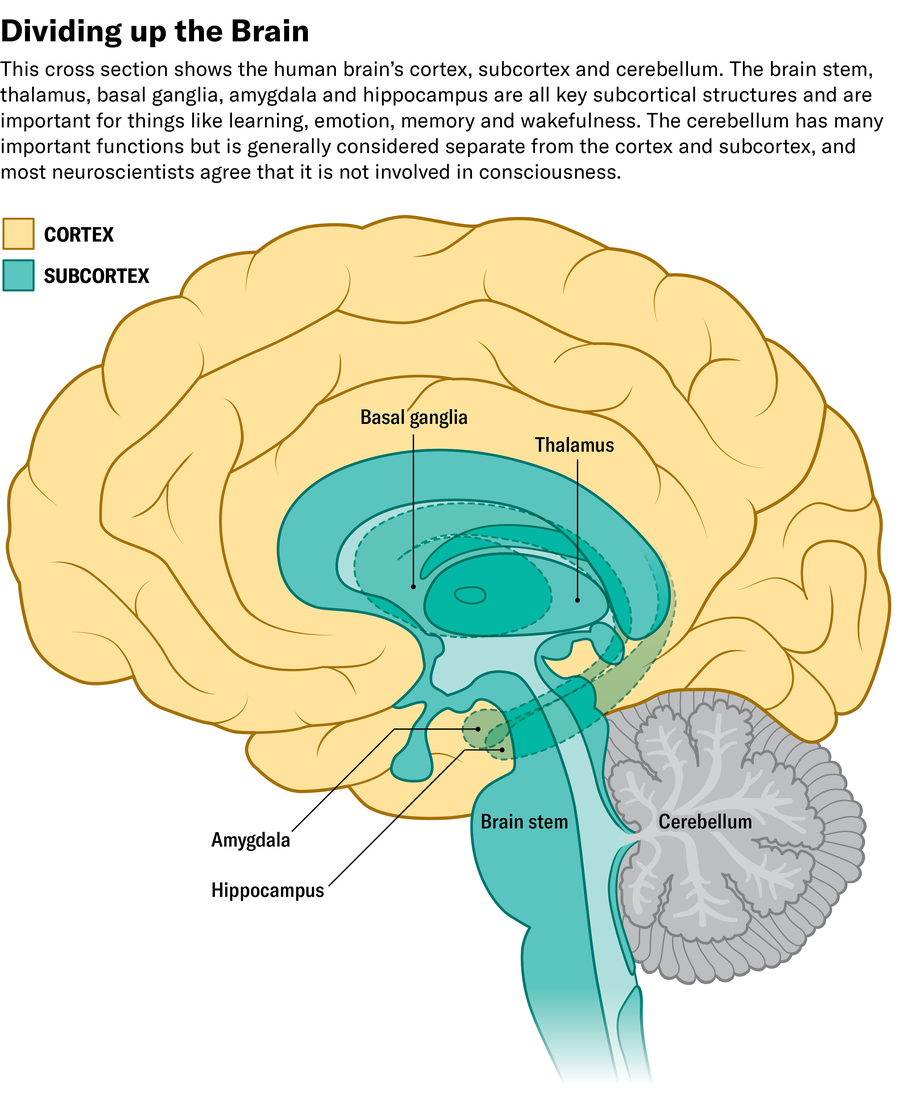
The cortex is neuroanatomy’s latest innovation, and it has done well for itself. Its size varies across species, but in humans and many other mammals, the cortex now swells to epic proportions—around 75 percent of brain mass, in our case—and envelops the older structures beneath it. The inmost region, the subcortex, holds more foundational responsibilities than the upstart upstairs: maintaining arousal, processing emotions, regulating the body, and relaying sensory information.
Amanda Montañez
The cortex and the subcortex are tightly interconnected. When most sensory information enters the brain, it flows through deep-brain relay points in the subcortex on its way up to the cortex, which then responds with feedback signals in an ongoing communication loop. Virtually all neuroscientists agree that, in healthy human brains, consciousness depends on this continuous dialogue between cortex and subcortex; it’s been clear for nearly a century that if certain parts of the subcortical brain stem get damaged, “the lights go out,” as Solms puts it. The question is whether the subcortex is merely a power supply keeping the cortex’s consciousness online, as corticalists hold, or whether it can sustain basic consciousness by itself.
Unconscious Zombies
The most intuitive evidence that the subcortex is more powerful than we thought is that many organisms without a cortex nevertheless seem conscious. We need not wait for Silicon Valley’s clones: children with a rare developmental disorder called hydranencephaly are already born sans cortex and, on that basis, are often classified as being in an unconscious vegetative state.
But in 2004, at what turned out to be a pivotal moment for how researchers think about the subcortex, Swedish neuroscientist Bjorn Merker joined five families that included children with hydranencephaly at Disney World.
He spent a week observing the children’s behavior. They giggled, played with toys, and generally showed “responsiveness to their surroundings in the form of emotional or orienting reactions to environmental events,” as he later wrote. They struck Merker as utterly normal, if developmentally delayed. Though they couldn’t speak and thus couldn’t report on their internal state, he simply could not believe he was in the presence of philosophical zombies—hypothetical beings that act like normal humans but have no felt experience.
Solms, following Merker’s example, also spent time around children with hydranencephaly. “The evidence that they are not ‘zombies’ is exactly the same evidence that your dog and your cat are not zombies,” he says. “They’re reporting by their behavior that they’re feeling things.”
Of course, the appearance of consciousness and consciousness itself are not the same thing. Strictly speaking, we can’t determine whether an organism is conscious unless it can somehow narrate its experience, leaving us to speculate about babies, brain organoids, and nonhuman animals. (What this means for large language models, which can narrate their “experience,” is another question.) So we seem to be at an impasse: How can nonverbal life-forms possibly prove they aren’t mindless automatons?
When language isn’t an option, most researchers will use other information to infer consciousness. Matthias Michel, a philosopher at the Massachusetts Institute of Technology, is prepared to attribute consciousness to other mammals, which have a cortex, and to birds, which have a functional equivalent in the pallium—but not to fish or insects, which do not.
Film and Writing Festival for Comedy. Showcasing best of comedy short films at the FEEDBACK Film Festival. Plus, showcasing best of comedy novels, short stories, poems, screenplays (TV, short, feature) at the festival performed by professional actors.

 THEPALMER/Getty Images

Leave a comment