On Wednesday, Gina Haspel, a veteran CIA officer who reportedly oversaw a secret prison in Thailand where an alleged terrorist was waterboarded and later helped destroy videotapes documenting interrogation sessions, will make the case to a Senate committee that she should be confirmed to be the director of the spy agency.
It will be the first time that Haspel, who has spent years undercover, will speak publicly about her career, and some lawmakers are urging the CIA to declassify documents that explain her role in the torture program. Haspel, the current acting director of the CIA, has never publicly atoned for her involvement in the now-defunct interrogation operation and the subsequent cover-up. If confirmed, she will serve under a president who campaigned on bringing back “a hell of a lot worse than waterboarding.”
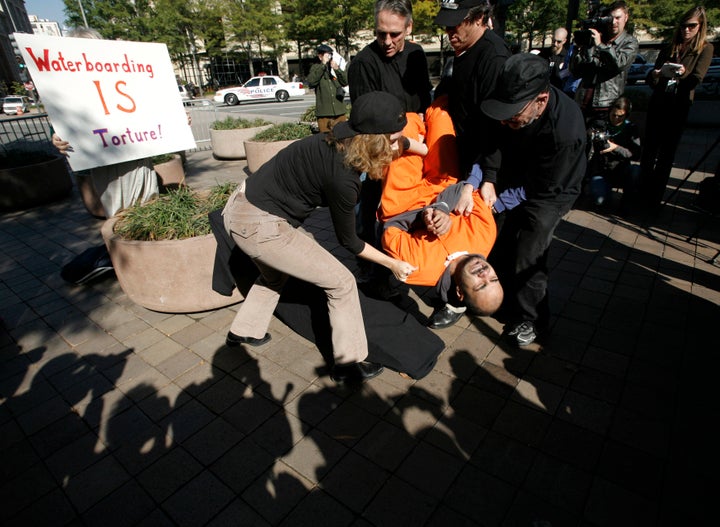
When Haspel appears before the Senate committee for her confirmation hearing, lawmakers will not just be evaluating her record. They will be deciding whether overseeing torture is disqualifying. Because most of the people who were tortured by CIA officials, at times under Haspel’s watch, cannot tell their stories, HuffPost asked several people who have been waterboarded as part of mock interrogations or military training to describe the experience. (The military quietly banned the use of waterboarding in training in 2007 because it was too brutal, HuffPost reported in March.)
.
Kevin Lamarque/Reuters
Demonstrator Maboud Ebrahimzadeh is lowered onto the board during a simulation of waterboarding outside the Justice Departement in Washington November 5, 2007.
The violence that left seven inmates dead and a score more injured in a South Carolina prison this week was inevitable, Henry McMaster, the state’s Republican governor, suggested Monday. “It’s not a surprise when we have violent events take place inside the prison, any prison in the country,” he said.
In fact, a night of unchecked prison violence that ends in more than a half-dozen deaths is extremely unusual. States have a responsibility to protect inmates and prison staff—and well-funded, properly staffed prisons can and do prevent widespread inmate violence or stop it swiftly when it occurs, prison experts say.
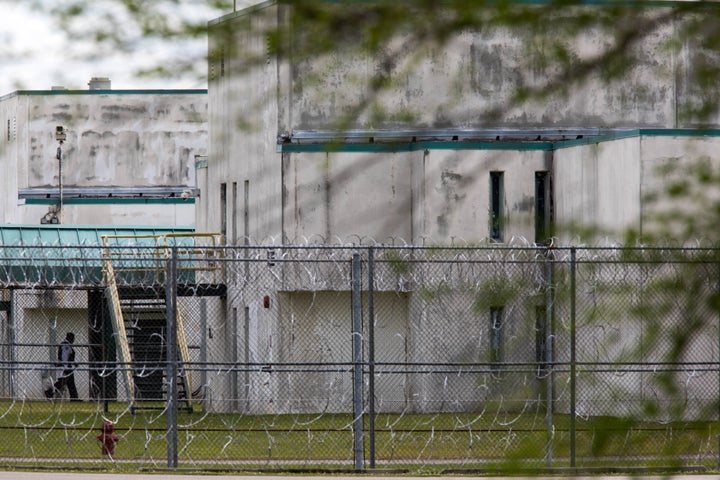
Lee Correctional Institution, the high-security prison where inmate fights broke out on April 15, houses violent offenders with longer sentences, as well as people with behavioral issues. The incidents started around 7:15 p.m., but a large emergency response team didn’t enter the first dorm of three dorms until 11:30 p.m., officials said, and the last dorm hours later. CBS News obtained leaked video (not independently verified) that shows what McMaster apparently finds unsurprising: An eerie dystopia featuring an inmate smearing blood against a white wall and another roaming shirtless with a weapon that resembles a kitchen knife.
.
LOGAN CYRUS via Getty Images
A guard walks between buildings at the Lee Correctional Institution, in Bishopville, South Carolina, on April 16, 2018.
President Donald Trump’s decision to strike Syrian facilities in response to Syrian President Bashar Assad’s reported use of chemical weapons against civilians fulfills Trump’s promise of being tougher than President Barack Obama.
But it’s unlikely to have much impact beyond that ― and will likely be historically judged as a failure on Trump’s own terms.
Trump’s military response alongside France and the U.K. is ostensibly an attempt to deter Assad’s murderous behavior and demonstrate American toughness to Assad’s patrons, Iran and Russia. It won’t serve either of those goals.
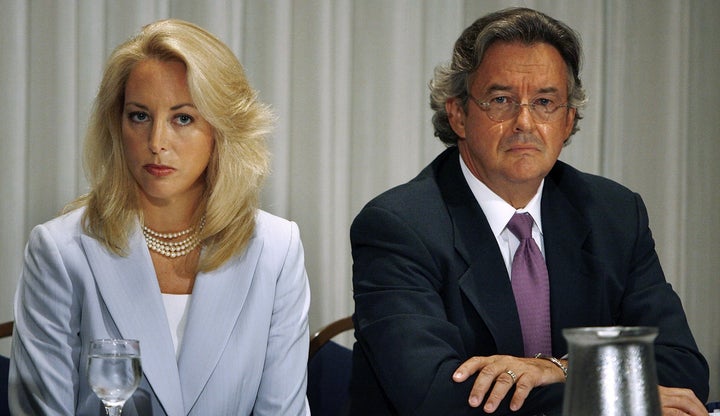
Former U.S. ambassador Joseph Wilson, a man whose family was turned upside down by Scooter Libby and other President George W. Bush administration officials, sharply criticized President Donald Trump for pardoning Libby, saying it showed his disregard for America’s national security.
“It has nothing to do with Libby, and it has nothing to do with me,” Wilson told HuffPost Friday. “Libby’s problem was with the Justice Department. He was indicted, tried and convicted on obstruction of justice and perjury charges for basically violating the national security of the United States of America.”
“Now he’s being pardoned for it, which suggests of course that Mr. Trump is willing to allow people to violate the essence of our defense structure, our national security, our intelligence apparatus and essentially get away with it,” he added.
.
Chip Somodevilla/Getty Images
Valerie Plame’s cover at the CIA was blown by the Bush administration. Her husband, former Ambassador Joseph Wilson, helped show that the administration fabricated intelligence to invade Iraq.
The Trump administration took one of its most aggressive actions against Russia on Friday, announcing sweeping sanctions against members of Russian President Vladimir Putin’s inner circle, along with top officials and several businesses, including a state-owned weapons trading company.
Senior U.S. administration officials said the sanctions are not aimed to punish Moscow for any particular event, but are instead a broader measure aimed at the “totality of the Russian government’s ongoing and increasingly malign activities in the world.”
The Treasury Department, in connection with the State Department, targeted seven Russian oligarchs and 12 companies they own or control. It also issued sanctions on 17 senior government officials, along with a state-owned weapons trading company and its subsidiary, a Russian bank.
.
Russian Prime Minister Vladimir Putin speaks with Oleg Deripaska, a Russian tycoon who was hit with U.S. sanctions on Friday, at an investment forum in Sochi in 2008.Ilia Pitalev / AFP-Getty Images file
A London-based lawyer who admitted to lying to special counsel Robert Mueller’s team in November 2017 was ordered Tuesday to serve 30 days in prison, the first sentence imposed since Mueller was appointed nearly a year ago.
Alex van der Zwaan, 33, had pleaded guilty in February to making false statements when he was interviewed last fall about his phone calls and e-mails with a former Trump campaign aide, Richard Gates.
Van der Zwaan addressed the judge directly on Tuesday, saying in a brief statement: “What I did was wrong. I apologize to the court, my wife and my family.”
.
Alex van der Zwaan going through security upon arriving at Federal District Court in Washington on April 3, 2018.Pablo Martinez Monsivais / AP
The U.S. Supreme Court on Monday declined to hear the Trump administration’s appeal of a federal judge’s ruling that requires the government to keep the Deferred Action for Childhood Arrivals program going.
Under a lower court order that remains in effect, the Department of Homeland Security must continue to accept renewal applications from the roughly 700,000 young people who are currently enrolled in the program, known as DACA. The administration had intended to shut the program down by March 5, but that deadline is now largely meaningless.
In a brief order, the court said simply, “It is assumed the court of appeals will act expeditiously to decide this case.”
.
Immigration activists march in front of the U.S. Capitol on Feb. 7, 2018 in Washington. A coalition of activists from across the U.S. demonstrated to pressure Congress to pass legislation protecting “Dreamers” as part of federal budget negotiations.John Moore / Getty Images file
A new era of internet regulation is about to begin.
Years after Facebook and Google went public, regulators in the United States and abroad are finally taking a closer look at the internet behemoths. And they’re not only looking at the way these companies have come to dominate markets, but also examining the heart of the two firms’ business models. What they decide will have powerful implications for the way we do business on the internet.
Most people associate Facebook with cute family photos and think of Google like a semi-reliable encyclopedia. But these services have only a tangential relationship to the way either company actually makes money. The twin Silicon Valley titans rely on two closely intertwined technologies, customer surveillance and advertising, to maximize shareholder profits. The pair control 63 percent of the U.S. digital advertising market, and in 2016, they secured 99 percent of all digital advertising growth. That profit-making combo is exactly what regulators are focused on in 2018.
Many of the companies’ difficulties stem from the European Union’s tough new stance on privacy. The biggest threat to their business model comes from the General Data Protection Regulation, new data privacy rules set to go in effect in the EU in May. For the most part, Facebook and Google prevent you from using their products if you decline to agree to their entire terms of service. You cannot pick and choose what to agree to and still use their free services.
.
Joshua Roberts / Reuters
Congress grilled representatives from Facebook, Twitter and Google over their advertising and privacy practices in November 2017. (Pictured from left to right: Colin Stretch, Facebook general counsel, Sean Edgett, Twitter acting general counsel, and Richard Salgado, Google director of law enforcement and information security.)
It was hours after Donald Trump became the president-elect, and two FBI officials, like many of their fellow citizens, were flabbergasted. Peter Strzok and Lisa Page ― both of whom had worked on the FBI investigation into Hillary Clinton’s emails, which the former secretary of state would blame for her loss ― were worried about the future of their country and their agency.
One text that Page sent Strzok early on the morning of Nov. 9, 2016, has dominated the conservative media world this week, serving as a springboard for a Republican conspiracy theory suggesting that the nation’s premier law enforcement organization was plotting a coup against Trump within hours of his stunning victory.
“Are you even going to give out your calendars? Seems kind of depressing,” Page, a FBI lawyer, wrote in the text to Strzok from her FBI-issued phone. “Maybe it should just be the first meeting of the secret society.”
.
AFP via Getty Images
An FBI official bought calendars featuring “beefcake” photos of Vladimir Putin for the early Russia probe team.
Representative Patrick Meehan, a Pennsylvania Republican who has taken a leading role in fighting sexual harassment in Congress, used thousands of dollars in taxpayer money to settle his own misconduct complaint after a former aide accused him last year of making unwanted romantic overtures to her, according to several people familiar with the settlement.
A married father of three, Mr. Meehan, 62, had long expressed interest in the personal life of the aide, who was decades younger and had regarded the congressman as a father figure, according to three people who worked with the office and four others with whom she discussed her tenure there.
But after the woman became involved in a serious relationship with someone outside the office last year, Mr. Meehan professed his romantic desires for her — first in person, and then in a handwritten letter — and he grew hostile when she did not reciprocate, the people familiar with her time in the office said.
.
Representative Patrick Meehan, Republican of Pennsylvania, traveled with President Trump to the state on Thursday.CreditDoug Mills/The New York Times
Film and Writing Festival for Comedy. Showcasing best of comedy short films at the FEEDBACK Film Festival. Plus, showcasing best of comedy novels, short stories, poems, screenplays (TV, short, feature) at the festival performed by professional actors.


 .
.





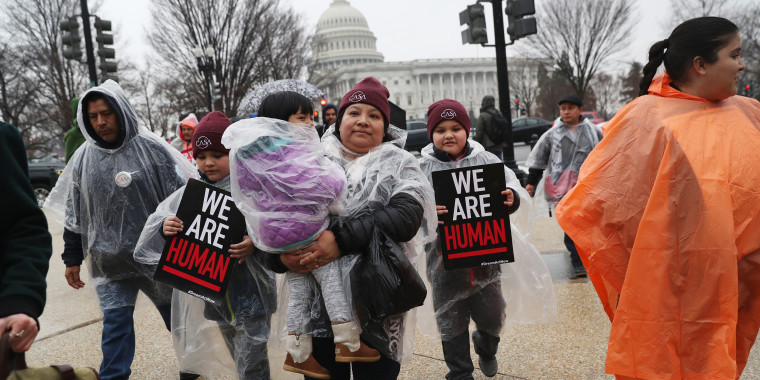 Immigration activists march in front of the U.S. Capitol on Feb. 7, 2018 in Washington. A coalition of activists from across the U.S. demonstrated to pressure Congress to pass legislation protecting “Dreamers” as part of federal budget negotiations.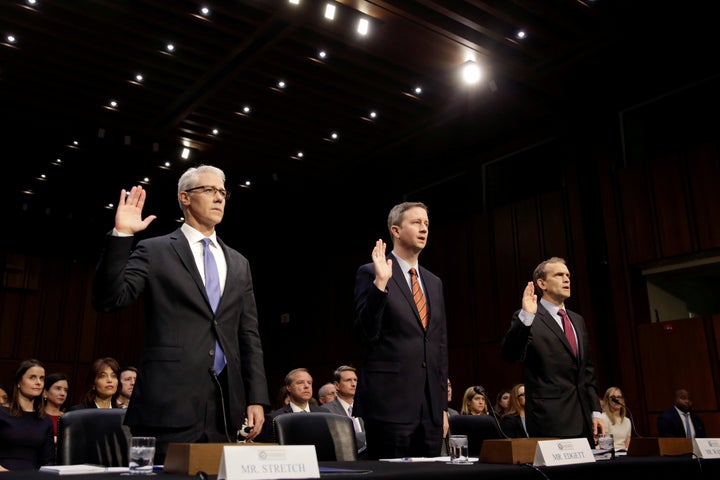



 James' World 2