San Antonio, officially the City of San Antonio, is the seventh-most populous city in the United States, and the second-most populous city in Texas with 1,547,253 residents in 2019. Founded as a Spanish mission and colonial outpost in 1718, the city became the first chartered civil settlement in present-day Texas in 1731. The area was still part of the Spanish Empire, and later of the Mexican Republic. It is the state’s oldest municipality, having celebrated its 300th anniversary on May 1, 2018.
The city’s deep history is contrasted with its rapid growth over the past few decades. It was the fastest-growing of the top ten largest cities in the United States from 2000 to 2010, and the second from 1990 to 2000. Straddling the regional divide between South and Central Texas, San Antonio anchors the southwestern corner of an urban megaregion colloquially known as the Texas Triangle. The Greater San Antonio and Greater Austin areas are separated from each other by approximately 80 miles (129 km) along Interstate 35. Both metropolitan regions are expected to form a new metroplex similar to Dallas and Fort Worth.
The city of San Antonio serves as the seat of Bexar County; San Antonio is the center of the San Antonio–New Braunfels metropolitan statistical area. Commonly called Greater San Antonio, the metropolitan area had a population of 2,550,960 based on the 2019 U.S. census estimates, making it the 24th-largest metropolitan area in the United States and third-largest in Texas. Wikipedia
Most people have heard it by now: Our meat habit is bad for the world. Polling suggests that tens of millions of people are taking this message seriously: One in four Americans said they tried to cut back on meat in the last year, and half of those cited environmental concerns as a major reason. The popular food site Epicurious recently announced they’ve stopped publishing recipes with beef in them, because of beef’s climate impacts, setting off the latest round of discussion on meat’s effects on the environment.
Cutting meat consumption is as smart an idea as advertised. Industrial farming — the source of 99 percent of the meat Americans eat — provides the world with cheap meat, but it does so at a terrible environmental and moral cost.
Where it gets complicated is when people decide which meat, exactly, they’ll be cutting back on. Often, it’s beef that loses out in that calculus. And often, the messaging is that we can save the world by switching out our beef consumption for chicken.
Did Nazi scientists, eager to devise a weapon that could throwback advancing Allied armies, create a time-traveling UFO to win World War II? Almost certainly not. Nevertheless, the legend of “Die Glocke” (“The Bell”) persists in conspiracy and UFO circles.
A new video from military historian Mark Felton included below, explores the bell-shaped device that Adolf Hitler’s Schutzstaffel (SS) paramilitary organization purportedly developed. However, sci-fi writers and hoaxers may have actually concocted the machine, plying the postwar reputation of Nazi scientists being capable of almost any technological feat.
Even though the Nazis lost World War II, they emerged from the war with an almost mythical reputation for high-tech weapons. Nazi tanks were often technically superior to Allied tanks; the Luftwaffe flew fighter jets in combat before the Allies did; and the V (for Vengeance) series of terror weapons, including the V-1 cruise missile and V-2 ballistic missile, made for terrifying, though strategically questionable, weapons.
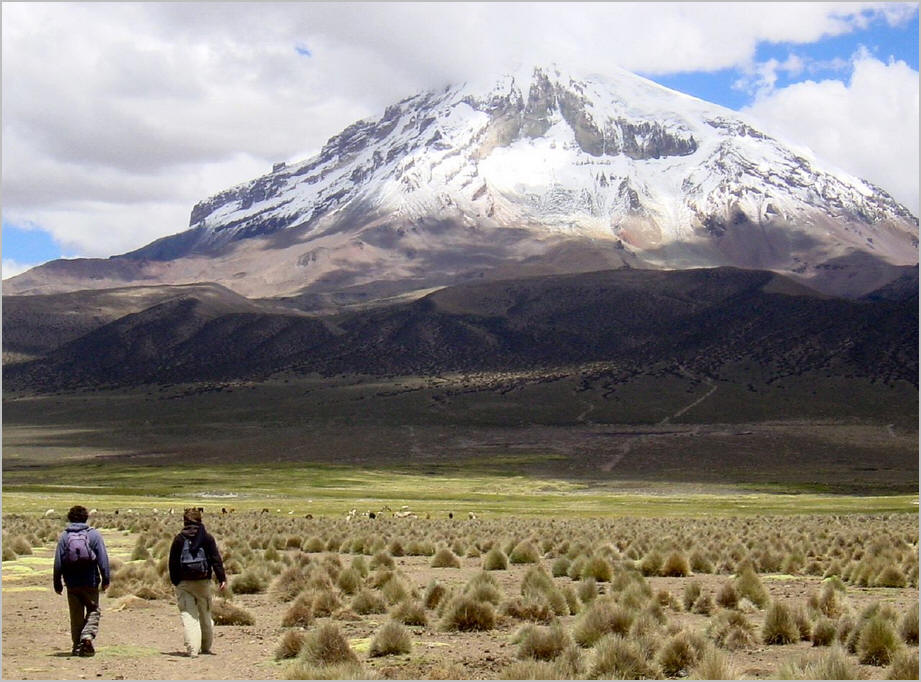
Nevado Sajama ([neˈβaðo saˈxama]; Aymara: Chak Xaña) is an extinct stratovolcano and the highest peak in Bolivia. The mountain is located in the Oruro Department, Sajama Canton. It is situated in Sajama National Park and is a composite volcano consisting of a stratovolcano on top of several lava domes. It is not clear when it erupted last but it may have been during the Pleistocene or Holocene.
The mountain is covered by an ice cap and Polylepis tarapacana trees occur up to 5,000 meters (16,000 ft) in height. Wikipedia
The Harvard astrophysicist who first suggested that the interstellar object (ISO) ‘Oumuamua was a ‘light sail sent from another civilization in space now suggests there may be a link to the mysterious space object and the US government’s upcoming report on UFOs
In an op-ed for Scientific American, Loeb, who is the Frank B. Baird Jr. Professor of Science at Harvard, theorizes that ‘Oumuamua could have ‘been meant to scan signals from all viewing directions,’ looking for sensors that a yet-to-be-discovered predecessor put into Earth’s atmosphere.
‘A predecessor to ‘Oumuamua could have been a craft that deposited small probes into the Earth’s atmosphere without being noticed because it visited before Pan-STARRS started its operations,’ Loeb wrote in the op-ed.
Imagine yourself at home on the open road: There’s nothing tying you down, and a world of adventures is ahead of you. Now imagine that you can make that life not just feasible but comfortable, with everything you need to work and play right at your fingertips. This is van life.
In late 2018, my fiancé and I began planning our foray into elective nomadism, leaving behind offices and apartments for work, play, and life on the road. We spent six months living happily in our van, seeing sights and visiting friends. And although the pandemic cut our trip short, we’re looking forward to restarting our van adventures once that crisis is fully behind us.
The community of “van lifers” is only growing, filled with adventurers who see the vast expanse of living potential in that middle ground between lumbering RVs towing golf carts and bare-bones minivan mattresses. But how do you even get started? You can spin your wheels for a long time mixing and matching creature comforts and practical realities, but there are a few major paths people take.
Last spring, several months into the pandemic, a series of images appeared on Instagram, depicting a luxury home nestled into the cliffs of the Scala dei Turchi, on the coast of Italy. The building appeared to be sculpted from cream-colored adobe, and its rounded, uncovered windows and doors looked out over a peaceful aquamarine sea. Furniture by Gerd Lange for Bofinger and Le Corbusier sat invitingly by an ocean-fed pool; inside, Picasso ceramics were arranged artfully around a minimalist seating area and bathed in early-afternoon light. The residence, Villa Saraceni, was the work of designers Riccardo Fornoni and Charlotte Taylor. It also didn’t exist in real life: the house was built with rendering software, and its design was entirely speculative. In reality, the Scala dei Turchi is a tourist destination that has seen erosion and damage from overuse. In 2007, the surrounding municipality applied to designate the area a UNESCO World Heritage site, and last year it was seized by Italian authorities concerned with its preservation. Still, some admirers of Villa Saraceni were transfixed to the point of sending booking inquiries. “Gorgeous,” one Instagram user commented. “Do they rent?”
Instagram is full of such images: living rooms, patios, bedrooms, and estates that do not and will never exist. The pictures are strangely soothing, with their fanciful palettes, evocative silhouettes, and enticing water features. Sunken living rooms are full of pillows, or clouds; spiral staircases are wrapped in cyan glass. Against the backdrop of something resembling the Mediterranean, a striking, ergonomically nonviable chaise lounge is flanked by two human-size vases and a climatically confused cactus. A high-ceilinged, white-tiled, cerulean spa offers arched, curtained relaxation nooks painted in soft pink. Atop a brass-plated console table, in front of a geometric, color-blocked backsplash, a floral arrangement seems to be suffering, in a dash of realism, from dehydration. The spaces project order and calm, and rely on a visual vocabulary of affluence, indulgence, and restraint. They are uncluttered and private; welcoming but undamaged by human use. They are also slightly sterile. Although some incorporate hints of activity—a rumpled bedspread, an open magazine placed poolside—the spaces are uninhabited. An important part of the fantasy, it seems, is the absence of other people.
.
The 3-D-modelling software used to design digital interiors lends itself to certain elements, such as plastics, curves, and soft light. Space design and rendering by Nareg Taimoorian and Charlotte Taylor
The U.S. Air Force’s first two F-15EX Super Eagle fighters flew to Alaska this month to participate in the Northern Edge 21 wargame—to mixed results.
During the joint multi-service exercise, the two planes flew 33 sorties (or dispatches), while paired up with a variety of active duty planes, including F-15C Eagles, F-16 Fighting Falcons, F-35 Joint Strike Fighters, and F-22 Raptors.
There, the F-15EX “shot down some adversaries and was shot down itself,” according to Air Force magazine. Still, the results aren’t exactly shocking, considering the Air Force has yet to figure out a strategy for the new, non-stealthy fighters.
Lt. Col. John O’Rear of the 84th Test and Evaluation Squadron told Air Force the F-15EX “tallied some kills,” but also took some losses. O’Rear said the performance met expectations, as any simulated adversary worth practicing against would naturally be strong enough to inflict losses.
Film and Writing Festival for Comedy. Showcasing best of comedy short films at the FEEDBACK Film Festival. Plus, showcasing best of comedy novels, short stories, poems, screenplays (TV, short, feature) at the festival performed by professional actors.

 An image from San Antonio, TX, USA
/cdn.vox-cdn.com/uploads/chorus_image/image/69327810/fp_chicken_draft.0.jpg)