On Nov. 14, skywatchers will be treated to a supermoon so big and bright that it’s being billed as a “super-dupermoon” or an “extra-supermoon.”
Supermoons aren’t especially uncommon, but this will be the nearest that a full moon has come to Earth since January 26, 1948. The full moon won’t get this close again until November 25, 2034.
The term supermoon refers to a full moon that occurs when our planet’s natural satellite is at its closest point to Earth in its elliptical orbit. Astronomers call that point perigee, and so “perigee moon” is another term for supermoon. (The point at which the moon is most distant from Earth in its orbit is known as apogee.)
A supermoon can appear up to 14 percent bigger and 30 percent brighter than an apogee full moon, according to NASA. The effect is most pronounced when the moon is viewed near the horizon.
.
pjsells via Getty Images
.
.
Click link below for article, video and slideshow:
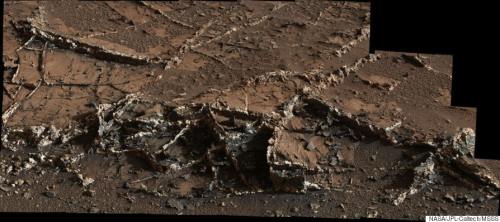
The discovery of strange, mineral veins on Mars has planetary scientists buzzing. And no wonder: the find may shed new light on the Red Planet’s watery past and could even help reveal whether Mars was once habitable.
NASA’s Curiosity rover spotted the prominent veins in “Garden City.” That’s the name scientists use for a geologically rich site on towering Mount Sharp (Aeolis Mons), a mountain that rises almost 3.5 miles off the Martian surface.
A composite image of the veins was made by combining 28 separate photos taken on March 18, 2015 by the right-eye camera of the rover’s Mastcam instrument.
.
This March 18, 2015, view from the Mast Camera on NASA’s Curiosity Mars rover shows a network of two-tone mineral veins at an area called “Garden City” on lower Mount Sharp.
When astronomers detected a strange signal in a massive galaxy cluster millions of light years from Earth, they knew they had stumbled upon something big.
“I couldn’t believe my eyes,” Esra Bulbul, of the Harvard Center for Astrophysics, said in a written statement. “What we found, at first glance, could not be explained by known physics.”
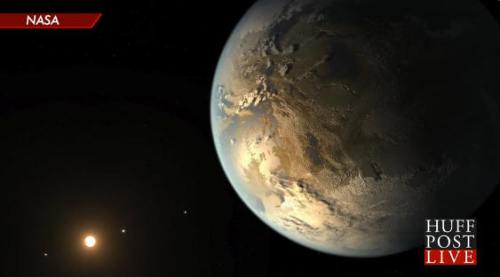
Astronomers have discovered what they say is the most Earth-like planet yet detected — a distant, rocky world that’s similar in size to our own and exists in the Goldilocks zone where it’s not too hot and not too cold for life.
The find, announced Thursday, excited planet hunters who have been scouring the Milky Way galaxy for years for potentially habitable places outside our solar system.
“This is the best case for a habitable planet yet found. The results are absolutely rock solid,” University of California, Berkeley astronomer Geoff Marcy, who had no role in the discovery, said in an email.
When a black hole swallows a star, things get violent. Very violent.
At least, that’s what scientists found in a new study when they used computer simulations to mimic the destruction of a star as it falls into a giant black hole. Just check it out in the video.
The simulations show that when the gravitational force of a supermassive black hole pulls in a star, the star is stretched into a long blob before it’s destroyed. About half of the star’s mass may get ejected as a stream of debris and the other half eventually may spiral into the black hole, forming what’s called an “accretion disk.”
.
Illustration of a star distorted by supermassive black hole.
While astronomers didn’t bag that elusive first “alien Earth” in 2013, they made plenty of exciting exoplanet discoveries during the past year.
Here’s a list of the top exoplanet finds of 2013, from a tiny world about the size of Earth’s moon to a blue gas giant on which it rains molten glass:
The smallest exoplanet
In February, astronomers announced the discovery of Kepler-37b, the smallest alien world ever found around a sun-like star. The planet is about 2,400 miles (3,900 kilometers) wide, making it just slightly larger than Earth’s moon.
.
Data from NASA’s Kepler mission finds evidence for at least 100 billion planets in our galaxy. Image released January 3, 2013. | NASA
Habitable alien planets similar to Earth may not be that rare in the universe, a new study suggests.
About one in five sunlike stars observed by NASA’s planet-hunting Kepler spacecraft has an Earth-size planet in the so-called habitable zone, where liquid water — and, potentially life — could exist, according to the new study. If these results apply elsewhere in the galaxy, the nearest such planet could be just 12 light-years away.
“Human beings have been looking at the stars for thousands of years,” said study researcher Erik Petigura, a graduate student at the University of California, Berkeley (UC Berkeley). “How many of those stars have planets that are in some way like Earth? We’re very excited today to start to answer that question,” Petigura told SPACE.com. [9 Exoplanets That Could Host Alien Life]
It took two major expeditions charting the solar eclipse of 1919 to verify Albert Einstein’s weird prediction about gravity — that it distorts the path of light waves around stars and other astronomical bodies, distorting objects in the background. Now, researchers have created the first precise analogue of that effect on a microchip.
Any large mass distorts the geometry of space around it, for instance making parallel light rays diverge or converge. One consequence, described by Einstein’s general theory of relativity, is that objects behind a body such as the Sun may look magnified or distorted as the optical path of light goes through the region of warped space.
Metamaterials scientist Hui Liu of Nanjing University in China and his colleagues mimicked this ‘gravitational lensing’ — which affects light in the vacuum of space — by making light travel through solid materials instead. Different transparent media have different indexes of refraction, causing light to bend. One example is at the interface between water and air, a familiar effect that makes a pencil look broken when it is half-dipped in water. But if a medium has an index of refraction that varies gradually rather than abruptly, it will make the the paths of light rays curve as they travel through it.
.
The warping of the empty space around a massive star means that the shortest path of light around a star is a ‘curved’ one — but the bending of light rays in a medium can mimic the same effect. | Nature Photonics
NASA will launch a new spacecraft tonight (Sept. 6) to unlock the mysteries of moon dust and the wispy lunar atmosphere, and you can watch the blastoff live online.
The space agency’s Lunar Atmosphere and Dust Environment Explorer, nicknamed LADEE, is poised to liftoff atop a brand-new Minotaur V rocket from Wallops Island, Va., at 11:27 p.m. EDT (0327 Sept. 7 GMT) in what will be the first-ever lunar mission to launch from Virginia. Weather permitting, the nighttime launch may be visible to millions of observers along a wide swath of the U.S. East Coast that stretches from Maine to North Carolina.
But for observers outside the viewing area, NASA has two webcasts to offer live video views of tonight’s planned moon shot. You can watch the LADEE launch live on SPACE.com beginning at 9:30 p.m. EDT (0130 GMT), courtesy of NASA TV.
Stargazers are thrilled over the surprise appearance of a star explosion, known as a nova, in the night sky last week, but there is more to this cosmic event than meets the eye.
The new Nova Delphinus 2013 was first spotted in the constellation Delphinus (The Dolphin) by Japanese amateur astronomer Koichi Itagaki on Aug. 14 and quickly confirmed by other skywatchers soon after. Novas are stars that are undergoing a powerful eruption, causing them to brighten significantly, so that they appear suddenly in the night sky where previously no star was visible.
Since its discovery, this nova has brightened rapidly to become an object visible to the naked eye, though stargazers will need to be away from city lights in order to see it clearly
Just how frequently does a nova become bright enough to be seen without the use of binoculars or a telescope?
On average, new novas are detected about once every four or five years. Over the last 112 years, there have been 47 novas that have flared into naked-eye view. The majority of these — 26 — were quite dim and could only be positively identified by using a star chart or sky atlas.
.
Photographer Justin Ng photographed Nova Delphinus 2013 on August 18, 2013. He is based in Singapore.
Film and Writing Festival for Comedy. Showcasing best of comedy short films at the FEEDBACK Film Festival. Plus, showcasing best of comedy novels, short stories, poems, screenplays (TV, short, feature) at the festival performed by professional actors.


 This March 18, 2015, view from the Mast Camera on NASA’s Curiosity Mars rover shows a network of two-tone mineral veins at an area called “Garden City” on lower Mount Sharp.


 James' World 2