January 26, 2022
Mohenjo
Business, Food For Thought, Human Interest, Science, Technical
amazon, business, Business News, current-events, Future, Hotels, human-rights, medicine, mental-health, research, Science, Science News, technology, Technology News, travel, vacation

Click the link below the picture
.
Ask people what they think they’ll look like in 25 years, and chances are they’ll mention how their parents looked at that age. And while genetics certainly play a part, research shows there’s more to the story. Only about 30% of what we see as aging is inherited, explains John Rowe, M.D., Julius B. Richmond Professor of Health Policy and Aging at Columbia Mailman School of Public Health.
When you look specifically at things above the neck — like cognitive function, vision, and hearing — that number goes up to about 50%. “People feel there’s some intrinsic clock playing out a program in their body that they don’t have influence over,” says Dr. Rowe. “It’s just not true.”
Yes, good news: We have real control over how our bodies age. Aging is happening on a cellular level at every moment, so for long and healthy life, it’s vital to stay on top of the changes within your body and your mind. For a better understanding of these shifts through every decade, we talked to the experts.
.

.
.
Click the link below for the article:
.
__________________________________________
January 26, 2022
Mohenjo
Business, Food For Thought, Human Interest, Overlooked Past Article, Science, Technical
amazon, business, Business News, current-events, Future, Hotels, human-rights, medicine, mental-health, research, Science, Science News, technology, Technology News, travel, vacation

Click the link below the picture
.
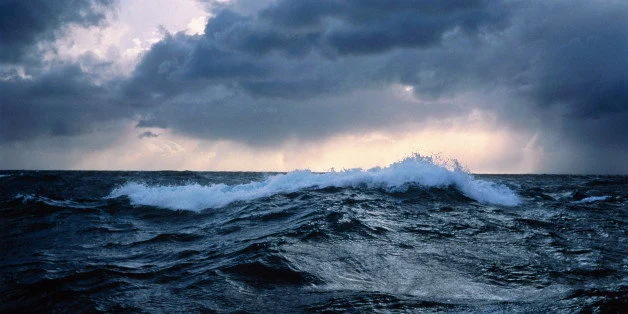
It turns out the hole in the now-famous ozone layer above the South Pole isn’t the only hole in the atmosphere. Researchers recently discovered, to their considerable surprise, that the atmosphere above part of the western tropical Pacific Ocean is nearly devoid of one of the key chemicals that scrubs pollutants from the air.
This newfound hole occurs naturally over thousands of kilometers in one of the most remote places on the planet (which accounts for its having gone unnoticed until now) and one of the main spots where the air is sent up to the stratosphere. The stratosphere is the layer of Earth’s atmosphere above the troposphere, the layer where humans live and in which most weather occurs. Having air shooting up to this layer without first being “washed” of all the junk that humans and nature put into the atmosphere has uncertain implications for the health of the planet’s protective ozone layer and its overall climate.
In tropical thunderstorms over the West Pacific, air masses and the chemical substances they contain are quickly hurled upward to the edge of the stratosphere. On the way, hydroxyl (OH) molecules “scrub” these substances from the air before it reaches the stratosphere, where they would be able to spread around the globe and would last for longer than in the lower reaches of the atmosphere. Except in a region of the tropical Pacific, a hole in this OH “shield” has been discovered.
“I first suspected a series of false measurements and had to convince myself that the measurements were correct,” Rex told Climate Central in an email.
But the probes were right: There was barely any ozone throughout this huge chunk of the atmosphere. Without any ozone, there weren’t any hydroxyl radicals, a molecule made up of an oxygen and hydrogen atom (designated as OH) that is highly reactive in the atmosphere. This reactivity makes it an excellent “detergent” for cleaning from the air many of the thousands of other chemical compounds released by humans, other animals, microbes, and plants. For this reason, the layer of OH that exists elsewhere in the troposphere is known as the “OH shield.”
.
 This post originally appeared on Climate Central
.
.
Click the link below for the article:
.
__________________________________________
January 26, 2022
Mohenjo
Crime, Food For Thought, Human Interest, Medical, missed News, Political, Science, sports, Technical
amazon, business, Business News, current-events, Future, Hotels, human-rights, medicine, mental-health, research, Science, Science News, technology, Technology News, travel, vacation

.
News You might have missed!
Use your browser or smartphone back arrow (<-) to return to this table for your next selection.
.
__________________________________________
January 25, 2022
Mohenjo
Business, Food For Thought, Human Interest, Science, Technical
amazon, business, Business News, current-events, Future, Hotels, human-rights, medicine, mental-health, research, Science, Science News, technology, Technology News, travel, vacation

Click the link below the picture
.
Last May, I compared the COVID-19 pandemic to a grueling marathon. I’ve come to see that was not quite right: when you’re out running, no matter how hard it is, you know you’re done after 26.2 miles. But since the pandemic began two years ago, the finish line keeps moving. Now the ultra-contagious Omicron variant is raging across the country. Hospitals and schools are overwhelmed—and you might be feeling absolutely fried even if you’re not a nurse or a teacher.
For some ideas for how to think about this latest phase of the pandemic, I went to the latest research in psychology, neuroscience, and sociology, as well as traditional teachings and age-old wisdom. This is the thinking behind groundedness, and idea I developed for my book The Practice of Groundedness, an instruction manual for developing the internal strength and fortitude to sustain you through ups and downs. If resilience is about bouncing back, groundedness is about holding your ground, about not getting knocked down during hardships and challenges.
If there ever was a time to prioritize these values, this winter sure seems to be it. The following principles might help serve as a guide for what (knock wood) will hopefully be the last long winter of this pandemic.
.
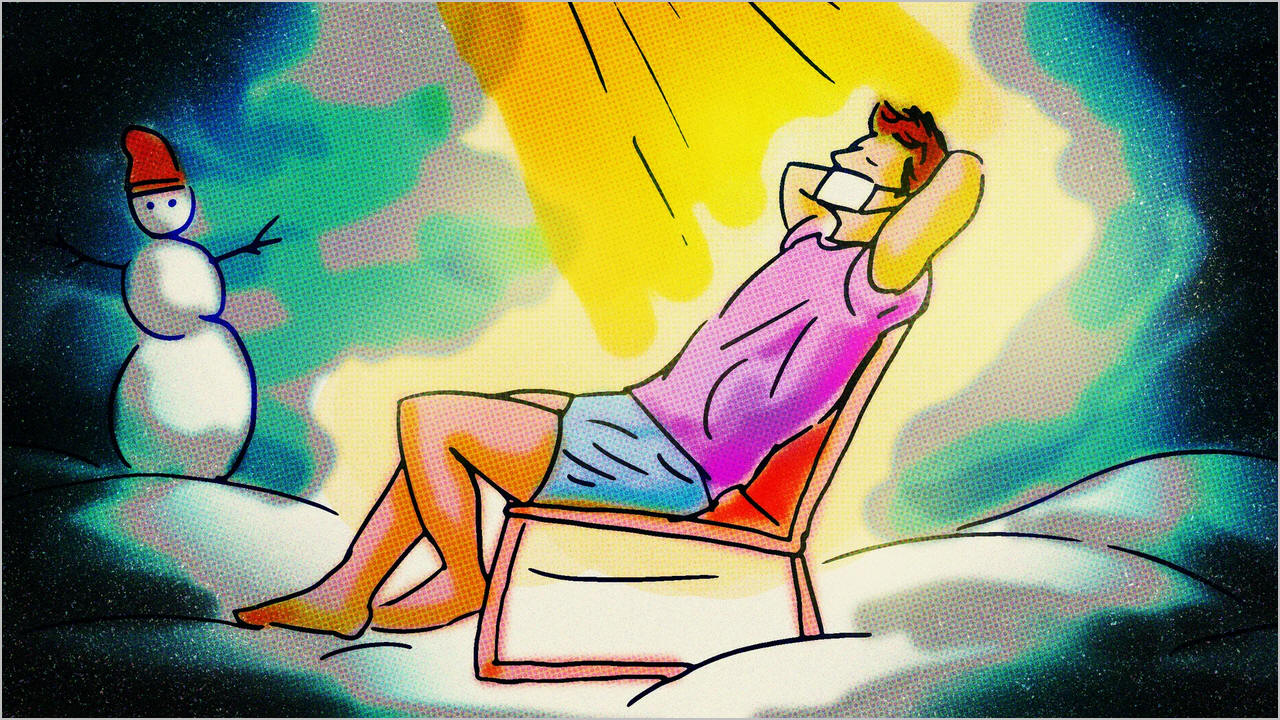 Illustration by Rob Vargas
.
.
Click the link below for the article:
.
__________________________________________
January 25, 2022
Mohenjo
Crime, Food For Thought, Human Interest, Medical, missed News, Political, Science, Technical
amazon, business, Business News, current-events, Future, Hotels, human-rights, medicine, mental-health, research, Science, Science News, technology, Technology News, travel, vacation
.
News You might have missed!
Use your browser or smartphone back arrow (<-) to return to this table for your next selection.
.
__________________________________________
January 24, 2022
Mohenjo
Business, Food For Thought, Human Interest, Science, Technical
amazon, business, Business News, current-events, Future, Hotels, human-rights, medicine, mental-health, research, Science, Science News, technology, Technology News, travel, vacation

Click the link below the picture
.
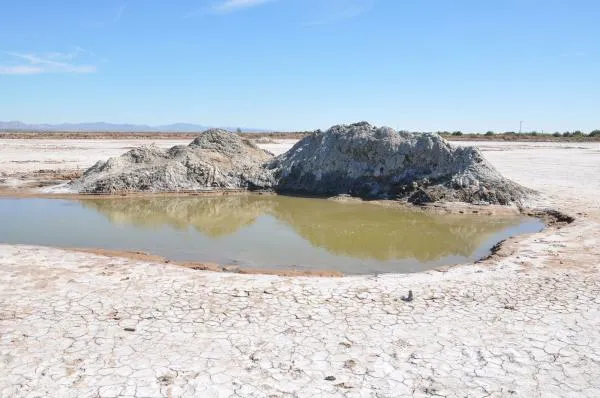
The Davis-Schrimpf seep field is located about 40 miles (64 kilometers) southeast of Palm Springs, Calif., at an elevation of 230 feet (70 meters) below sea level. Here, carbon dioxide gases gurgle to the surface as a result of a magma zone found 1 mile (1.6 km) below the Earth’s surface cooking the gas from carbonate minerals.
Over 50 mud volcanic features are found in this seep field, including gryphons, gas vents, salses, mudpots, and springs all located within a 2-square-mile (5-square-km) area.
Gryphons are small earthen mounds built by the eruptions of mud volcanoes. The fluids that create the gryphons are powered by hydrothermal carbon dioxide gas mixed with near-surface brines and are merely warm to the touch rather than hot.
The viscosity of the mud extruding from a specific mud volcanic vent will help determine the height that each gryphon grows to. The amount of escaping carbon dioxide gas also influences the erupting power of the mixture and thus how high the small mountain of mud will grow.
.
 (Image credit: Linda and Dr. Dick Buscher.)
.
.
Click the link below for the article:
.
__________________________________________
January 24, 2022
Mohenjo
Business, Food For Thought, Human Interest, Science, Technical
amazon, business, Business News, current-events, Future, Hotels, human-rights, medicine, mental-health, research, Science, Science News, technology, Technology News, travel, vacation

Click the link below the picture
.
A new island emerged from the ocean offshore of the city of Gwadar, Pakistan, after a strong magnitude-7.7 earthquake shook the country on Sept. 24.
The mound appears to be 20 to 40 feet (6 to 12 meters) high and 100 feet (30 m) wide, DIG Gwadar Moazzam Jah, a district police officer, told Pakistan’s Geo News. It rose out of the sea at a spot located about 350 feet (100 m) from the coast, he said.
The news sparked lively chatter among geologists, who debated whether the hill was a landslide, a fault scarp or even a hoax. A fault scarp marks vertical displacement along a fault, anything from a small step to a huge, steep cliff.
Scientists are still far from consensus, but many think that Pakistan’s newest piece of land may be a mud volcano.
Geologist Bob Yeats, an expert on Pakistan’s earthquake hazards, said he’s waiting until he hears from his colleagues in Pakistan (it’s currently night there) before judging the case. The two most likely possibilities are a landslide or a mud volcano, Yeats told LiveScience’s OurAmazingPlanet.
.
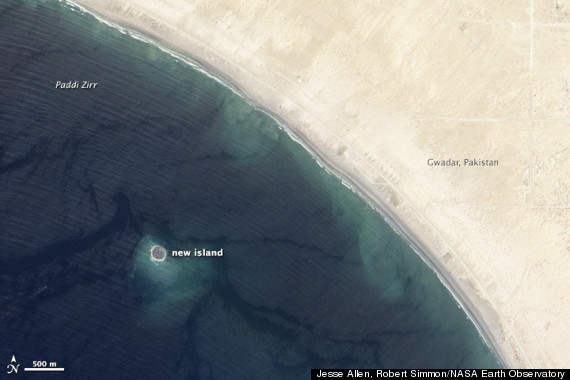 On September 26, 2013, NASA’s Earth Observing-1 (EO-1) satellite captured this image of a new island off the coast of Pakistan. The “mud island” rose from the seafloor near Gwadar on September 24, shortly after a magnitude 7.8 earthquake rattled the Balochistan province of northwestern Pakistan.
.
.
Click the link below for the article:
.
__________________________________________
January 24, 2022
Mohenjo
Crime, Food For Thought, Human Interest, Medical, missed News, Political, Science, Technical
amazon, business, Business News, current-events, Future, Hotels, human-rights, medicine, mental-health, research, Science, Science News, technology, Technology News, travel, vacation
.
News You might have missed!
Use your browser or smartphone back arrow (<-) to return to this table for your next selection.
.
__________________________________________
January 23, 2022
Mohenjo
Business, Food For Thought, Human Interest, Medical, Science, Technical
amazon, business, Business News, current-events, Future, Hotels, human-rights, medicine, mental-health, research, Science, Science News, technology, Technology News, travel, vacation

Click the link below the picture
.
Whether you’re feeling a bit overwhelmed by lockdown ending or are feeling sore from sitting at your desk for long hours throughout the working day, yoga can help.
However, the practice can feel intimidating to those who have never done it before. Plus, not everyone has the time to squeeze in a couple of 90-minute classes every week just to destress from a busy week. That doesn’t mean you have to miss out on what yoga can do for you. In fact, just by working some basic stretches into your routine, you can start to feel all the physical and mental health benefits the practice has to offer.
Donna Noble is a yoga teacher and the founder of Curvesomeyoga, an organization that aims to make yoga inclusive, diverse, and accessible for all. Here, she explains exactly why we should start incorporating simple yoga stretches into our day-to-day lives, and which to try first. There’s no better time than today to start.
.
 Photos by Getty Images
.
.
Click the link below for the article:
.
__________________________________________
January 23, 2022
Mohenjo
Business, Food For Thought, Human Interest, Overlooked Past Article, Science, Technical
amazon, business, Business News, current-events, Future, Hotels, human-rights, medicine, mental-health, research, Science, Science News, technology, Technology News, travel, vacation
Click the link below the picture
.
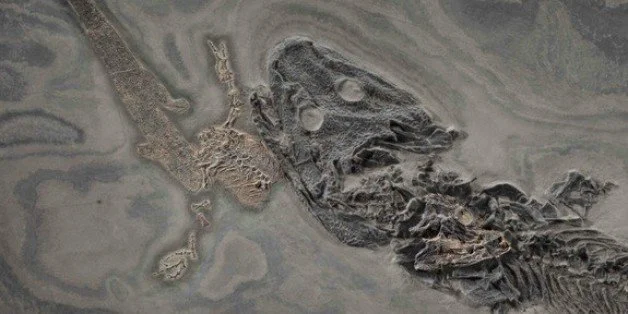
In rare cases, one of life’s important childhood lessons — always chew your food properly — becomes fossilized. And now, anyone can own one of these reminders in rock. A specimen containing the remains of a large, predatory amphibian choking on another creature is up for auction in October.
Nearly 300 million years ago, during the Paleozoic Era, this predator attempted to eat another, smaller amphibian. The larger creature died mid-meal with the smaller one’s body half-consumed. This type of fossil, in which a predator chokes on its prey, is known as an aspiration.
When a scene like this is captured forever by geology, the value of the fossil goes up, said Jim Walker, director of the nature and science department at the auction house Heritage Auctions. [See Photos of ‘Choking Predators’ and other Fossils for Auction]
“It affects it to the degree of eight or 10 times without any trouble at all,” Walker said. Heritage expects this specimen to sell for between $150,000 and $250,000.
The predator, in this case, is a 28-inch-long (71 centimeters) creature known as Sclerocephalus haeuseri. Artists’ representations of it depict an animal that looks like a cross between an alligator and a salamander, with a heavy skull and jaws, a streamlined body with a menacing-looking tail, and eyes on top of its head.
The resemblance to a crocodile or alligator is no coincidence. During the Permian Period — the last period of the Paleozoic lasting from 299 million to 251 million years ago — this ancient amphibian filled a similar ecological role to these modern aquatic predators, Walker said.
.
 Choking
.
.
Click the link below for the article:
.
__________________________________________
Older Entries
Newer Entries

