January 17, 2022
Mohenjo
Business, Food For Thought, Human Interest, Science, Technical
amazon, business, Business News, current-events, Future, Hotels, human-rights, medicine, mental-health, research, Science, Science News, technology, Technology News, travel, vacation

Click the link below the picture
.
What happens after you die doesn’t need to be a mystery. At least when it comes to your email, that is.
As we move through life there are few things that we truly take with us. A family heirloom, perhaps. Your loved ones, if you’re lucky. And, more and more frequently, one of those things happens to be an email account steadily filling up with personal correspondence, bills, medical records, and embarrassing moments from your past.
And thanks to the modern wonder of cloud computing, that collection will likely long outlast you. Unless you set your entire Google account to self-destruct after your death — which, thanks to Google’s Inactive Account Manager, you can do.
Why you should enable Inactive Account Manager
Take a moment to think about the contents of your email account. Likely spanning from the quotidian and mundane to the extremely revealing, as the years progress your email account will accumulate evidence of the life you’ve lived.
Which can be extremely useful. It’s also extremely personal. Once you’re gone, is there really a reason for this compendium of deeply revealing data to sit for who knows how long on Google’s servers?
.

Let it burn. Credit: Xanya69 / Getty Images
.
.
Click the link below for the article:
.
__________________________________________
January 17, 2022
Mohenjo
Crime, Food For Thought, Human Interest, Medical, missed News, Political, Science, Technical
amazon, business, Business News, current-events, Future, Hotels, human-rights, medicine, mental-health, research, Science, Science News, technology, Technology News, travel, vacation

.
News You might have missed!
Use your browser or smartphone back arrow (<-) to return to this table for your next selection.
.
__________________________________________
January 16, 2022
Mohenjo
Business, Food For Thought, Human Interest, Science, Technical
amazon, business, Business News, current-events, Future, Hotels, human-rights, medicine, mental-health, research, Science, Science News, technology, Technology News, travel, vacation

Click the link below the picture
.
Hello from low-earth orbit! I have spent hundreds of hours working here in virtual reality. Even as I write this to you, I have Facebook’s Oculus strapped to my face and am in an aptly named app called Immersed. It puts me in this orbiting spaceship where there’s just me, the computer screen in front of me, and—let me look out the window—Ecuador.
I’m not sure where Facebook’s Metaverse begins or ends; perhaps I am in it right now. But I am primarily a writer of English text and computer code, a solitary profession that rarely requires real-time meetings like those in the Metaverse demos. When I was a kid, I wrote homework essays on a manual typewriter. What I do now is not much different, except I don’t need to use that white correction tape stuff to erase typos—and I’m in space.
Working from home certainly feels isolating to all of us who do so, but when working from space I’m a thousand kilometers from the next human.
I wasn’t thinking about such things when I got this VR headset. I just wanted to be more comfortable and relaxed while working. Sitting at a desk is the opposite of relaxed. Working on the couch feels better at first, but using a laptop always involves contortions wherein either the screen is too close or the keyboard is too far. Wouldn’t it be great if I could have a screen floating before me at just the right position?
VR desktops like Immersed put you in an environment like this spaceship, or a mountain lodge, or a serene forest shrine, and project your computer’s screen before you. Stretch your screen to massive proportions if you’d like. If you want a standing desk, just stand up and take a few seconds to flick your monitors to the right height.
.
 Photograph: pixdeluxe/Getty Images
.
.
Click the link below for the article:
.
__________________________________________
January 16, 2022
Mohenjo
Business, Food For Thought, Human Interest, Science, Technical
amazon, business, Business News, current-events, Future, Hotels, human-rights, medicine, mental-health, research, Science, Science News, technology, Technology News, travel, vacation

Click the link below the picture
.
The narrow stretch that separates Quay Tower from a thatch of bamboo and oaks in Brooklyn Bridge Park doesn’t look like much, especially in winter. Unless you’re a bird.
To a bird, the copper-colored building’s glass is a mirror, reflecting the thick grove of trees and suggesting that the wilderness continues across the road. To a bird, that can be a deadly mistake.
“You see that reflection? To a bird that looks like a tree, that is a tree, and they will go right for the tree,” says Catherine Quayle, social media director at the Wild Bird Fund.
The surprising uptake of birding as a pandemic hobby, along with social media and data collection tools like eBird and dBird, has created new visibility for bird collisions with glass, which kill as many as 1 billion birds in the U.S. per year. At the same time, a new generation of urban parks has given birds more places to roost in highly populated areas. But something else has followed these parks as well: real estate capital. The vogue for urban parks creates more economic impetus to build shiny buildings with big windows opposite those urban wetlands, glades, and groves.
.
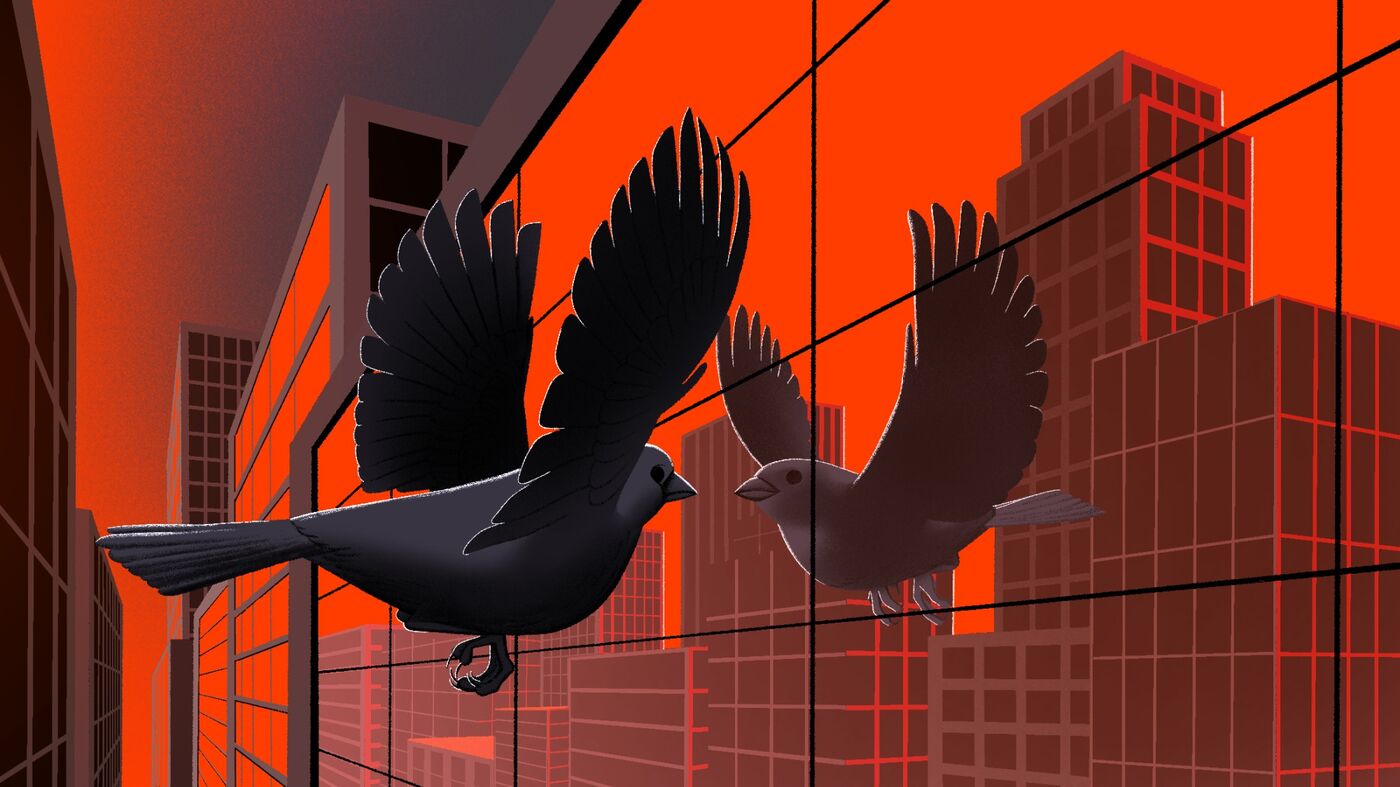 Illustrator: Cathryn Virginia
.
.
Click the link below for the article:
.
__________________________________________
January 15, 2022
Mohenjo
Business, Food For Thought, Human Interest, Science, Technical
amazon, business, Business News, current-events, Future, Hotels, human-rights, medicine, mental-health, research, Science, Science News, technology, Technology News, travel, vacation

Click the link below the picture
.
First, it was Facebook, and then it was Twitter. In 2019, Twitter admitted that it allowed marketers to access the phone numbers that users had registered with the site. Many had given their numbers to enable two-factor authentication (2FA)—that process where a website sends you a text message to verify it’s really you who’s logging in. Users didn’t realize they were also allowing marketers to verify who they are in order to build better advertising profiles incorporating Twitter user data. (Twitter says this was an inadvertent mistake and that it has closed the hole.)
That’s especially scary because our phone numbers have become powerful tools to identify and track us, not just for companies but for anyone who wants to look up our personal information stored in a myriad of public records such as court filings, voter registration, real estate transactions, and marriage records.
Twitter’s admission is a nasty case of déjà vu since Facebook admitted to misusing phone numbers for ad targeting about a year before this article was written in 2019. “For a lot of people, [text-message authentication] is a totally reasonable protection that you should feel comfortable using,” says Gennie Gebhart, a researcher on consumer privacy and security at the Electronic Frontier Foundation. “But Facebook was irresponsible, and now we can’t have nice things.”
.
 Photo by Yagi Studio/Getty Images
.
.
Click the link below for the article:
.
__________________________________________
January 15, 2022
Mohenjo
Business, Food For Thought, Human Interest, Science, Technical
amazon, business, Business News, current-events, Future, Hotels, human-rights, medicine, mental-health, research, Science, Science News, technology, Technology News, travel, vacation

Click the link below the picture
.
SOME YEARS AGO, I WENT through a divorce and lived with my sister’s family for a time. They went to bed early, which left me with the run of a big house in Toronto. This meant the run of the Netflix.
I had never used Netflix before. I have always been a late adopter, perhaps the last adopter—less Luddite, say, than laggard. In any case, I didn’t use the platform well. Instead of scrolling through the seemingly endless rows of tiles organized into categories—“Trending Now,” “True Crime,” “Reality TV”—I cued up reruns of the sitcom Community. I even rejected Netflix’s suggestions supposedly customized just for me (“Because you watched Community . . .”). I wanted comfort food, not a buffet addressed to catholic tastes.
The sheer volume of stuff on offer—which only seems to intensify during Hollywood’s awards season—can paralyze your mind. But Netflix charges a flat fee, so you can be cavalier about your choices. The platform abets sampling and second thoughts. You can leave things half-finished on your plate—or you can binge. It’s all you can eat. It’s all good.
But the constant press of incoming material means you can tear through an entire season of something, sincerely enjoy it, and barely recall an episode a week later. Streamed content, as forceful and ephemeral as wind, demands about as much mental space as it does shelf space.
.
 Illustration by Tung Chau
.
.
Click the link below for the article:
.
__________________________________________
January 15, 2022
Mohenjo
Crime, Food For Thought, Human Interest, Medical, missed News, Political, Science, sports, Technical
amazon, business, Business News, current-events, Future, Hotels, human-rights, medicine, mental-health, research, Science, Science News, technology, Technology News, travel, vacation
.
News You might have missed!
Use your browser or smartphone back arrow (<-) to return to this table for your next selection.
.
__________________________________________
January 14, 2022
Mohenjo
Business, Food For Thought, Human Interest, Science, Technical
amazon, business, Business News, current-events, Future, Hotels, human-rights, medicine, mental-health, research, Science, Science News, technology, Technology News, travel, vacation

.
Rulers must be healers, and good rulers will be so; they must study to unite their subjects, and not to widen the differences that are among them. Those only are fit for government that are of a meek, quiet, healing, spirit. They must also heal the wounds that are given to any of the interests of their people, by suitable applications. Matthew Henry Commentary
.
__________________________________________
January 14, 2022
Mohenjo
Business, Food For Thought, Human Interest, Political, Science, Technical
amazon, business, Business News, current-events, Future, Hotels, human-rights, medicine, mental-health, research, Science, Science News, technology, Technology News, travel, vacation

Click the link below the picture
.
It’s not unusual to hear that a particular military technology has found its way into other applications, which then revolutionized our lives. From the imaging sensors that were refined to fly on spy satellites to advanced aerodynamics used on every modern jetliner, many of these ideas initially sounded like bad science fiction.
So did this one.
Consider the following scenario:
To defend the United States and Canada, a massive array of interconnected radars would be set up across the two nations. Connected by high-speed links to a distributed network of computers and radar scopes, Air Force personnel scan the skies for unexpected activity. One day, an unidentified aircraft is discovered, flying over the Arctic and heading toward the United States. A quick check of all known commercial flights rules out a planeload of holiday travelers lost over the Northern Canadian tundra. At headquarters, the flight is designated as a bogey, as all attempts to contact it have failed. A routine and usually uneventful intercept will therefore fly alongside to identify the aircraft and record registration information.
Before the intercept can be completed, more aircraft appear over the Arctic; an attack is originating from Russia. Readiness is raised to DEFCON 2, one step below that of nuclear war. Controllers across the country begin to get a high-level picture of the attack, which is projected on a large screen for senior military leaders. At a console, the intercept director clicks a few icons on his screen, assigning a fighter to its target. All the essential information is radioed directly to the aircraft’s computer, without talking to the pilot.
.
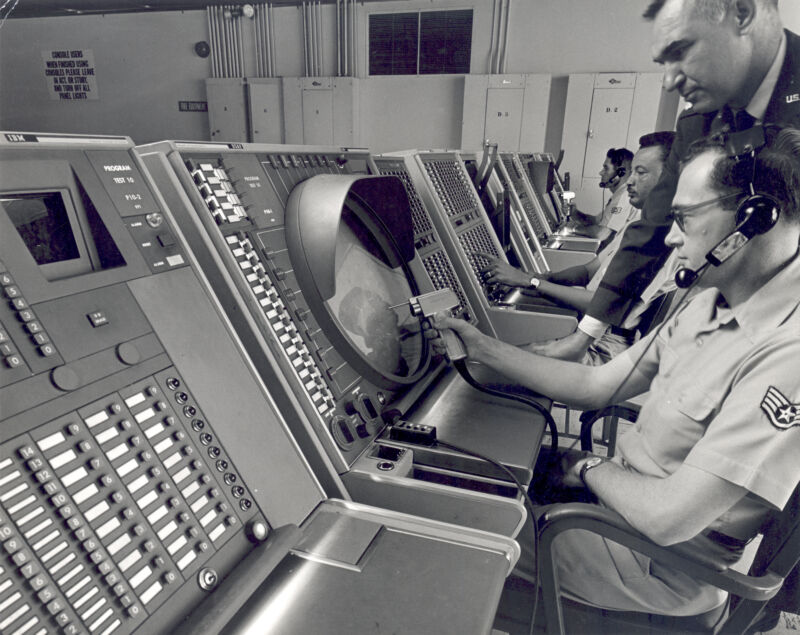 Airmen operating SAGE radar consoles.
.
.
Click the link below for the article:
.
__________________________________________
January 14, 2022
Mohenjo
Business, Food For Thought, Human Interest, Science, Technical
amazon, business, Business News, current-events, Future, Hotels, human-rights, medicine, mental-health, research, Science, Science News, technology, Technology News, travel, vacation

Click the link below the picture
.
The party-going partner now prefers chamomile tea on the couch. The lover of wanderlust has started to cling to routine. The big spender has become a frugal budgeter. Blond turns brown, turns gray, turns bald. Waistlines expand and contract. So do sex drives.
We don’t marry one person as much as we marry one version of a person, a snapshot of who we (and our partner) are individually and to one another at the moment when we say “I do.” Who we are five, 10 or 40 years later is anybody’s guess.
People change. As a result, relationships change, too.
“Not only do relationships change with time, but people change, which can affect the relationship dynamics as well,” said Michelle Chalfant, a therapist in Charlotte, N.C.
Personalities are more malleable than we may think. Most of us change, though often gradually, according to a study published in 2018 by the University of Houston, University of Tübingen, and University of Illinois at Urbana-Champaign, which assessed the personality traits of 1,795 people in the U.S. in adolescence and then 50 years later. Many participants, the study showed, tended to become more emotionally stable, conscientious, and agreeable over time.
.
 Holly Stapleton
.
.
Click the link below for article:
.
__________________________________________
Older Entries
Newer Entries
 James' World 2