The Milky Way is teeming with billions of planets, including many that are similar to our own. But how many of these alien worlds have water, and do any host extraterrestrial life?
No answers to those questions just yet. But astronomers using a new infrared technique say they’ve discovered water vapor in the atmosphere of a nearby gas giant planet called “tau Boötis b.”
The finding suggests that the technique may play an important role in identifying which exoplanets might be hospitable for life.
.
An artist’s conception of a hot-Jupiter extrasolar planet orbiting a star similar to tau Boötes. | David Aguilar, Harvard-Smiths. Center Astrophysics
When wolves were reintroduced to Yellowstone National Park in the United States after being absent nearly 70 years, the most remarkable “trophic cascade” occurred. What is a trophic cascade and how exactly do wolves change rivers? George Monbiot explains in this movie remix.
Gaze deeply into the eye of a chicken, and what do you see? Some see terrifying stupidity. But researchers at Princeton University and Washington University in St. Louis say they see in the bird’s eye the first known biological occurrence of a strange state of matter known as “disordered hyperuniformity.”
The potentially new state of matter is the result of the way five photoreceptor cells of different sizes are packed into the retina, the light-sensitive layer at the back of chickens’ eyes, according to a written statement describing the research.
In other animals, these “cone” cells are often arranged in a regular pattern, according to LiveScience. Insect cones, for example, are arranged in a hexagonal grid.
NASA has set up a “rapid response system” to pick the best candidates for its ambitious asteroid-capture mission.
The space agency aims to use a robotic spacecraft to haul a near-Earth asteroid into a stable lunar orbit, where astronauts would visit it in the future. It’s not as easy as just picking a space rock and going, however. Many asteroids are too big to be moved easily or are in unstable orbits. Others are too distant for telescopes to figure out what they’re made of, which could make them unsuitable candidates.
When a black hole swallows a star, things get violent. Very violent.
At least, that’s what scientists found in a new study when they used computer simulations to mimic the destruction of a star as it falls into a giant black hole. Just check it out in the video.
The simulations show that when the gravitational force of a supermassive black hole pulls in a star, the star is stretched into a long blob before it’s destroyed. About half of the star’s mass may get ejected as a stream of debris and the other half eventually may spiral into the black hole, forming what’s called an “accretion disk.”
.
Illustration of a star distorted by supermassive black hole.
Want to boost your eyesight? There’s an app for that.
In a new baseball study, researchers have found that training your brain with a perceptual learning app just may improve your vision.
The researchers tested the vision of baseball players at the University of California in Riverside. Then, during the 2013 NCAA Division 1 season, 19 of the players were given 25-minute brain-training sessions with an app called UltimEyes four days per week.
What did the researchers find when they did follow-up vision tests? The players who used UltimEyes reported significant improvements in seeing at a distance of 20 feet and farther, and “greater peripheral vision.” Some said that their “eyes feel stronger” and that it’s “easy to see further.”
America’s multibillion-dollar, laser-blasting fusion machine has gotten more energy out of a smidgen of fuel than was put into it — but the most significant thing is how it was done.
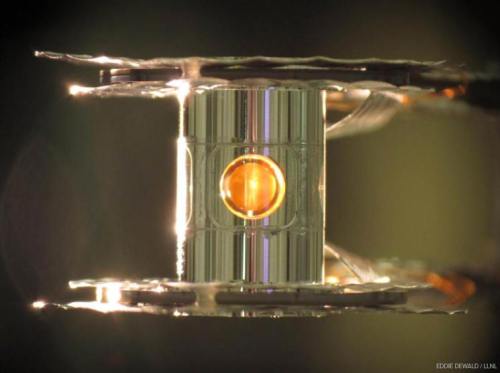
The latest experiments, reported in this week’s issue of the journal Nature, marked a first for the National Ignition Facility at Lawrence Livermore National Laboratory in California. They’re the first laser shots to produce a net gain in energy under any definition, and they’re also the first to show evidence of a mechanism that’s essential if controlled fusion is ever to become a reality.
.
A closeup from the National Ignition Facility shows a cutaway view of a gold cylinder known as a hohlraum, with a spherical fusion fuel capsule gleaming inside. The hohlraum measures about half an inch (1 centimeter) in height, and the capsule is about a tenth of an inch (2mm) in diameter. Beams of light from 192 lasers are directed at the capsule to cause an implosion.
Science isn’t just for the laboratory and the classroom: It’s also for big-screen theaters and video games, as demonstrated by the winners of this year’s International Science and Engineering Visualization Challenge.
“The winners made scientific data beautiful and brought their new ideas to life, while at the same time immersing the viewer in science,” Monica Bradford, executive editor of the journal Science, said in Thursday’s announcement of the awards.
.
Winners for “Invisible Coral Flows”: Vicente I. Fernandez, Orr H. Shapiro, Melissa S. Garren, Assaf Vardi, and Roman Stocker, Massachusetts Institute of Technology.
This image of a 100-foot crater was snapped by a NASA spacecraft last fall and released this week. The space agency says the impact formed sometime between July 2010 and May 2012, and sent debris as far as 9.3 miles away.
The crater and the big scar around it look blue due to the enhanced image and the removal of dust from the area, the agency said in a press release.
.
A fresh crater is seen on Mars in this image taken by the High Resolution Imaging Science Experiment (HiRISE) camera on NASA’s Mars Reconnaissance Orbiter. | NASA/JPL-Caltech/Univ. of Arizona
In the event of a future mass extinction, rats may be the animals best suited to repopulate the world, some scientists say.
And if rats did “take over” after such a wipeout, they’d likely balloon in size, scientists also say.
Mass extinctions have hit the Earth at least five times in geologic history, most recently about 65 million years ago, when scientists think an asteroid hit the planet and wiped out the dinosaurs. Mammals took advantage of the newly available ecological space and ultimately repopulated and dominated the animal kingdom.
.
Scientists say that after a mass extinction, oversized rats may repopulate Earth. | Simon Flint via Getty Images
Film and Writing Festival for Comedy. Showcasing best of comedy short films at the FEEDBACK Film Festival. Plus, showcasing best of comedy novels, short stories, poems, screenplays (TV, short, feature) at the festival performed by professional actors.





 Winners for “Invisible Coral Flows”: Vicente I. Fernandez, Orr H. Shapiro, Melissa S. Garren, Assaf Vardi, and Roman Stocker, Massachusetts Institute of Technology.


