The Harvard astrophysicist who first suggested that the interstellar object (ISO) ‘Oumuamua was a ‘light sail sent from another civilization in space now suggests there may be a link to the mysterious space object and the US government’s upcoming report on UFOs
In an op-ed for Scientific American, Loeb, who is the Frank B. Baird Jr. Professor of Science at Harvard, theorizes that ‘Oumuamua could have ‘been meant to scan signals from all viewing directions,’ looking for sensors that a yet-to-be-discovered predecessor put into Earth’s atmosphere.
‘A predecessor to ‘Oumuamua could have been a craft that deposited small probes into the Earth’s atmosphere without being noticed because it visited before Pan-STARRS started its operations,’ Loeb wrote in the op-ed.
Imagine yourself at home on the open road: There’s nothing tying you down, and a world of adventures is ahead of you. Now imagine that you can make that life not just feasible but comfortable, with everything you need to work and play right at your fingertips. This is van life.
In late 2018, my fiancé and I began planning our foray into elective nomadism, leaving behind offices and apartments for work, play, and life on the road. We spent six months living happily in our van, seeing sights and visiting friends. And although the pandemic cut our trip short, we’re looking forward to restarting our van adventures once that crisis is fully behind us.
The community of “van lifers” is only growing, filled with adventurers who see the vast expanse of living potential in that middle ground between lumbering RVs towing golf carts and bare-bones minivan mattresses. But how do you even get started? You can spin your wheels for a long time mixing and matching creature comforts and practical realities, but there are a few major paths people take.
Last spring, several months into the pandemic, a series of images appeared on Instagram, depicting a luxury home nestled into the cliffs of the Scala dei Turchi, on the coast of Italy. The building appeared to be sculpted from cream-colored adobe, and its rounded, uncovered windows and doors looked out over a peaceful aquamarine sea. Furniture by Gerd Lange for Bofinger and Le Corbusier sat invitingly by an ocean-fed pool; inside, Picasso ceramics were arranged artfully around a minimalist seating area and bathed in early-afternoon light. The residence, Villa Saraceni, was the work of designers Riccardo Fornoni and Charlotte Taylor. It also didn’t exist in real life: the house was built with rendering software, and its design was entirely speculative. In reality, the Scala dei Turchi is a tourist destination that has seen erosion and damage from overuse. In 2007, the surrounding municipality applied to designate the area a UNESCO World Heritage site, and last year it was seized by Italian authorities concerned with its preservation. Still, some admirers of Villa Saraceni were transfixed to the point of sending booking inquiries. “Gorgeous,” one Instagram user commented. “Do they rent?”
Instagram is full of such images: living rooms, patios, bedrooms, and estates that do not and will never exist. The pictures are strangely soothing, with their fanciful palettes, evocative silhouettes, and enticing water features. Sunken living rooms are full of pillows, or clouds; spiral staircases are wrapped in cyan glass. Against the backdrop of something resembling the Mediterranean, a striking, ergonomically nonviable chaise lounge is flanked by two human-size vases and a climatically confused cactus. A high-ceilinged, white-tiled, cerulean spa offers arched, curtained relaxation nooks painted in soft pink. Atop a brass-plated console table, in front of a geometric, color-blocked backsplash, a floral arrangement seems to be suffering, in a dash of realism, from dehydration. The spaces project order and calm, and rely on a visual vocabulary of affluence, indulgence, and restraint. They are uncluttered and private; welcoming but undamaged by human use. They are also slightly sterile. Although some incorporate hints of activity—a rumpled bedspread, an open magazine placed poolside—the spaces are uninhabited. An important part of the fantasy, it seems, is the absence of other people.
.
The 3-D-modelling software used to design digital interiors lends itself to certain elements, such as plastics, curves, and soft light. Space design and rendering by Nareg Taimoorian and Charlotte Taylor
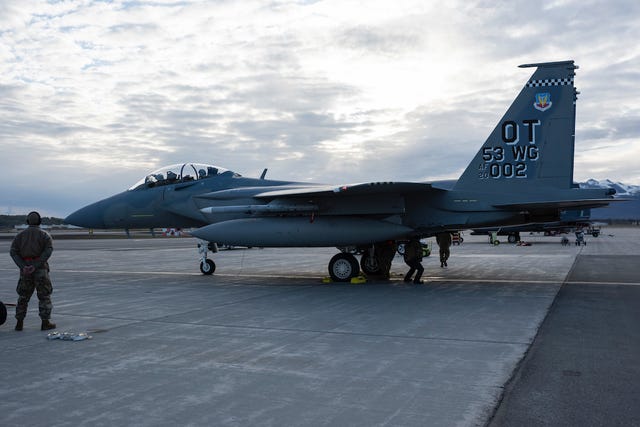
The U.S. Air Force’s first two F-15EX Super Eagle fighters flew to Alaska this month to participate in the Northern Edge 21 wargame—to mixed results.
During the joint multi-service exercise, the two planes flew 33 sorties (or dispatches), while paired up with a variety of active duty planes, including F-15C Eagles, F-16 Fighting Falcons, F-35 Joint Strike Fighters, and F-22 Raptors.
There, the F-15EX “shot down some adversaries and was shot down itself,” according to Air Force magazine. Still, the results aren’t exactly shocking, considering the Air Force has yet to figure out a strategy for the new, non-stealthy fighters.
Lt. Col. John O’Rear of the 84th Test and Evaluation Squadron told Air Force the F-15EX “tallied some kills,” but also took some losses. O’Rear said the performance met expectations, as any simulated adversary worth practicing against would naturally be strong enough to inflict losses.
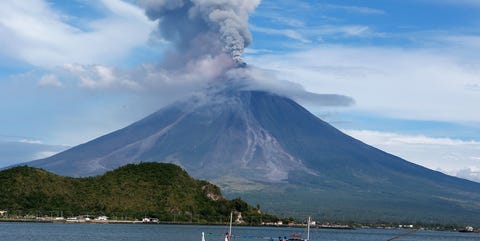
In 2021, we’ve seen lava erupt from volcanoes in Iceland, St. Vincent and the Grenadines, and, most recently, the Democratic Republic of the Congo. While volcanic eruptions are certainly nothing new, these recent eruptions serve as a reminder that dangerous active volcanoes exist and will continue to serve as a potential threat to the surrounding creatures and environment.
While there are many active volcanoes around the world (and in space), experts generally classify the most dangerous ones as those that are closest to highly populated areas, as they can have the most deadly effects.
And while it may seem like the volcanoes with the most recent eruptions would be the most dangerous, the opposite is true in some cases: When volcanoes go a long time without erupting, they have more mounting pressure inside of them, leading to a bigger explosion.
Take a look at some of the most dangerous volcanoes that exist today.
.
Xinhua News AgencyGetty Images
.
.
Click the link below for the article and slideshow:
Some content on this page was disabled on April 15, 2025 as a result of a DMCA takedown notice from Guardian Media Group. You can learn more about the DMCA here:
Whoops, we accidentally made the planet move: New research says human-caused climate change has accelerated the rate at which Earth’s rotational axis changes.
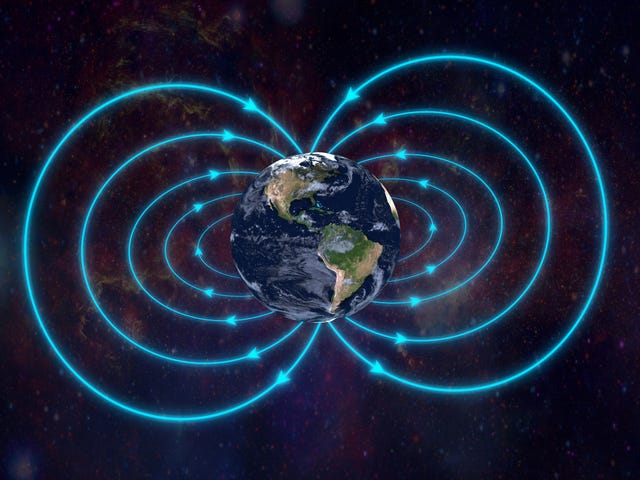
Earth has two kinds of poles. The north and south magnetic poles, which affect things like navigation, drift and even switch places back and forth over time. Earth’s other kind of pole is the axis around which the planet physically spins. This axis has also slightly shifted over time, but scientists haven’t been able to exactly figure out why.
To get to the bottom of it, researchers from the Institute of Geographic Sciences and Natural Resources Research in China and the Technical University of Denmark pulled satellite data from NASA’s Gravity Recovery and Climate Experiment (GRACE) spacecraft and studied this “true polar wander” phenomenon during a specific period of time in the 1990s.
By now, you have probably heard of the huge Facebook data breach, in which upwards of 533 million Facebook users from 106 countries had personal data leaked online, including phone numbers, Facebook IDs, birthdates — you name it.
Your first question will be, of course, how to check whether you are part of that breach. There are a couple of places out there where you can find out whether your data has been compromised.
One well-known site that tracks data breaches is Have I Been Pwned. Just follow the link to the site and put in your email address or phone number. You will find out not only if you’ve been part of the Facebook breach, but also any other breaches in which your data may have been compromised.
Troy Hunt, creator of Have I Been Pwned, was considering whether to include a phone number search (as this comes with certain privacy risks), but ultimately decided to add the feature:
In the world, human beings are facing various problems. People who are full of greed, anger, and ignorance are seen to be fighting with each other in words and deeds. As the fighting continues, various problems such as civil wars, wars of aggression, and wars of aggression are occurring. As world peace is being destroyed, humans are facing unbearable problems. Innocent children and women are not getting the rights they deserve and deserve. I can't think of one thing every time. What is it? The United Nations. If we look at the responsibilities and duties of the United Nations, I think it is not suitable for solving the problems that are happening in the world today. In fact, the United Nations and the World Security Council, such an organization must rule the world, must be able to give orders, and must have various ways to obey orders. There must be no organization that can influence more than that organization. There should be experts from each country. They can even dominate the superpowers like the US, China, and Britain. Only then will global peace be achieved quickly. Now, if a country with power develops more militarily, economically, or socially than its own country, then powerful countries will jealously seek out enemies and wage war. Or they will attack with fighter jets. In this, innocent people are losing their lives. No one understands the value of a life. You should think about how to achieve global peace by controlling these. If the US continues to be the permanent president of the UN, world peace will never be achieved. If you think carefully, no one sees that they are working for the common good, but for their own benefit, for the benefit of their own country. The permanent president of the UN and the Security Council has rejected this, As a young Rohingya, I have come to realize that only by electing the president and secretary from among the countries in the world through a secret ballot system and governing the world fairly can we achieve global peace. The United Nations and the Security Council are organizations in which any country must govern, give orders, and make them obey their orders. For example, only when a defendant is tried in court can we hold the leaders of the countries in check and control them, can we achieve global peace smoothly. Otherwise, it will not be easy for powerful countries to use various excuses to end this war every year, every year, for the benefit of themselves and their countries. No country's leaders pay any attention to the words of the United Nations and the Security Council. If we look at it in practice, look at the Rohingya issue. Myanmar is a small country. Even that country has been under siege for 8 years. What action can be taken? Why is the UN and the Security Council Powerless? Without such Power, how can the organization bring about global peace? Everyone should think about it. Whether there is a veto or a strong one, all countries in the world can only achieve global peace if they are subject to the UN and the Security Council. Seek peace in the quiet embrace of nature. Peace is an indispensable need of the human race. It is not as if one person can kill another person, and it is as if one country can attack another country, but instead of trying to build peace, we must try to destroy the peace now, and the world is getting hotter and is on the verge of collapse. I especially appeal to all the world experts to urgently try to bring about peace in all parts of the world. Mr, Noor Muhamed Arkhan Rohingya Youth Myanmar
Film and Writing Festival for Comedy. Showcasing best of comedy short films at the FEEDBACK Film Festival. Plus, showcasing best of comedy novels, short stories, poems, screenplays (TV, short, feature) at the festival performed by professional actors.





/cdn.vox-cdn.com/uploads/chorus_image/image/69076937/acastro_180806_1777_facebook_0001.0.jpg)

