
Click the link below the picture
.
Rachel Feltman: For Scientific American’s Science Quickly, I’m Rachel Feltman.
How much time did you spend on your phone this week? It’s okay; you don’t actually have to tell me. But chances are good, like really good, that the number is higher than you’d like it to be: according to a recent survey by Pew Research Center, more than half of U.S. adults say they spend too much time on their phones. Folks under 50 are especially dissatisfied with their device usage: 64 percent of adults aged 30 to 49 think their screen use is out of hand, and 70 percent of adults aged 18 to 29 say the same.
Setting aside the survey data and just speaking personally, I think that these days, you’re either someone who actively avoids using screened devices, someone who knows they use screened devices too much or someone who’s currently in deep denial.
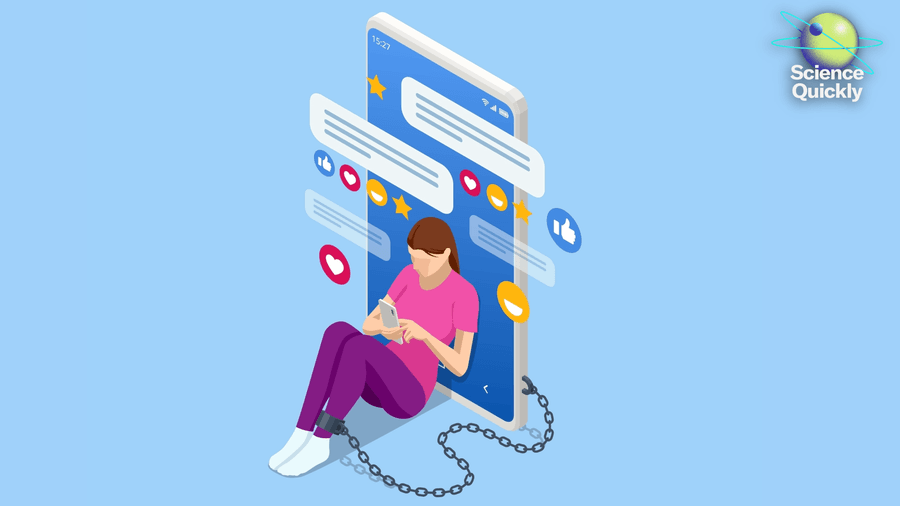
There are now apps, physical phone accessories and even pared-down smartphones designed to help us curb our reflexive swiping and scrolling. But some people are taking things a step further by treating screen addiction with the same kind of programming traditionally reserved for substance abuse.
Scientific American associate editor Allison Parshall explored the new frontier of screen addiction in a feature for the latest issue of the magazine. She’s here to tell us what she’s learned about our dependence on technology—and what we can do to take back control.
Allison, thanks so much for coming on to chat. It’s always great to have you.
Allison Parshall: Thank you for having me.
Feltman: So I’d love to start by asking how you, you know, first got interested in writing this piece.Parshall: I don’t know if you saw there were a lot of court cases to do with social media addiction earlier this year. They’re still ongoing, but, like, some of the biggest headlines were hitting. Basically Meta and Google were on trial from plaintiffs who said that their products were addictive and that they’d
addicted kids, and the jury actually held them liable for that, which was a big first. So that got me interested in understanding, kind of, what’s behind these social media addiction claims because the companies claim it’s not an official addiction because there’s no diagnosis, and then, on the other side, you know, clinicians are like, “No, we’re seeing a problem.” So I kinda wanted to understand and get to the bottom of that tension.
But there was also a more personal motivation, which was that I just kept getting those, like, Sunday weekly screen time recaps, and they were always, like, way higher than I could possibly ever have fathomed. Like, I think I pushed up to seven hours a day, and that’s outside of work. So I’m doing the math, going like, “Am I on my phone literally every waking moment? That doesn’t seem possible.”
Feltman: Eight hours for work, eight hours for sleep, eight hours for what you will—is all we will phone. [Laughs.]
Rachel Feltman: For Scientific American’s Science Quickly, I’m Rachel Feltman.
How much time did you spend on your phone this week? It’s okay; you don’t actually have to tell me. But chances are good, like really good, that the number is higher than you’d like it to be: according to a recent survey by Pew Research Center, more than half of U.S. adults say they spend too much time on their phones. Folks under 50 are especially dissatisfied with their device usage: 64 percent of adults aged 30 to 49 think their screen use is out of hand, and 70 percent of adults aged 18 to 29 say the same.
Setting aside the survey data and just speaking personally, I think that these days, you’re either someone who actively avoids using screened devices, someone who knows they use screened devices too much or someone who’s currently in deep denial.
There are now apps, physical phone accessories and even pared-down smartphones designed to help us curb our reflexive swiping and scrolling. But some people are taking things a step further by treating screen addiction with the same kind of programming traditionally reserved for substance abuse.
Scientific American associate editor Allison Parshall explored the new frontier of screen addiction in a feature for the latest issue of the magazine. She’s here to tell us what she’s learned about our dependence on technology—and what we can do to take back control.
Allison, thanks so much for coming on to chat. It’s always great to have you.
Allison Parshall: Thank you for having me.
Feltman: So I’d love to start by asking how you, you know, first got interested in writing this piece.Parshall: I don’t know if you saw there were a lot of court cases to do with social media addiction earlier this year. They’re still ongoing, but, like, some of the biggest headlines were hitting. Basically Meta and Google were on trial from plaintiffs who said that their products were addictive and that they’d
addicted kids, and the jury actually held them liable for that, which was a big first. So that got me interested in understanding, kind of, what’s behind these social media addiction claims because the companies claim it’s not an official addiction because there’s no diagnosis, and then, on the other side, you know, clinicians are like, “No, we’re seeing a problem.” So I kinda wanted to understand and get to the bottom of that tension.
But there was also a more personal motivation, which was that I just kept getting those, like, Sunday weekly screen time recaps, and they were always, like, way higher than I could possibly ever have fathomed. Like, I think I pushed up to seven hours a day, and that’s outside of work. So I’m doing the math, going like, “Am I on my phone literally every waking moment? That doesn’t seem possible.”
Feltman: Eight hours for work, eight hours for sleep, eight hours for what you will—is all we will phone. [Laughs.]
Parshall: All I will is phone. And then I, like, run through justifications, right? It was the winter. I was actually talking with friends most of the time; I’ve got a lot of really close long-distance friendships. A lot of it was, like, engaging creatively in things that I was very passionate about.
And then a lot of it was frankly just TikTok scrolling. So, I basically have just been kind of at war with myself and noticing a lot of my friends at war with themselves over these screen times and, like, wondering, “At what point do I say this is actually a problem? At what point does this helplessness and ambiguity I feel, like, resemble something closer to the experience of people who experience addiction to substances or to gambling and other behaviors?”
So that’s kind of where I started, with a little bit of a personal mission to figure out if I thought this was a problem or not. I can’t say I landed on a really satisfying place.
Feltman: [Laughs.] Well, it is, as you know, like, such a complex question. You know, even just speaking personally and, you know, based on the experiences of other people I know personally, because so much of it is very contextual, like you said. Like, there isn’t a distinction between online life and real life anymore. We live a lot of our lives through the channeling of these devices, so it’s like, there are many, like, good, prosocial, beneficial things one can and maybe even should do that involve staring at a screen. And then there’s the stuff that we know is just scrolling through TikTok.
I’m curious, you know, I have some familiarity with the whole, you know, “Is it an addiction?” question, not just for screens and social media specifically but really anything that’s behavioral. And I think it feels especially complicated when it’s behavioral and involves a relatively new technology. So I’d love to hear, sort of, you know, what you’ve learned and, and what your takeaways are in terms of that whole “Is it an addiction?” question.
Parshall: I think, [the] “Is it an addiction?” question is one that I am just going to have to say: I think we’re just gonna have to live in the nuance of this forever. I don’t think we’re ever gonna have a super satisfying answer because the more you look into the history of our concept of addiction, the muddier it gets.
I think a lot of people have an understanding of, like, okay, drugs are straightforwardly addictive because they can hook your brain in a chemical way. Then when we start getting into behaviors, things get a little more squishy. Gambling, we’re like, “That’s really an addiction because it does something very specific to your brain, almost like a drug.” So, you know, that—you could put it there. Well, then you get into love and sex addiction, food addiction, and it all gets quite complicated.
But I think the thing that I realized in talking to researchers was, like, even when you go back into the history of drug addiction, we’ve had to push this line to get cocaine accepted as an addictive drug. So there’s, like, all of [these] questions of: “At what point are we going to broaden it enough?” And there’s a lot of concern among various pockets of addiction researchers and clinicians that if we make it too broad, the word loses meaning. It’s, like, a serious concern, but at the same time, you do have to let it be broad enough to encompass the problems that people are experiencing, and people are experiencing this problem of tech addiction.
.
 Golden Sikorka/Shutterstock
.
.
Click the link below for the complete article (sonnd on to listen):
.
__________________________________________


Leave a Reply