It’s been almost a year since Donald Trump emerged from an election campaign of threats, lies and vitriol as the future president of the United States of America.
His victory speech on Nov. 9, 2016, sparked cautious optimism that perhaps his presidency would not be quite as hate-filled as his campaign.
“We will deal fairly with everyone, with everyone — all people and all other nations,” Trump vowed. “We will seek common ground, not hostility; partnership, not conflict.”
But within weeks, he had unleashed the first of a seemingly endless stream of Twitter tirades from his new bully pulpit. He lambasted the “failing” New York Times, the “highly overrated” Broadway musical “Hamilton,” the “unwatchable” “Saturday Night Live” and, of course, the “crooked” media, to name a few.
.
John MacDougall/Pool/Reuters
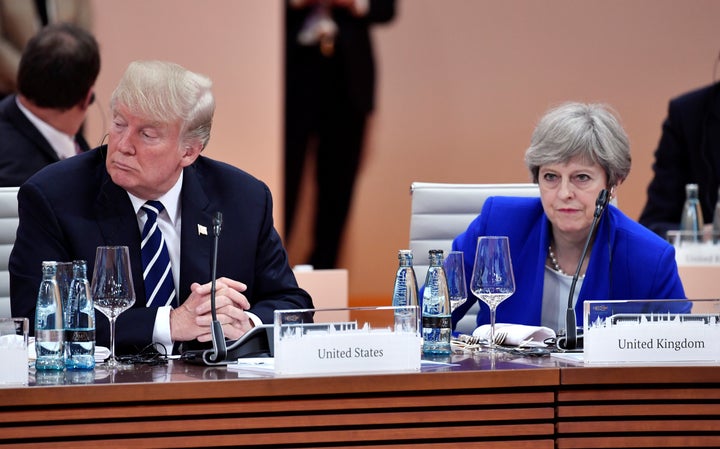
Trump and British Prime Minister Theresa May wait at the start of the first working session of the G-20 meeting in Hamburg, Germany, on July 7.
Federal investigators have gathered enough evidence to bring charges in their investigation of President Donald Trump’s former national security adviser and his son as part of the probe into Russia’s intervention in the 2016 election, according to multiple sources familiar with the investigation.
Michael T. Flynn, who was fired after just 24 days on the job, was one of the first Trump associates to come under scrutiny in the federal probe now led by Special Counsel Robert Mueller into possible collusion between Moscow and the Trump campaign.
Mueller is applying renewed pressure on Flynn following his indictment of Trump campaign chairman Paul Manafort, three sources familiar with the investigation told NBC News.
The investigators are speaking to multiple witnesses in coming days to gain more information surrounding Flynn’s lobbying work, including whether he laundered money or lied to federal agents about his overseas contacts, according to three sources familiar with the investigation.
.
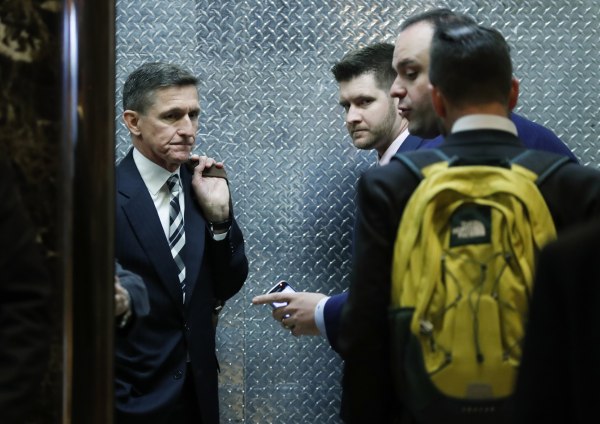
From left, retired Lt. Gen. Michael T. Flynn, his son Michael G. Flynn, and Boris Epshteyn, a spokesman for President-elect Donald Trump, board an elevator at Trump Tower in New York on Nov. 17, 2016. Carolyn Kaster / AP file
Wilbur Ross, the commerce secretary in the Trump administration, shares business interests with Vladimir Putin’s immediate family, and he failed to clearly disclose those interests when he was being confirmed for his cabinet position.
Ross — a billionaire industrialist — retains an interest in a shipping company, Navigator Holdings, that was partially owned by his former investment company. One of Navigator’s most important business relationships is with a Russian energy firm controlled, in turn, by Putin’s son-in-law and other members of the Russian president’s inner circle.
Some of the details of Ross’s continuing financial holdings — much of which were not disclosed during his confirmation process — are revealed in a trove of more than 7 million internal documents of Appleby, a Bermuda-based law firm, that was leaked to the German newspaper Süddeutsche Zeitung. The documents consist of emails, presentations and other electronic data. These were then shared with the International Consortium of Investigative Journalists — a global network that won the Pulitzer Prize this year for its work on the Panama Papers — and its international media partners. NBC News was given access to some of the leaked documents, which the ICIJ calls the “Paradise Papers.”
.
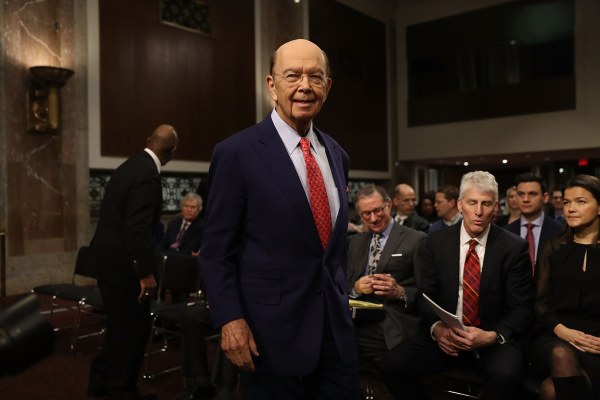
Wilbur Ross, picked by President-elect Donald Trump to serve as his commerce secretary, arrives to testify at his confirmation hearing in front of the Senate Commerce Committee on Capitol Hill on January 18, 2017 in Washington. Joe Raedle / Getty Images file
In fall 2010, the Russian billionaire investor Yuri Milner took the stage for a Q. and A. at a technology conference in San Francisco. Mr. Milner, whose holdings have included major stakes in Facebook and Twitter, is known for expounding on everything from the future of social media to the frontiers of space travel. But when someone asked a question that had swirled around his Silicon Valley ascent — who were his investors? — he did not answer, turning repeatedly to the moderator with a look of incomprehension.
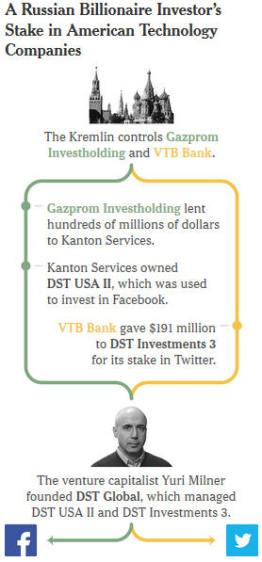
Now, leaked documents examined by The New York Times offer a partial answer: Behind Mr. Milner’s investments in Facebook and Twitter were hundreds of millions of dollars from the Kremlin.
Obscured by a maze of offshore shell companies, the Twitter investment was backed by VTB, a Russian state-controlled bank often used for politically strategic deals.
And a big investor in Mr. Milner’s Facebook deal received financing from Gazprom Investholding, another government-controlled financial institution, according to the documents. They include a cache of records from the Bermuda law firm Appleby that were obtained by the German newspaper Süddeutsche Zeitung and reviewed by The Times in collaboration with the International Consortium of Investigative Journalists.
.
By The New York Times
Mr. Milner, right, with Mark Zuckerberg, the chief executive of Facebook. The company, along with Twitter and other social media sites, has become a major focus of investigations into Russian interference in the 2016 presidential election.Credit Kimberly White/Getty Images for Breakthrough Prize
Mark Zuckerberg’s original motto for Facebook was “Move fast and break things.” It now appears that the CEO is going to have to answer for moving too fast and breaking too many things.
After years of trying to avoid oversight from Washington, the 2-billion-person social network platform is set for a reckoning. This past week, Facebook faced its first major congressional oversight hearings since it revealed that a Russian “troll factory,” called the Internet Research Agency, had purchased ads on the site in order to influence the 2016 election.
In three committee hearings, representatives from Facebook, Google and Twitter were grilled about their sites’ roles in facilitating the foreign influence operation. Lawmakers from both parties poked at the companies’ failure to reckon with questions about the lack of transparency in online advertising and the vast power they hold over our lives.
Sen. John Kennedy (R-La.) took particular umbrage with Facebook: “Your power sometimes scares me.”
.
JAMES LAWLER DUGGAN/Reuters
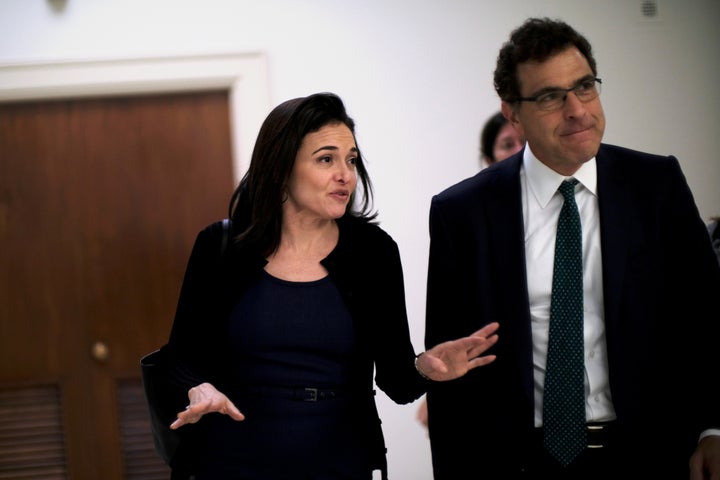
Sheryl Sandberg, Facebook’s chief operating officer, and Elliot Schrage, its vice president of global communications and public policy, meet with lawmakers on Capitol Hill on Oct. 12.
Over the past two years and up until at least August, Russian Twitter accounts masquerading as American people, news outlets and political groups regularly appeared in the articles published in many of the United States’ most famous media outlets. This wasn’t a matter of fake news; this was “real” news made a little less so.
The Boston Globe quoted @Pamela_Moore13, who hated a Stephen Colbert joke about Vladimir Putin and Donald Trump. NBC News, in the aftermath of the Pulse night club shooting, gave space to @lgbtunitedcom on the subject of the Chicago gay pride parade. Vox and HuffPost both turned to the thoughts of @Crystal1Johnson, the former on the bullet holes in an Emmett Till sign and the latter on quadruplets attending Yale together.
We know now that these were trolls working on behalf of the Russian government. Without knowing, we laughed or scowled at their jokes. We mocked or cheered their opinions. We looked at their photos and watched their videos, and few if any of us batted an eye as they covertly shaped the way we looked at our own country.
What do President Donald Trump, CNN anchor Jake Tapper, The Washington Post, Breitbart and Jack Dorsey, the head of Twitter, all have in common?
They and at least 40 celebrities and politicians were all roped into retweeting or otherwise engaging with accounts created by a Russian “troll factory” to millions of followers, according to a new exclusive analysis.
Over 3,000 global news outlets also inadvertently published articles containing embedded tweets by the confirmed Kremlin-linked troll accounts in over 11,000 news articles in the run-up to the 2016 election, separate exclusive reporting shows.
On Wednesday, the House Intelligence Committee publicly released for the first time the list of over 2,700 handles provided by Twitter that the social media platform linked to the Internet Research Agency (IRA), a Russian intelligence agency-linked firm based in St. Petersburg, Russia.
More than 300,000 Central Americans and Haitians living in the United States under a form of temporary permission no longer need to be shielded from deportation, the State Department told Homeland Security officials this week, a few days ahead of a highly anticipated DHS announcement about whether to renew that protection.
On Tuesday, Secretary of State Rex Tillerson sent a letter to acting DHS secretary Elaine Duke to inform her that conditions in Central America and Haiti that had been used to justify the protection no longer necessitate a reprieve for the migrants, some of whom have been allowed to live and work in the United States for 20 years under a program known as Temporary Protected Status (TPS).
Tillerson’s assessment, required by law, has not been made public, but its recommendations were confirmed by several administration officials familiar with its contents. The officials spoke on the condition of anonymity to discuss internal deliberations.
. Pastor Jean St. Ulme greets members of his congregation at Eglise Baptiste du Calvaire Church on Sunday, August 13, 2017 in Adelphi, Md. Haitian churches in the area were dealing with fears among church members that their Temporary Protected Status (TPS) visas could be revoked soon. (Pete Marovich/For The Washington Post)
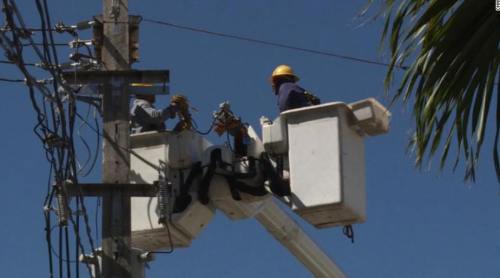
Towns and communities across Puerto Rico are entirely without power, more than six weeks after Hurricane Maria.
The island’s leadership is touting restoration figures that show nearly 40% of electricity generation has resumed — but it doesn’t say how much of that power is actually reaching homes, schools and hospitals.
.
Officials from the government and the Puerto Rico Electric Power Authority (PREPA) don’t even know how many people have power for lights, air conditioners, refrigerators and other basic necessities.
.
So, while some power plants can generate power, the ability to transmit it to homes may not be possible in some areas.
Film and Writing Festival for Comedy. Showcasing best of comedy short films at the FEEDBACK Film Festival. Plus, showcasing best of comedy novels, short stories, poems, screenplays (TV, short, feature) at the festival performed by professional actors.




 By The New York Times


 .
.




 Who has power?
 James' World 2