January 22, 2023
Mohenjo
Business, Food For Thought, Human Interest, Political, Science, Technical
amazon, business, Business News, current-events, Future, Hotels, human-rights, medicine, mental-health, research, Science, Science News, technology, Technology News, travel, vacation

Click the link below the picture
.
Black holes form natural time machines that allow travel to both the past and the future. But don’t expect to be heading back to visit the dinosaurs any time soon.
At present, we don’t have spacecraft that could get us anywhere near a black hole. But, even leaving that small detail aside, attempting to travel into the past using a black hole might be the last thing you ever do.
A black hole is an extremely massive object that is typically formed when a dying star collapses in on itself.Like planets and stars, black holes have gravitational fields around them. A gravitational field is what keeps us stuck to Earth, and what keeps Earth revolving around the Sun.
As a rule of thumb, the more massive an object is, the stronger its gravitational field.
Earth’s gravitational field makes it extremely difficult to get to space. That’s why we build rockets: we have to travel very fast to break out of Earth’s gravity.
.
 An artist’s illustration of a black hole. (Image credit: solars even via Getty Images)
.
.
Click the link below for the article:
.
__________________________________________
January 22, 2023
Mohenjo
Business, Food For Thought, Human Interest, Political, Science, Technical
amazon, business, Business News, current-events, Future, Hotels, human-rights, medicine, mental-health, research, Science, Science News, technology, Technology News, travel, vacation

Click the link below the picture
.
The First Five:
1 Exercise on a Monday night (nothing fun happens on a Monday night).
2 On the fence about a purchase? Wait 72 hours before you buy it.
3 Tip: the quickest supermarket queue is always behind the fullest trolley (greeting, paying and packing take longer than you think).
4 Bring fruit to work. Bring fruit to bed!
5 Consider going down to four days a week. It’s likely a disproportionate amount of your fifth day’s work is taxed anyway,
.
 Photo by Malte Mueller/Getty Images
.
.
Click the link below for the article:
.
__________________________________________
January 21, 2023
Mohenjo
Business, Food For Thought, Human Interest, Political, Science, Technical
amazon, business, Business News, current-events, Future, Hotels, human-rights, medicine, mental-health, research, Science, Science News, technology, Technology News, travel, vacation

Click the link below the picture
.
Architects designing the living space for the upcoming lunar Gateway did their best to make it comfortable for astronauts, but technical constraints forced them to create a tiny, noisy corridor with no windows and barely enough room to stand upright.
The European-built international habitat, or I-Hab, is meant to provide living quarters for astronauts on board the Lunar Gateway, a future outpost that will orbit the Moon. The purpose of Gateway, a collaboration between NASA, the European Space Agency, and other international partners, is to provide a place for astronauts to conduct science in lunar orbit and to transfer from one spacecraft to another, such as a lunar lander. But an architect involved in I-Hab’s design recently revealed the claustrophobic conditions for the orbital habitat that’s supposed to house up to four astronauts for around 90 days at a time.
During the Czech Space Week conference in Brno, Czechia (the country formerly known as the Czech Republic), René Waclavicek, a space architect and design researcher at Austria-based LIQUIFER Space Systems, stated that the Lunar Gateway will be roughly one-sixth of the size of the International Space Station (ISS), Space.com reported. Waclavicek, who was involved in I-Hab’s design, said that the architects behind the lunar living quarters were constrained by the amount of material that can be transported to the Moon, requiring them to make some sacrifices.
.
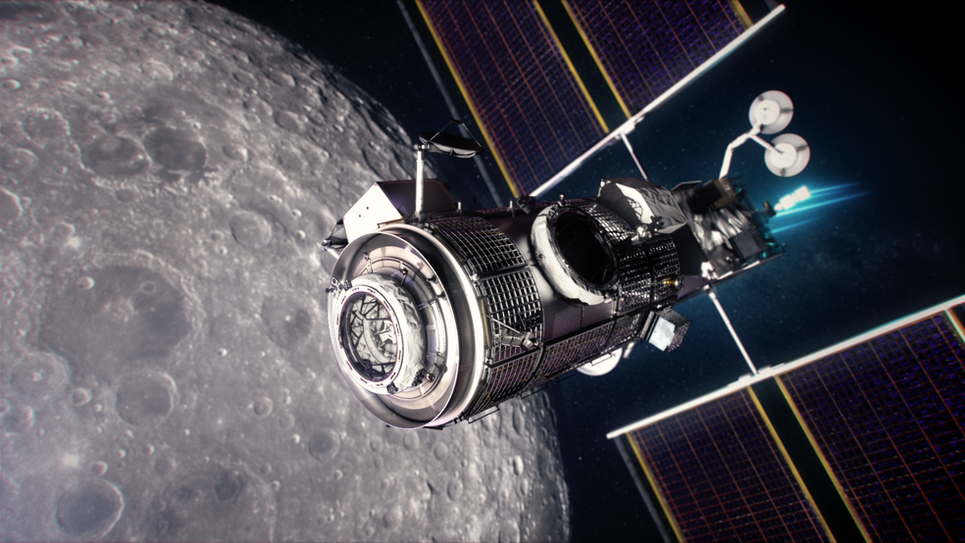 An illustration of the lunar gateway in orbit around the Moon.
.
.
Click the link below for the article:
.
__________________________________________
January 21, 2023
Mohenjo
Business, Food For Thought, Human Interest, Political, Science, Technical
amazon, business, Business News, current-events, Future, Hotels, human-rights, medicine, mental-health, research, Science, Science News, technology, Technology News, travel, vacation

Click the link below the picture
.
You Can Do It!
You don’t need to be well-versed in quantum physics or even complex math to solve Albert Einstein’s famous house riddle. All it takes to tackle the problem below is logic—and if that isn’t enough for you, you can find the answer at the end of the article.
According to Popular Mechanics, the riddle goes like this: There are five houses lined up next to each other along a street. Each house is a different color, and each homeowner is of a different nationality, drinks a different beverage, smokes a different brand of cigar, and owns a different pet.
.
 Albert Einstein photographed in 1905. / Ann Ronan Pictures/Print Collector/Hulton Archive/Getty Images
.
.
Click the link below for the article:
.
__________________________________________
January 20, 2023
Mohenjo
Business, Food For Thought, Human Interest, Political, Science, Technical
amazon, business, Business News, current-events, Future, Hotels, human-rights, medicine, mental-health, research, Science, Science News, technology, Technology News, travel, vacation
Click the link below the picture
.
Some call it fate. Others call it destiny. And some just brush it off as coincidence. But however you view it, life has a funny way of bringing people together at just the right place and time. Check out some of the most random historical encounters we could find—meetings that, had they not happened, would have resulted in a very different world today.
.
 Sacagawea acted as a guide for Lewis and Clark. / Edgar Samuel Paxson, Wikimedia//Public Domain
.
.
Click the link below for the article:
.
__________________________________________
January 19, 2023
Mohenjo
Business, Food For Thought, Human Interest, Political, Science, Technical
amazon, business, Business News, current-events, Future, Hotels, human-rights, medicine, mental-health, research, Science, Science News, technology, Technology News, travel, vacation

Click the link below the picture
.
New GUINNESS WORLD RECORD™ Title! The best of classical music, played by a train.
Take part in our three challenges:
1. How many songs are being played?
2. Which songs?
3. How many glasses were used in total?
A little hint: We used melodies from Wolfgang Amadeus Mozart, Giuseppe Verdi, Ludwig van Beethoven, Johann Strauß, Pyotr Illych Tchaikovsky, Johann Sebastian Bach, Antonio Vivaldi, Johannes Brahms, Georges Bizet, and many more.
These greatest classical music pieces are famous all over the world. So lay back, relax and enjoy this crazy video with one of the most special classical music compilations.
.
 Classical Music Medleys played by a Train
.
.
Click the link below for the article:
.
__________________________________________
January 19, 2023
Mohenjo
Business, Food For Thought, Human Interest, Political, Science, Technical
amazon, business, Business News, current-events, Future, Hotels, human-rights, medicine, mental-health, research, Science, Science News, technology, Technology News, travel, vacation

Click the link below the picture
.
In late 2022, Jessica found herself in a predicament that will sound familiar to many job seekers: slogging through an extended interview process with seemingly no end in sight.
She was up for a job as a fundraiser at a major social services organization in New York. Across the span of two months, she took part in six separate interviews with nine people total, multiple of whom she met more than once. She’d pulled one of her first all-nighters in years putting together a dummy presentation on a hypothetical corporate partnership for interview No. 4, which entailed what she describes as a 15-minute “monologue” from her on the matter followed by a 45-minute Q&A with a panel. It wasn’t until the final interview that she got a real one-on-one sit-down with the person who would be her boss.
“Every time I thought, ‘Okay, this is the final hump,’ there was another thing,” said Jessica, which is a pseudonym. Vox granted her anonymity in order to protect her privacy and keep her out of hot water with her current employer. “It just gets really mentally exhausting, and it’s hard to manage your work schedule because obviously, you don’t want your employer to know you’re interviewing.”
Job-seeking can be a real exercise in immersive futility. It often feels like you’re tossing your resume into the abyss and praying to the recruitment gods for a response. If and when you get that response, the landscape doesn’t always get easier. Companies are seemingly coming up with new, higher, and harder hoops to jump through at every turn. That translates to endless rounds of interviews, various arbitrary tests, and complex exercises and presentations that entail hours of work and prep. There can be good reasons for firms to do this — they really want to make sure they get the right person, and they’re trying to reduce biases — but it’s hard not to feel like it can just be too much.
.
:format(webp)/cdn.vox-cdn.com/uploads/chorus_image/image/71856229/bigsqueeze0111.0.jpg) It should not take endless interviews to get a job. And yet.Getty Images/Vox
It should not take endless interviews to get a job. And yet.Getty Images/Vox
.
.
Click the link below for the article:
.
__________________________________________
January 19, 2023
Mohenjo
Business, Food For Thought, Human Interest, Political, Science, Technical
amazon, business, Business News, current-events, Future, Hotels, human-rights, medicine, mental-health, research, Science, Science News, technology, Technology News, travel, vacation
Click the link below the picture
.
“OXCART” WAS AN ODD NICKNAME for the plane that killed pilot, Walter Ray. Oxcarts are slow, cumbersome, and old. Ray’s A-12 jet, meanwhile, was fast, almost invisible, and novel. Among the US’s first attempts at stealth aircraft, it could travel as quickly as a rifle bullet, and fly at altitudes around 90,000 feet. On a radar screen, it appeared as barely a blip—all the better to spy on Soviets with—and had only one seat.
On January 5, 1967, that single space belonged to Ray, a quiet, clean-cut 33-year-old who spent his workdays inside Area 51, then the CIA’s advanced aviation research facility. Set atop the dried-up bed of Groom Lake in the Nevada desert, the now-infamous spot made for good runways, and was remote enough to keep prying eyes off covert Cold War projects. On the books, Ray was a civilian pilot for Lockheed Martin. In reality, and in secret, he reported to the CIA.
Ray’s last morning on Earth was chilled and windy, with clouds moving in and preparing to drop snow on the nearby mountains. He took off for his four-hour flight to Florida and back a minute ahead of schedule at 11:59 a.m., the sleek curves of the Oxcart’s titanium body triggering sonic shock waves (booms) as it sliced through the atmosphere. He’d done this many times, having already logged 358 hours in these crafts.
.
 Stealth A-12 jets were never meant to be seen, then one went missing in the Nevada desert. US Air Force
.
.
Click the link below for the article:
.
__________________________________________
January 18, 2023
Mohenjo
Business, Food For Thought, Human Interest, Political, Science, Technical
amazon, business, Business News, current-events, Future, Hotels, human-rights, medicine, mental-health, research, Science, Science News, technology, Technology News, travel, vacation
Some content on this page was disabled on April 15, 2025 as a result of a DMCA takedown notice from Guardian Media Group. You can learn more about the DMCA here:
https://wordpress.com/support/copyright-and-the-dmca/
January 18, 2023
Mohenjo
Business, Food For Thought, Human Interest, Political, Science, Technical
amazon, business, Business News, current-events, Future, Hotels, human-rights, medicine, mental-health, research, Science, Science News, technology, Technology News, travel, vacation

Click the link below the picture
.
It all started with a bang. During an unimaginably brief fraction of a second, the embryonic universe ballooned in size with unimaginable swiftness. In a flash, dimples of imperfection stretched into cosmic scars and locked in the universe we experience today, a milieu filled with galaxies, stars, planets, and humans.
The circumstantial evidence for this origin story, known as inflation, is overwhelming. It has inspired a generation of cosmologists to write papers, teach classes, and publish textbooks about the sundry ways inflation could have played out. And yet, a smoking gun remains elusive: Ancient ripples in spacetime should have left a particular imprint on the sky, but searches have repeatedly come up short.
A group of astronomers known as the BICEP/Keck collaboration leads the hunt for these “primordial gravitational waves.” In 2021 the researchers released their latest results, the culmination of years of painstaking labor in one of the harshest places on Earth. Once more, they found no sign of their quarry. If an inflating universe reverberated with gravitational waves—as most cosmologists still fully expect it did— it must have done so in a rather subtle way.
.
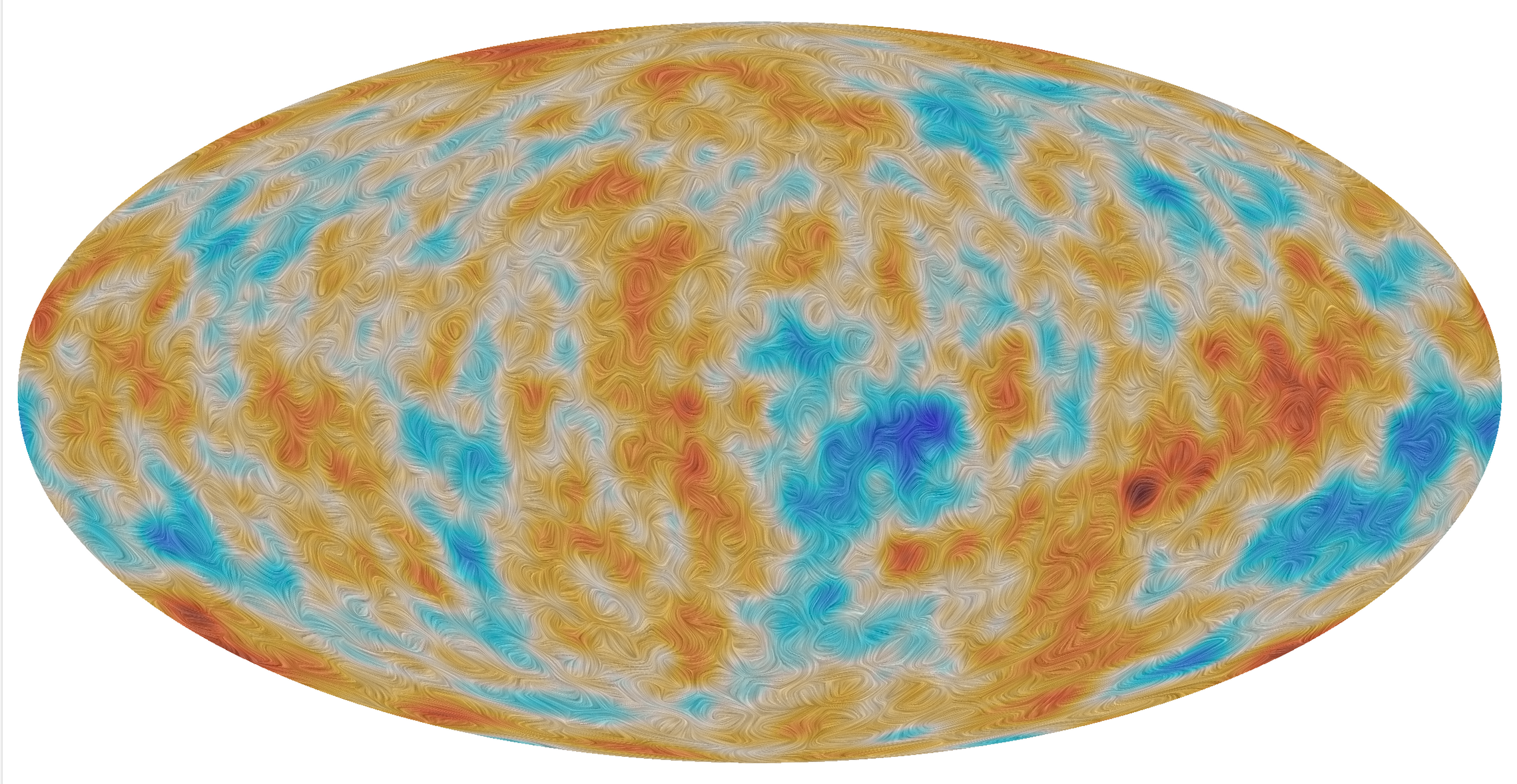 Fingerprints of reverberations from the first moment could be hiding in the universe’s oldest light, but astronomers haven’t found them yet. ESA and the Planck Collaboration
.
.
Click the link below for the article:
.
__________________________________________
Older Entries
Newer Entries
 James' World 2