September 25, 2023
Mohenjo
Business, Food For Thought, Human Interest, Political, Science, Technical
amazon, business, Business News, current-events, Future, Hotels, human-rights, medicine, mental-health, research, Science, Science News, technology, Technology News, travel, vacation

Click the link below the picture
.
If you read about the energy industry in the ’00s and ’10s, you probably caught some excited, hopeful stories about geothermal, the renewable energy source that harnesses heat hundreds of meters below the earth’s surface. “Enhanced geothermal” — a novel approach in which fluids are poured deep underground, heat up, and then are recovered for their steam heat and used to generate electricity — got particular attention, because it promised a geothermal technique that could work most places on earth, not just in volcanic areas like Iceland or Indonesia.
Enhanced geothermal is “increasingly being eyed as an enormous potential source of pollution-free energy,” science journalist David Biello wrote all the way back in 2008. Enhanced geothermal has “often been touted as the answer to the tepid growth of the geothermal industry,” reporter Megan Geuss wrote in Ars Technica in 2014, already with a bit of jaded weariness that the promises were yet unfulfilled. Startups like AltaRock Energy got press for their promises of a clean energy source, deployable in any geography, that still worked when the sun wasn’t shining and the wind wasn’t blowing.
But as of 2022, a mere 0.4 percent of US electricity generation came from geothermal. That’s some eight times less than solar, 25 times less than wind, and 45 times less than nuclear. If that weren’t depressing enough, consider those numbers still meant the US produced more geothermal electricity than any other country that year, even surpassing heavily volcanic Indonesia.
But some significant breakthroughs have recently earned geothermal renewed attention. Fervo Energy, an enhanced geothermal company, announced that it was able to build and perform tests on a well in Nevada for 30 days, which it claims is capable of generating 3.5 megawatts of power. That’s not a lot (a typical natural gas power block produces over 800 megawatts), and it’s still much more expensive to produce than solar or gas power, but it’s the furthest an enhanced geothermal project has gotten to date. Last year, Energy Secretary Jennifer Granholm announced a major initiative promising to slash the cost of geothermal generation by 90 percent by 2035. That announcement put the current cost at about $450 per megawatt-hour, compared to around $30 to $50 for onshore wind and solar.
.
:format(webp)/cdn.vox-cdn.com/uploads/chorus_image/image/72641745/Fervo_Energy_Project_Red_Rig_2_2048x1367.0.jpg) Fervo’s test well in Nevada. Fervo Energy
Fervo’s test well in Nevada. Fervo Energy
.
.
Click the link below for the article:
.
__________________________________________
September 25, 2023
Mohenjo
Business, Food For Thought, Human Interest, Political, Science
amazon, business, Business News, current-events, Future, Hotels, human-rights, medicine, mental-health, research, Science, Science News, technology, Technology News, travel, vacation

Click the link below the picture
.
One of the most iconic recurring scenes in the much-loved TV series Star Trek: The Next Generation (TNG) involves the captain of the starship Enterprise, Jean-Luc Picard, alone in his cabin, announcing to thin air, “Tea. Earl Grey.”
A machine set into the wall, resembling a large built-in microwave with its door missing, responds to this command by materializing a fine bone china teacup on a saucer, filled with steaming hot tea. This remarkable device is a replicator (aka molecular synthesizer), a machine that can create almost anything out of thin air, but is particularly used for food and beverages.
As with several other iconic Star Trek technologies, replicators are directly responsible for inspiring developments in real-life technology, which use 3-D printing to create food, meals, plastic and metal items, buildings, and even complex machine parts. Star Trek is far from being the only sci-fi source of inspiration for the dream of a device that can produce finished items from scratch.
To trace the roots of Star Trek’s replicator, it is necessary to understand that it is essentially a repurposed form of the transporter—the teleportation or matter transmission device that “beams” the crew between starship and planet surface. According to legend, the transporter was invented only because the original series lacked the budget to film special, effect-heavy scenes of planetary landing shuttles, but Star Trek did not invent the concept of matter transmission. Its first appearance in science fiction dates back at least as far as 1877, in Edward Page Mitchell’s story “The Man Without a Body,” which prefigures George Langelaan’s much better-known 1957 story “The Fly,” by having a scientist experience a teleportation mishap when his batteries die while he is only partway through a transmission, so that only his head rematerializes.
The replicator uses the same basic principle as the transporter, in which the atomic structure of a physical object is scanned, and the information is used to reconstruct the object at the “receiving” end through energy-matter conversion. In practice, all transporters are replicators, and matter “transmission” is a misnomer, because matter itself is not transmitted, only information. Every time Captain Kirk steps out of the transporter having “beamed up” from a planet’s surface, it is, in fact, a copy of him—the original has been disintegrated during the initial phase of the operation.
.
:focal(800x602:801x603)/https://tf-cmsv2-smithsonianmag-media.s3.amazonaws.com/filer_public/b0/96/b096b98c-3581-4361-a150-3b7e655816b9/starship_enterprise.jpg) The studio model starship Enterprise from Star Trek was not just a key prop in a groundbreaking series; it and its crews’ travels inspired many who would make their own mark in real-life space exploration. Gift of Paramount Pictures Inc.
The studio model starship Enterprise from Star Trek was not just a key prop in a groundbreaking series; it and its crews’ travels inspired many who would make their own mark in real-life space exploration. Gift of Paramount Pictures Inc.
.
.
Click the link below for the article:
.
__________________________________________
September 24, 2023
Mohenjo
Business, Food For Thought, Human Interest, Political, Science, Technical
amazon, business, Business News, current-events, Future, Hotels, human-rights, medicine, mental-health, research, Science, Science News, technology, Technology News, travel, vacation

Click the link below the picture
.
How can we live a good life? It’s a question psychologist Dacher Keltner has spent much of his professional career trying to answer. In his latest book, Awe: The New Science of Everyday Wonder and How It Can Transform Your Life, he argues that an appreciation of the world — whether through experiencing the natural beauty of Yosemite National Park or simply being with a friend — not only benefits us mentally and emotionally but is a crucial part of our physiological health. A big part of well-being, he says, comes from what primatologist Jane Goodall calls “being amazed at things outside yourself.” And his studies show this is a skill we can cultivate.
A professor of psychology at the University of California, Berkeley, Keltner has authored more than two hundred research papers examining emotion, neuroscience, aesthetics, morality, and decision-making. His other books — including The Power Paradox, The Compassionate Instinct, and Born to Be Good — offer a science-based, optimistic view of human behavior and culture. Pushing back against philosopher Thomas Hobbes’s description of life as “nasty, brutish, and short,” Keltner believes evolution has given Homo sapiens emotions like gratitude, joy, amusement, and compassion because they help us survive and build cooperative, ethical societies.
Although he spends a lot of time designing experiments in his laboratory, Keltner’s work often takes him outside of academia. He was the scientific adviser for the Pixar animated feature Inside Out, which personifies the emotions of an eleven-year-old girl experiencing a disruptive move with her family. He has also consulted extensively for Google, Apple, and Pinterest.
Born in Jalisco, Mexico, Keltner was raised in California by parents who were part of the counterculture: his father was an artist; his mother, a literature professor. He received his BA in psychology and sociology from the University of California, Santa Barbara, and his PhD from Stanford. He did postdoctoral work with pioneering psychologist Paul Ekman, and in 1996 he joined the faculty at UC Berkeley, where he directs the Greater Good Science Center.
.
 Nadya Pajarillo
.
.
Click the link below for the article:
.
__________________________________________
September 24, 2023
Mohenjo
Business, Food For Thought, Human Interest, Political, Science, Technical
amazon, business, Business News, current-events, Future, Hotels, human-rights, medicine, mental-health, research, Science, Science News, technology, Technology News, travel, vacation

Click the link below the picture
.
Alongside humans, leafcutter ants form some of nature’s vastest, most sophisticated societies — a single mature colony can contain as many ants as there are people on Earth, living with a great deal more social harmony and consonance of purpose than we do.
They are also one of our planet’s most dazzling testaments to evolutionary biologist Lynn Margulis’s insistence that “we abide in a symbiotic world”: For 50 million years, leafcutter ants have been practicing a form of agriculture in their mutualist relationship with a fungus they cultivate as a food source, growing it in fungus gardens and feeding it plant matter, which the fungus converts into nutrients the ants can feed on in turn.
In fact, leafcutter ants evolved their sharp mandibles and deft prehensile legs precisely in order to cut and manipulate leaf fragments, which they then carry to their fungal garden. A single ant can carry twenty times its bodyweight — the equivalent of me carrying three grand pianos. In less than a day, a colony can clear entire trees. Emblems of emergence, they do all this as complexity theory incarnate, not a single individual aware of the big-picture goal of the labor.
In her mesmerizing film Antworks, artist Catherine Chalmers captures the strange beauty of this communal consciousness as a leafcutter ant colony dismantles a kaleidoscopic plant in the jungles of Costa Rica, then carries the fragments — “tiny Abstract Expressionist paintings” she calls them — to their secret garden.
.
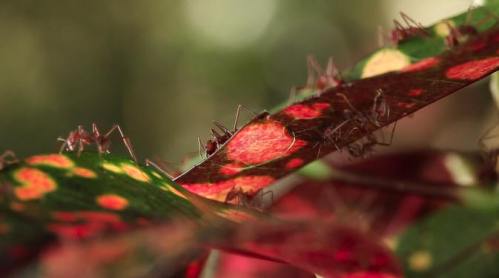 Artworks
.
.
Click the link below for the article:
.
__________________________________________
September 23, 2023
Mohenjo
Business, Food For Thought, Human Interest, Political, Science, Technical
amazon, business, Business News, current-events, Future, Hotels, human-rights, medicine, mental-health, research, Science, Science News, technology, Technology News, travel, vacation
Click the link below the picture
.
In June, astronomers reported a disappointing discovery: The James Webb Space Telescope (JWST) failed to find a thick atmosphere around the rocky planet TRAPPIST-1 C, an exoplanet in one of the most tantalizing planetary systems in the search for alien life.
The finding follows similar news regarding neighboring planet TRAPPIST-1 B, another planet in the TRAPPIST-1 system. Its dim, red star hosts seven rocky worlds, a few of which are in the habitable zone—at a distance from their star at which liquid water could exist on their surfaces and otherworldly life might thrive.
What it would take to detect that life, if it exists, isn’t a new question. But thanks to the JWST, it’s finally becoming a practical one. In the next few years, the telescope could glimpse the atmospheres of several promising planets orbiting distant stars. Hidden away in the chemistry of those atmospheres may be the first hints of life beyond our solar system. This presents a sticky problem: What qualifies as a true chemical signature of life?
“You’re trying to take very little information about a planet and make a conclusion that is potentially quite profound—changing our view of the whole universe,” says planetary scientist Joshua Krissansen-Totton of the University of Washington.
To detect such a biosignature, scientists must find clever ways to work with the limited information they can glean by observing exoplanets.
Chemicals in context
Even the most powerful telescopes, including the JWST, almost never “see” exoplanets—by and large, astronomers know these distant worlds only by the flickering of their stars.
.
:focal(540x406:541x407)/https://tf-cmsv2-smithsonianmag-media.s3.amazonaws.com/filer_public/93/d0/93d0ead8-bcdb-4356-afe2-1700b538faed/biosignatures-1080x1080_web.jpg) The James Webb Space Telescope will help scientists look for signs on life on other planets. Adapted from NASA / JPL-Caltech / R. Hurt, T. Pyle (IPAC)
The James Webb Space Telescope will help scientists look for signs on life on other planets. Adapted from NASA / JPL-Caltech / R. Hurt, T. Pyle (IPAC)
.
.
Click the link below for the article:
.
__________________________________________
September 23, 2023
Mohenjo
Business, Food For Thought, Human Interest, Political, Science, Technical
amazon, business, Business News, current-events, Future, Hotels, human-rights, medicine, mental-health, research, Science, Science News, technology, Technology News, travel, vacation

Click the link below the picture
.
Can a mouse learn a new song?
Such a question might seem whimsical. Though humans have lived alongside mice for at least 15,000 years, few of us have ever heard mice sing, because they do so in frequencies beyond the range detectable by human hearing. As pups, their high-pitched songs alert their mothers to their whereabouts; as adults, they sing in ultrasound to woo one another. For decades, researchers considered mouse songs instinctual, the fixed tunes of a windup music box, rather than the mutable expressions of individual minds.
But no one had tested whether that was really true. In 2012, a team of neurobiologists at Duke University, led by Erich Jarvis, a neuroscientist who studies vocal learning, designed an experiment to find out. The team surgically deafened five mice and recorded their songs in a mouse-size sound studio, tricked out with infrared cameras and microphones. They then compared sonograms of the songs of deafened mice with those of hearing mice. If the mouse songs were innate, as long presumed, the surgical alteration would make no difference at all.
Jarvis and his researchers slowed down the tempo and shifted the pitch of the recordings so that they could hear the songs with their own ears. Those of the intact mice sounded “remarkably similar to some bird songs,” Jarvis wrote in a 2013 paper that described the experiment, with whistlelike syllables similar to those in the songs of canaries and the trills of dolphins. Not so the songs of the deafened mice: Deprived of auditory feedback, their songs became degraded, rendering them nearly unrecognizable. They sounded, the scientists noted, like “squawks and screams.” Not only did the tunes of a mouse depend on its ability to hear itself and others, but also, as the team found in another experiment, a male mouse could alter the pitch of its song to compete with other male mice for female attention.
.

Credit…Illustration by Denise Nestor
.
.
Click the link below for the article:
.
__________________________________________
September 22, 2023
Mohenjo
Business, Food For Thought, Human Interest, Political, Science, Technical
amazon, business, Business News, current-events, Future, Hotels, human-rights, medicine, mental-health, research, Science, Science News, technology, Technology News, travel, vacation
Click the link below the picture
.
My interest in capitalism began with an observation. I worked as an economics reporter for six years, from 2013 to 2019, for some of the biggest radio shows in the US. In that time, I never once used the word “capitalism” on air.
Then, in the summer of 2017, during a zeitgeisty taping of The Nod podcast, a panel discussion turned to the economic message embedded in Jay-Z’s new record, 4:44. Vinson Cunningham, a writer for the New Yorker, asserted that “capitalism is not the answer for Black people.”
It hit me: Economics reporters like myself weren’t talking about capitalism. Everyone else was. I reported this observation to skeptical econ-colleagues, who chalked it up to youthful nonsense — but I spent years thinking about what had happened and why.
Now, years later, some of those thoughts have crystallized in a new Today, Explained series, “Blame Capitalism.” In the four-part series, which is airing on Fridays in September, we talk to economists, thinkers, and regular Americans about what happened to change our attitudes about our economic system. Why did we lose faith? Can we get it back? And should we try?
The best way to understand capitalism is to live it. We have no choice. The second best way to understand it is to read about it. Below are five new-ish books, and one very old one, that I read while reporting the series.
You can listen to “Blame Capitalism” and Today, Explained on Apple Podcasts, Spotify, or wherever you get podcasts.
.
:format(webp)/cdn.vox-cdn.com/uploads/chorus_image/image/72650843/964533506.0.jpg) A first edition of Scottish economist and philosopher Adam Smith’s book The Wealth Of Nations is displayed at the Dutch House of Representatives library in The Hague on May 31, 2018. Bart Maat/AFP via Getty Images
A first edition of Scottish economist and philosopher Adam Smith’s book The Wealth Of Nations is displayed at the Dutch House of Representatives library in The Hague on May 31, 2018. Bart Maat/AFP via Getty Images
.
.
Click the link below for the article:
.
__________________________________________
September 22, 2023
Mohenjo
Business, Food For Thought, Human Interest, Political, Science, Technical
amazon, business, Business News, current-events, Future, Hotels, human-rights, medicine, mental-health, research, Science, Science News, technology, Technology News, travel, vacation

Click the link below the picture
.
As the smallest living units, cells are key to understanding disease—and yet so much about them remains unknown. We do not know, for example, how billions of biomolecules—like DNA, proteins, and lipids—come together to act as one cell. Nor do we know how our many types of cells interact within our bodies. We have limited understanding of how cells, tissues, and organs become diseased and what it takes for them to be healthy.
AI can help us answer these questions and apply that knowledge to improve health and well-being worldwide—if researchers can access and harness these powerful new technologies.
Imagine if we had a way to represent every cell state and cell type using AI models. A “virtual cell” could simulate the appearance and known characteristics of any cell type in our body—from the rods and cones that detect light in our retinas to the cardiomyocytes that keep our hearts beating.
Scientists could use such a simulator to predict how cells might respond to specific conditions and stimuli: how an immune cell responds to an infection, what happens at the cellular level when a child is born with a rare disease, or even how a patient’s body will respond to a new medication. Scientific discovery, patient diagnosis, and treatment decisions would all become faster, safer, and more efficient.
.
 Eva Redamonti
.
.
Click the link below for the article:
.
__________________________________________
September 21, 2023
Mohenjo
Business, Food For Thought, Human Interest, Political, Science, Technical
amazon, business, Business News, current-events, Future, Hotels, human-rights, medicine, mental-health, research, Science, Science News, technology, Technology News, travel, vacation
Click the link below the picture
.
On May 17, 1986, the Smithsonian National Air and Space Museum unleashed its flying reptile at Andrews Air Force Base. Known as Q.N. to the engineers and experts who created the flyer, the model was a half-size replica of the immense pterosaur Quetzalcoatlus northropi that had just been discovered a decade before. Technically called an ornithopter, because it was meant to be birdlike in the way it flew, Q.N. was a mock-up with an 18-foot wingspan. “We had to go through the evolutionary cycle in our development, just like nature did. But we were going about a million years a week,” project leader Paul MacCready told the Los Angeles Times earlier that year. Q.N. had chewed through $700,000 in funding and staggered through a series of crashes before the flapping aircraft was finally ready to fly.
More than 300,000 people gathered at the air base, ready to see a pterosaur—or something pterosaur-like—take to the air for the first time in 66 million years. The reptile-like flying machine had done just fine out in the arid desert of Death Valley, where it was filmed for the IMAX movie On the Wing, so a tour around Andrews seemed simple enough. But crowds may have left the event wondering how such animals could have taken to the air in the first place. Soon after being released from a tow line used to get Q.N. into the air, the mechanical pterosaur began to spin and turn so sharply that the faux-reptile’s neck snapped, and it crashed, headless, to the ground.
Despite Q.N.’s public embarrassment, however, the ornithopter’s inspiration has lived on. In the early 1990s, when Q.N. was still in storage at the Smithsonian National Air and Space Museum, curator Russell Lee made the case that the pterosaur should be accessioned into the collection as an important part of aviation history. “A lot of thought and effort went into developing this thing,” Lee says, adding Q.N. was a state-of-the-art aircraft despite its failure. And now, the spirit of Q.N. lives on as experts are going back to these ancient creatures to find new ways to fly, from aircraft with pterosaur-like crests to pterosaur-inspired spacecraft exploring the nooks and crannies of Mars.
Despite the family resemblance, pterosaurs were not dinosaurs. Rather, they were close evolutionary cousins of the dinosaurs that shared many of the same biological hallmarks. A hot-blooded metabolism, bodies covered in multicolored feathers, and lightweight bones assisted the rise of the pterosaurs at the same time that dinosaurs were beginning to stalk around on land around 243 million years ago. But what makes pterosaurs immediately distinctive are their wings.
The wing of a pterosaur was much more like a bat’s than a bird’s. Pterosaurs all shared extremely elongated fourth fingers—the equivalent of your ring fingers—that could be longer than the entire rest of their bodies. These hyper-elongated digits supported thin membranes that connected to the reptile’s sides and legs, sometimes with some accessory membranes attached between the legs and hips. Even though pterosaurs also had feathers on their heads, necks, and torsos, they relied on these leathery wings to get aloft. But how they used their membrane-based wings stumped paleontologists for nearly two centuries.
.
:focal(800x602:801x603)/https://tf-cmsv2-smithsonianmag-media.s3.amazonaws.com/filer_public/e9/65/e96535cc-7df2-4e24-81ef-829aae5d657a/gettyimages-89164154_web.jpg) An artist’s illustration of Quetzalcoatlus flying De Agostini via Getty Images
An artist’s illustration of Quetzalcoatlus flying De Agostini via Getty Images
.
.
Click the link below for the article:
.
__________________________________________
September 21, 2023
Mohenjo
Business, Food For Thought, Human Interest, Political, Science, Technical
amazon, business, Business News, current-events, Future, Hotels, human-rights, medicine, mental-health, research, Science, Science News, technology, Technology News, travel, vacation

Click the link below the picture
.
The long evolutionary journey that created modern humans began with a single step—or more accurately—with the ability to walk on two legs. One of our earliest-known ancestors, Sahelanthropus, began the slow transition from ape-like movement some six million years ago, but Homo sapiens wouldn’t show up for more than five million years. During that long interim, a menagerie of different human species lived, evolved, and died out, intermingling and sometimes interbreeding along the way. As time went on, their bodies changed, as did their brains and their ability to think, as seen in their tools and technologies.
To understand how Homo sapiens eventually evolved from these older lineages of hominins, the group including modern humans and our closest extinct relatives and ancestors, scientists are unearthing ancient bones and stone tools, digging into our genes, and recreating the changing environments that helped shape our ancestors’ world and guide their evolution.
These lines of evidence increasingly indicate that H. sapiens originated in Africa, although not necessarily in a single time and place. Instead, it seems diverse groups of human ancestors lived in habitable regions around Africa, evolving physically and culturally in relative isolation, until climate-driven changes to African landscapes spurred them to intermittently mix and swap everything from genes to tool techniques. Eventually, this process gave rise to the unique genetic makeup of modern humans.
“East Africa was a setting in foment—one conducive to migrations across Africa during the period when Homo sapiens arose,” says Rick Potts, director of the Smithsonian’s Human Origins Program. “It seems to have been an ideal setting for the mixing of genes from migrating populations widely spread across the continent. The implication is that the human genome arose in Africa. Everyone is African, and yet not from any one part of Africa.”
New discoveries are always adding key waypoints to the chart of our human journey. This timeline of Homo sapiens features some of the best evidence documenting how we evolved.
.
 Homo sapien skulls on display at the Hubei Provincial Museum, China. (Public domain/Wikimedia Commons)
.
.
Click the link below for the article:
.
__________________________________________
Older Entries
Newer Entries
 James' World 2