For the past 20 years, Google’s mission has been to organize the world’s information. Increasingly, the information it serves up is ordered around you—your browsing habits, where you go, who you talk to, what you say, and what you search for.
The trend came into stark relief Tuesday at Google’s annual developer conference, where the company introduced a suite of new services that, frankly, sound awfully convenient. Take Google Lens, a visual search tool that “proactively” surfaces information about the objects around you, or Google Assistant, which thanks to its new “continued conversation” feature, doesn’t need a wake word every time.
“You open the camera and you start to see [Google] Lens surface proactively all the information instantly and it even anchors that information to the things that you see,” said vice president Aparna Chennapragada, demonstrating how the feature, which will soon be built in to phones from other manufacturers, can identify everything in your friend’s apartment, down to the Zadie Smith book on her coffee table. The company told WIRED that Lens begins working when you open the camera app.
.
Google CEO Sundar Pichai at the company’s developer conference, where it announced new convenience tools.
Aaron Stallings, who used to work as a bill collector for Capital One, says he’s no longer interested in having a full-time job.
Instead, for the past year, he has cobbled together work — 50, sometimes 60 hours a week — by parachuting into restaurants in Richmond that have last-minute openings to prep food, bus tables and bottle beer. There are obvious downsides, like the lack of health insurance and the trouble of not having an employer withhold money for taxes. But he says the arrangement reflects a new reality in which flexibility trumps stability. Plus, he says, he is often treated better than full-time employees.
“It’s definitely stressful to show up and have your first day almost every time,” Stallings, 25, said, “but at least I don’t feel miserable and stuck on the job.”
The gig economy is clocking in to retailers and restaurants.
.
Aaron Stallings and Carmen Price work at Ardent Craft Ales in Richmond. The two use Snag Work, a website that allows them to pick up on-demand work. (Julia Rendleman/For The Washington Post)
On the road to the property where seven people from the same family were killed on Friday in Australia’s worst mass shooting in decades, a small makeshift sign says, “Church open for prayer.”
In a community so small and tight-knit that some farms have just the first names of their owners painted on the driveway gates, it’s a small, silent reference to a trauma that the entire area is still struggling to grasp.
But there are other indications: the police vehicles blocking roads; and the community center in nearby Margaret River offering counseling with television news cameras clustering outside.
.
The police investigating the deaths of seven members of a family in a suspected murder-suicide in Osmington, a quiet rural area 13 miles outside the town of Margaret River, Australia.
Somehow, in the last few weeks, I have become someone who wakes up at 6:30 a.m. I did not choose this path—I would always rather be sleeping, thanks—but I’m trying to make the best of my body’s sudden refusal to sleep in.
This is part of The Grown-Up Kitchen, Skillet’s series designed to answer your most basic culinary questions and fill in any gaps that may be missing in your home chef education.
Rising early has forced me to re-evaluate my views on breakfast. I write about food for a living, so one might think that I have a big, delicious breakfast every single day. One would be wrong: it takes me several hours to concede that coffee and water are not food, and by the time that happens, I’m so furiously hungry that only the fastest, easiest meal will do. For me, that’s always been eggs and toast and, thanks to my imaginary mom Alice Medrich, I’m currently having a major poached egg moment.
When it comes to which elements of your stride you can improve, your hips don’t lie. That’s because hip flexors—the muscles that allow flexion at the hip joint—play a huge role in fluid running, and a set of tight ones can really mess with your mechanics.
“The iliopsoas is the strongest group of muscles in the hip flexors, connecting the spine to the femur, and it’s what helps contract and pull the thigh toward the torso, allowing you to bring your knee toward your chest as you run,” explains Amanda Nurse, an elite marathoner, running coach, and certified yoga instructor in Boston.
When running, you’re regularly shortening that muscle, never lengthening it; this can lead to imbalances. Sitting all day (think: desk job, travel) can make matters worse. “The more time we spend sitting, the more the iliopsoas shortens,” says Tom Holland, an exercise physiologist in Darien, Connecticut.
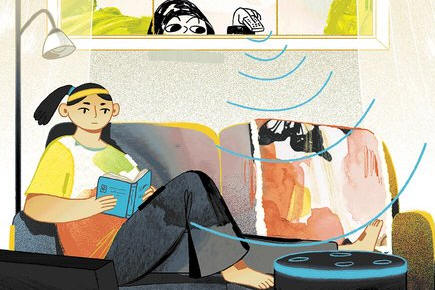
Many people have grown accustomed to talking to their smart devices, asking them to read a text, play a song or set an alarm. But someone else might be secretly talking to them, too.
Over the last two years, researchers in China and the United States have begun demonstrating that they can send hidden commands that are undetectable to the human ear to Apple’s Siri, Amazon’s Alexa and Google’s Assistant. Inside university labs, the researchers have been able to secretly activate the artificial intelligence systems on smartphones and smart speakers, making them dial phone numbers or open websites. In the wrong hands, the technology could be used to unlock doors, wire money or buy stuff online — simply with music playing over the radio.
A group of students from University of California, Berkeley, and Georgetown University showed in 2016 that they could hide commands in white noise played over loudspeakers and through YouTube videos to get smart devices to turn on airplane mode or open a website.
The very notion of what in the ancient world defines the human being in contrast to all other living things is simple: upright posture. Best known of the ancient commentators is Plato, who, according to legend, is claimed to have seen the human as bipedal and featherless. To describe humans as “featherless” sounds odder to modern ears than does the functional association of bipedalism and intelligence, but Plato sees the absence of bodily covering as a move away from the base toward the human, for he is quite aware that the other bipedal animal is the bird. Greek thought gives the bird a middle role between the human and the gods, since birds are connected to the gods through their use in divination. Responding to Plato’s contorted definition of man, Diogenes of Sinope, known as the Cynic, notoriously plucked a (bipedal) chicken and took it to Plato’s Academy, declaring, “Here is Plato’s man.”1
Although bipedalism seems to us an obvious way of seeing human beings, it was Plato who used upright posture to move the rational mind as far from the center of the appetite and the organ of generation as possible: The head, for Plato, is the “acropolis” of the body, its highest point both literally and metaphorically. The state is to the upright body as the body is to the citystate. Plato’s upright body at its best must also possess wisdom and nobility, agathos kai sophos (ἀγαθὸς καὶ σοφὸς), which he abstracts in the Meno from the older Greek notion of kalos kagathos (καλός καγαθός), beauty and goodness.2 This older concept describes military posture, in the sense both of the soldier’s body and of his loyalty to the state.
On April 11, the Allow States and Victims to Fight Online Sex Trafficking Act (FOSTA), which says websites can be held legally liable if their users post ads for prostitution, was signed into law. In the lead-up to its passage, the bill was responsible for the closure of a host of advertising and review sites used by sex workers, most prominently Craigslist Personals and Backpage, the latter of which was seized and shut down by the FBI.
The bill was intended to fight sex trafficking, but it has had a dangerous effect on the many sex workers who have consensually chosen the profession and who relied on the internet and its tools to keep themselves safe and make a living.
For many consensual sex workers, losing these free or low-cost advertising platforms means losing the ability to work indoors and the ability to screen clients ― two major factors that contribute to a sex worker’s overall safety. (People being forced or coerced into prostitution also benefit from client screening and not having to work on the streets, the bill’s opponents point out.)
Sex workers also rely on the safety tool of communal “bad date lists” ― websites where sex workers share information on bad or dangerous clients. Sex workers say these too are being shut down in the wake of FOSTA’s passage.
.
Photo Courtesy of Arabelle Raphael
Arabelle Raphael says FOSTA has motivated her to start organizing within her community.
The headlines pop up with alarming frequency: People of color going about their daily business — shopping, golfing, moving in — only to have the cops called on them.
But for every story that makes the news, there are countless others that don’t involve police. Black customers who get followed too closely by store employees. Hispanic students and Muslims who get asked if they’re really American.
This is everyday racial profiling — and it doesn’t just hurt the victims. It has an insidious ripple effect on the rest of society — in business, health and public safety.
Film and Writing Festival for Comedy. Showcasing best of comedy short films at the FEEDBACK Film Festival. Plus, showcasing best of comedy novels, short stories, poems, screenplays (TV, short, feature) at the festival performed by professional actors.

 Google CEO Sundar Pichai at the company’s developer conference, where it announced new convenience tools.
 .
.
 Aaron Stallings and Carmen Price work at Ardent Craft Ales in Richmond. The two use Snag Work, a website that allows them to pick up on-demand work. (Julia Rendleman/For The Washington Post)


 Photo: A.A. Newton