September 11, 2022
Mohenjo
Business, Food For Thought, Human Interest, Medical, Political, Science, Technical
amazon, business, Business News, current-events, Future, Hotels, human-rights, medicine, mental-health, research, Science, Science News, technology, Technology News, travel, vacation

Click the link below the picture
.
President Eisenhower signed the law establishing the National Aeronautics and Space Administration on July 29, 1958. At the time, the United States had put about 30 kg of small satellites into orbit. Less than 11 years later, Neil Armstrong and Buzz Aldrin landed on the Moon.
President Obama signed a NASA Authorization Act on October 11, 2010. Among its provisions, the law called on NASA to create the Space Launch System rocket and have it ready for launch in 2016. It seemed reasonable. At the time, NASA had been launching rockets, including very large ones, for half a century. And in some sense, this new SLS rocket was already built.
The most challenging aspect of almost any launch vehicle is its engines. No problem—the SLS rocket would use engines left over from the space shuttle program. Its side-mounted boosters would be slightly larger versions of those that powered the shuttle for three decades. The newest part of the vehicle would be its large core stage, housing liquid hydrogen, and oxygen fuel tanks to feed the rocket’s four main engines. But even this component was derivative. The core stage’s 8.4-meter diameter was identical to the space shuttle’s external tank, which carried the same propellants for the shuttle’s main engines.
.
 NASA’s Space Launch System Rocket at LC-39B, preparing to lift off at 8:33 am ET on August 29th, 2022.
.
.
Click the link below for the article:
.
__________________________________________
September 11, 2022
Mohenjo
Business, Food For Thought, Human Interest, Medical, Political, Science, Technical
amazon, business, Business News, current-events, Future, Hotels, human-rights, medicine, mental-health, research, Science, Science News, technology, Technology News, travel, vacation

Click the link below the picture
.
Dear Prudence,
I’m 49, and my husband, Quinn, is 42. I love the way I look and the way I’ve aged, so I don’t say the following to be self-deprecating: Quinn is breathtakingly gorgeous and has only grown more handsome with age. Women and men are drawn to him, and I can’t fault them for taste. Most people are respectful about it, but there have been a number of people over the years who’ve either believed I wasn’t good-looking enough for Quinn or that he would cheat on me (possibly with them). Those experiences bothered us both, but we love and trust each other, and it’s easy to move on from them. Seventeen years and three kids in, I don’t think about the so-called discrepancy between our looks unless someone calls my attention to it.
Recently, Anna, a good friend whom I met through our daughters’ school, texted me screenshots of a conversation between her and Bridget and Rita, two other good friends. Bridget and Rita spoke very graphically about what they’d like to do to Quinn and said some really unkind things about me. She said she thought I should know what was being said behind my back. I was shocked and haven’t replied to her.
I’m really sad that my friendship with Bridget and Rita wasn’t genuine. Our daughters are friends, and we facilitate Skype play dates each week, so I’m not sure what to say to them or whether our kids should play together anymore. I’m also angry about how they talked about Quinn like a slab of meat. And a small part of me that I hate most of all feels shame about the things Bridget and Rita said about me, which is what’s kept me from showing Quinn the messages. I like myself a lot, and it feels so stupid that I’ve let two mean girls affect that and make me feel embarrassed to confide in my husband. This has shaken me, and I want to start moving forward. What should I do?
.
 Photo illustration by Slate. Photo by fizkes/iStock/Getty Images Plus.
.
.
Click the link below for the article:
.
__________________________________________
September 10, 2022
Mohenjo
Business, Enthralling, Human Interest, Photographs
amazon, business, Business News, current-events, Future, Hotels, human-rights, medicine, mental-health, research, Science, Science News, technology, Technology News, travel, vacation

Click the link below the picture
.
Castle Hill Lighthouse is located on Narragansett Bay in Newport, Rhode Island at the end of the historic Ocean Drive. It is an active navigation aid for vessels entering the East Passage, between Conanicut Island and Aquidneck Island. The lighthouse has become a symbol of Newport, and a frequent site for wedding photos, proposals, and tourist photos. Although the property is owned by the nearby Castle Hill Inn, the lighthouse is owned by the United States Coast Guard.
Henry Hobson Richardson drew a sketch for a lighthouse at this location which may or may not have been the basis for the actual design. The structure does not include the residence which was featured in Richardson’s sketch. The keeper’s house was built and still stands, near Castle Hill Cove, a few hundred feet away.
The lighthouse was completed in 1890 on property formerly belonging to the naturalist, oceanographer, and zoologist Alexander Agassiz of Harvard University. Agassiz sold the land to the United States Government for the lighthouse for $1. His mansion on the property, commissioned in 1874, is now an inn. It was added to the National Register of Historic Places in 1988 as Castle Hill Lighthouse.
Although the lighthouse building is not open to the public, the shoreline and cliff face where the lighthouse sits are accessible by several footpaths from the Castle Hill Inn and the Castle Hill Cove Marina. The lighthouse is a popular site for tourist photos and wedding shoots, and widely recognizable as a symbol of Newport. While the property is owned by the nearby Castle Hill Inn, the lighthouse itself is owned by the United States Coast Guard.
By 2020, the iconic lighthouse had become streaked with unsightly brown rust, and the Coast Guard indicated that it had no plans to perform any exterior maintenance.
In March 2021, the Castle Hill Inn signed a five-year agreement with the Coast Guard to refresh the lighthouse’s exterior appearance. A local contractor was hired to perform a full power wash, paint, and beautification at a cost of $17,000, just in time for the 2021 summer wedding season. Wikipedia
.
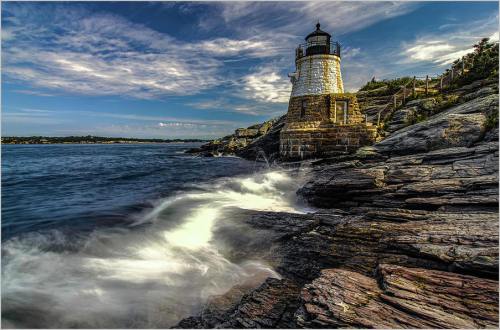 An image of Castle Hill Lighthouse Rhode Island
.
.
Click the link below for images:
.
__________________________________________
September 10, 2022
Mohenjo
Business, Food For Thought, Human Interest, Political, Science, Technical
amazon, business, Business News, current-events, Future, Hotels, human-rights, medicine, mental-health, research, Science, Science News, technology, Technology News, travel, vacation

Click the link below the picture
.
When astronauts look down at Earth from the International Space Station at night, they often see glittering lights marking cities, boats and other human endeavors. But day passes are a different story, which is why European Space Agency astronaut Samantha Cristoforetti pointed out a strange daylight sight of a bright dot in the desert.
“Intriguing sight! A bright dot in the Negev desert… so unusual to see human-made lights in day passes,” Cristoforetti tweeted on Thursday, posting three photos showing a distant white speck against a brown landscape.
.

The white circle highlights a bright dot seen from the ISS in the Negev desert in southern Israel. Samantha Cristoforetti/ESA
.
.
Click the link below for the article:
.
__________________________________________
September 10, 2022
Mohenjo
Business, Food For Thought, Human Interest, Political, Science, Technical
amazon, business, Business News, current-events, Future, Hotels, human-rights, medicine, mental-health, research, Science, Science News, technology, Technology News, travel, vacation

Click the link below the picture
.
“If only I could have learned a new language last year.”
“If only I learned about investing when I was still in my early 20s.”
For many of us, there are more things we want to learn than we have time to.
Shortening the learning curve is a topic that’s been studied for many years. I’ve personally applied what I’m about to share now to learning how to speak Spanish, English, and Korean (plus a bit of Portuguese). You will also be able to leverage these principles in any topic including business, musical instruments, and more.
Deconstruct the skill
The first step is to deconstruct the skill into its basic, fundamental components.
This is in reference to the popularized Pareto’s Principle, where the goal is to generate 80 percent of results by putting in 20 percent of the effort.
.
 Illustration: Getty Images
.
.
Click the link below for the article:
.
__________________________________________
September 10, 2022
Mohenjo
Crime, Food For Thought, Human Interest, Medical, missed News, Political, Science, Technical
amazon, business, Business News, current-events, Future, Hotels, human-rights, medicine, mental-health, research, Science, Science News, technology, Technology News, travel, vacation

.
News You might have missed!
Use your browser or smartphone back arrow (<-) to return to this table for your next selection.
.
__________________________________________
September 9, 2022
Mohenjo
Business, Food For Thought, Human Interest, Medical, Political, Science, Technical
amazon, business, Business News, current-events, Future, Hotels, human-rights, medicine, mental-health, research, Science, Science News, technology, Technology News, travel, vacation

Click the link below the picture
.
If you worry about a wet or damp basement, a busy sump pump, or muddy puddles in your yard after a heavy rainfall, this story is for you. We want to introduce you to a new tool to improve drainage— a rain garden.
A rain garden is basically a plant pond, that is, a garden bed that you plant with special deep-rooted species. These plants help the water rapidly seep into the soil, away from your house, and out of your hair. You direct the rainwater from the downspouts to the garden via a swale (a stone channel) or plastic piping. The garden captures the water and, when properly designed, drains it into the soil within a day. You don’t have to worry about creating a mosquito haven; the water drains before mosquitoes even have time to breed.
If there’s an especially heavy rainfall, excess water may overflow the rain garden and run into the storm sewer system. Even so, the rain garden will have done its job. It will have channeled water away from your foundation and reduced the load on the sewer system. A rain garden also reduces the amount of lawn chemicals and pet wastes that may otherwise run off into local lakes and rivers. In some communities, the runoff problem is so big that homes with rain gardens qualify for a tax break! Call your municipality to learn your local policy.
.
 Family Handyman
.
.
Click the link below for the article:
.
__________________________________________
September 9, 2022
Mohenjo
Business, Enthralling, Human Interest, Photographs
amazon, business, Business News, current-events, Future, Hotels, human-rights, medicine, mental-health, research, Science, Science News, technology, Technology News, travel, vacation

Click the link below the picture
.
Scotts Bluff National Monument is located west of the City of Gering in western Nebraska, United States. This National Park Service site protects over 3,000 acres of historic overland trail remnants, mixed-grass prairie, rugged badlands, towering bluffs and riparian area along the North Platte River. The park boasts over 100,000 annual visitors.
The monument’s north bluff is named after Hiram Scott, who was a clerk for the Rocky Mountain Fur Company and died near the bluff in 1828. The bluff served as an important landmark on the Oregon Trail, California Trail and Pony Express Trail, and was visible at a distance from the Mormon Trail. Over 250,000 westward emigrants passed by Scotts Bluff between 1843 and 1869. It was the second-most referred to landmark on the Emigrant Trails in pioneer journals and diaries.
Scotts Bluff County and the city of Scottsbluff, Nebraska, were named after the landmark.
Although called “Scotts Bluff National Monument,” the site includes two separate bluffs, “South Bluff” and the northern bluff called “Scotts Bluff.” There are five major outcroppings on the bluffs, known as Dome Rock, Crown Rock, Sentinel Rock, Eagle Rock, and Saddle Rock. The area between Scotts Bluff and the North Platte River is known as the “Badlands.”The collection of bluffs was first charted by non-native people in 1812 by the Astorian Expedition of fur traders traveling along the river. The expedition party noted the bluffs as the first large rock formations along the North Platte River where the Great Plains started giving way to the foothills of the Rocky Mountains. Their findings were not widely communicated because of the War of 1812. Explorers rediscovered the route to the Rocky Mountains in 1823, and fur traders in the region relied on the bluffs as a landmark. European Americans named the north, and most prominent bluff, after Hiram Scott, a fur trader who died in 1828 near the bluffs. The local Native Americans had called it Me-a-pa-te, “the hill that is hard to go around.”
Fur traders, missionaries, and military expeditions began regular trips past Scotts Bluff during the 1830s. Beginning in 1841, multitudes of settlers passed by Scotts Bluff on their way west along the Great Platte River Road to Oregon, and later California and Utah. All these groups used the bluff as a major landmark for navigation.
Although a natural gap existed between South Bluff and Scotts Bluff, the area was not easily traversed. So initially the Oregon Trail passed to the south of the Scotts Bluff area at Robidoux Pass and the Mormon Trail passed to the north of the bluff, on the other side of the North Platte River. In the early 1850s, a road was constructed in the gap, which later became known as Mitchell Pass. Beginning in 1851, this new passage became the preferred route of the Oregon and California Trails; although the Mormon Trail continued to pass the bluff only at a distance. Who built the road through Mitchell Pass about 1850 is unknown, although one possibility includes soldiers from Fort Laramie. Many emigrants preferred this route rather than trying to traverse the badlands on the north side of the bluffs or detouring south to the older trail at Robidoux Pass. Use of the Emigrant Trail tapered off in 1869 after the trail was superseded by the completion of the transcontinental railroad.
.
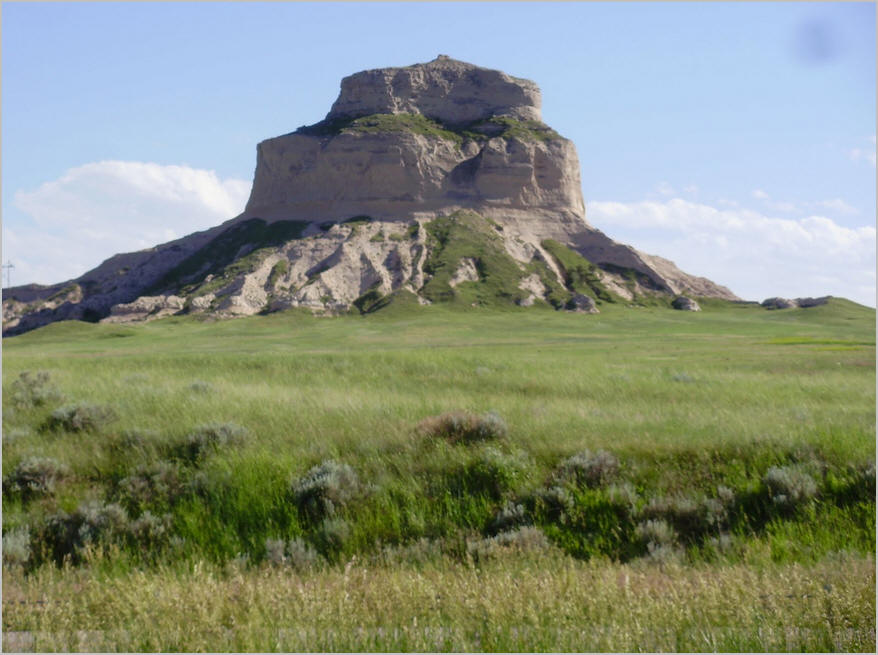 An image of Scotts Bluff National Monument
.
.
Click the link below for images:
.
__________________________________________
September 9, 2022
Mohenjo
Business, Food For Thought, Human Interest, Medical, Political, Science, Technical
amazon, business, Business News, current-events, Future, Hotels, human-rights, medicine, mental-health, research, Science, Science News, technology, Technology News, travel, vacation

Click the link below the picture
.
If you want to know how to do something, don’t just search the internet. Instead, find a person who already knows how and ask them. At first, they’ll give you a hurried, broad-strokes kind of answer, assuming that you’re uninterested in all the procedural details. But of course, that’s precisely what you’re after! Ask for a slowed-down, step-by-step guide through the minutiae of the thing.
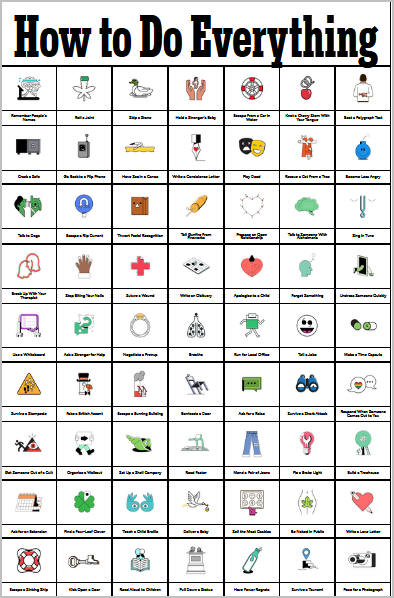
For seven years, I did exactly that — I called a stranger and asked that person to describe how to do a specific task or skill. For my weekly advice column in The New York Times Magazine, I interviewed hundreds of experts, among them a heart surgeon; a congresswoman; a boy scout who survived a tsunami; a hospital baby cuddler; a telenovela star; an iceberg-dodging sea captain; many psychologists; a grave digger; scientists; artists; astronauts; and a 13-year-old lemonade entrepreneur.
Sometimes the instruction was for a physical task (How to Rescue a Cat From a Tree or How to Milk a Killer Whale), and other times the skill was emotional (How to Apologize to a Child or How to Propose an Open Relationship). In every case, the advice eventually drifted from precise instructions to the most existential guidance on how to navigate the world. Take the safecracker from Providence, R.I., who, after some 40 years on the job, knows that nearly all locked safes will be empty but that humans will want them opened anyway; we’re curious, covetous, and prone to disregard terrible odds (How to Crack a Safe). Or the laughter researcher who has tickled humans, chimpanzees, bonobos, orangutans, and gorillas and reminds us that touch should be consensual (How to Tickle Someone). Or the octogenarian British actor’s advice on how to play dead: You don’t need flailing, gasping or guts spilling out — sometimes death is just a quiet slide toward stillness.
.
.
.
Click the link below for the article:
.
__________________________________________
September 9, 2022
Mohenjo
Business, Food For Thought, Human Interest, Medical, Political, Science, Technical
amazon, business, Business News, current-events, Future, Hotels, human-rights, medicine, mental-health, research, Science, Science News, technology, Technology News, travel, vacation

Click the link below the picture
.
DuckDuckGo’s tracker-removing email service, which has been available in private beta for a year, is now open to anyone who uses a DuckDuckGo mobile app, browser extension, or Mac browser. It has also added a few more privacy tools.
The service provides you a duck.com email address, one intended to be given out for the kind of “Subscribe to our newsletter for 20 percent off” emails you know exist only to harvest data and target you for ads. Email sent to your duck.com address forwards to your chosen primary email—but with trackers removed.
Email Protection now also fixes up links, strips them of tracking modifiers, upgrades unencrypted HTTP URLs to HTTPS where possible, and, for the rare necessary reply, allows you to send directly from your duck address instead of exposing your primary email. During their closed beta, DuckDuckGo claims that 85 percent of the emails it processed contained hidden trackers.
To sign up for Email Protection, you’ll need to use either the DuckDuckGo mobile app for iOS or Android, use DuckDuckGo’s browser extension on Firefox, Chrome, Edge, or Brave, or use its beta Mac browser (the list for which must be joined in the DuckDuckGo mobile app).
.
 DuckDuckGo’s Email Protection, now available in public beta, gives you an email address that will strip trackers from emails and forward the rest to you.
.
.
Click the link below for the article:
.
__________________________________________
Older Entries
Newer Entries

