September 7, 2022
Mohenjo
Business, Food For Thought, Human Interest, Medical, Political, Science, Technical
amazon, business, Business News, current-events, Future, Hotels, human-rights, medicine, mental-health, research, Science, Science News, technology, Technology News, travel, vacation

Click the link below the picture
.
“I want a party in the woods with an all-night campfire. I’ll be off to the side in a sleeping bag, nice and cozy. There will be s’mores and cocktails. My friends can come and go, saying goodbye however they want, or just sitting quietly with me and holding my hand. Nobody should touch my feet, though. I hate having my feet touched. A playlist of my favorite songs should be on repeat. I’d like to die as the fire burns out at dawn. Lights out and lights out, you know?”
I’m on Zoom and a chaplain from Iowa is describing her ideal final hours of life. We’re training to become end-of-life doulas, and this morning’s assignment is to help each other talk through a final hours ritual. It’s one of many exercises designed to confront us with our own mortality, so we can leave our own feelings about death at the door before we step across someone else’s threshold to help with theirs.
End-of-life (EOL) doulas are at the opposite end of the life cycle spectrum from birth doulas. They provide non-clinical care (emotional, logistical, and physical) and help with planning; engage with life reviews and legacy work; and provide support for family and friends so caretakers can bring their best, rested selves to support their dying loved one.
.
:format(webp)/cdn.vox-cdn.com/uploads/chorus_image/image/71219868/GettyImages_1362749729.0.jpg)
Denis Novikov/Getty Images
.
.
Click the link below for the article:
.
__________________________________________
September 7, 2022
Mohenjo
Business, Food For Thought, Human Interest, Medical, Political, Science, Technical
amazon, business, Business News, current-events, Future, Hotels, human-rights, medicine, mental-health, research, Science, Science News, technology, Technology News, travel, vacation

Click the link below the picture
.
A major breakthrough in nuclear fusion has been confirmed a year after it was achieved at a laboratory in California.
Researchers at Lawrence Livermore National Laboratory’s (LLNL’s) National Ignition Facility (NIF) recorded the first case of ignition on August 8, 2021, the results of which have now been published in three peer-reviewed papers.
Nuclear fusion is the process that powers the Sun and other stars: heavy hydrogen atoms collide with enough force that they fuse together to form a helium atom, releasing large amounts of energy as a by-product. Once the hydrogen plasma “ignites”, the fusion reaction becomes self-sustaining, with the fusions themselves producing enough power to maintain the temperature without external heating.
Ignition during a fusion reaction essentially means that the reaction itself produced enough energy to be self-sustaining, which would be necessary in the use of fusion to generate electricity.
.
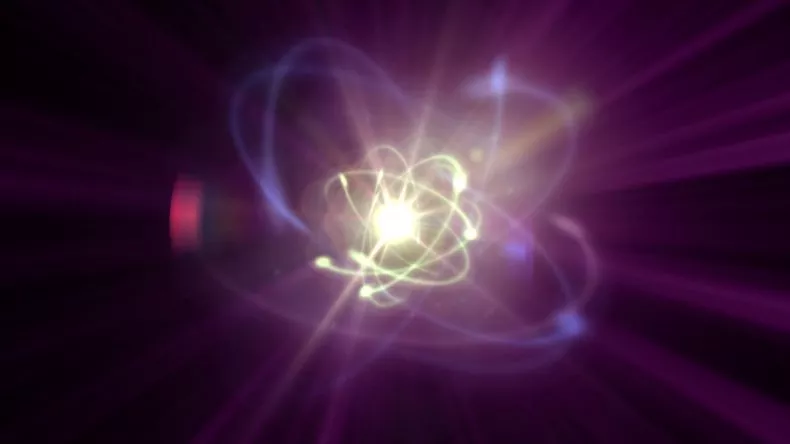 Stock image of an atom. Results of nuclear fusion experiments that achieved ignition last year have no been confirmed in peer-reviewed papers. iStock / Getty Images Plus
.
.
Click the link below for the article:
.
__________________________________________
September 6, 2022
Mohenjo
Business, Enthralling, Human Interest, Photographs
amazon, business, Business News, current-events, Future, Hotels, human-rights, medicine, mental-health, research, Science, Science News, technology, Technology News, travel, vacation

Click the link below the picture
.
The Cheltenham Badlands are in Caledon, Ontario, on the southeast side of Olde Base Line Road, between Creditview and Chinguacousy Roads. The site occupies an area of approximately 0.4 square kilometers and features exposed and highly eroded Queenston shale. The Cheltenham Badlands are a significant educational site due to the readily visible geologic processes and the red color and the unique topography of the exposed shale make this a popular tourist site. The site is a Provincial Earth Sciences Area of Natural and Scientific Interest (ANSI) since it is considered one of the best examples of “badlands topography” in Ontario.
The Cheltenham Badlands sometimes referred to as the Chinguacousy Badlands, the Red Clay Hills, the Caledon Badlands, or the Inglewood Badlands, are approximately 3.8 km west of highway 10 on Olde Base Line Road near the villages of Inglewood and Cheltenham. The northern boundary of the badlands site is Peel Regional Road 12 (Olde Base Line Road). The total area of the property is 36.6 hectares and the exposed badlands occupies an area of approximately 0.4 square kilometers.
The Badlands are considered part of the Niagara Escarpment, which was designated a UNESCO World Biosphere Reserve in 1990. Acting as a buffer zone between the undeveloped and natural portions of the escarpment and the more developed areas further to the south, the badlands site is designated as an Escarpment Protection Area. Under the Niagara Escarpment Plan, the badlands are also considered an Escarpment Access Park and the main trail of the Bruce Trail system crosses the site and is the starting point for the Caledon Hills Bruce Trail Club section. In addition to being considered a Ministry of Natural Resources and Forestry designated Earth Sciences Area of Natural Scientific Interest, the Cheltenham Badlands are also part of an important groundwater discharge area, the Inglewood Slope Environmentally Sensitive Area, designated by the Credit Valley Conservation Authority. The cold water stream, at the base of the badlands, is a tributary of the Credit River, which drains into Lake Ontario.[citation needed]
The Badlands is an exposed section of the Queenston Formation, which was formed between 420 and 415 million years ago during the Middle and Late Ordovician periods. During this period, the collision of Gondwana into Laurentia resulted in the formation of the Taconic Mountains. The creation of these mountains also resulted in several basins, such as the Appalachian Basin and the Michigan Basin, in the interior of Laurentia. Over time, the erosion of these mountains resulted in the formation of the Queenston Delta, which drained into the Michigan Basin. The deposition of mud eroded from the mountains during the Middle and Late Ordovician period formed the Queenston Shale. The continuous deposition of the mud and sand from the mountains extended the Queenston Delta further into the Michigan Basin; however, as the mountains continued to erode, less and less mud and sand reached the delta, resulting in the formation of inter-layered beds of sandstone, shale, and limestone throughout the Silurian period. These inter-layered beds that overlay the Queenston Shale include Lower Silurian sandstones, such as the Whirlpool Formation, and dolostones, such as the Manitoulin Formation, which can be seen along the Niagara Escarpment. The Queenston Shale overlies the shales and the inter-bedded limestones of the Georgian Bay Formation. At the badlands site, glacial erosion of the overlaying sandstones and dolostones has caused the Queenston Formation to be the first layer of rock to underlie the soil. Wikipedia
.
 An image of Cheltenham Badlands
.
.
Click the link below for images:
.
__________________________________________
September 6, 2022
Mohenjo
Business, Food For Thought, Human Interest, Science, Technical
amazon, business, Business News, current-events, Future, Hotels, human-rights, medicine, mental-health, research, Science, Science News, technology, Technology News, travel, vacation

Click the link below the picture
.
Isaac Newton was not known for his generosity of spirit, and his disdain for his rivals was legendary. But in one letter to his competitor Gottfried Leibniz, now known as the Epistola Posterior, Newton comes off as nostalgic and almost friendly. In it, he tells a story from his student days, when he was just beginning to learn mathematics. He recounts how he made a major discovery equating areas under curves with infinite sums by a process of guessing and checking. His reasoning in the letter is so charming and accessible, it reminds me of the pattern-guessing games little kids like to play.
It all began when young Newton read John Wallis’ Arithmetica Infinitorum, a seminal work of 17th-century math. Wallis included a novel and inductive method of determining the value of pi, and Newton wanted to devise something similar. He started with the problem of finding the area of a “circular segment” of adjustable width x. This is the region under the unit circle, defined by y=1−x2−−−−−√, that lies above the portion of the horizontal axis from 0 to x. Here x could be any number from 0 to 1, and 1 is the radius of the circle. The area of a unit circle is pi, as Newton well knew, so when x=1, the area under the curve is a quarter of the unit circle, π4. But for other values of x, nothing was known.
.
 Maggie Chiang for Quanta Magazine
.
.
Click the link below for the article:
.
__________________________________________
September 6, 2022
Mohenjo
Business, Food For Thought, Human Interest, Political, Science, Technical
amazon, business, Business News, current-events, Future, Hotels, human-rights, medicine, mental-health, research, Science, Science News, technology, Technology News, travel, vacation

Click the link below the picture
.
As marketers, data brokers, and tech giants endlessly expand their access to individuals’ data and movements across the web, tools like VPNs or cookie blockers can feel increasingly feeble and futile. Short of going totally off the grid forever, there are few options for the average person to meaningfully resist tracking online. Even after coming up with a technical solution last year for how phone carriers could stop automatically collecting users’ locations, researchers Barath Raghavan and Paul Schmitt knew it would be challenging to convince telecoms to implement the change. So they decided to be the carrier they wanted to see in the world.
The result is a new company, dubbed Invisv, that offers mobile data designed to separate users from specific identifiers so the company can’t access or track customers’ metadata, location information, or mobile browsing. Launching in beta today for Android, the company’s Pretty Good Phone Privacy or PGPP service will replace the mechanism carriers normally use to turn cell phone tower connection data into a trove of information about users’ movements. And it will also offer a Relay service that disassociates a user’s IP address from their web browsing.
“If you can decouple a user’s identity from the way they connect to a network, that’s a general-purpose hammer that can solve a lot of privacy problems,” says Raghavan, a professor at the University of Southern California. “Privacy should be the default and it’s not currently, so we’re working on that. There’s a growing appetite as people become more concerned about what their phone is leaking to telecoms and tech companies.”
.

.
.
Click the link below for the article:
.
__________________________________________
September 5, 2022
Mohenjo
Business, Food For Thought, Human Interest, Medical, Political, Science, Technical
amazon, business, Business News, current-events, Future, Hotels, human-rights, medicine, mental-health, research, Science, Science News, technology, Technology News, travel, vacation


Save America from Trump
Save America from Trump
Save America from Trump
Save America from Trump
We won’t drink the kool-aid
..
__________________________________________
September 5, 2022
Mohenjo
Business, Enthralling, Human Interest, Photographs
amazon, business, Business News, current-events, Future, Hotels, human-rights, medicine, mental-health, research, Science, Science News, technology, Technology News, travel, vacation
Click the link below the picture
.
Denali State Park is a 325,240-acre (131,620 ha) state park in the U.S. state of Alaska. It is located in the Matanuska-Susitna Borough adjacent to the east side of Denali National Park and Preserve, along the Parks Highway.
The park is undeveloped wilderness with the exception of the two day-use areas, three campgrounds, and two trailheads accessible from the Parks Highway.
Denali State Park is a 325,240-acre (131,620 ha) state park in Alaska. It is located on the southeastern border of Denali National Park and Preserve formerly known as Mt. McKinley National Park, a much larger and more popular park in the area. Denali State Park is in the southern portion of Alaska. Denali State Park is situated between Fairbanks and Anchorage Alaska. Alaska’s Highway 3, George Parks Highway, connects Fairbanks and Anchorage and runs directly through Denali State Park. This highway provides access to many different hiking routes and lookout points which allow visitors to see Denali and many different parts of the natural environment only found in Alaska. One of these points include Kesugi Ridge in the Peters Hills area. A very popular trail which is known for its incredible views of the Alaska Range and tundra around it. The Alaska Range runs just north of Denali State Park and inside of Denali National Park, making the national park a more well known tourist destination. Denali State Park is in sight of Mount Denali. Denali is the highest mountain peak in North America, with a summit elevation 20,310 feet above sea level. Since it rises roughly 18000 ft base to peak it is the largest mountain situated entirely above sea level. To the east, the state park borders the Susitna River, which feeds into the Gompertz Channel near Anchorage, then into the ocean. There are several other rivers in the park and the surrounding area which are visited by tourists.
Denali State Park is home to many different terrains, animals, plants, and opportunities to safely and respectfully enjoy these parts of a natural wild environment.
The Denali State Park wilderness draws many different types of visitors for many different reasons. It gives many opportunities to explore for backpackers, campers, canoers, families, fishermen, kayakers, rock climbers, and just people driving through.
Denali is one of the main attractions, and there are easy-to-reach lookout points for visitors driving through. Sometimes, though, it is hard to view the peak due to clouds and other weather issues. Denali, however, is not the only peak one can view, and its surrounding range is not the only place for exploration. The Talkeetna Mountains to the east also offer different levels of climbing and backpacking experiences. Divided by a large valley, there are many different views of Alaska looking in either direction. Wikipedia
.
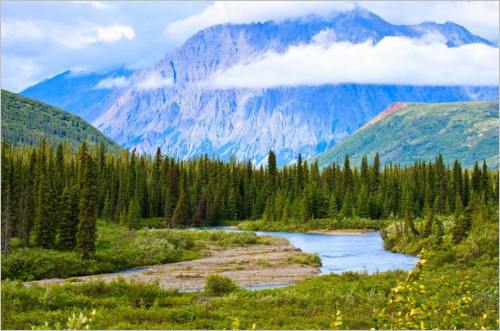 An image from Denali National Park Scenery
.
.
Click the link below for images:
.
__________________________________________
September 5, 2022
Mohenjo
Business, Food For Thought, Human Interest, Medical, Science, Technical
amazon, business, Business News, current-events, Future, Hotels, human-rights, medicine, mental-health, research, Science, Science News, technology, Technology News, travel, vacation
Click the link below the picture
.
No one on Earth has ever heard a dinosaur roar. But that hasn’t stopped scientists and filmmakers from wondering: What did dinosaurs sound like?
Figuring out what dinosaurs actually sounded like is an almost impossible task because scientists can’t exactly dig up a fossilized roar. “Most of the sound-producing structures are soft tissues or less resilient hard tissues,” paleontologist Michael Habib says on Unexplainable, Vox’s science podcast about unanswered questions. “It’s muscle and cartilage, and those tend not to fossilize.”
.
:format(webp)/cdn.vox-cdn.com/uploads/chorus_image/image/71279150/GettyImages_777490__1_.0.jpg) Did this T-rex roar, or honk?Mark Wilson/Newsmakers/Getty Images
Did this T-rex roar, or honk?Mark Wilson/Newsmakers/Getty Images
.
.
Click the link below for the article:
.
__________________________________________
September 5, 2022
Mohenjo
Business, Food For Thought, Human Interest, Medical, Political, Science, Technical
amazon, business, Business News, current-events, Future, Hotels, human-rights, medicine, mental-health, research, Science, Science News, technology, Technology News, travel, vacation

Click the link below the picture
.
Doppelgängers share strikingly similar physical characteristics—they look so alike that, at times, these two unrelated people could easily pass for twins (or, at least, siblings).
Now, new research suggests that doppelgängers have more in common than meets the eye. People with very similar faces also share many of the same genes and lifestyle traits, according to a new paper published Tuesday in the journal Cell Reports.
It may seem obvious that people with similar facial features would also have some of the same DNA, but no one had scientifically proven this, until now. Thanks to the internet, it’s now easier than ever for researchers to track down and study doppelgängers.
To understand what was going on at the genetic level among look-alikes, scientists collaborated with the Canadian photographer François Brunelle. Since 1999, Brunelle has been traveling around the world to capture intimate portraits of strangers who look nearly identical to one another for his “I’m not a look-alike!” project.
Researchers asked 32 pairs of Brunelle’s models to answer questions about their lifestyles and submit samples of their DNA.
Using facial recognition software, the scientists analyzed headshots of the so-called “human doubles” and computed a score to quantify similarities among their faces. They compared the scores to those of identical twins and found that the software had awarded twin-like scores to exactly half of the doppelgänger pairs.
.
:focal(221x169:222x170)/https://tf-cmsv2-smithsonianmag-media.s3.amazonaws.com/filer_public/ac/8b/ac8bb1fb-3fb1-4474-a708-4abbd45634bf/capture.jpg) Four pairs of “human doubles” included in the study Courtesy of François Brunelle
Four pairs of “human doubles” included in the study Courtesy of François Brunelle
.
.
Click the link below for the article:
.
__________________________________________
September 4, 2022
Mohenjo
Business, Food For Thought, Human Interest, Medical, Political, Science, Technical
amazon, business, Business News, current-events, Future, Hotels, human-rights, medicine, mental-health, research, Science, Science News, technology, Technology News, travel, vacation

Click the link below the picture
.
If there’s one hallmark inherent to science, it’s that our understanding of how the Universe works is always open to revision in the face of new evidence. Whenever our prevailing picture of reality — including the rules it plays by, the physical contents of a system, and how it evolved from its initial conditions to the present time — gets challenged by new experimental or observational data, we must open our minds to changing our conceptual picture of the cosmos. This has happened many times since the dawn of the 20th century, and the words we use to describe our Universe have shifted in meaning as our understanding has evolved.
Yet, there are always those who cling to the old definitions, much like linguistic prescriptivists, who refuse to acknowledge that these changes have occurred. But unlike the evolution of colloquial language, which is largely arbitrary, the evolution of scientific terms must reflect our current understanding of reality. Whenever we talk about the origin of our Universe, the term “the Big Bang” comes to mind, but our understanding of our cosmic origins have evolved tremendously since the idea that our Universe even had an origin, scientifically, was first put forth. Here’s how to resolve the confusion and bring you up to speed on what the Big Bang originally meant versus what it means today.
.
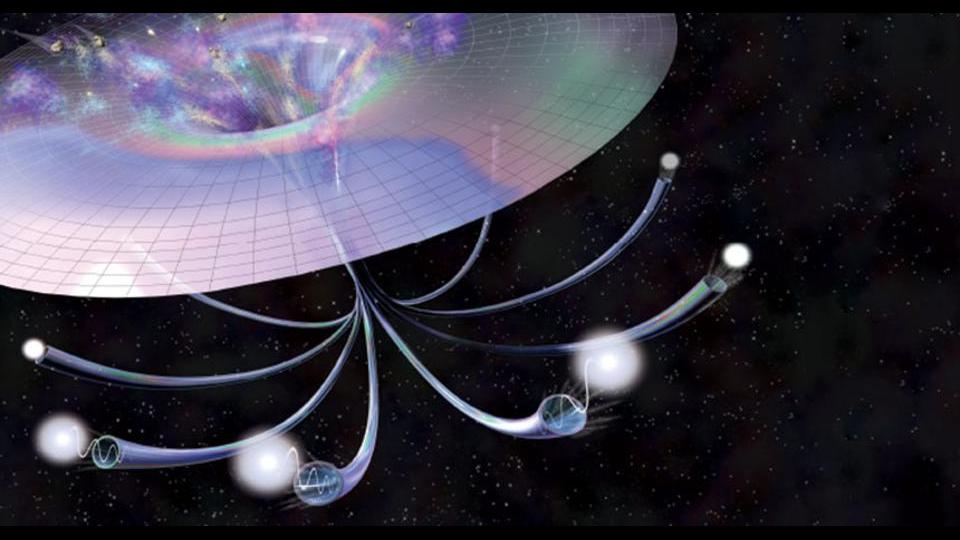 From a pre-existing state, inflation predicts that a series of universes will be spawned as inflation continues, with each one being completely disconnected from every other one, separated by more inflating space. One of these “bubbles,” where inflation ended, gave birth to our Universe some 13.8 billion years ago, where our entire visible Universe is just a tiny portion of that bubble’s volume. Each individual bubble is disconnected from all of the others, and each place where inflation ends gives rise to its own hot Big Bang. Credit: Nicolle Rager Fuller)
.
.
Click the link below for the article:
.
__________________________________________
Older Entries
Newer Entries

