July 8, 2026
Mohenjo
Business, Food For Thought, Human Interest, Political, Science, Technical
amazon, business, Business News, current-events, Future, Hotels, human-rights, medicine, mental-health, research, Science, Science News, technology, Technology News, travel, vacation

Click the link below the picture
.
Less time sleeping may mean more time sitting down—and more weight gained, according to a new study.
The research, published in Annals of Internal Medicine on Monday, found that getting just 90 minutes less sleep each night for six weeks led study participants to sit around more and gain weight.
This study included 95 people who typically slept seven or eight hours each night. After the six weeks of sleep deprivation, however, the participants had gained about a pound, on average, and their sedentary time had increased by an average of 17 minutes. Men and postmenopausal women became the most sedentary, spending an average of 30 extra minutes sitting each day.
This isn’t the first time researchers have connected sleep to weight, and particularly to obesity. In fact, not getting enough shut-eye is linked to increased risk of cardiovascular disease and other health problems, and more sedentary people are also at higher risk for chronic diseases. But many previous studies exploring sleep and weight have been conducted in labs—meaning they often take place over just a few days—and have involved far more drastic reductions in sleep, such as allowing participants a mere four hours of sleep over three days.
Short sleep-restriction studies don’t reflect the effects of chronic behavior that leads to these issues, says Marie-Pierre St-Onge, the study’s senior author and a professor of nutritional medicine at Columbia University Irving Medical Center. She argues that a six-week experiment conducted outside the lab and involving milder sleep restrictions is a more accurate representation of the realities of chronic mild sleep deprivation, which roughly 30 percent of adults experience, according to the authors.
“It’s a more naturalistic experiment; it more closely aligns with what we see, and it provides a message that’s directly applicable to what people actually feel,” she says.
In separate studies involving the same participants, she and her team have found that a decrease in sleep can raise the risk of type 2 diabetes and heart problems among certain groups.
The study stands out because it shows that lack of sleep is both associated with excess weight and that it causes weight gain, says Jean-Philippe Chaput, a senior scientist at the Children’s Hospital of Eastern Ontario, who studies sleep health and obesity and was not involved in this research.
“It shows what we already know in a more robust study design,” Chaput says.
One pound of weight gain over six weeks may not seem like a lot, Chaput adds, but it could become more significant if participants kept the same habits for many more months or years.
St-Onge hopes to focus her future research on potential interventions and the positive impact of getting enough sleep, she says.
“It’s easy to say that if you restrict your sleep, you have bad health outcomes. But the goal in life is not to do something bad to see if it has bad outcomes,” she says. “The goal in life is to do something good and then determine if it has healthful outcomes. So I think we should do a lot more of that now that we know that short sleep is not good.”
.
 Sulukhana Boonyarithsripong/Getty Images
.
.
Click the link below for the complete article:
.
__________________________________________
July 8, 2026
Mohenjo
Business, Food For Thought, Human Interest, Political, Science, Technical
amazon, business, Business News, current-events, Future, Hotels, human-rights, medicine, mental-health, research, Science, Science News, technology, Technology News, travel, vacation

Click the link below the picture
.
NEED TO KNOW
-
Michael Thompson, 56, was found guilty of raping and murdering his estranged wife, Kimberley Thompson, 43, after a six-week trial
-
Prosecutors said he suffocated Kimberley before staging the scene to make it appear she had died by suicide and posting to her social media accounts
-
Jurors also convicted Thompson of two counts of perverting the course of justice. He is scheduled to be sentenced next week
A man has been found guilty of raping and murdering his estranged wife after prosecutors said he killed her and then staged the scene to make it appear she had died by suicide.
Michael Thompson, 56, was convicted Wednesday of the rape and murder of Kimberley Thompson, 43, following a six-week trial at Nottingham Crown Court in England, according to a Northamptonshire Police press release and the BBC.
Jurors also found Thompson guilty of two counts of perverting the course of justice for attempting to cover up both the rape and the murder, according to the press release.
Prosecutors alleged Thompson raped and suffocated Kimberley sometime between midnight and 3:30 a.m. on Aug. 9, 2025, at the Northampton home the couple still shared despite having separated two years earlier, according to the press release.
The couple had been married for 19 years but were in the process of divorcing. The court heard Kimberley had started a new relationship, was planning to move out of the home and had requested about £65,000 as part of their divorce settlement, according to the BBC and Northamptonshire Police.
Following the murder, Thompson staged Kimberley’s bedroom to make it appear she had taken her own life, posted messages on her social media accounts and called East Midlands Ambulance Service at about 5:30 a.m., according to the Northamptonshire Police press release.
Authorities were initially told Kimberley had consumed alcohol and tablets before she was found unresponsive, the BBC reported. But a post-mortem examination found no alcohol in her system and only low levels of caffeine, paracetamol and codeine, according to the outlet.
Kimberley’s family and friends told investigators they did not believe she had died by suicide and described a history of domestic abuse during her marriage, prompting police to launch a murder investigation on Aug. 12, according to Northamptonshire Police and the BBC.
“It became clear throughout our investigation that Kim had been subjected to domestic abuse for much of her relationship with Thompson, with manipulation, coercive control and physical violence the norm,” Detective Chief Inspector Torie Harrison, who led the investigation, said in a statement.
“Over the years Thompson stripped Kim’s confidence away but in the time since their separation, friends and family began to see the old Kim re-emerging with a renewed enthusiasm for life.”
Harrison said Thompson “brutally rape[d] and murder[ed]” Kimberley before taking time to stage her death “in order to make people believe she had committed suicide.”
The detective also said the investigation revealed Kimberley had contacted a domestic abuse support service in 2013 but later withdrew her complaint because she feared what would happen if she reported the abuse, according to the press release.
Thompson is scheduled to be sentenced next week, per the BBC.
.
 Kimberley Thompson Credit: Northamptonshire Police
.
.
Click the link below for the complete article:
.
__________________________________________
July 8, 2026
Mohenjo
Business, Food For Thought, Human Interest, Political, Science, Technical
amazon, business, Business News, current-events, Future, Hotels, human-rights, medicine, mental-health, research, Science, Science News, technology, Technology News, travel, vacation

Click the link below the picture
.
President Trump’s head-spinning appearance at the NATO Summit in Ankara on Wednesday began with him insulting vast swaths of Europe during the morning sessions and finished just hours later with him declaring that the whole thing had been one big kumbaya session.
“I just want to say there was tremendous love in that room,” he said at a news conference not long after he had said repeatedly that “I’m not happy with NATO.”
Describing his meetings behind closed doors, he boasted: “They said, ‘Sir, we love you.’ These are grown people saying that. Isn’t that nice?”
“Maybe they’re trying to get to me, and in a way, they did,” he said. “Because there was tremendous unity in that room.”
There did, in fact, appear to be some progress to come out of the summit.
NATO pledged $80 billion in military aid to Ukraine this year and next, though that represented a mix of both previous and new commitments. And Mr. Trump told President Volodymyr Zelensky of Ukraine that the United States would allow the country to manufacture Patriot air defense systems to protect itself from Russian missiles.
Despite saying last month that he would bring a gift that would make Mr. Erdogan “very happy,” the president said he still had a decision to make about whether to allow Turkey to purchase F-35 fighter jets. He said he had an “inclination” to do so because Turkey did not help Iran during the war with the United States and Israel, and because of what he has described as his deep friendship with its leader, President Recep Tayyip Erdogan.
Hundreds of journalists from around the world pushed, elbowed, and yelled at one another to make it into a soaring auditorium here in Ankara for the chance to ask a question of a freewheeling American president who might say anything.
“That’s a lot of press, wow,” Mr. Trump said, sounding amused, as he took to the lectern. His secretaries of state, defense and treasury stood stone-faced behind him as he pin-balled his way through all sorts of topics over the next 40 minutes.
The war with Iran flared up again while Mr. Trump was in Ankara, just 1,000 miles from Tehran, and the fighting dominated the news conference.
The president said that the cease-fire with Iran was likely over after the United States carried out airstrikes on Tuesday against several Iranian targets. The Pentagon said they were in response to Iranian attacks on commercial ships in the Strait of Hormuz. On Wednesday, Iran’s armed forces said they had attacked U.S. military sites in Bahrain and Kuwait.
Early in the day at the summit, Mr. Trump unleashed verbally on Iran, referring to the country as “scum” and its leaders as “sick people.”
He was particularly incensed by what he characterized as the Iranians’ dishonest, tricksy negotiating style. “There’s something wrong with them,” he fumed. “We said, ‘Go and do your funeral stuff,’ and instead of that, they start shooting rockets at ships.”
By “funeral stuff,” he meant the nationwide funeral procession attended by millions of people for Ayatollah Ali Khamenei, the supreme leader killed in the war Mr. Trump launched alongside Israel in February.
“They’re cuckoo,” Mr. Trump said, tapping an index finger against his cranium.
The NATO secretary general, Mark Rutte, sat impassively by his side, legs crossed, and hands clasped over one knee.
A major motif of this year’s summit involved European leaders deciding whether it was politically advantageous to at last dispense with the niceties and fight back against Mr. Trump, as the leaders of Spain and Italy have started to do. The time when all European heads of state tried to play nice with the mercurial American president is decidedly over.
Early in the day, Mr. Trump made more menacing comments about taking over Greenland, and repeatedly criticized Germany, Italy, Britain, and France for not helping the United States in its war with Iran.
Spain, in particular, came in for a drubbing from Mr. Trump on Wednesday morning. “I don’t want anything to do with Spain,” he said.
His spat with the Spaniards started when they refused Mr. Trump’s demand that European nations raise their military spending, then kicked into a higher gear after Spain denied the use of its military bases to U.S. forces attacking Iran.
.
 President Trump at the NATO summit in Ankara, Turkey, on Wednesday. Credit…Doug Mills/The New York Times
.
.
Click the link below for the complete article:
.
__________________________________________
July 7, 2026
Mohenjo
Business, Food For Thought, Human Interest, Political, Science, Technical
amazon, business, Business News, current-events, Future, Hotels, human-rights, medicine, mental-health, research, Science, Science News, technology, Technology News, travel, vacation
Click the link below the picture
.
China’s Tianwen-2 aims to collect samples from asteroid Kamo’oalewa and return them to Earth
A Chinese spacecraft on a mission to collect and return samples of a near-Earth asteroid beamed back its first image of its target.
Called Kamo‘oalewa, the space rock loops by Earth, coming as close as 9 million miles and as far as 25 million miles from our planet. It’s a quasi-satellite, meaning it orbits the sun, but it sticks close to Earth—astronomers have discovered eight of these space rocks that seem to follow our planet’s path.
Some space scientists affectionately refer to these objects as Earth’s “mini moons,” or “quasi moons,” although research suggests Kamo‘oalewa may in fact be a stray piece of our moon that was thrown into space by an ancient impact. Other evidence, including James Webb Space Telescope observations, dispute that theory, however.
China’s Tianwen-2 has spent the last 400 days traveling to Kamo’oalewa, a journey that spanned around 621 million miles. The rock is about 66 feet in diameter—a little larger than a school bus—and it rotates on its axis every 28 minutes. It was discovered in 2016, and Tianwen-2 launched to retrieve samples from it on May 28, 2025. The spacecraft is scheduled to return the samples to Earth in 2027, dropping them into Earth’s atmosphere during a flyby of our planet.
Tianwen-2’s equipment will allow it to recover samples in three ways, depending on the situation. One way uses a touch-and-go method similar to that used by NASA’s OSIRIS-REx asteroid sampling mission and Japan’s Hayabusa2 asteroid mission. Tianwen-2 may also attempt an anchor-and-attach method, which involves the spacecraft physically attaching itself to the space rock and then collecting samples of the surface and subsurface. It could also use a hovering method, whereby a robotic arm will deploy from the spacecraft as it hovers above the asteroid and scoop up some of the surface material.
The China National Space Administration said in a statement that Tianwen-2 had reached a distance of 12 miles from the asteroid in late June.
“The probe will progressively conduct more detailed scientific exploration to acquire data on the asteroid’s morphology, material composition and internal structure, laying the groundwork for subsequent sample collection operations,” CNSA said.
After Tianwen-2 drops off the samples in Earth’s atmosphere, it is set to continue its journey to comet 311P/PanSTARRS, where it will conduct further observations and scientific studies.
.
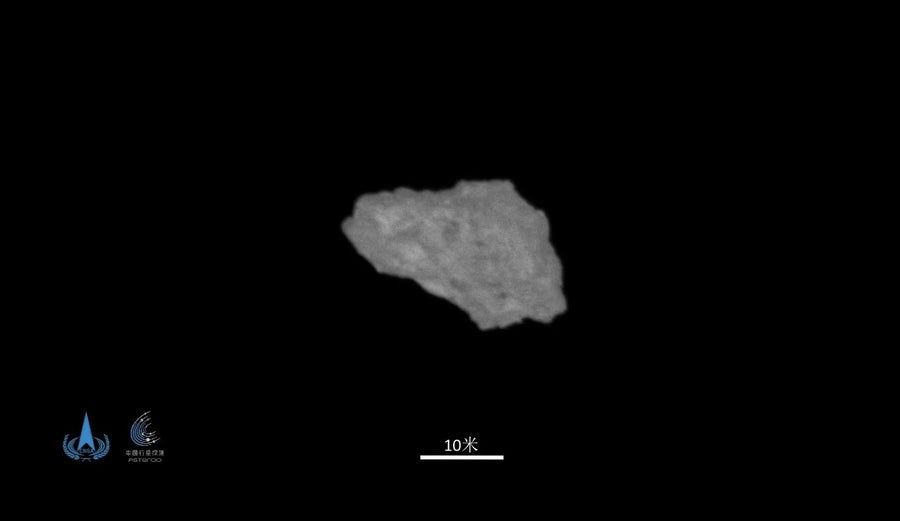
Near-Earth asteroid Kamo’oalewa imaged by Tianwen-2 CNSA
.
.
Click the link below for the complete article:
.
__________________________________________
July 7, 2026
Mohenjo
Business, Food For Thought, Human Interest, Political, Science, Technical
amazon, business, Business News, current-events, Future, Hotels, human-rights, medicine, mental-health, research, Science, Science News, technology, Technology News, travel, vacation

Click the link below the picture
.
Why Is Anger Management Tough To Teach?
I have noticed in my work with families, and in real life knowing anyone parenting children, that anger can be our toughest emotion to navigate. Our childhood experiences with adults expressing anger can play out with our own children. Seeing our child’s anger may be an emotional trigger for those whose caregivers blew up easily, or unfamiliar territory for those whose caregivers withdrew and went silent when angry, communicating that expressing anger is not permitted.
Because anger makes us uncomfortable for a range of reasons, we often convey to our children to express emotions, except anger. If we get more comfortable with anger as a natural human emotion, we help our children embrace their own, eventually without hurting anyone—or growling.
Anger and the Young Brain
The young child has the brain parts to feel strong emotions suddenly, but not yet the brain development to harness these emotions. In working with children in my therapy office, I start with the basics of emotions with almost every child regardless of age, like noticing how they feel in their bodies, labeling the feelings, and then articulating emotions to eventually replace exploding behaviors.
In my years of therapy practice and motherhood, I can attest that young children most often do not have the ability to calmly state how they are feeling when angry. It’s too complex for their brains. Doing so entails:
- Noticing
- Stopping a strong impulse
- Having insight
- Being able to put words to a highly emotional experience
(Side note: How many adults do you know who struggle with this?)
How To Manage Expectations
There’s a very important concept from child development critical for your dilemma: scaffolding. This refers to helping our children build important skills in a way that matches the skills they already have, and their readiness to level up.
You have done this by helping your daughter replace destructive acts of anger with facial expressions and vocalizations that express her anger safely. It sounds like you see the next level as replacing this type of expression with behavior that feels more socially appropriate.
Because it is probably a high bar for a 3-year-old to express anger calmly with words, I recommend focusing on two goals as the next developmental steps:
- Physically regulating strong emotion: This coping skill will help dial down the intensity of anger, giving her emotional regulation tools to last a lifetime.
- Becoming comfortable with her anger: Adults and other caregivers will be her greatest emotional teachers in this regard. Work on modeling this good behavior.
Co-Regulation is Key
This may sound a bit fancy, but self-regulation is actually one of our most powerful strategies for emotional health: learning to calm our bodies when in distress. Regulating with your daughter, called co-regulation, helps her feel how her nervous system shifts from high alert to calm. High alert, which happens when we feel intense emotions like fear and anger, can include a racing heart, heated up body temperature, tense muscles, and rapid breathing.
When my son gets heated, sometimes I take his hand in mine, put it on his chest, and simply say, “feel your heart right now.” When toddlers get mad, they need us to regulate with them, which means we need to be regulated (calm). When we stay calm and offer physical comfort like hugging, sitting them on our laps, or holding hands, our calmer nervous systems help their little bodies better regulate those big emotions.
.
:max_bytes(150000):strip_icc()/Ask-Your-Mom-Angry-Toddler-Final--fc53adcfe73145138f0370476b316621.png) Parents / Zoe Hansen
Parents / Zoe Hansen
.
.
Click the link below for the complete article:
.
__________________________________________
July 7, 2026
Mohenjo
Business, Food For Thought, Human Interest, Political, Science, Technical
amazon, business, Business News, current-events, Future, Hotels, human-rights, medicine, mental-health, research, Science, Science News, technology, Technology News, travel, vacation

Click the link below the picture
.
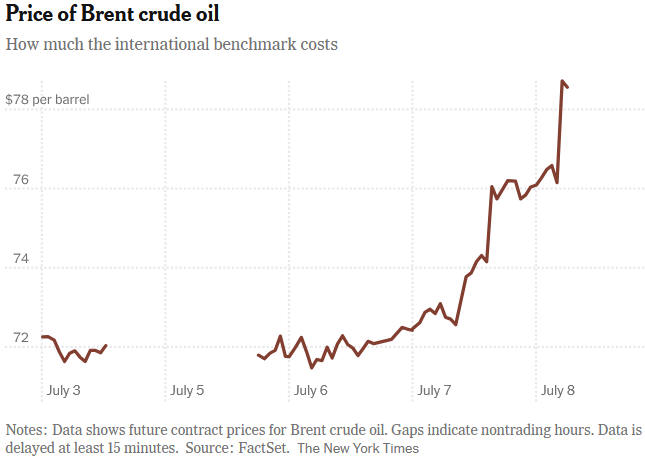
Oil prices spiked on Wednesday to the highest level in weeks after President Trump said that he thought the cease-fire with Iran was “over” amid a series of strikes in the Persian Gulf.
The Trump administration also revoked a waiver that allowed Iran to sell oil in retaliation for attacks on tankers this week in the Strait of Hormuz, a crucial conduit for the world’s energy.
U.S. Central Command said that it hit over 80 targets in Iran, including dozens of small boats used by the Iranian military, “to degrade Iran’s ability to continue attacking international commerce.” Iran’s military responded by targeting 85 U.S. military sites in Bahrain and Kuwait, prolonging a retaliatory cycle that could derail the nascent recovery in shipping traffic in the region.
Here’s what you need to know:
- Oil prices rise sharply, breaking relative period of calm.
- A tentative recovery in shipping appears at risk.
- Stock markets turn lower.
Oil prices rise sharply, breaking relative period of calm.
-
Brent crude oil, the international benchmark, rose more than 5 percent, to above $78 a barrel, its highest level in over two weeks. Although down significantly from its peak during the worst of the fighting, the recent jump pushed oil back above its prewar price of around $72 a barrel, where it had hovered for several days.
-
West Texas Intermediate crude, the U.S. benchmark, also jumped, to more than $74 a barrel. This grade of crude traded at $67 per barrel before the war.
-
Gasoline prices don’t move in lock step with crude. The U.S. national average price of gas was $3.80 a gallon on Wednesday, according to the AAA motor club. That price at the pump remains more than 27 percent higher than it was at the eve of the war in late February, amid signs that gas stations are maintaining wider profit margins amid the volatility.
A tentative recovery in shipping appears at risk.
-
The attacks this week on three commercial vessels, including a Saudi oil tanker and a Qatari liquefied natural gas carrier in the waters off the coast of Oman, threatened to throttle the flow of energy through the Strait of Hormuz, which had recovered somewhat as shipowners gained more confidence in sending vessels through the contested waterway. Tehran has not claimed responsibility for the attacks.
-
On Monday, 36 ships passed through the strait in both directions, according to Kpler, a maritime data company. Before the war, more than 100 ships a day routinely passed through the choke point between Iran and Oman.
-
Only three of the ships that transited on Monday took the Omani route, through which the U.S. Navy is providing guidance. Iran insists that vessels pass close to its coast, which some analysts see as a precursor to Tehran charging ships for passage. The middle of the strait is considered dangerous because of the risk of mines laid by Iran’s military.
Stock markets turn lower.
-
Stock market investors have generally seemed more focused on the prospects for technology companies and the build-out of artificial intelligence systems than the effects of the war in Iran. But the latest burst of fighting in the gulf appeared to rattle investors.
-
Futures for the S&P 500 fell by 1 percent, suggesting that stocks will slip when markets open in New York. The war-related anxiety comes as shares of major tech companies were recently been hit by fears that enormous investments in A.I. systems may not pay off as handsomely as expected, with semiconductor companies coming under pressure in recent trading sessions.
-
Stocks in Europe and Asia also fell on Wednesday, with declines accelerating as the fighting in the gulf escalated.
-
Still, many market strategists remain bullish. “The A.I. theme is intact, and strong earnings are on the way,” Louis Navellier, a longtime money manager, wrote in a research note. “The Iran situation still casts a shadow, with the chance for sudden high escalation still not out of the question,” he added, but an eventual resolution would be “a strong catalyst for a meaningful relief rally.”
More on the Fighting in the Middle East
-
Ayatollah Ali Khamenei’s Delayed Funeral: Khamenei’s remains were preserved for months, according to Iran’s government. Some Islamic scholars say it was a political and security calculation. Critics of his brutal rule have been angered by the scale of the commemorations being held to honor his life.
-
Possible Plot Against Iran’s Negotiators: U.S. officials believed that Israel might have been plotting to kill Iran’s top negotiators while Washington was engaged with Tehran in delicate talks this spring to reach an interim peace deal, according to current and former American officials.
-
Clash Between Trump and the Saudi Crown Prince: Crown Prince Mohammed bin Salman pressed President Trump earlier to cripple Iran. But as Iran asserted its power, the prince urged a cease-fire, and is now pursuing his security priorities.
.
.
.
Click the link below for the complete article:
.
__________________________________________
July 6, 2026
Mohenjo
Business, Food For Thought, Human Interest, Political, Science, Technical
amazon, business, Business News, current-events, Future, Hotels, human-rights, medicine, mental-health, research, Science, Science News, technology, Technology News, travel, vacation
Click the link below the picture
.
It seems that NASA’s Transiting Exoplanet Survey Satellite (TESS) is an overachiever.
When NASA launched TESS in 2018, the satellite had one job: watch nearby stars for the tiny dips in brightness caused by planets passing in front of them. It has done that spectacularly well, discovering hundreds of new worlds. Now scientists have realized TESS was also collecting evidence for something it was never expected to find.
In a study published July 1 in the Astrophysical Journal Letters, researchers report that TESS captured the signal of Gaia23bra b, a planet orbiting a star nearly 40,000 light-years away—more than 250 times the distance of the nearby stars TESS was designed to study.
It’s a bit like pointing a backyard bird camera at your feeder and later realizing you also captured wildlife on another continent.
Even more surprising, TESS found the planet using a technique it wasn’t designed to use.
The discovery began in April 2023, when the European Space Agency’s Gaia spacecraft spotted a brief brightening of a distant star. That flash was caused by gravitational microlensing, a phenomenon predicted by Albert Einstein.
When two stars align almost perfectly from Earth’s perspective, the gravity of the nearer one bends and magnifies the light from the more distant star, acting like a cosmic magnifying glass. If that foreground star hosts a planet, the planet leaves ripples in the magnified light.
Gaia recorded the stellar brightening, but it didn’t collect enough observations to reveal the planet itself. Fortunately, less than a month later, TESS happened to be staring at the same patch of sky.
“Gaia’s observations were too sparse to pick up on the planet,” Mallory Harris, a Ph.D. candidate at the University of New Mexico and lead author of the study, said in a statement. “The TESS spacecraft happened to be monitoring the same area of the sky during the microlensing event, and its denser time coverage showed extra features in the light curve caused by a planet.”
But nobody noticed.
Why would they?
“When TESS launched, no one expected it to ever be capable of finding this kind of planet,” study co-author Diana Dragomir, an assistant professor at the University of New Mexico, said in the same statement.
The microlensing lineup between the two stars came and went in 2023, and the telltale planetary signal sat unnoticed in TESS’s archive for nearly three years before researchers connected the dots.
“The discovery implies that there are probably other so-called microlensing planets hiding in TESS’s data that we hadn’t previously thought to look for,” Dragomir said.
The find suggests one of NASA’s most successful planet hunters may still have plenty of surprises hiding in its archives.
.
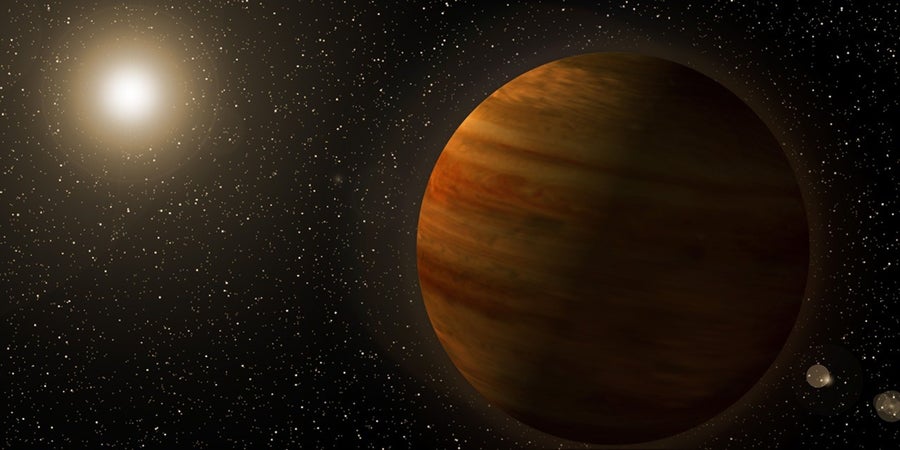
Artist’s concept visualizing Gaia23bra b, the first microlensing planet orbiting a distant star found by NASA’s TESS (Transiting Exoplanet Survey Satellite). NASA’s Goddard Space Flight Center
.
.
Click the link below for the complete article:
.
__________________________________________
July 6, 2026
Mohenjo
Business, Food For Thought, Human Interest, Political, Science, Technical
amazon, business, Business News, current-events, Future, Hotels, human-rights, medicine, mental-health, research, Science, Science News, technology, Technology News, travel, vacation

Hmmmm … Trump again!
Click the link below the picture
.
The United States’ quest to get Folarin Balogun’s red card overturned may have opened a Pandora’s box – one specifically designed to contain the national team’s worst nightmares.
With a country on the verge of falling in love with this team, and tens of millions eager for a reason to embrace the glory and pride this sport can provide, there were instead questions of fairness and propriety. A star striker, who made an honest, unintentional mistake – and said and did all the right things – became a talking point. And a day later, on an otherwise beautiful Monday evening in the Pacific north-west, the United States’ World Cup dream ended with a thud.
With a 4-1 loss to Belgium in the last 16, the US’s quest to change the way the world views American soccer ended at the same stage as it did in their last three World Cup appearances. The question this team rallied around – “Why not us?” – has been replaced by “What could have been?” Or, quite possibly: “What the hell just happened?”
Because though there were fleeting moments of hope, this US performance paled in comparison to those that set the world on notice earlier in this competition. No US team has looked better at a World Cup. No US team before scored goals like the ones they did – goals of quality and ingenuity. No US team before defended quite this capably, over such long periods of time.
Yet it ended with missed defensive assignments, poor giveaways and a moment of pure panic from the goalkeeper Matt Freese that sealed the US’s fate.
“From the beginning, we didn’t connect with the game. Even when we scored the goal, we conceded the next action. Congratulations, Belgium, they were better than us,” Mauricio Pochettino, the US coach, said after the game. “We didn’t show what this team can show.”
Given the events of the previous 36 hours, the US lineup came as no surprise. There was Balogun, starting up top in the same XI that so impressed against Paraguay and Bosnia and Herzegovina. His presence was always expected after his controversial, Trump-driven reinstatement.
On this evening, though, it was the Belgium manager, Rudi Garcia, who provided the first surprise. Two of the team’s stars, Kevin De Bruyne and Jérémy Doku, were omitted from the starting XI even though they were both healthy. Nicolas Raskin came in as the Red Devils’ central playmaker and Dodi Lukébakio replaced Doku on the wing. Lukébakio had terrorized the US in a friendly between the sides in March, scoring two goals in a 5-2 win that raised serious questions about the US’s ability to deal with the world’s best teams.
Consider those questions answered.
The US can’t claim there weren’t warning signs. In the eighth minute, Amadou Onana shrugged off several challenges and slipped the ball through to Lukébakio. The winger knifed through the US defense, sending a nice ball across the face of goal that Youri Tielemans scuffed. The danger had passed, but not for long.
Soon after, Belgium connected. This time, it was a long ball up from the back behind Alex Freeman that Leandro Trossard controlled with a single touch. His deflected pass was met by Raskin with a brilliant first touch of his own. He bounced the ball into the ground and past a flock of US defenders, giving Charles De Ketelaere a simple finish. The finish was deflating for the US fans, who dominated the stadium. For the second time at this World Cup, a high-flying US team faced a healthy dose of adversity.
And just as they did in the dead-rubber group game against Turkey, they crumbled. Weston McKennie, usually reliable and safe at this World Cup, handed Belgium additional opportunities through loose touches and misplaced passes. Christian Pulisic was frequently dispossessed in the midfield. Chris Richards, an anchor at the back, nearly gave the ball to De Ketelaere on the doorstep of goal. It took desperate defending to prevent a second Belgian goal.
Malik Tillman’s equalizer came out of nowhere. Balogun was vital, winning a free-kick on the edge of the area with some nice hold-up play. Just as he had against Bosnia and Herzegovina last week, Tillman sent a looping ball over the wall, finding a kind deflection from Hans Vanaken to flat-foot Thibaut Courtois. With the goal, Tillman became just the second player in World Cup history to score twice from direct free-kicks in a single tournament.
That will be cold comfort for the US. Any hopes of Tillman’s strike kicking off a US fightback were quickly extinguished. Once again, the Belgian threat came from the US’s right. Trossard found space behind Freeman and played a well-weighted ball on to the head of De Ketelaere, who had done well to muscle between Tim Ream and Antonee Robinson.
.
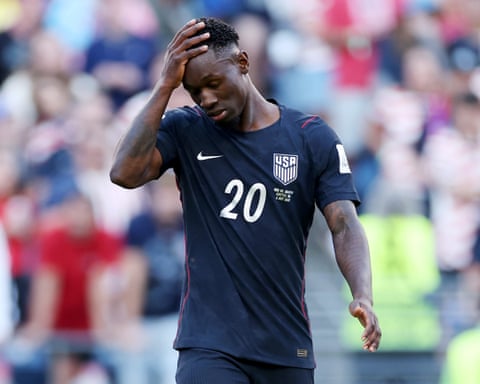 Folarin Balogun reflects as the US make their way to defeat against Belgium. Photograph: Sarah Stier/FIFA/Getty Images
.
.
Click the link below for the complete article:
.
__________________________________________
July 6, 2026
Mohenjo
Business, Food For Thought, Human Interest, Political, Science, Technical
amazon, business, Business News, current-events, Future, Hotels, human-rights, medicine, mental-health, research, Science, Science News, technology, Technology News, travel, vacation

Click the link below the picture
.
European leaders arrive for this year’s NATO summit meeting in Ankara, Turkey, with the alliance under threat.
They want to keep President Trump and the United States deeply engaged in NATO, but they have come to accept that the alliance is changing — and will have to rely far less on Washington for the conventional defense of Europe.
The Trump administration has made it clear that it is withdrawing troops and capabilities from Europe to shore up American military power in the Middle East and the Indo-Pacific, where China has become a rival to the United States.
The European governments want to ensure that the transition toward what many call NATO 3.0 is done as smoothly as possible. They want to feel confident that the gaps the Americans leave can be filled, even if imperfectly, to diminish their vulnerability to a more aggressive, militarized Russia.
The dangers of the current moment have been underscored by China’s test of a long-range ballistic missile on Monday, the first such launch in nearly two years, and another huge Russian missile and drone attack on Kyiv.
NATO leaders are expected to endorse continued support for Ukraine, with the non-American members pledging $80 billion this year and next. President Volodymyr Zelensky of Ukraine will attend, to press his urgent desire for more air defenses against the Russian onslaught.
Mark Rutte, the secretary general of NATO, is trying to walk a narrow line, prodding European member states to pay more for security while making sure Mr. Trump does not abandon the alliance in the process.
“We will breathe life into the concept of NATO 3.0: A stronger Europe in a stronger NATO,” he said last week.
But for several years at least, senior European officials say, the reality will be a gradually stronger Europe in a weaker NATO. There will be fewer American troops, fewer high-tech American capabilities and doubts that Mr. Trump would come to NATO’s aid in all circumstances, undermining deterrence.
Radoslaw Sikorski, Poland’s foreign minister and a former defense minister, outlined the transformation of NATO after it was founded in the aftermath of World War II.
“NATO 1.0 was a clear defense against Soviet aggression and expansionism, and NATO 2.0 was a post-Cold War search for purpose,” he said in an interview, with the alliance looking outside North America and Europe and, after Sept. 11, especially, to fight terrorism in Afghanistan and the Middle East.
Russia was seen as a possible ally and certainly less of a threat, and some European NATO members effectively disarmed, he said.
But with Russia’s full-scale invasion of Ukraine in 2022, China’s rising ambitions and Washington wanting to shift resources to Asia away from Europe, Mr. Sikorski said, “NATO 3.0 will mean that Europe will take more of the burden for conventional defense and the U.S. will be more of a cavalry-over-the-hill kind of ally.”
Time may be short to prepare. German and many NATO officials say a battle-hardened Russia would be ready for a war against NATO by 2029, so the pressure is on Europe to become more “war-ready,” as the Germans say, and on the United States not to create unnecessary vulnerabilities in the meantime.
In Ankara, Mr. Trump and his officials are expected to keep the pressure on other NATO members to pay more for defense, and to stick to a commitment made last year to increase spending to 5 percent of gross national product by 2035. Matthew Whitaker, the U.S. ambassador to NATO, warned allies last week that there may be benefits for those who pay up and difficulties for those who lag the others.
For a time, the Europeans hoped that American threats to reduce its contributions to NATO would fade, as they did in Mr. Trump’s first term. They now accept that the Americans are serious, and that they must step up in their own interests.
“It’s very clear that the U.S. role is changing,” said Claudia Major, an expert on trans-Atlantic security at the German Marshall Fund, a research group. She added that “the main hope is to do damage control and to get predictability.”
Europeans know they must do more, she said. The change “can be shaped but not avoided.”
.
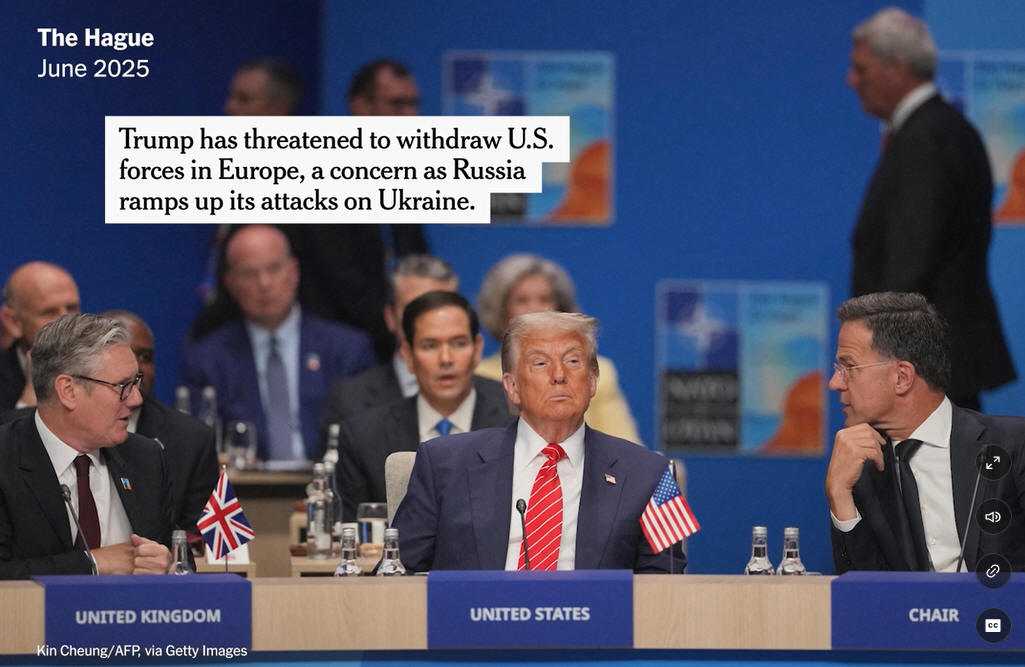 President Trump is expected to discuss American weaponry, NATO spending, and the Russia-Ukraine war during a NATO summit in Ankara, Turkey. CreditCredit…Haiyun Jiang/The New York Times
.
.
Click the link below for the complete article:
.
__________________________________________
July 6, 2026
Mohenjo
Business, Food For Thought, Human Interest, Political, Science, Technical
amazon, business, Business News, current-events, Future, Hotels, human-rights, medicine, mental-health, research, Science, Science News, technology, Technology News, travel, vacation

Hmmmm … Enlightening!
Click the link below the picture
Then you need to wait for this video to load, to a picture entitled
‘WE LOST THEM ALL’! THEN hit the play button, it’s approx 54 mins long!
‘Please be patient’
.
Thank you for watching and supporting Remembe! Discover the untold stories behind some of Hollywood’s most beloved talents in this powerful tribute. In this video, we honor 20 Black actors you may not have known have passed away — celebrating their legacy, unforgettable performances, and lasting impact on film and culture. From iconic roles to behind-the-scenes influence, these legends helped shape generations of storytelling.
Join Remembered Lives Channel as we reflect on their lives, careers, and the memories they left behind. This heartfelt compilation is a reminder of how their artistry continues to inspire millions around the world.
👉 Don’t forget to like, comment, and subscribe for more tributes and stories that deserve to be remembered. All materials featured in this video remain the property of their respective owners and are used with full respect and proper credit. This content is created in accordance with the U.S. Copyright Act of 1976, Section 107, which allows fair use.
We do not claim ownership of any copyrighted material included. All footage has been carefully repurposed under fair use guidelines for educational and inspirational purposes, with the intention of honoring legacy, resilience, and meaningful contributions throughout history. If any content owner has concerns or would like their material removed, please contact us directly.
✅ Thank you for being part of Remembered Lives Channel!
.
 .
.
.
Click the link below for the complete article:
.
__________________________________________
Older Entries
Newer Entries

