
Click the link below the picture
.
European leaders arrive for this year’s NATO summit meeting in Ankara, Turkey, with the alliance under threat.
They want to keep President Trump and the United States deeply engaged in NATO, but they have come to accept that the alliance is changing — and will have to rely far less on Washington for the conventional defense of Europe.
The Trump administration has made it clear that it is withdrawing troops and capabilities from Europe to shore up American military power in the Middle East and the Indo-Pacific, where China has become a rival to the United States.
The European governments want to ensure that the transition toward what many call NATO 3.0 is done as smoothly as possible. They want to feel confident that the gaps the Americans leave can be filled, even if imperfectly, to diminish their vulnerability to a more aggressive, militarized Russia.
The dangers of the current moment have been underscored by China’s test of a long-range ballistic missile on Monday, the first such launch in nearly two years, and another huge Russian missile and drone attack on Kyiv.
NATO leaders are expected to endorse continued support for Ukraine, with the non-American members pledging $80 billion this year and next. President Volodymyr Zelensky of Ukraine will attend, to press his urgent desire for more air defenses against the Russian onslaught.
Mark Rutte, the secretary general of NATO, is trying to walk a narrow line, prodding European member states to pay more for security while making sure Mr. Trump does not abandon the alliance in the process.
“We will breathe life into the concept of NATO 3.0: A stronger Europe in a stronger NATO,” he said last week.
But for several years at least, senior European officials say, the reality will be a gradually stronger Europe in a weaker NATO. There will be fewer American troops, fewer high-tech American capabilities and doubts that Mr. Trump would come to NATO’s aid in all circumstances, undermining deterrence.
Radoslaw Sikorski, Poland’s foreign minister and a former defense minister, outlined the transformation of NATO after it was founded in the aftermath of World War II.
“NATO 1.0 was a clear defense against Soviet aggression and expansionism, and NATO 2.0 was a post-Cold War search for purpose,” he said in an interview, with the alliance looking outside North America and Europe and, after Sept. 11, especially, to fight terrorism in Afghanistan and the Middle East.
Russia was seen as a possible ally and certainly less of a threat, and some European NATO members effectively disarmed, he said.
But with Russia’s full-scale invasion of Ukraine in 2022, China’s rising ambitions and Washington wanting to shift resources to Asia away from Europe, Mr. Sikorski said, “NATO 3.0 will mean that Europe will take more of the burden for conventional defense and the U.S. will be more of a cavalry-over-the-hill kind of ally.”
Time may be short to prepare. German and many NATO officials say a battle-hardened Russia would be ready for a war against NATO by 2029, so the pressure is on Europe to become more “war-ready,” as the Germans say, and on the United States not to create unnecessary vulnerabilities in the meantime.
In Ankara, Mr. Trump and his officials are expected to keep the pressure on other NATO members to pay more for defense, and to stick to a commitment made last year to increase spending to 5 percent of gross national product by 2035. Matthew Whitaker, the U.S. ambassador to NATO, warned allies last week that there may be benefits for those who pay up and difficulties for those who lag the others.
For a time, the Europeans hoped that American threats to reduce its contributions to NATO would fade, as they did in Mr. Trump’s first term. They now accept that the Americans are serious, and that they must step up in their own interests.
“It’s very clear that the U.S. role is changing,” said Claudia Major, an expert on trans-Atlantic security at the German Marshall Fund, a research group. She added that “the main hope is to do damage control and to get predictability.”
Europeans know they must do more, she said. The change “can be shaped but not avoided.”
.
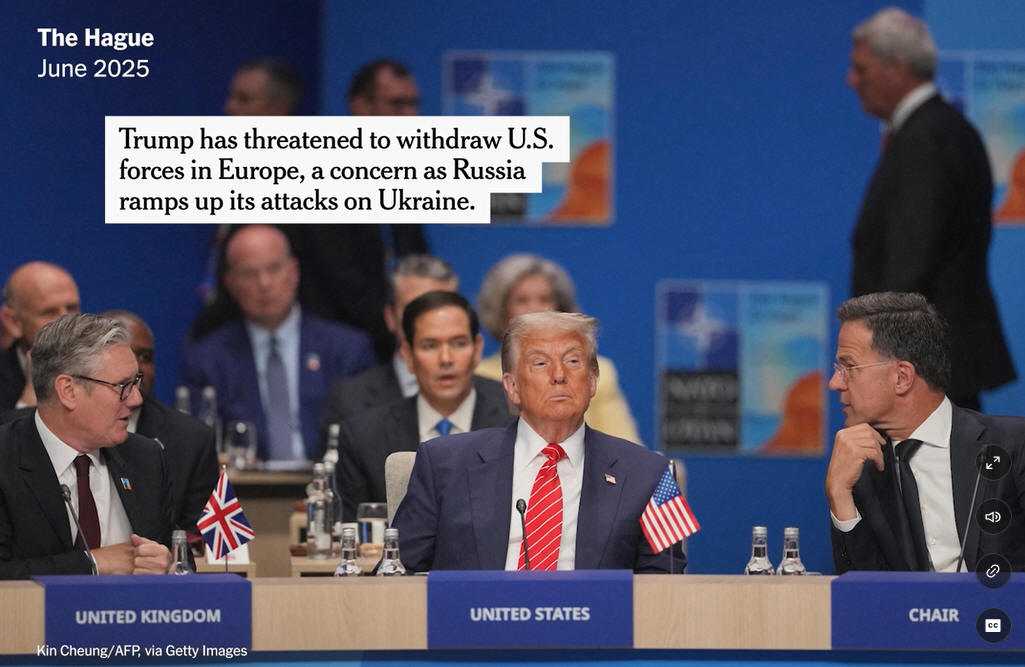 President Trump is expected to discuss American weaponry, NATO spending, and the Russia-Ukraine war during a NATO summit in Ankara, Turkey. CreditCredit…Haiyun Jiang/The New York Times
.
.
Click the link below for the complete article:
.
__________________________________________


Jul 07, 2026 @ 13:33:55
Nice read.
LikeLike