June 16, 2021
Mohenjo
Business, Food For Thought, Human Interest, Science, Technical
amazon, business, Business News, current-events, Future, Hotels, human-rights, medicine, mental-health, research, Science, Science News, technology, Technology News, travel, vacation

Click the link below the picture
.
In 1974, Stephen Hawking theorized that the universe’s darkest gravitational behemoths, black holes, were not the pitch-black star swallowers astronomers imagined, but they spontaneously emitted light — a phenomenon now dubbed Hawking radiation.
The problem is, no astronomer has ever observed Hawking’s mysterious radiation, and because it is predicted to be very dim, they may never will. This is why scientists today are creating their own black holes.
Researchers at the Technion-Israel Institute of Technology did just that. They created a black hole analog out of a few thousand atoms. They were trying to confirm two of Hawking’s most important predictions, that Hawking radiation arises from nothing and that it does not change in intensity over time, meaning it’s stationary.
“A black hole is supposed to radiate like a black body, which is essentially a warm object that emits a constant infrared radiation,” study co-author Jeff Steinhauer, an associate professor of physics at Technion-Israel Institute of Technology, told Phys.org. “Hawking suggested that black holes are just like regular stars, which radiate a certain type of radiation all the time, constantly. That’s what we wanted to confirm in our study, and we did.”
.
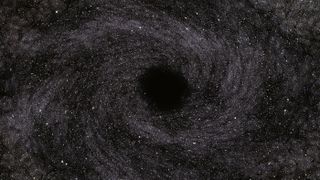 Image credit: Aaron Horowitz via Getty Images)
.
.
Click the link below for the article:
.
__________________________________________
June 16, 2021
Mohenjo
Crime, Human Interest, Medical, missed News, Political, Science, sports, Technical
amazon, business, Business News, current-events, Future, Hotels, human-rights, medicine, mental-health, research, Science, Science News, technology, Technology News, travel, vacation

.
News You might have missed!
Use your browser or smartphone back arrow (<-) to return to this table for your next selection.
.
__________________________________________
June 15, 2021
Mohenjo
Business, Enthralling, Human Interest, Photographs
amazon, business, Business News, current-events, Future, Hotels, human-rights, medicine, mental-health, research, Science, Science News, technology, Technology News, travel, vacation

Click the link below the picture
.
Rio de Janeiro, or simply Rio, is the second-most populous city in Brazil and the sixth-most populous in the Americas. Rio de Janeiro is the capital of the state of Rio de Janeiro, Brazil’s third-most populous state, after São Paulo and Minas Gerais. Part of the city has been designated as a World Heritage Site, named “Rio de Janeiro: Carioca Landscapes between the Mountain and the Sea”, by UNESCO on 1 July 2012 as a Cultural Landscape.
Founded in 1565 by the Portuguese, the city was initially the seat of the Captaincy of Rio de Janeiro, a domain of the Portuguese Empire. Later, in 1763, it became the capital of the State of Brazil, a state of the Portuguese Empire. In 1808, when the Portuguese Royal Court transferred itself from Portugal to Brazil, Rio de Janeiro became the chosen seat of the court of Queen Maria I of Portugal, who subsequently, in 1815, under the leadership of her son, the prince regent, and future King João VI of Portugal, raised Brazil to the dignity of a kingdom, within the United Kingdom of Portugal, Brazil, and Algarves. Rio stayed the capital of the plus continental Lusitanian monarchy until 1822 when the War of Brazilian Independence began. This is one of the few instances in history that the capital of a colonizing country officially shifted to a city in one of its colonies. Rio de Janeiro subsequently served as the capital of the independent monarchy, the Empire of Brazil, until 1889, and then the capital of a republican Brazil until 1960 when the capital was transferred to Brasília. Wikipedia
.
 An image from Rio de Janeiro Brazil
.
.
Click the link below for images:
.
__________________________________________
June 15, 2021
Mohenjo
Business, Human Interest, Science, Technical
amazon, business, Business News, current-events, Future, Hotels, human-rights, medicine, mental-health, research, Science, Science News, technology, Technology News, travel, vacation

Click the link below the picture
.
A few years ago researchers using the radio-based Event Horizon Telescope (EHT) performed an extraordinary observation, the likes of which remains a dream for most other astronomers. The EHT team announced in April 2019 that it had successfully imaged the shadow of a supermassive black hole in a nearby galaxy by combining observations from eight different radio telescopes spread across our planet. This technique, called interferometry, effectively gave the EHT the resolution, or the ability to distinguish sources in the sky, of an Earth-sized telescope. At the optical wavelengths underpinning the gorgeous pictures from the Hubble Space Telescope and many other famed facilities, today’s interferometers can only combine light from instruments that are a few hundred meters apart at most. That may be set to change as astronomers turn to quantum physicists for help to start connecting optical telescopes that are tens, even hundreds, of kilometers away from one another.
Such optical interferometers would rely on advances being made in the field of quantum communications—particularly the development of devices that store the delicate quantum states of photons collected at each telescope. Called quantum hard drives (QHDs), these devices would be physically transported to a centralized location where the data from each telescope would be retrieved and combined with the others to collectively reveal details about some distant celestial object.
This technique is reminiscent of the iconic double-slit experiment, first performed by physicist Thomas Young in 1801, in which light falls on an opaque barrier that has two slits through which it can pass. The light recombines on the other side of the barrier, creating an interference pattern of bright and dark stripes, also known as an interferogram. This works even if individual photons trickle through the slits one by one: over time, the interference pattern will still emerge.
.
 Composed of four 8.2-meter telescopes that can act as one, the European Southern Observatory’s Very Large Telescope in northern Chile is the world’s premier astronomical facility for optical interferometry. New approaches from the quantum world, however, could allow astronomers to make far larger and more capable optical interferometers. Credit: Juan Carlos Muñoz-Mateos/ESO
.
.
Click the link below for the article:
.
__________________________________________
June 15, 2021
Mohenjo
Business, Human Interest, Science, Technical
amazon, business, Business News, current-events, Future, Hotels, human-rights, medicine, mental-health, research, Science, Science News, technology, Technology News, travel, vacation
Some content on this page was disabled on April 15, 2025 as a result of a DMCA takedown notice from Guardian Media Group. You can learn more about the DMCA here:
https://wordpress.com/support/copyright-and-the-dmca/
June 15, 2021
Mohenjo
Food For Thought, Human Interest, Medical, missed News, Science, Technical
amazon, business, Business News, current-events, Future, Hotels, human-rights, medicine, mental-health, research, Science, Science News, technology, Technology News, travel, vacation
.
News You might have missed!
Use your browser or smartphone back arrow (<-) to return to this table for your next selection.
.
__________________________________________
June 14, 2021
Mohenjo
Business, Enthralling, Human Interest, Photographs
amazon, business, Business News, current-events, Future, Hotels, human-rights, medicine, mental-health, research, Science, Science News, technology, Technology News, travel, vacation
Click the link below the picture
.
The Quadiriki Caves are located in Arikok National Park on the island of Aruba. There are three caves, which tourists commonly explore. The caves are located at the base of a limestone cliff. They contain Amerindian petroglyphs. The name of the caves is of Arawak origin.
The first two chambers in the largest 150 m (490 ft) long cave are illuminated by holes in the cave ceiling, while the third chamber is damp and dark, filled with bat guano. The limestone cave contains stalactites and stalagmites.
A smaller 30 m (98 ft) long cave to the east from the main cave is especially rich in Amerindian petroglyphs.
A mythical folk tale relates to a daughter of an Indian chief who fell in love and was imprisoned in the cave as her lover was not acceptable to her father. Her beloved one was imprisoned nearby, in Huliba Cave (Tunnel of Love), but both lovers managed to meet underground. Both reportedly died in the cave and their spirit vanished into heaven through the holes in the roof of the cave. Wikipedia
.
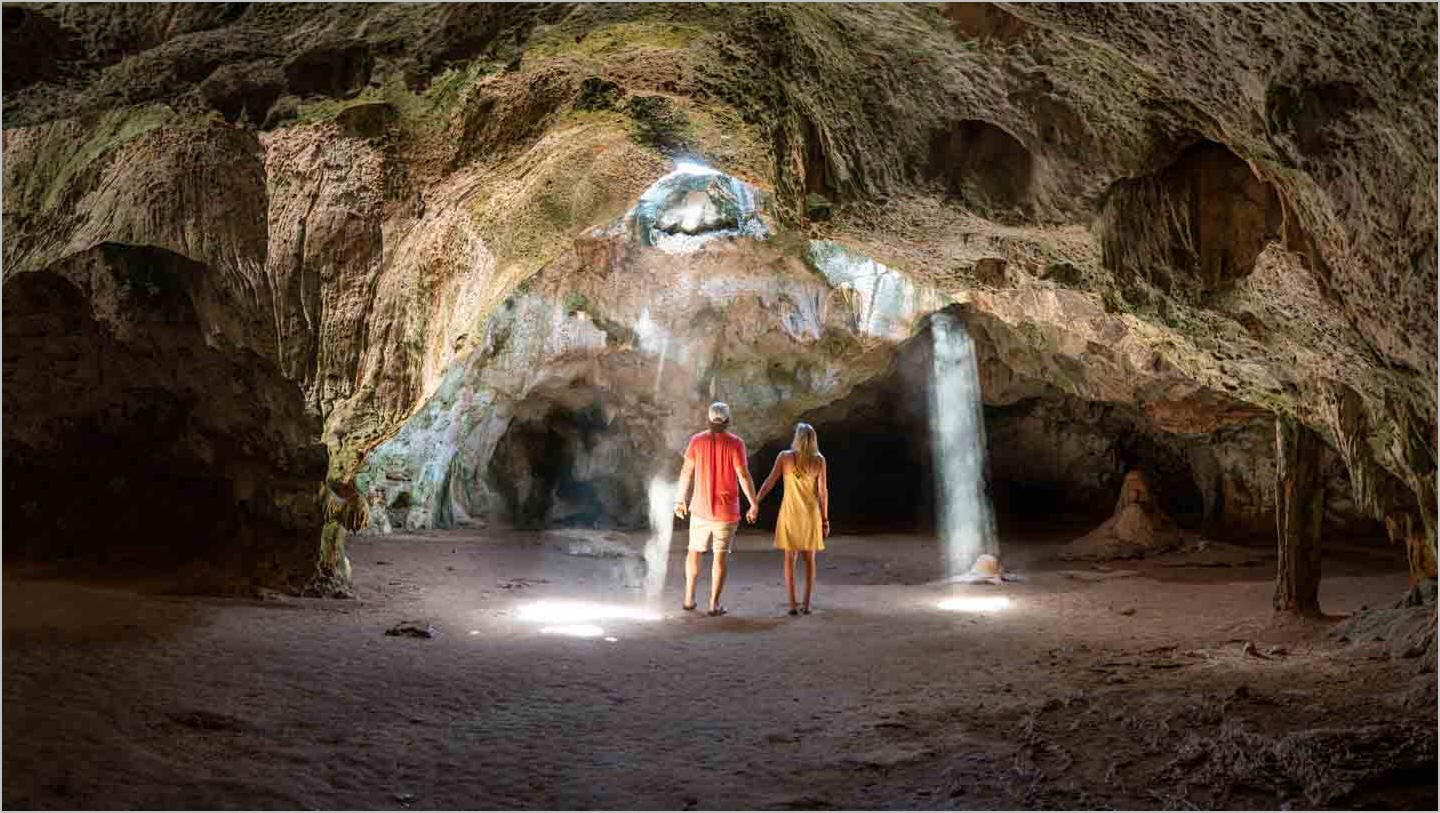 An image from Quadirikiri Cave, Arikok National Park, Aruba
.
.
Click the link below for images:
.
__________________________________________
June 14, 2021
Mohenjo
Business, Food For Thought, Human Interest, Science, Technical
amazon, business, Business News, current-events, Future, Hotels, human-rights, medicine, mental-health, research, Science, Science News, technology, Technology News, travel, vacation

Click the link below the picture
.
On September 16, 2011, an anime fan posted a math question to the online bulletin board 4chan about the cult classic television series The Melancholy of Haruhi Suzumiya. Season one of the show, which involves time travel, had originally aired in nonchronological order, and a re-broadcast and a DVD version had each further rearranged the episodes. Fans were arguing online about the best order to watch the episodes, and the 4chan poster wondered: If viewers wanted to see the series in every possible order, what is the shortest list of episodes they’d have to watch?
In less than an hour, an anonymous person offered an answer — not a complete solution, but a lower bound on the number of episodes required. The argument, which covered series with any number of episodes, showed that for the 14-episode first season of Haruhi, viewers would have to watch at least 93,884,313,611 episodes to see all possible orderings. “Please look over [the proof] for any loopholes I might have missed,” the anonymous poster wrote.
The proof slipped under the radar of the mathematics community for seven years — apparently, only one professional mathematician spotted it at the time, and he didn’t check it carefully. But in a plot twist in late-2018, the Australian science fiction novelist Greg Egan proved a new upper bound on the number of episodes required. Egan’s discovery renewed interest in the problem and drew attention to the lower bound posted anonymously in 2011. Both proofs are now being hailed as significant advances on a puzzle mathematicians have been studying for at least 25 years.
.

Credit: Maciej Rebisz for Quanta Magazine.
.
.
Click the link below for the article:
.
__________________________________________
June 14, 2021
Mohenjo
Business, Food For Thought, Human Interest, Science, Technical
amazon, business, Business News, current-events, Future, Hotels, human-rights, medicine, mental-health, research, Science, Science News, technology, Technology News, travel, vacation

Click the link below the picture
.
Raul Puente-Martinez has been pierced by quite a number of cactuses in his time. A research botanist and curator of living collections at the Desert Botanical Garden in Phoenix, he’s been studying prickly pears and chollas, which are infamous for their barbed spines, for decades. However, the worst cholla attack he’s ever witnessed came while he was hiking with several friends in Mexico. As they strolled through a cholla forest, one of the hikers discovered a chunk of cactus stuck to the tip of his shoe. He tried kicking his foot out to dislodge the spiny hitchhiker. Sure enough, most of the cactus flew off—including one piece that shot straight up and became stuck in the man’s upper lip.
Luckily, Puente-Martinez has had a lot of practice with removing spines. “You could see that they were really deep inside his lip,” he recalls. “Every time I pulled one, there was this little stream of blood coming out of the hole; that was pretty bad.”
Most cactus encounters aren’t quite that harrowing. But cactuses are ubiquitous in some parts of the desert, not to mention their popularity as houseplants. They’ve evolved a wide variety of spines to thrive in the unforgiving desert and some can snare you more easily than others. They can also cause painful complications. So it’s a good idea to prepare yourself for a cactus crisis. Luckily, Puente-Martinez and several other cactus experts can offer a number of tips for removing spines based on their hard-won experience.
.

Prickly pear spines up close and personal. Photo by Raul Puente-Martinez.
.
.
Click the link below for the article:
.
__________________________________________
June 14, 2021
Mohenjo
Crime, Human Interest, Medical, missed News, Political, Science, sports, Technical
amazon, business, Business News, current-events, Future, Hotels, human-rights, medicine, mental-health, research, Science, Science News, technology, Technology News, travel, vacation
.
News You might have missed!
Use your browser or smartphone back arrow (<-) to return to this table for your next selection.
.
__________________________________________
Older Entries
Newer Entries
 James' World 2