
Click the link below the picture
.
A Trump administration proposal to exclude some types of immigrants from the 2030 census might not expand the congressional map for Republicans, and could even result in fewer House seats in red states.
If congressional seats were redistributed based on recent census figures, excluding undocumented immigrants and other noncitizens without green cards could cause Texas to lose a congressional seat it would otherwise have gained, according to a New York Times analysis. Minnesota, a blue-leaning state, could gain a seat.
States are allotted congressional seats based on their populations during a process called reapportionment, which uses census data and occurs every 10 years. The next decennial census is slated to happen in 2030.
Though there are no official public statistics for the immigrants targeted by the proposal, two separate organizations estimated the group’s size in two recent years, 2023 and 2024. The Times used those estimates to explore the effect Mr. Trump’s proposal could have on the number of congressional seats each state would have received if reapportionment had happened in each of those years.
Both groups — FWD.us and Pew — produce detailed statistics on the types of foreign-born residents in order to estimate the undocumented population. Despite using different methods, they ended up with broadly similar results.
If reapportionment had happened in 2024 under the Trump administration proposal, it would have struck two seats from Republican strongholds in Texas and Florida, according to The Times’s analysis of the FWD.us estimates. Minnesota and Oregon would each have received one additional seat.
The map would look slightly different using Pew’s estimates, which are based on 2023 population figures. A hypothetical scenario for that year would result in a political wash. Texas would again have one fewer seat than it would have had under a full census count, and Minnesota one more, but Ohio would also gain a seat at the expense of Rhode Island.
“This isn’t exactly what I think the powers that be expected,” said Jeffrey Passel, a senior demographer at Pew who produced its breakdown of the immigrant population.
The variance between the scenarios can be attributed to differences both in the census counts for each year and in the two groups’ estimates.
For example, Florida’s growth between 2023 and 2024 would have been enough to give it another House seat. But excluding the immigrants targeted in the proposal would have canceled out that gain.
.
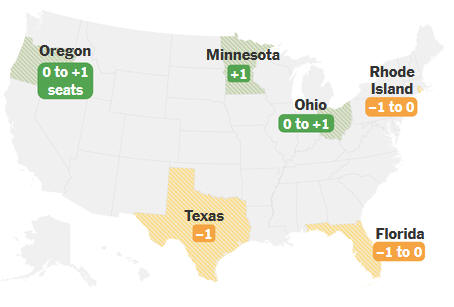
Result in fewer House seats in red states.
.
.
Click the link below for the complete article:
.
__________________________________________


Leave a Reply