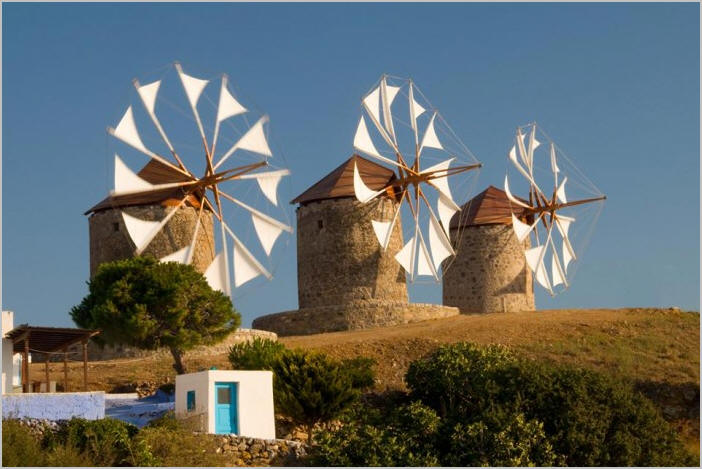
The windmills are an iconic feature of the Greek island of the Mykonos.The island is one of the Cyclades islands, which neighbour Delos in the Aegean Sea. The windmills can be seen from every point of the village of Mykonos, the island’s principal village, which is frequently called the Chora (which translates to “Country” in Greek, but refers to an island’s “Town”) on Greek islands. The windmills are the first thing seen when coming into the harbour of Alefkandra, as they stand on a hill overlooking the area. Most windmills face towards the North where the island’s climate sources its strongest winds over the largest part of the year. There are currently 16 windmills on Mykonos of which seven are positioned on the landmark hill in Chora. Most of them were built by the Venetians in the 16th century, but their construction continued into the early 20th century. They were primarily used to mill wheat. They were an important source of income for the inhabitants. Their use gradually declined until they ceased production in the middle of the 20th century. The architecture of each of them is similar, all have a round shape, white colour and a pointed roof and very small windows. Such windmills are found in almost all Cyclades islands. One of these windmills has been transformed into a museum. The whole village of Chora and part of the harbour are visible from this point.
“It’s such an interesting feeling,” said Alex Delaney, 28, a teacher who lives in Brooklyn. “I fully identify as an introvert and like to spend time alone, but I’ve had more urges [in the last year] than ever to want to be at a club or go to a bar, which are places I would never go prior to the pandemic. It’s funny, though, because I feel like once I do have the option to go to those places again, I probably won’t.”
Delaney is one of the thousands of introverts who responded to a callout from BuzzFeed News asking how the pandemic has affected them. It’s easy to assume that for a group of people known to relish their alone time, a pandemic that encourages social distancing and isolation might paradoxically offer some great respite. It’s not that simple though.
While a great portion of respondents noted that their desire for socializing has decreased during the pandemic, others realized that they do like — and even need — a decent amount of human interaction from time to time, like Jane Eckles, 24, of Hartland, Wisconsin. “I’ve almost forgotten what it’s like when a person accidentally bumps into you in Target and you start chatting, and you realize that your cousins went to the same college,” she said. “I miss the little things.”
The academic discipline of psychology was developed largely in North America and Europe. Some would argue it’s been remarkably successful in understanding what drives human behavior and mental processes, which have long been thought to be universal. But in recent decades some researchers have started questioning this approach, arguing that many psychological phenomena are shaped by the culture we live in.
Clearly, humans are in many ways very similar – we share the same physiology and have the same basic needs, such as nourishment, safety, and sexuality. So what effect can culture really have on the fundamental aspects of our psyche, such as perception, cognition, and personality? Let’s take a look at the evidence so far.
Experimental psychologists typically study behavior in a small group of people, with the assumption that this can be generalized to the wider human population. If the population is considered to be homogeneous, then such inferences can indeed be made from a random sample.
.
Holistic thinking, common in Japan, leads to a certain way of memorizing. Photo from mackwo7/pixabay.
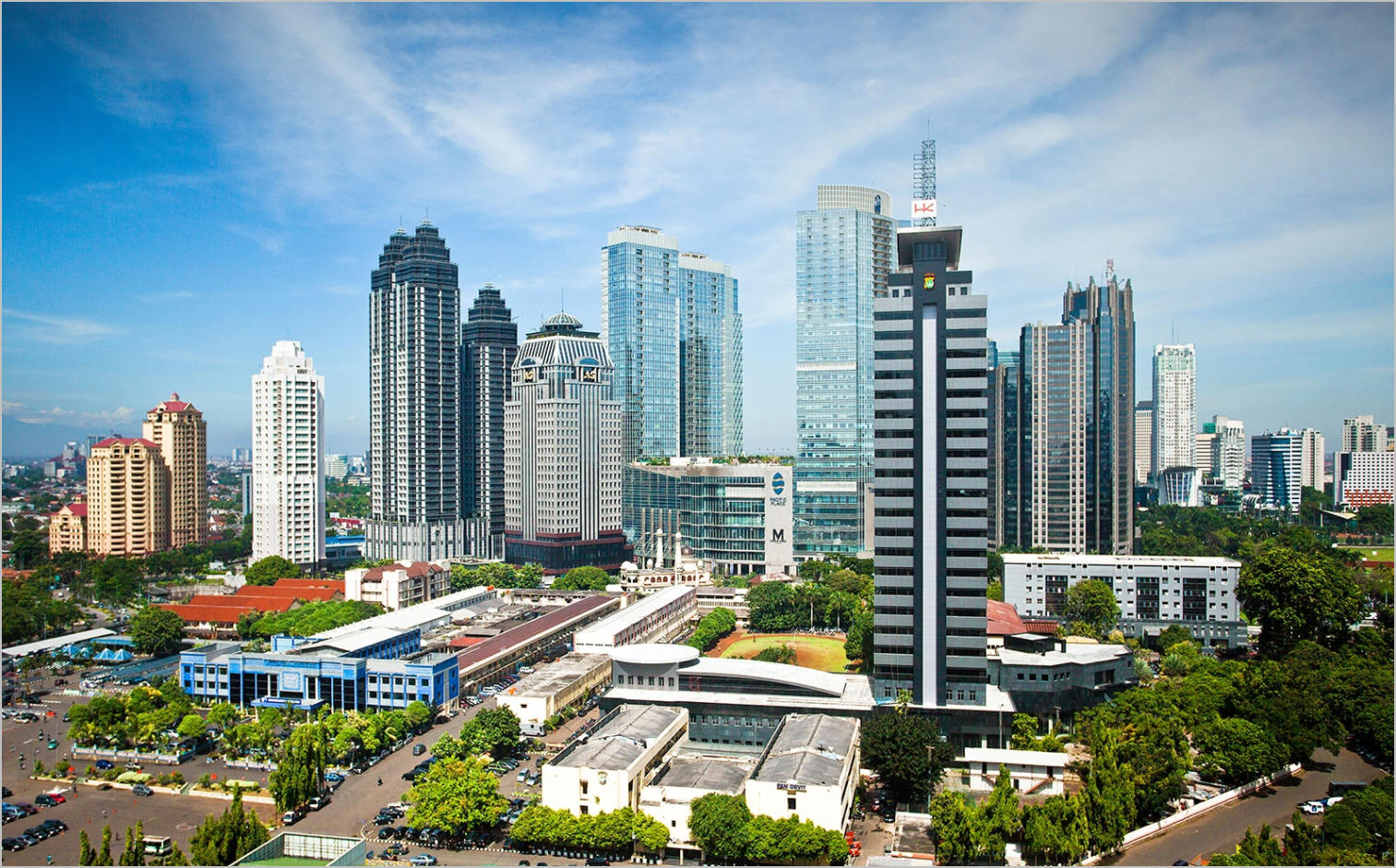
Jakarta, officially the Special Capital Region of Jakarta, is the capital of Indonesia.It lies on the northwest coast of Java (the world’s most populous island). Jakarta is the center of the economy, culture, and politics of Indonesia. It has a province-level status which had a population of 10,562,088 as of 2020. Although Jakarta extends over only 699.5 square kilometers (270.1 sq mi) and thus has the smallest area of any Indonesian province, its metropolitan area covers 6,392 square kilometers (2,468 sq mi), and is the world’s second-most populous urban area, after Tokyo. It has a population of about 35.934 million as of 2020. Jakarta’s business opportunities, and its ability to offer a potentially higher standard of living than is available in other parts of the country, have attracted migrants from across the Indonesian archipelago, making it a melting pot of numerous cultures. Jakarta’s nickname is “the Big Durian”, after the thorny, strong-smelling fruit of that name that is native to the region. Calling Jakarta “the Big Durian” is seen as a nod to New York’s nickname, “the Big Apple”.
In July, Clare Wenham—and her daughter, Scarlett, and Scarlett’s picture of a unicorn—went viral. Wenham researches global health policy at the London School of Economics, and she was giving an interview to the BBC about Britain’s attempts to manage the coronavirus pandemic. But Scarlett had another pressing issue on her mind: Which shelf displayed her unicorn to its best advantage?
Wenham soldiered on through Scarlett’s entreaties, and her interviewer even offered his opinion (the lower shelf, if you’re interested). The moment provided a neat contrast with another incident three years earlier, also on the BBC, when the South Korea expert Robert Kelly was interrupted by his children during a live interview from his home. Back then, the clip’s humor came from Kelly’s wife desperately trying to salvage his professional facade by running into the room to retrieve his 4-year-old daughter and nine-month-old son. For Wenham, that wasn’t an option: Her partner was working in another room, oblivious to the chaos. She just had to get on with it.
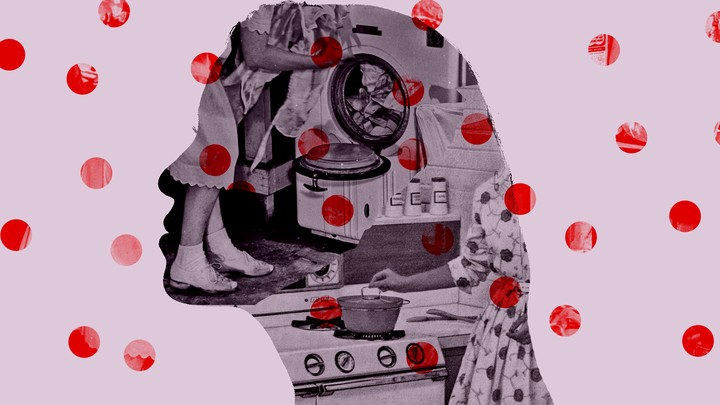
The idealized image of working parents as swans—serene on the surface, frantically paddling away under the water—has been an unexpected casualty of the pandemic. Zoom meetings have ensured that employers, and the outside world, can’t help but see the struggle.
.
Hulton Archive / The LIFE Picture Collection / Getty / Adam Maida / The Atlantic
Advice My Parents Gave Me: Go to college and major in what you love.
Advice I Will Give My Kids: Go to college only if you’ll major in science, engineering, or money. It’s a bleak job market, and majoring in English literature or anything with the word “English” in it has been useless since the Taft Administration.
My Parents: Never show up to a party empty-handed.
Me: Never show up to a party. Send a text to the host twenty minutes before the party starts to say that you’re “sooooooo sorry” to cancel but your stomach is feeling “weird.”
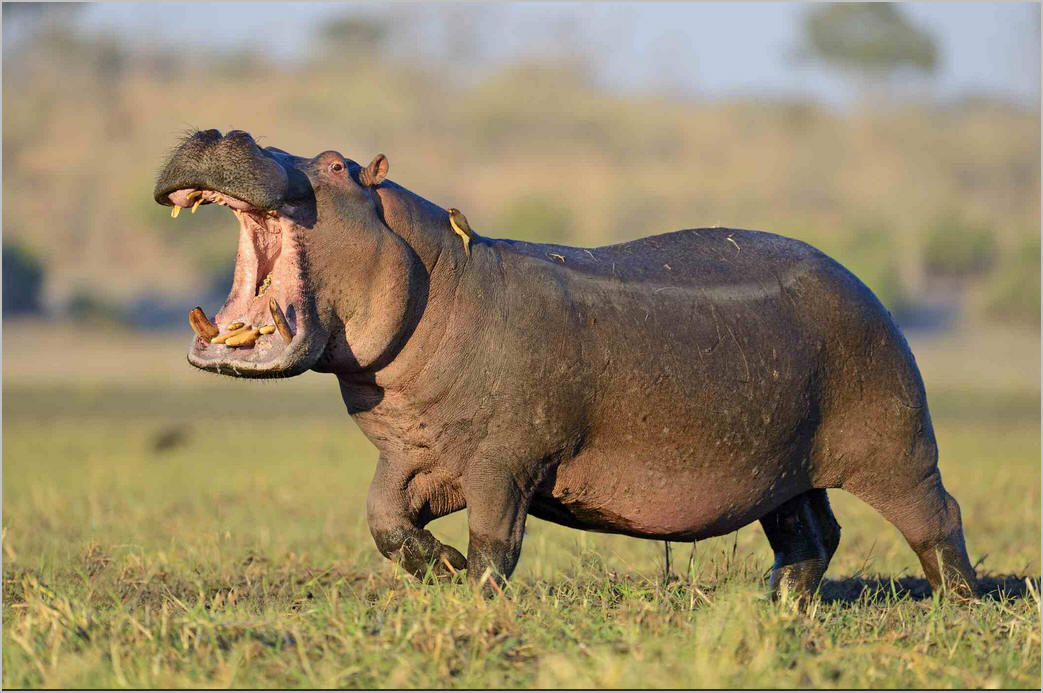
The hippopotamus also called the hippo, common hippopotamus or river hippopotamus, is a large, mostly herbivorous, semiaquatic mammal and ungulate native to sub-Saharan Africa. It is one of only two extant species in the family Hippopotamidae, the other being the pygmy hippopotamus (Choeropsis liberiensis or Hexaprotodon liberiensis). The name comes from the ancient Greek for “river horse” (ἱπποπόταμος).
After the elephant and rhinoceros, the hippopotamus is the third-largest type of land mammal and the heaviest extant artiodactyl (in the traditional, non-cladistic sense of the term, not including cetaceans). Despite their physical resemblance to pigs and other terrestrial even-toed ungulates, the closest living relatives of the Hippopotamidae are cetaceans (whales, dolphins, porpoises, etc.), from which they diverged about 55 million years ago. Hippos are recognizable by their barrel-shaped torsos, wide-opening mouths revealing large canine tusks, nearly hairless bodies, columnar legs, and large size; adults average 1,500 kg (3,310 lb) for males and 1,300 kg (2,870 lb) for females. Despite its stocky shape and short legs, it is capable of running 30 km/h (19 mph) over short distances.
A few years ago on a gorgeous June day, I found myself in a windowless bathroom with forget-me-not wallpaper, my butt on a toilet, without any good reason to be there. It was a standard mothering move. Beyond the door, I could hear my two small kids laughing and eating cereal, so I stayed in this little space, smartphone in hand. In an hour, I was headed to a bowling alley with my kids, both of whom could now walk through a doorway on their own. And this was a brilliant new development, not just for the 2-year-old who’d learned to walk at the standard age, but for the 4-year-old, Fiona, who’d spent the past three and a half years in physical therapy striving toward this lofty goal. Forty-five percent of people with Wolf-Hirschhorn syndrome walk, said the report when I first got her diagnosis. Her ability to walk meant I no longer had to consider wheelchair or stroller accessibility. Her ability to walk independently meant she could navigate the tight turns around a bowling ball return without having to steer a clunky walker. So I was taking my kids’ bowling, as soon as I stopped pretend-peeing and reading on my phone.
I was reading a friend’s blog post about a recent appointment with her counselor. As soon as she mentioned her son, who has the same chromosomal syndrome as my daughter, she began to cry.
The therapist asked, “Why do you always cry when you talk about him in here?”
Film and Writing Festival for Comedy. Showcasing best of comedy short films at the FEEDBACK Film Festival. Plus, showcasing best of comedy novels, short stories, poems, screenplays (TV, short, feature) at the festival performed by professional actors.