Scientists at Michigan State University announced this week the creation of a “transparent luminescent solar concentrator” that could turn windows and even cellphone screens into solar-power generators.
This technology could mean that one day entire skyscrapers might be able to generate solar power without blocking out light or ruining tenants’ views.
The material works by absorbing light in the invisible spectrum (ultraviolet and near infrared) and then re-emitting it in the infrared. The infrared light is then channeled to the edge of the clear surface, where thin strips of photovoltaic cells generate the power.
.
Solar power with a view: MSU doctoral student Yimu Zhao holds up a transparent luminescent solar concentrator module. | Yimu Zhao
Scientists have created a swarm of over a thousand coin-sized robots that can assemble themselves into two-dimensional shapes by communicating with their neighbours.
At 1,024 members, this man-made flock — described in the 15 August issue of Science — is the largest yet to demonstrate collective behaviour. The self-organization techniques used by the tiny machines could aid the development of ‘transformer’ robots that reconfigure themselves, researchers say, and they might shed light on how complex swarms form in nature.
Scientists know that humans, chimpanzees, and other primates can convey surprising amounts of information by means of a glance and tilt of the head. But what about animals with eyes on the sides of their heads, like deer and horses? What kind of social cues do they use to communicate?
Now, mammal communication experts report that, at least for horses, a great deal of information is conveyed through the position of the animal’s ears as well as its eyes.
.
Author Jennifer Wathan is shown with study participant Bartie.
National Aeronautics and Space Administration has produced something(fuel) out of nothing(empty space), paving a way to the stars in the process. The new ‘impossible’ microwave propulsion system, ‘Cannae Drive’ is a concept from inventor Roger Sawyer, which NASA was initially sceptical to test.
The propulsion system uses just electricity to produce propulsion. Usually, according to the law of “equal and opposite reactions, thrusters need to eject some mass. All scientists face the question of how to get the maximum thrust from the least amount of fuel.
When astronomers detected a strange signal in a massive galaxy cluster millions of light years from Earth, they knew they had stumbled upon something big.
“I couldn’t believe my eyes,” Esra Bulbul, of the Harvard Center for Astrophysics, said in a written statement. “What we found, at first glance, could not be explained by known physics.”
Political favoritism can quite literally be seen from space, according to a new study that finds the home regions of leaders become brighter at night after the person comes to power.
The findings apply mostly to countries with weak political institutions and limited public education. One prominent example was Zaire (now the Democratic Republic of the Congo) during the reign of Mobuto Sese Seko. Mobuto, who was president between 1971 and 1997, was born near the small town of Gbadolite. While he was in power, the town flourished.
“Mobuto built a huge palace complex costing millions of dollars, luxury guesthouses, an airport capable of handling Concords, and had the country’s best supply of water, electricity and medical services,” study researcher Paul Raschky, an economist at Monash University in Australia, said in a statement. Years of satellite data reveal Gbadolite as initially dark at night, brightening under Mobuto and quickly fading again after the authoritarian ruler’s exile and death.
.
In this image, snapped from the International Space Station on Jan. 30, 2014, while South Korea (lower right) and China (upper left) are aglow in lights, poverty-stricken North Korea is really in the dark. | NASA Earth Observatory
Black holes might end their lives by transforming into their exact opposite — ‘white holes’ that explosively pour all the material they ever swallowed into space, say two physicists. The suggestion, based on a speculative quantum theory of gravity, could solve a long-standing conundrum about whether black holes destroy information.
The theory suggests that the transition from black hole to white hole would take place right after the initial formation of the black hole, but because gravity dilates time, outside observers would see the black hole lasting billions or trillions of years or more, depending on its size. If the authors are correct, tiny black holes that formed during the very early history of the Universe would now be ready to pop off like firecrackers and might be detected as high-energy cosmic rays or other radiation. In fact, they say, their work could imply that some of the dramatic flares commonly considered to be supernova explosions could in fact be the dying throes of tiny black holes that formed shortly after the Big Bang.
.
Artist’s conception of a black hole. | MARK GARLICK via Getty Images
It’s highly unlikely we’re alone in the universe, NASA experts are saying, and we may be close to finding alien life. In fact, it may happen in the next two decades.
NASA held a panel discussion at the agency’s Washington headquarters on Monday, where space experts talked about the search for Earth-like planets that host life. Based on recent advancements in space telescope technology, scientists estimated that in the coming decades we’ll confirm suspicions that we’re not alone.
“I think in the next 20 years we will find out we are not alone in the universe,” NASA astronomer Kevin Hand said in footage filmed at the discussion and posted on YouTube.
.
NASA scientist say it won’t be long before we find habitable, Earth-like planets with alien life. | Getty Images
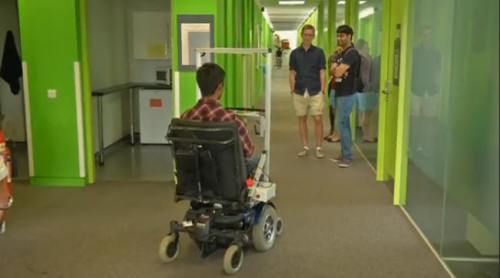
Scientists in London have developed an algorithm-based decoder system that enables wheelchair users to move around simply by looking to where they wish to travel. The researchers at Imperial College London say the system is inexpensive and easy to use and could transform the lives of people who are unable to use their limbs.
Algorithms working with inexpensive software could help quadriplegics steer wheelchairs simply by looking in their desired direction of travel. An Imperial College London team says their newly devised system can read eye movements to tell if a person is merely gazing or wants to move. Co-designer and student Kirubin Pillay says it’s simple to use.
Film and Writing Festival for Comedy. Showcasing best of comedy short films at the FEEDBACK Film Festival. Plus, showcasing best of comedy novels, short stories, poems, screenplays (TV, short, feature) at the festival performed by professional actors.