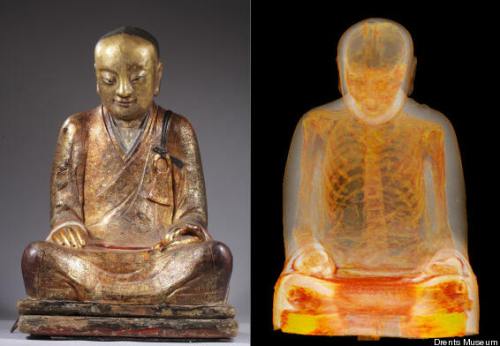
Researchers examining a nearly 1,000-year-old statue of Buddha on display in Holland discovered something very unusual hidden inside: the mummy of a meditating monk.
Calling the mummy its “oldest patient ever,” the Meander Medical Center in the Dutch city of Amersfoort used a CT scanner to take images of the body inside the statue and an endoscope to examine the thoracic and abdominal cavities.
The mummy is believed to be that of Liuquan, a Buddhist monk who died in China around 1,100 A.D. During their examination, the researchers found that the mummy’s internal organs had apparently been removed and the space filled with “paper scraps that were printed with ancient Chinese characters,” the hospital said in a news release.
.
Buddha mummy statue (left) and CT scan image showing mummy inside (right).
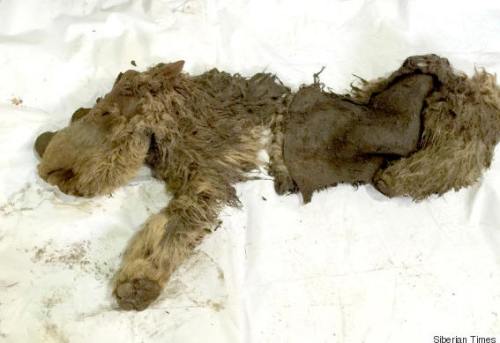
Scientists are going gaga over the recent discovery of a baby woolly rhino.
The pristine specimen of the tiny extinct rhino–the only one of its type ever found–was discovered in permafrost along the bank of a stream in Siberia’s Sakha Republic, The Siberian Times reported.
“At first we thought it was a reindeer’s carcass, but after it thawed and fell down we saw a horn on its upper jaw and realized it must be a rhino,” Alexander ‘Sasha’ Banderov, the hunter who made the discovery, told the Times. “The part of the carcass that stuck out of the ice was eaten by wild animals, but the rest of it was inside the permafrost and preserved well.”
.
(Academy of Sciences Republic of Sakha/Siberian Times)
Sea levels across the Northeast coast of the United States rose nearly 3.9 inches between 2009 and 2010, according to a new study from researchers at the University of Arizona and the National Oceanic and Atmospheric Administration. The waters near Portland, Maine, saw an even greater rise — 5 inches — over the two-year period.
While scientists have been observing higher sea levels across the globe in recent decades, the study found a much more extreme rise than previous averages. Such an event is “unprecedented” in the history of the tide gauge record, according to the researchers, and represents a 1-in-850 year event.
“Unlike storm surge, this event caused persistent and widespread coastal flooding even without apparent weather processes,” the study’s authors wrote. “In terms of beach erosion, the impact of the 2009-2010 [sea level rise] event is almost as significant as some hurricane events.”
.
Sea Levels along the U.S. Northeast rose nearly 4 inches in two years, according to a new study. (Fotosearch/Getty Images) | Fotosearch via Getty Images
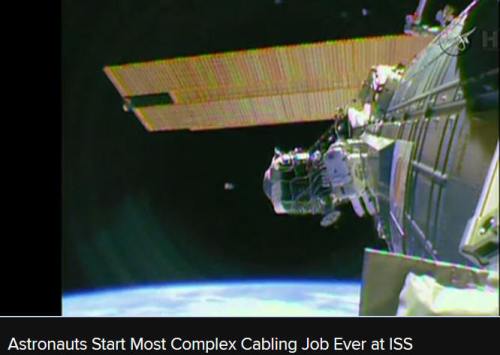
Spacewalking astronauts routed more than 300 feet of cable outside the International Space Station on Saturday to prepare for the arrival of new American-made crew capsules. It was the first of three spacewalks planned for NASA astronauts Butch Wilmore and Terry Virts over the coming week.
Altogether, Wilmore and Virts have 764 feet (233 meters) of cable to run outside the space station. They got off to a strong start Saturday, rigging eight power and data lines, or about 340 feet (105 meters). The longest single stretch was 43 feet (13 meters). “Broadening my resume,” Virts observed.
NASA considers this the most complicated cable-routing job in the 16-year history of the space station. Equally difficult will be running cable on the inside of the complex.
Tiny amounts of lead, chemical flame retardants and organophosphate pesticides, among other toxins, course through the blood of nearly every American. But just how much worry is a little poison worth?
A lot, especially when considering the cumulative effects of this chemical cocktail on children, warns a video unveiled Thursday during an environmental health conference in Ottawa, Canada. The seven-minute project, “Little Things Matter,” draws on emerging scientific evidence that even mild exposures to common contaminants can derail normal brain development — lowering IQs and raising risks of behavioral conditions such as attention deficit hyperactivity disorder, or ADHD.
“The chemical industry argues that the effect of toxins on children is subtle and of little consequence,” co-producer Bruce Lanphear, an environmental health expert at Simon Fraser University in British Columbia, states in the video. “But that is misleading.”
An ancient tragedy is shining new light on life in the Neolithic Era, as archaeologists have uncovered the remains of a woman who appears to have died with her twins during childbirth nearly 8,000 years ago.
It’s the oldest example of death by dystocia, or obstructed labor, and the earliest known example of twins on the archaeological record, researchers wrote in an article describing the discovery, published in the Feb. issue of the journal Antiquity.
Fido just can’t help himself. Each time you scratch that sweet spot on his belly, his hind leg starts kicking like crazy–but why?
Ultimately, it’s all about self-preservation.
“Dogs kick when we scratch their belly because it’s an involuntary reflex,” Dr. Marc Bekoff, a canine expert based in Boulder, Colorado, and author of the book “Why Dogs Hump and Bees Get Depressed,” told The Huffington Post in an email.
Astronomers may be a step closer to solving the mystery of a strange object seen orbiting the massive black hole at the center of our Milky Way galaxy.
Dubbed G2, the object was first spotted in 2011 and was thought initially to be a gas cloud on the verge of being ripped apart by the black hole, which is known as Sagittarius A*. But when the object stayed intact, some scientists suggested G2 was something else: a pair of binary stars.
But now a team of scientists at the Max Planck Institute for Extraterrestrial Physics in Garching, Germany have sparked new debate, offering more evidence to support the gas cloud theory.
.
Simulation of gas cloud G2 after close approach to the black hole at the center of the Milky Way | ESO/MPE/Marc Schartmann
That’s according to the Bulletin of the Atomic Scientists, which each year updates the hands on a clock meant to symbolize how close we are to the annihilation of the human race, or midnight. For the last three years, the world was five minutes from the end. Today, we’re three minutes away.
The two-minute move is symbolic, but it gives a sense of how grim the outlook some of the best scientific minds have for humanity. The decision to move the hands forward, said Bulletin of the Atomic Scientists executive director Kennette Benedict, came about largely due to the threats posed by anthropogenic climate change and the proliferation of nuclear weapons.
You never know what’s lying just beneath the surface in your own yard.
Most people find some old coins or a rusty bicycle chain. But two men in Michigan hit the jackpot when they discovered the remains of a massive Ice Age mammal.
Contractor Daniel LaPoint Jr. was working in Eric Witzke’s Bellevue, Mich., yard when he noticed a giant rib sticking out of the ground, according to the Lansing State Journal. Over four days in November, the two worked together to pull 42 bones out of the ground.
.
Mastodon Bones
.
.
Click link below for story, video, photos and slideshow:
Film and Writing Festival for Comedy. Showcasing best of comedy short films at the FEEDBACK Film Festival. Plus, showcasing best of comedy novels, short stories, poems, screenplays (TV, short, feature) at the festival performed by professional actors.
 Buddha mummy statue (left) and CT scan image showing mummy inside (right).
 (Academy of Sciences Republic of Sakha/Siberian Times)

 .
.
 .
.

 Doomsday Clock

