
.
News You might have missed!
Use your browser or smartphone back arrow (<-) to return to this table for your next selection.
.
__________________________________________
Assorted human interest posts.
July 16, 2021
Crime, Food For Thought, Human Interest, Medical, missed News, Political, Science, Technical amazon, business, Business News, current-events, Future, Hotels, human-rights, medicine, mental-health, research, Science, Science News, technology, Technology News, travel, vacation Leave a comment
.
.
__________________________________________
July 15, 2021
Business, Food For Thought, Human Interest, Science, Technical amazon, business, Business News, current-events, Future, Hotels, human-rights, medicine, mental-health, research, Science, Science News, technology, Technology News, travel, vacation Leave a comment

Click the link below the picture
.
The weather, often derided as a mundane conversation topic of last resort, has actually been a prolific source of entertainment. Natural disasters drive big-budget blockbusters. Solar power fuels Lorde’s latest single. Double rainbows produced a lasting meme. But is the weather worthy of an entire streaming service?
Fox certainly thinks so. This fall, the network is set to launch Fox Weather, a platform for meteorology programming 24/7, rain or shine.* So does the Weather Channel, which is starting a streaming service it hopes will have 30 million subscribers by 2026—a far cry from Netflix’s more than 200 million subscribers, but on par with smaller streamers such as HBO Max and Hulu. According to The New York Times, these impending launches have led to bidding wars over star TV meteorologists, the building of posh new high-tech studios, and debates over the potential influence on public opinion: The prospect of Fox Weather is already worrying many, given the network’s history of climate-change denial.
.
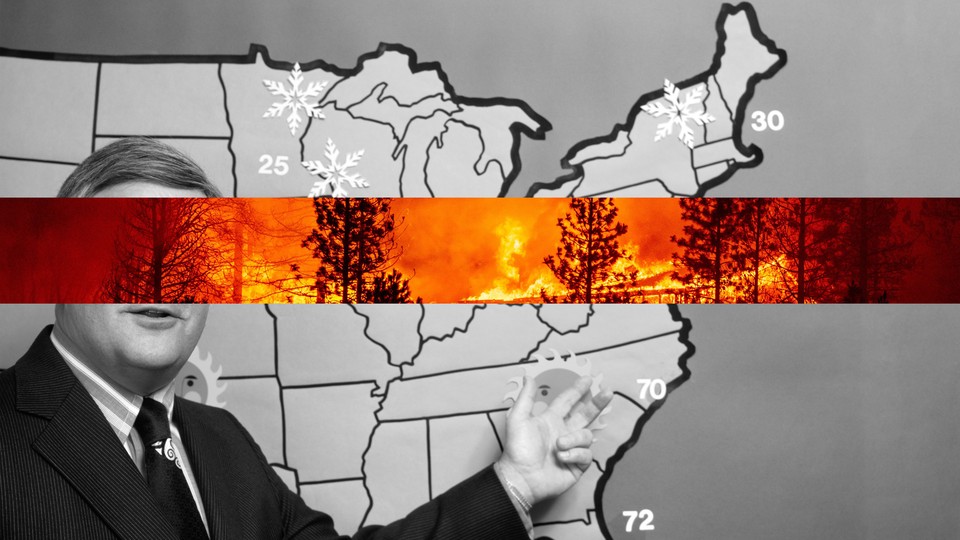 H. Armstrong Roberts / ClassicStock / Getty; Josh Edelson / AFP /Getty; The Atlantic
.
.
Click the link below for the article:
.
__________________________________________
July 15, 2021
Business, Food For Thought, Human Interest, Science, Technical amazon, business, Business News, current-events, Future, Hotels, human-rights, medicine, mental-health, research, Science, Science News, technology, Technology News, travel, vacation Leave a comment

Click the link below the picture
.
Eugene Schieffelin was the eccentric ornithologist who in 1890 shipped 60 starlings from London to New York City and set them free in Central Park. The next year he released 40 more, and today there are maybe 200 million starlings in the United States and Southern Canada. As immigrants go, starlings are shrewd flyers, clever mimics, and often unwelcome. The truth is they’re no more than uptown blackbirds, stocky, three-ounce grifters with iridescent blue and green plumage, along with yellow beaks and a long history of displacing woodpeckers and flycatchers, and destroying entire crops of berries and cherries. Not to mention the havoc they cause at many airports.
Ah, but when they come round in their murmurations on fall afternoons, or in early winter, what magicianry is that, gathering up out of nowhere, arriving in strands or massive clusters, over inlets or forests. You’ll see them fill up neighboring trees and fall into an oily, high-pitched chatter. Sooner or later, they settle and fall silent, like an orchestra before the first note. And then—the most subtle spooking will do it, a dog’s bark, the slam of a car door down the street, or nothing at all, and off they go at 50 miles per hour, wheeling around the countryside, sheets and sheets of them, thickening and thinning, blackening and scattering, merging and splitting, sometimes looking like a tornado cloud, or else some strange omen, and it’ll go on for 15 minutes or more, a merry band thrashing through the sky in vast clouds of star-shaped dots, like the vanishing images on a Buddha board.
.

Photo from Coatesy / Shutterstock.
.
.
Click the link below for the article:
.
__________________________________________
July 15, 2021
Crime, Human Interest, Medical, missed News, Political, Science, Technical amazon, business, Business News, current-events, Future, Hotels, human-rights, medicine, mental-health, research, Science, Science News, technology, Technology News, travel, vacation Leave a comment
.
.
__________________________________________
July 14, 2021
Arts, Business, Food For Thought, Human Interest, Science, Technical amazon, business, Business News, current-events, Future, Hotels, human-rights, medicine, mental-health, research, Science, Science News, technology, Technology News, travel, vacation Leave a comment

Click the link below the picture
.
When we conjure up ancient philosophers the image that springs to mind might be a bald Socrates discoursing with beautiful young men in the sun, or a scholarly Aristotle lecturing among cool columns.
But what about Aspasia, the foreign mistress of the foremost politician in Athens who gave both political and erotic advice? Or Sosipatra, mystic, mother, and Neoplatonist who was a more popular teacher than her husband, Eustathius?
Women also shaped the development of philosophy. Although their writings, by and large, do not survive, their verbal teaching made a significant impact on their contemporaries, and their voices echo through the ages.
More than two millennia later, intelligent, verbal women still struggle to have their own voices heard. So here are six ancient female philosophers you should know about.
.

Michel Corneille the Younger: Aspasia surrounded by Greek philosophers. Photo by Wikimedia Commons
.
.
Click the link below for the article:
.
__________________________________________
July 14, 2021
Crime, Food For Thought, Human Interest, Medical, missed News, Political, Science, sports, Technical amazon, business, Business News, current-events, Future, Hotels, human-rights, medicine, mental-health, research, Science, Science News, technology, Technology News, travel, vacation Leave a comment
.
.
__________________________________________
July 13, 2021
Business, Food For Thought, Human Interest, Science, Technical amazon, business, Business News, current-events, Future, Hotels, human-rights, medicine, mental-health, research, Science, Science News, technology, Technology News, travel, vacation Leave a comment
Click the link below the picture
.
The “language police” have a point: words matter. There are plenty of verbal habits or throwaway phrases that can undermine our credibility and ability to communicate.
Conversely, there are also words that throw open the doors to better communication. Few people know this better than Alexandra Carter, negotiation trainer for the United Nations and director of the Mediation Clinic at Columbia University Law School, and author of Ask for More: 10 Questions to Negotiate Anything. Carter started using the phrase “tell me” when she was trained as a mediator in the early 2000s, and she was astonished at the information it revealed.
.

CaptionPhoto by (Xavi Gomez/Cover/Getty Images)
.
.
Click the link below for the article:
.
__________________________________________
July 13, 2021
Crime, Food For Thought, Human Interest, Medical, missed News, Political, Science, sports, Technical amazon, business, Business News, current-events, Future, Hotels, human-rights, medicine, mental-health, research, Science, Science News, technology, Technology News, travel, vacation Leave a comment
.
.
__________________________________________
July 12, 2021
Business, Food For Thought, Human Interest, Science, Technical amazon, business, Business News, current-events, Future, Hotels, human-rights, medicine, mental-health, research, Science, Science News, technology, Technology News, travel, vacation Leave a comment
Click the link below the picture
.
Wanting to understand how Einstein learned physics may, at first, seem as pointless as trying to fly by watching birds and flapping your arms really hard. How do you emulate someone who is synonymous with genius?
However, I think the investigation can still bear fruits, even if you or I might not have the intellectual gifts to revolutionize physics. Whatever Einstein did to learn, he clearly did something right, so there’s merit in trying to figure out what that was.
How Smart Was Einstein? (Did He Really Fail Elementary Mathematics?)
One of the most common stories about Einstein is that he failed grade school math. I think this is one of those ideas that sounds so good it has to get repeated, regardless of whether it is true or not.
Unfortunately, it’s not true. Einstein was a strong math student from a very young age. He himself admits:
“I never failed in mathematics. Before I was fifteen I had mastered differential and integral calculus.”
.
 Einstein
.
.
Click the link below for the article:
.
__________________________________________
July 12, 2021
Business, Food For Thought, Human Interest, Science, Technical amazon, business, Business News, current-events, Future, Hotels, human-rights, medicine, mental-health, research, Science, Science News, technology, Technology News, travel, vacation Leave a comment

Click the link below the picture
.
Four years ago, organizers created the international AI City Challenge to spur the development of artificial intelligence for real-world scenarios like counting cars traveling through intersections or spotting accidents on freeways.
In the first years, teams representing American companies or universities took top spots in the competition. Last year, Chinese companies won three out of four competitions.
Last week, Chinese tech giants Alibaba and Baidu swept the AI City Challenge, beating competitors from nearly 40 nations. Chinese companies or universities took first and second place in all five categories. TikTok creator ByteDance took second place in a competition to identify car accidents or stalled vehicles from freeway video feeds.
The results reflect years of investment by the Chinese government in smart cities. Hundreds of Chinese cities have pilot programs, and by some estimates, China has half of the world’s smart cities. The spread of edge computing, cameras, and sensors using 5G wireless connections is expected to accelerate use of smart-city and surveillance technology.
.
 Photograph: Getty Images
.
.
Click the link below for the article:
.
__________________________________________
Dragoste si lumina
Find the Best Forex Broker for Your Trading Success
AS HUMILDES OPINIÕES DE UMA MULHER DE CORAGEM QUE DIZ SIM À VIDA!
Să facem glume, nu război
In the world, human beings are facing various problems. People who are full of greed, anger, and ignorance are seen to be fighting with each other in words and deeds. As the fighting continues, various problems such as civil wars, wars of aggression, and wars of aggression are occurring. As world peace is being destroyed, humans are facing unbearable problems. Innocent children and women are not getting the rights they deserve and deserve. I can't think of one thing every time. What is it? The United Nations. If we look at the responsibilities and duties of the United Nations, I think it is not suitable for solving the problems that are happening in the world today. In fact, the United Nations and the World Security Council, such an organization must rule the world, must be able to give orders, and must have various ways to obey orders. There must be no organization that can influence more than that organization. There should be experts from each country. They can even dominate the superpowers like the US, China, and Britain. Only then will global peace be achieved quickly. Now, if a country with power develops more militarily, economically, or socially than its own country, then powerful countries will jealously seek out enemies and wage war. Or they will attack with fighter jets. In this, innocent people are losing their lives. No one understands the value of a life. You should think about how to achieve global peace by controlling these. If the US continues to be the permanent president of the UN, world peace will never be achieved. If you think carefully, no one sees that they are working for the common good, but for their own benefit, for the benefit of their own country. The permanent president of the UN and the Security Council has rejected this, As a young Rohingya, I have come to realize that only by electing the president and secretary from among the countries in the world through a secret ballot system and governing the world fairly can we achieve global peace. The United Nations and the Security Council are organizations in which any country must govern, give orders, and make them obey their orders. For example, only when a defendant is tried in court can we hold the leaders of the countries in check and control them, can we achieve global peace smoothly. Otherwise, it will not be easy for powerful countries to use various excuses to end this war every year, every year, for the benefit of themselves and their countries. No country's leaders pay any attention to the words of the United Nations and the Security Council. If we look at it in practice, look at the Rohingya issue. Myanmar is a small country. Even that country has been under siege for 8 years. What action can be taken? Why is the UN and the Security Council Powerless? Without such Power, how can the organization bring about global peace? Everyone should think about it. Whether there is a veto or a strong one, all countries in the world can only achieve global peace if they are subject to the UN and the Security Council. Seek peace in the quiet embrace of nature. Peace is an indispensable need of the human race. It is not as if one person can kill another person, and it is as if one country can attack another country, but instead of trying to build peace, we must try to destroy the peace now, and the world is getting hotter and is on the verge of collapse. I especially appeal to all the world experts to urgently try to bring about peace in all parts of the world. Mr, Noor Muhamed Arkhan Rohingya Youth Myanmar
Publicație umoristică dedicată glumeților de pretutindeni
Faith saved us from the savages that we were, losing faith makes us savages again
Where Trends Meet Truth
https://www.tangietwoods
Freelance poetry writing
Zalai Betti
INOVATION BLOG PEOPLE AND NEWS
Németh György
Konsultan Lingkungan Hidup di Lombok - NTB
Lea Krasznai (LeaArt21) – Idezetek (Idézetek) WordPress (Budapest, Hungary)
Appunti, spunti e passioni in liberta'
Gyorgy Nemeth
تعنى بتقديم نصائح للمعلمين المبتدئين، والطلبة الممتحنين، ومشاركة الاخرين تجربة الادخار في المال، بترشيد الاستهلاك المنزلي، وترتيب البيت، والحفاظ على البيئة، وتشجيع السيارات صديقةالبيئة، والسياحة والاسفار، ونماء رؤوس الاموال، والطب البديل وتشجيع التعليم الرقمي والذكاء الاصطناعي، والعناية بالنحل وتربية الاسماك، والاسثمار في رؤوس الاموال، الزراعة العضوية، والعناية باسنان الرضع، و صحة الحوامل، وتفسير القران
apprendre pour évoluer
Thoughts on books, language, meaning, and the culture around it.
Outdoor Recreation & Adventure in the Great Lakes Region
News, Info, Bio, Articles, Reviews, Lyrics, Technology, Science, Inspiration, Motivation, Philosphy and many more...
Christian Lifestyle Blogger
CEO and president of The Mullins Companies
Two Cultures. One Life. Endless Stories
Real Estate Development Specialist
¡Bienvenido de vuelta viajero!
so looking to the sky ¡ sing and from my heart to YOU ¡ bring...
CEO and Founder of Nsight Health
Catholic News, Prayers, HD Images, Rosary, Music, Videos, Holy Mass, Homily, Saints, Lyrics, Novenas, Retreats, Talks, Devotionals and Many More
Decoding Power. Defying Narratives.
A creative collaboration introducing the art of nature and nature's art.
The Home Of Entertainment News, Reviews and Reactions
•Whenever you are confronted with an opponent, conquer him with love.(Gandhi)
Algotrader at TRADING-CLUBS.COM
Film and Writing Festival for Comedy. Showcasing best of comedy short films at the FEEDBACK Film Festival. Plus, showcasing best of comedy novels, short stories, poems, screenplays (TV, short, feature) at the festival performed by professional actors.
Peace. Tranquility. Insanity.
Take a ride on the wild side
Découvre des musiques prometteuses (principalement) dans la sphère musicale française.
No tiene que Ser una Pesadilla.
Life in Kana-text (er... CONtext)
Where feelings meet metaphors and make questionable choices.

