July 20, 2021
Mohenjo
Business, Food For Thought, Human Interest, Science, Technical
amazon, business, Business News, current-events, Future, Hotels, human-rights, medicine, mental-health, research, Science, Science News, technology, Technology News, travel, vacation

Click the link below the picture
.
Humans are not all equal in every way. There are a few individuals who have achieved an unparalleled mastery in their field — and they are what I call the exceptionals. Put another way, they are the 1% of the 1% of the world’s most successful people.
Some examples include innovators like Elon Musk and Jeff Bezos, athletes like Michael Jordan and Serena Williams, and musicians like Mozart and Beethoven. Or they may be people you’ve never heard of who invented life-saving drugs or won Nobel Prizes by making fundamental advances in knowledge.
In my five-plus years of studying how to raise exceptional adults, I’ve found that almost all of them, at a young age, developed the skills to maximize the physical, mental and social potential available to them. In most cases, their parents had an enormous impact in creating an environment that allowed them to thrive.
.
.
.
Click the link below for the article:
.
__________________________________________
July 20, 2021
Mohenjo
Arts, Finance, Food For Thought, Human Interest, Medical, missed News, Political, Science, Technical
amazon, business, Business News, current-events, Future, Hotels, human-rights, medicine, mental-health, research, Science, Science News, technology, Technology News, travel, vacation

.
News You might have missed!
Use your browser or smartphone back arrow (<-) to return to this table for your next selection.
.
__________________________________________
July 19, 2021
Mohenjo
Business, Food For Thought, Human Interest, Science, Technical
amazon, business, Business News, current-events, Future, Hotels, human-rights, medicine, mental-health, research, Science, Science News, technology, Technology News, travel, vacation

Click the link below the picture
.
One of the most troubling features of the digital revolution is that some people pay to subject themselves to surveillance that others are forced to endure and would, if anything, pay to be free of.
Consider a GPS tracker you can wear around one of your arms or legs. Make it sleek and cool — think the Apple Watch or FitBit — and some will pay hundreds or even thousands of dollars for the privilege of wearing it. Make it bulky and obtrusive, and others, as a condition of release from jail or prison, being on probation, or awaiting an immigration hearing, will be forced to wear one — and forced to pay for it too.
In each case, the device collects intimate and detailed biometric information about its wearer and uploads that data to servers, communities, and repositories. To the providers of the devices, this data and the subsequent processing of it are the main reasons the devices exist. They are means of extraction: That data enables further study, prediction, and control of human beings and populations. While some providers certainly profit from the sale of devices, this secondary market for behavioral control and prediction is where the real money is — the heart of what Shoshana Zuboff rightly calls surveillance capitalism.
.
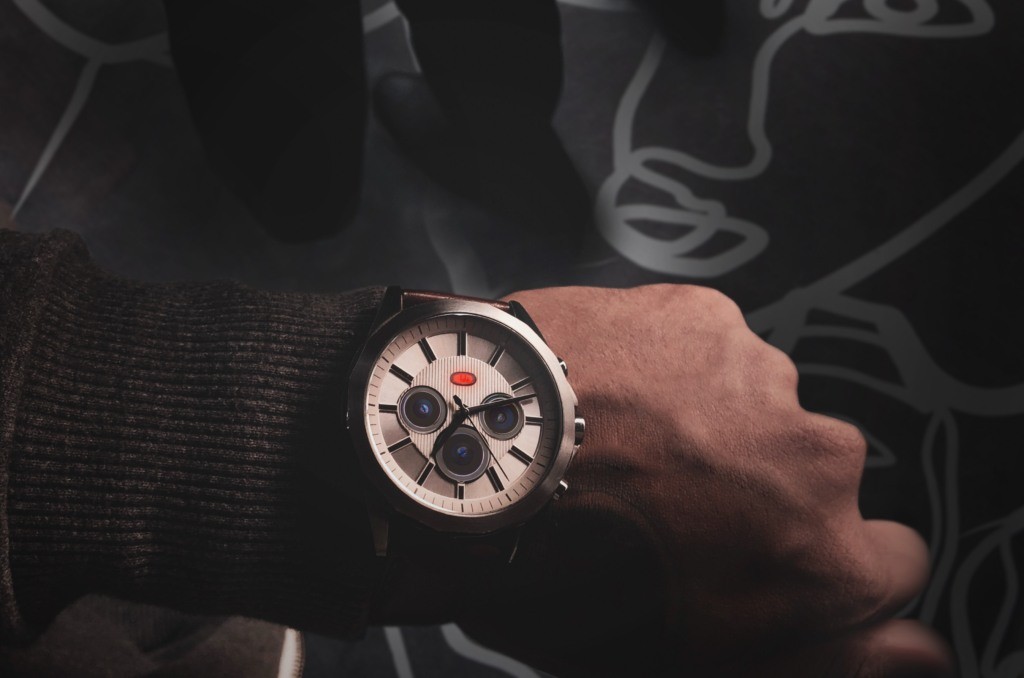 Image: By Russell Sadeghpour for Real Life.
.
.
Click the link below for the article:
.
__________________________________________
July 19, 2021
Mohenjo
Business, Food For Thought, Human Interest, Science, Technical
amazon, business, Business News, current-events, Future, Hotels, human-rights, medicine, mental-health, research, Science, Science News, technology, Technology News, travel, vacation

Click the link below the picture
.
Four years ago, Matice Ahnjamine filmed her first vlog. Ahnjamine, gorgeous in red lipstick and box braids, stands against a monochrome background and introduces herself to new viewers. “Welcome t-t-t-t-to my YouTube channel,” she says. “As you can ssssee I stutter, and that is why I wanted to start this YouTube channel.” Over the next five minutes, she describes how most of her life she felt alone until, at twenty-eight, she met another person who stuttered. It was exhilarating to encounter someone who spoke with “long pauses” and “made these crazy faces like me,” and now she wants to offer that same sense of connection to other people through her videos—to let us know we’re not alone.
I can imagine what Ahnjamine’s channel might have meant to me had it existed in those early, uncomfortable years of accepting and defining myself as a person who stutters. I had no role models to look to, and all the depictions of disfluency I saw came refracted through able-bodied performers in movies and on television—actors who wore disfluency as a costume. I only heard impressions of stutters, never real ones; I knew only characters who stuttered, not people.
This is still the case for most nonstutterers, whose points of reference for disfluency are usually either works of caricature or inspiration porn. The disclosure of my disfluency is sometimes met with invocations of scripted films: Oh, like The King’s Speech? like The Waterboy? like A Fish Called Wanda? But these are scripted stories, anchored by people pretending to talk like me. In these films stuttering is a dramatic obstacle, a tragic flaw, a character-defining challenge. Ahnjamine’s videos, on the other hand, give first-person insights into the experience of disfluency and impart that stuttering is what we do, not who we are.
.
 Screencap via Matice Ahnjamine/YouTube
.
.
Click the link below for the article:
.
__________________________________________
July 18, 2021
Mohenjo
Business, Food For Thought, Human Interest, Science, Technical
amazon, business, Business News, current-events, Future, Hotels, human-rights, medicine, mental-health, research, Science, Science News, technology, Technology News, travel, vacation

Click the link below the picture
.
Quantum mechanics deals with the behavior of the Universe at the super-small scale: atoms and subatomic particles that operate in ways that classical physics can’t explain. In order to explore this tension between the quantum and the classical, scientists are attempting to get larger and larger objects to behave in a quantum-like way.
In the case of this particular study, the object in question is a tiny glass nanosphere, 100 nanometers in diameter – about a thousand times smaller than the thickness of a human hair. To our minds, that’s very, very small, but in terms of quantum physics, it’s actually rather huge, made up to 10 million atoms.
Pushing such a nanosphere into the realm of quantum mechanics is actually a huge achievement, and yet that’s exactly what physicists have now accomplished.
Using carefully calibrated laser lights, the nanosphere was suspended in its lowest quantum mechanical state, one of extremely limited motion where quantum behavior can start to happen.
“This is the first time that such a method has been used to control the quantum state of a macroscopic object in free space,” says Lukas Novotny, a professor of photonics from ETH Zurich in Switzerland.
.
 © ETH Zurich
.
.
Click the link below for the article:
.
__________________________________________
July 17, 2021
Mohenjo
Business, Food For Thought, Human Interest, Science, Technical
amazon, business, Business News, current-events, Future, Hotels, human-rights, medicine, mental-health, research, Science, Science News, technology, Technology News, travel, vacation

Click the link below the picture
.
In 1953, at the dawn of modern computing, Nils Aall Barricelli played God. Clutching a deck of playing cards in one hand and a stack of punched cards in the other, Barricelli hovered over one of the world’s earliest and most influential computers, the IAS machine, at the Institute for Advanced Study in Princeton, New Jersey. During the day the computer was used to make weather forecasting calculations; at night it was commandeered by the Los Alamos group to calculate ballistics for nuclear weaponry. Barricelli, a maverick mathematician, part Italian and part Norwegian, had finagled time on the computer to model the origins and evolution of life.
Inside a simple red brick building at the northern corner of the Institute’s wooded wilds, Barricelli ran models of evolution on a digital computer. His artificial universes, which he fed with numbers drawn from shuffled playing cards, teemed with creatures of code—morphing, mutating, melting, maintaining. He created laws that determined, independent of any foreknowledge on his part, which assemblages of binary digits lived, which died, and which adapted. As he put it in a 1961 paper, in which he speculated on the prospects and conditions for life on other planets, “The author has developed numerical organisms, with properties startlingly similar to living organisms, in the memory of a high-speed computer.” For these coded critters, Barricelli became a maker of worlds.
.

Illustration by Daniel Zender.
.
.
Click the link below for the article:
.
__________________________________________
July 17, 2021
Mohenjo
Business, Food For Thought, Human Interest, Science, Technical
amazon, business, Business News, current-events, Future, Hotels, human-rights, medicine, mental-health, research, Science, Science News, technology, Technology News, travel, vacation
Click the link below the picture
.
My favorite book of 2018 was Dan Sperber and Hugo Mercier’s The Enigma of Reason. I covered it in my book club as a podcast, but the ideas are so interesting that I wanted to take a second chance to explain them.
The basic puzzle is this:
-
If reason is so useful, why do human beings seem to be the only animals to possess it? Surely, a lion who had excellent reasoning abilities would catch more gazelles? Yet human beings seem to be alone in the ability to reason about things.
-
If reason is so powerful, why are we so bad at it? Why do we have tons of cognitive biases? Reasoned thinking is supposed to be good, but we seem to use it fairly little as a species.
.

Photo from SHODOgraphy / Getty Images.
.
.
Click the link below for the article:
.
__________________________________________
July 17, 2021
Mohenjo
Food For Thought, Human Interest, Medical, missed News, Political, Science, Technical
amazon, business, Business News, current-events, Future, Hotels, human-rights, medicine, mental-health, research, Science, Science News, technology, Technology News, travel, vacation
.
News You might have missed!
Use your browser or smartphone back arrow (<-) to return to this table for your next selection.
.
__________________________________________
July 16, 2021
Mohenjo
Business, Food For Thought, Human Interest, Science, Technical
amazon, business, Business News, current-events, Future, Hotels, human-rights, medicine, mental-health, research, Science, Science News, technology, Technology News, travel, vacation

Click the link below the picture
.
Ivan Afonso checked his computer one last time before picking up the phone. It was April 2020, and like most of Spain, Afonso was stuck at home under a strict Covid lockdown. But his mind was in the mountains.
An environmental scientist, Afonso also served as head of the environmental division in the Aran Valley, a tiny area of the Pyrenees mountain range that forms a dent along Spain’s border with France. For the past three years, his duties had included monitoring the movements of Cachou, a 6-year-old, 130-kilo (287-pound) brown bear. The bear was a local celebrity, one of the few males born in the wild in the Pyrenees and living proof that conservationists’ efforts to rejuvenate the region’s struggling brown bear colony were working.
The task had been a nightmare from the start. Cachou was young and fiery, and—to the dismay of conservationists and farmers—prone to wreaking havoc. Like most bears, Cachou had a sweet tooth. He’d started with assaulting bee farms, but by 2019, he’d learned to hunt horses many times his size. Eventually, authorities put a tracker on him, but even that didn’t work. At one point he was blamed for four attacks within two weeks.
.

The Garona River, seen here from the village of Bossost, is born high on the Pyrenees and flows into the Atlantic Ocean in France.
Photographer: Angel Garcia/Bloomberg
.
.
Click the link below for the article:
.
__________________________________________
July 16, 2021
Mohenjo
Business, Food For Thought, Human Interest, Science, Technical
amazon, business, Business News, current-events, Future, Hotels, human-rights, medicine, mental-health, research, Science, Science News, technology, Technology News, travel, vacation

Click the link below the picture
.
Eric Richins looked out from his pontoon boat to the shallows on the lake’s western edge. He squinted and paused as if he had come upon a foreign shore. For the first time in a career navigating the waters of the American West, he didn’t know where he was.
“I could have sworn I was here just six weeks ago catching smallmouth and bigmouth bass,” said the 35-year-old fisherman who runs tours on this 247-square-mile basin where the Colorado River meets the Hoover Dam to form the nation’s largest reservoir.
He pointed ahead to what looked like dozens of tiny steps made from successive layers of dried mud now covered in tall grass and weeds — the effect of rapidly creeping vegetation over a shoreline that has been dropping by nearly a foot a week.
“Now it looks like a lawn. I knew the drought was bad. I didn’t realize it was this bad,” he said. “This place is unrecognizable.”
.
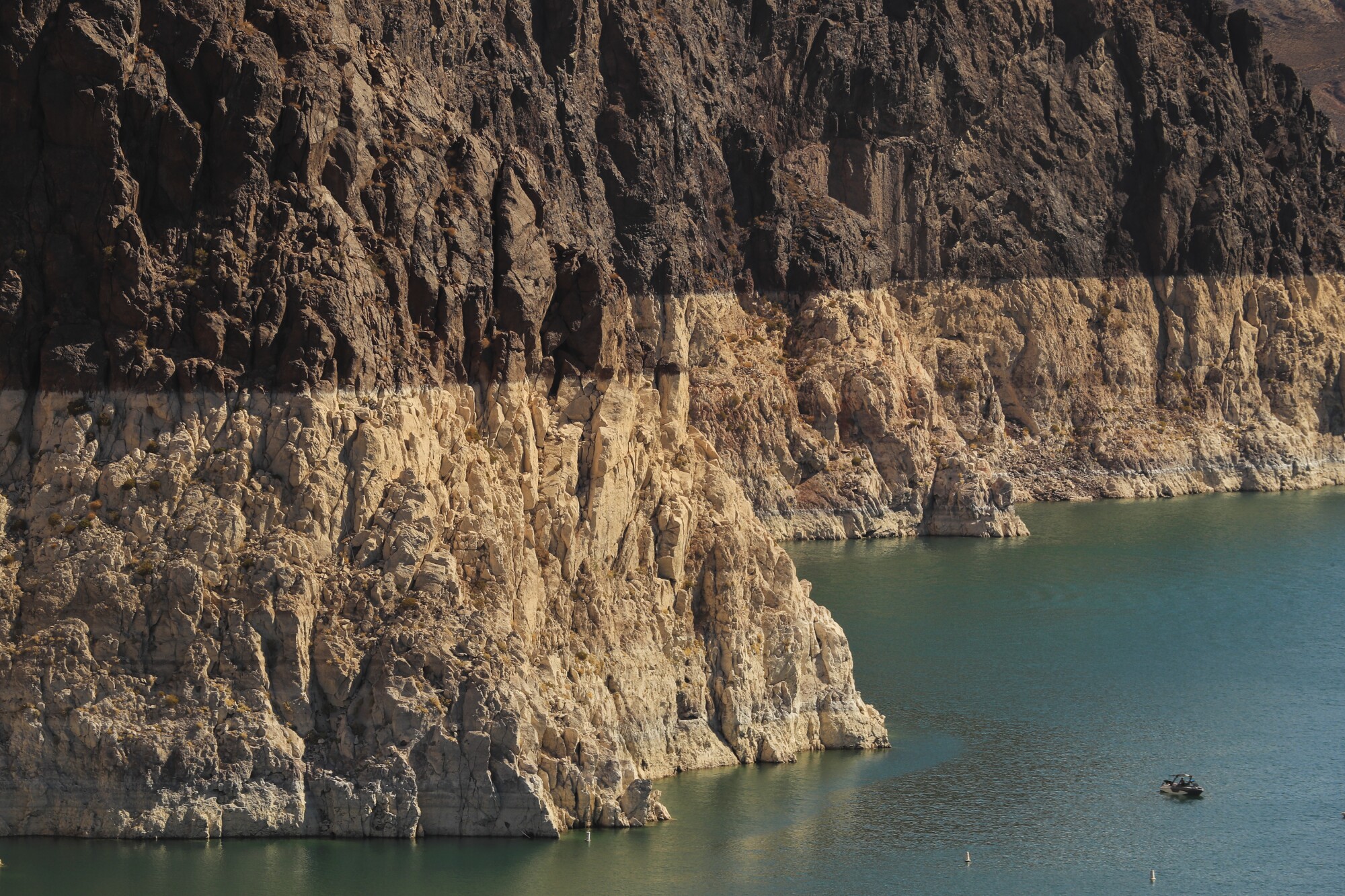 Lake Mead
.
.
Click the link below for the article:
.
__________________________________________
Older Entries
Newer Entries


