
.
News You might have missed!
Use your browser or smartphone back arrow (<-) to return to this table for your next selection.
.
__________________________________________
Assorted human interest posts.
November 27, 2021
Food For Thought, Human Interest, Medical, missed News, Political, Science, Technical amazon, business, Business News, current-events, Future, Hotels, human-rights, medicine, mental-health, research, Science, Science News, technology, Technology News, travel, vacation Leave a comment
.
.
__________________________________________
November 26, 2021
Business, Food For Thought, Human Interest, Science, Technical amazon, business, Business News, current-events, Future, Hotels, human-rights, medicine, mental-health, research, Science, Science News, technology, Technology News, travel, vacation Leave a comment

Click the link below the picture
.
Dr. Gagneur is a neonatologist and a professor of pediatrics at the University of Sherbrooke. His research has led to programs that increase childhood vaccinations through motivational interviewing. Dr. Tamerius is a former psychiatrist and the founder of Smart Politics, an organization that teaches people to communicate more persuasively.
The difference between people who eagerly want the Covid-19 vaccine and people who are hesitant is not as great as it may seem. Most vaccine holdouts are not anti-vaxxers or conspiracy theorists.
Before you demand that your loved ones get a shot, know that not all conversations are created equal. Research shows that many common persuasive styles — commanding, advising, lecturing, and shaming — not only don’t work but also often backfire.
To help you learn the basics of a method that works, we’ve created a vaccination chatbot based on the principles of motivational interviewing, a research-backed approach for encouraging people to get vaccinated that’s used by health care professionals to harness people’s innate drive for change.
.
 Albert Tercero
.
.
Click the link below for the article:
.
__________________________________________
November 26, 2021
Business, Food For Thought, Human Interest, Science, Technical amazon, business, Business News, current-events, Future, Hotels, human-rights, medicine, mental-health, research, Science, Science News, technology, Technology News, travel, vacation Leave a comment

Click the link below the picture
.
This year, I turned 30, a development that came with a breathless sense of dread at time’s passing. It wakes me up in the early mornings: Nocturnal terror breaks through the surface of sleep like a whale breaching for air. My ambition and fear kick in together until I get up, pour myself some water, and look out the window at the squid-ink sky and the string of lights along my neighbors’ houses. I lie down again after finding firmer mental ground, dry land.
So when a guy that my friend was seeing evangelized about “time slips” — a genre of urban legend in which people claim that, while walking in particular places, they accidentally traveled back, and sometimes forward, in time — I was a ripe target. Curious and increasingly existential, I Googled these supposed time slips. I found a global community of believers building an archive of temporal dislocations from the present. These congregants gathered in corners of the internet to testify about how, in the right conditions, the dusting of alienation that settles over the world as we age can crystallize into collective fiction.
.
 Credit…Photo illustration by Ricardo Tomás
.
.
Click the link below for the article:
.
__________________________________________
November 26, 2021
Crime, Food For Thought, Human Interest, Medical, missed News, Political, Science, Technical amazon, business, Business News, current-events, Future, Hotels, human-rights, medicine, mental-health, research, Science, Science News, technology, Technology News, travel, vacation Leave a comment
.
.
__________________________________________
November 25, 2021
Arts, Business, Food For Thought, Human Interest, Science, Technical amazon, business, Business News, current-events, Future, Hotels, human-rights, medicine, mental-health, research, Science, Science News, technology, Technology News, travel, vacation Leave a comment

Click the link below the picture
.
Basran Burhan was born in Indonesia, on the centrally located island of Sulawesi. He studied archeology at Hasanuddin University, at first, he told me, mostly because he liked how it involved “a lot of outdoor activities.” After graduating, in 2010, he worked for a few different Indonesian research and cultural heritage institutions. He also became an independent archeologist, helping organize excavations for a researcher named Adam Brumm at Griffith University, in Australia. Burhan’s fieldwork struck Brumm as exceptional, and on the strength of it, Brumm tried to get Burhan into a Ph.D. program. But Burhan’s imperfect English delayed this project for a number of years. Instead, he kept working for Brumm and his team.
In 2017, Burhan was helping Brumm and other researchers plan their next season of fieldwork: searching for evidence of Paleolithic humans in Sulawesi. Earlier that year, Brumm had briefly explored a new area on the island that seemed promising. Burhan and a team of six Indonesian archeologists were sent there on a field exploration.
The survey lasted for several weeks. At some point, poring over a map of the island’s southern region, Burhan found his eyes drawn to an area he’d never noticed, let alone visited—a valley in a mountain region twenty miles or so northeast of the city of Makassar. There were no roads into the valley, and there was nothing on the map to suggest a way through the bush and mountain peaks. The map did indicate rice paddies and other signs of human habitation, but Burhan didn’t know if the area was currently populated. A good part of archeology is simply exploration. Burhan thought, Why not?
.
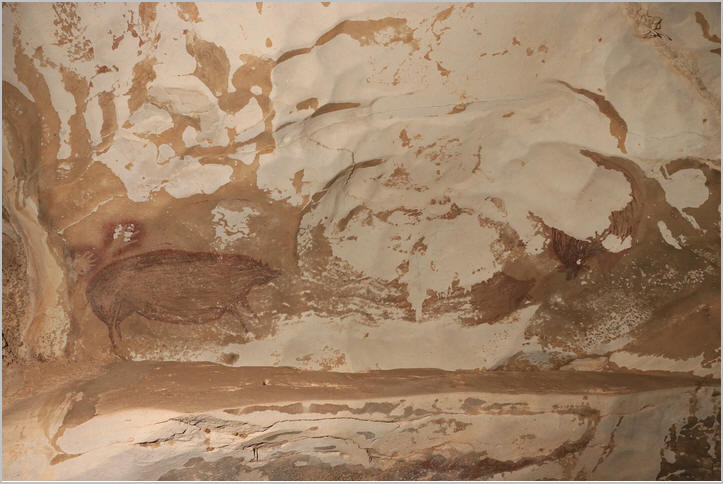 The discovery of the Sulawesi warty pig helps put to rest the idea that figurative cave art was unique to Europe.Photograph courtesy Basran Burhan
.
.
Click the link below for the article:
.
__________________________________________
November 25, 2021
Arts, Crime, Food For Thought, Human Interest, Medical, missed News, Political, Science, Technical amazon, business, Business News, current-events, Future, Hotels, human-rights, medicine, mental-health, research, Science, Science News, technology, Technology News, travel, vacation Leave a comment
.
.
__________________________________________
November 24, 2021
Business, Food For Thought, Human Interest, Science, Technical amazon, business, Business News, current-events, Future, Hotels, human-rights, medicine, mental-health, research, Science, Science News, technology, Technology News, travel, vacation Leave a comment

Click the link below the picture
.
Advertisers have begun invading our sleep in an attempt to place their products in our dreams. This is neither metaphor nor fiction; it’s a fact. The night before Super Bowl LV, the beverage company Molson Coors ran what they called the ‘world’s largest dream study’. They explicitly aimed to place images of Coors beer, along with positive imagery (of refreshing alpine rivers, for instance), into dreamers’ minds. They hired a Harvard psychologist to design dream-incubation stimuli, incentivized participation with offers of free drinks, and, in a marketing coup, had the pop star Zayn Malik agree to sleep on Instagram Live while having an incubated Coors dream – though he did mention the whole project was ‘kinda messed up.
This isn’t an isolated case. Multiple marketing studies are openly testing new ways to alter and drive purchasing behavior through sleep and dream hacking. The American Marketing Association New York’s 2021 Future of Marketing study found that of more than 400 marketers from firms across the United States, 77 percent of them aim to deploy dream-tech for advertising in the next three years. The commercial, for-profit use of dream incubation – the presentation of stimuli before or during sleep to affect dream content – is rapidly becoming a reality.
Of course, advertisers are far from the first people to work on influencing and incubating dreams. Dream incubation stretches back more than 4,000 years to ancient Egypt, where sleepers lay in sacred beds in the Ṣaqqārah Serapeum to receive divine dreams; to ancient Greece, where ailing people went to dream in oracular temples; to today, where dream incubation plays a key role in healing, therapeutic and spiritual practices such as yoga nidra and Mohave shamanism. These traditions span time and place, providing tools for people to move from unpredictable dream content to sought-after dreams dealing with specific themes and issues. But technological advances and improved sleep science are expanding how such techniques can be reliably implemented.
.
 Dreamscape
.
.
Click the link below for the article:
.
__________________________________________
November 24, 2021
Crime, Food For Thought, Human Interest, Medical, missed News, Political, Science, Technical amazon, business, Business News, current-events, Future, Hotels, human-rights, medicine, mental-health, research, Science, Science News, technology, Technology News, travel, vacation Leave a comment
.
.
__________________________________________
November 23, 2021
Business, Food For Thought, Human Interest, Science, Technical amazon, business, Business News, current-events, Future, Hotels, human-rights, medicine, mental-health, research, Science, Science News, technology, Technology News, travel, vacation Leave a comment

Click the link below the picture
.
For months, during the main pandemic stretch, I’d get inexplicably tired in the afternoon, as though vital organs and muscles had turned to Styrofoam. Just sitting in front of a computer screen, in sweatpants and socks, left me drained. It seemed ridiculous to be grumbling about fatigue when so many people were suffering through so much more. But we feel how we feel.
Nuke a cup of cold coffee, take a walk around the block: the standard tactics usually did the trick. But one advantage, or disadvantage, of working from home is the proximity of a bed. Now and then, you surrender. These midafternoon doldrums weren’t entirely unfamiliar. Even back in the office years, with editors on the prowl, I learned to sneak the occasional catnap under my desk, alert as a zebra to the telltale footfall of a consequential approach. At home, though, you could power all the way down.
Still, the ebb, lately, had become acute, and hard to account for. By the standards of my younger years, I was burning the candle at neither end. Could one attribute it to the wine the night before, the cookies, the fitful and abbreviated sleep, the boomerang effect of the morning’s caffeine and carbs, a sedentary profession, middle age? That will be a yes. And yet the mind roamed: Covid? Lyme? Diabetes? Cancer? It’s no HIPAA violation to reveal that, as various checkups determined, none of those pertained. So, embrace it. A recent headline in the Guardian: “Extravagant eye bags: How extreme exhaustion became this year’s hottest look.”
.

.
.
Click the link below for the article:
.
__________________________________________
November 23, 2021
Business, Food For Thought, Human Interest, Science, Technical amazon, business, Business News, current-events, Future, Hotels, human-rights, medicine, mental-health, research, Science, Science News, technology, Technology News, travel, vacation Leave a comment

Click the link below the picture
.
Most articles don’t, for good reason, start with “My therapist said….”
And yet: That’s exactly where this story begins.
“Have you ever heard of attachment theory and adult attachment styles?” asked my very own therapist in a session earlier this year.
Oh, I definitely had. A few years ago, a high-octane romance suddenly exploded in spectacular fashion, out of nowhere. One of us shut down. The other spiraled. In the immediate blast radius, for both parties, it was as heartbreaking as it was indecipherable.
Near the end, this person expressed their desire to untangle their side of things, along with a photo of a book they had just purchased: “Attached: The New Science of Adult Attachment, and How It Can Help You Find — and Keep — Love.” I bought it a few days later.
The result? Revelatory. Not for what I learned about them, but for what I discovered about myself, my own contribution to this romantic meltdown, and one thing or another about pretty much all the relationships that came before it. To say it changed the way I view (let alone operate in) romance since then would be a vast understatement.
So “yeah, of course,” I told my therapist like she asked me about FM radio. “I’ve read ‘Attached.’ What about it?” I went on to describe the various attachment styles the book describes, characterized my own, and explained how I’ve seen it reflected throughout my life.
.
 Shuhua Xiong
.
.
Click the link below for the article:
.
__________________________________________
Dragoste si lumina
Find the Best Forex Broker for Your Trading Success
AS HUMILDES OPINIÕES DE UMA MULHER DE CORAGEM QUE DIZ SIM À VIDA!
Să facem glume, nu război
In the world, human beings are facing various problems. People who are full of greed, anger, and ignorance are seen to be fighting with each other in words and deeds. As the fighting continues, various problems such as civil wars, wars of aggression, and wars of aggression are occurring. As world peace is being destroyed, humans are facing unbearable problems. Innocent children and women are not getting the rights they deserve and deserve. I can't think of one thing every time. What is it? The United Nations. If we look at the responsibilities and duties of the United Nations, I think it is not suitable for solving the problems that are happening in the world today. In fact, the United Nations and the World Security Council, such an organization must rule the world, must be able to give orders, and must have various ways to obey orders. There must be no organization that can influence more than that organization. There should be experts from each country. They can even dominate the superpowers like the US, China, and Britain. Only then will global peace be achieved quickly. Now, if a country with power develops more militarily, economically, or socially than its own country, then powerful countries will jealously seek out enemies and wage war. Or they will attack with fighter jets. In this, innocent people are losing their lives. No one understands the value of a life. You should think about how to achieve global peace by controlling these. If the US continues to be the permanent president of the UN, world peace will never be achieved. If you think carefully, no one sees that they are working for the common good, but for their own benefit, for the benefit of their own country. The permanent president of the UN and the Security Council has rejected this, As a young Rohingya, I have come to realize that only by electing the president and secretary from among the countries in the world through a secret ballot system and governing the world fairly can we achieve global peace. The United Nations and the Security Council are organizations in which any country must govern, give orders, and make them obey their orders. For example, only when a defendant is tried in court can we hold the leaders of the countries in check and control them, can we achieve global peace smoothly. Otherwise, it will not be easy for powerful countries to use various excuses to end this war every year, every year, for the benefit of themselves and their countries. No country's leaders pay any attention to the words of the United Nations and the Security Council. If we look at it in practice, look at the Rohingya issue. Myanmar is a small country. Even that country has been under siege for 8 years. What action can be taken? Why is the UN and the Security Council Powerless? Without such Power, how can the organization bring about global peace? Everyone should think about it. Whether there is a veto or a strong one, all countries in the world can only achieve global peace if they are subject to the UN and the Security Council. Seek peace in the quiet embrace of nature. Peace is an indispensable need of the human race. It is not as if one person can kill another person, and it is as if one country can attack another country, but instead of trying to build peace, we must try to destroy the peace now, and the world is getting hotter and is on the verge of collapse. I especially appeal to all the world experts to urgently try to bring about peace in all parts of the world. Mr, Noor Muhamed Arkhan Rohingya Youth Myanmar
Publicație umoristică dedicată glumeților de pretutindeni
Faith saved us from the savages that we were, losing faith makes us savages again
Where Trends Meet Truth
https://www.tangietwoods
Freelance poetry writing
Zalai Betti
INOVATION BLOG PEOPLE AND NEWS
Németh György
Konsultan Lingkungan Hidup di Lombok - NTB
Lea Krasznai (LeaArt21) – Idezetek (Idézetek) WordPress (Budapest, Hungary)
Appunti, spunti e passioni in liberta'
Gyorgy Nemeth
تعنى بتقديم نصائح للمعلمين المبتدئين، والطلبة الممتحنين، ومشاركة الاخرين تجربة الادخار في المال، بترشيد الاستهلاك المنزلي، وترتيب البيت، والحفاظ على البيئة، وتشجيع السيارات صديقةالبيئة، والسياحة والاسفار، ونماء رؤوس الاموال، والطب البديل وتشجيع التعليم الرقمي والذكاء الاصطناعي، والعناية بالنحل وتربية الاسماك، والاسثمار في رؤوس الاموال، الزراعة العضوية، والعناية باسنان الرضع، و صحة الحوامل، وتفسير القران
apprendre pour évoluer
Thoughts on books, language, meaning, and the culture around it.
Outdoor Recreation & Adventure in the Great Lakes Region
News, Info, Bio, Articles, Reviews, Lyrics, Technology, Science, Inspiration, Motivation, Philosphy and many more...
Christian Lifestyle Blogger
CEO and president of The Mullins Companies
Two Cultures. One Life. Endless Stories
Real Estate Development Specialist
¡Bienvenido de vuelta viajero!
so looking to the sky ¡ sing and from my heart to YOU ¡ bring...
CEO and Founder of Nsight Health
Catholic News, Prayers, HD Images, Rosary, Music, Videos, Holy Mass, Homily, Saints, Lyrics, Novenas, Retreats, Talks, Devotionals and Many More
Decoding Power. Defying Narratives.
A creative collaboration introducing the art of nature and nature's art.
The Home Of Entertainment News, Reviews and Reactions
•Whenever you are confronted with an opponent, conquer him with love.(Gandhi)
Algotrader at TRADING-CLUBS.COM
Film and Writing Festival for Comedy. Showcasing best of comedy short films at the FEEDBACK Film Festival. Plus, showcasing best of comedy novels, short stories, poems, screenplays (TV, short, feature) at the festival performed by professional actors.
Peace. Tranquility. Insanity.
Take a ride on the wild side
Découvre des musiques prometteuses (principalement) dans la sphère musicale française.
No tiene que Ser una Pesadilla.
Life in Kana-text (er... CONtext)
Where feelings meet metaphors and make questionable choices.

