March 11, 2022
Mohenjo
Business, Food For Thought, Human Interest, Medical, Overlooked Past Article, Political, Science, Technical
amazon, business, Business News, current-events, Future, Hotels, human-rights, medicine, mental-health, research, Science, Science News, technology, Technology News, travel, vacation

Click the link below the picture
.
“Given projected growth in consumption, in a business-as-usual scenario, by 2050 oceans are expected to contain more plastics than fish (by weight), and the entire plastics industry will consume 20% of total oil production, and 15% of the annual carbon budget,” the foundation wrote in a news release on the paper.
The total amount of plastic already in the world’s oceans is immense. A massive patch of plastic waste now sits in each of the world’s five oceans, though the vast majority of the plastic remains unaccounted for, and the material does not biodegrade like organic garbage.
Current theories on where the plastic is going include that it is washing back ashore, sinking, breaking down into undetectable pieces or being consumed by plankton and fauna, Vox reports.
Either way, much more of it is coming.
According to Popular Science, in 2015 researchers from the University of California, Santa Barbara, estimated that humans dump somewhere between 4.8 million and 12.7 million metric tons of plastic into the sea each and every year. Study co-author Roland Geyer told the magazine, “Using the average density of uncompacted plastic waste, 8 million metric tons — the midpoint of our estimate — would cover an area 34 times the size of Manhattan ankle-deep in plastic waste.”
.
 Plastic
.
.
Click the link below for the article:
.
__________________________________________
March 11, 2022
Mohenjo
Arts, Crime, Food For Thought, Human Interest, Medical, missed News, Overlooked Past Article, Political, Science, Technical
amazon, business, Business News, current-events, Future, Hotels, human-rights, medicine, mental-health, research, Science, Science News, technology, Technology News, travel, vacation

.
News You might have missed!
Use your browser or smartphone back arrow (<-) to return to this table for your next selection.
.
__________________________________________
March 10, 2022
Mohenjo
Business, Food For Thought, Human Interest, Science, Technical
amazon, business, Business News, current-events, Future, Hotels, human-rights, medicine, mental-health, research, Science, Science News, technology, Technology News, travel, vacation

Click the link below the picture
.
Chances are you know a whole lot about your partner. What makes them laugh, what makes them seethe, what makes them blush. You probably know their dessert of choice, coffee preference, and that story from their childhood by heart. And the list of other things you know by heart is likely quite long because of course it is. You share a life with them and likely have more insight into who they truly are than anyone else.
But there’s always more to learn. And when playing a round of “How Well Do You Know Your Spouse?” it’s wise to have rock-solid answers to some other questions at the ready. About what brings them joy, what’s caused them pain, and what’s still on their bucket list. Questions that touch on the past, present, and future, because an awareness of all three is crucial, and understanding the answers will help you and your relationship in more ways than one.
Why? Now knowing the answers to these questions won’t necessarily solve problems, but it will give you a heads-up on what drives your partner. And when you understand the whys, you have a better understanding of why they react to certain things the way they do. With that knowledge, you become more empathetic, so the person you love feels loved, and possibilities for changing become more possible, since the explicit and implicit message is, “We’re in it together.”
.

Answers
.
.
Click the link below for the article:
.
__________________________________________
March 10, 2022
Mohenjo
Business, Food For Thought, Human Interest, Medical, Overlooked Past Article, Political, Science, Technical
amazon, business, Business News, current-events, Future, Hotels, human-rights, medicine, mental-health, research, Science, Science News, technology, Technology News, travel, vacation
Click the link below the picture
.
It’s no secret that breastfeeding is healthy — not just for babies, but for mothers too.
And yet for U.S. mothers, breastfeeding a baby is no easy feat. From the lack of paid maternity leave to the rampant stigma against women who breastfeed their babies in public, the breastmilk barriers are numerous.
We could be approaching a tipping point, thanks to a comprehensive two-part Lancet series on the enormous health benefits of breastfeeding. The new papers compiled data from more than 1,300 different breastfeeding studies, some commissioned for this series, according to CNN.
The studies yielded many compelling findings, including this stunning fact: If every mother in the world breastfed her child, more than 800,000 infant deaths could be prevented each year — or 13% of all deaths of children under age 5. Universal breastfeeding could also prevent 20,000 moms from dying of breast cancer each year.
Breastfeeding has a plethora of proven health benefits for babies and their moms. In babies, it’s been shown to promote healthy growth, as well as protect against illness such as asthma and lower respiratory infection. In mothers, it can prevent diabetes, heart disease, breast cancer, and ovarian cancer.
.

.
.
Click the link below for the article:
.
__________________________________________
March 10, 2022
Mohenjo
Crime, Food For Thought, Human Interest, Medical, missed News, Overlooked Past Article, Political, Science, Technical
amazon, business, Business News, current-events, Future, Hotels, human-rights, medicine, mental-health, research, Science, Science News, technology, Technology News, travel, vacation
.
News You might have missed!
Use your browser or smartphone back arrow (<-) to return to this table for your next selection.
.
__________________________________________
March 9, 2022
Mohenjo
Business, Food For Thought, Human Interest, Science, Technical
amazon, business, Business News, current-events, Future, Hotels, human-rights, medicine, mental-health, research, Science, Science News, technology, Technology News, travel, vacation

Click the link below the picture
.
How much do you read?
For most of my adult life, I read maybe five books a year — if I was lucky. I’d read a couple on vacation and I’d always have a few slow burners hanging around the bedside table for months.
And then, one year, I surprised myself by reading 50 books. This year I’m on pace for 100. I’ve never felt more creatively alive in all areas of my life. I feel more interesting, I feel like a better father, and my writing output has dramatically increased. Amplifying my reading rate has been the domino that’s tipped over a slew of others.
I’m disappointed that I didn’t do it sooner.
Why did I wait 20 years?
Well, our world today is designed for shallow skimming rather than deep diving, so it took me some time to identify the specific changes that skyrocketed my reading rate. None of them had to do with how fast I read. I’m actually a pretty slow reader.
.
 Reading
.
.
Click the link below for the article:
.
__________________________________________
March 9, 2022
Mohenjo
Business, Food For Thought, Human Interest, Science, Technical
amazon, business, Business News, current-events, Future, Hotels, human-rights, medicine, mental-health, research, Science, Science News, technology, Technology News, travel, vacation
Some content on this page was disabled on April 15, 2025 as a result of a DMCA takedown notice from Guardian Media Group. You can learn more about the DMCA here:
https://wordpress.com/support/copyright-and-the-dmca/
March 9, 2022
Mohenjo
Arts, Crime, Food For Thought, Human Interest, Medical, missed News, Political, Science, Technical
amazon, business, Business News, current-events, Future, Hotels, human-rights, medicine, mental-health, research, Science, Science News, technology, Technology News, travel, vacation
.
News You might have missed!
Use your browser or smartphone back arrow (<-) to return to this table for your next selection.
.
__________________________________________
March 8, 2022
Mohenjo
Business, Food For Thought, Human Interest, Science, Technical
amazon, business, Business News, current-events, Future, Hotels, human-rights, medicine, mental-health, research, Science, Science News, technology, Technology News, travel, vacation
Click the link below the picture
.
Scientists already had a pretty good idea that things have been about as dry as can be out west for a while now. The region has been experiencing a “megadrought” that dates back to the start of the century. In 2020, researchers dubbed it the worst drought in 500 years, in a paper published in the journal Science.
Things have only gotten worse since then. In the last two years, the region already bereft of rainfall saw record-setting heatwaves — including a new high for hottest temperature ever recorded and a devastating heat dome that literally started to melt infrastructure — along with out of control wildfires, shrinking water reservoirs, and dwindling supplies of natural water sources. With a full record of the last two decades, scientists concluded that the West’s ongoing drought is the worst since at least 800 A.D.
Researchers and climate scientists examined moisture levels in soils collected from a wide stretch of the American West, ranging from up north in Montana to areas of northern Mexico, out west toward the coast of the Pacific Ocean, and eastbound to the Rocky Mountains. Those samples — along with tree ring samples, which appear closer together during dry periods — helped to paint a picture of this modern drought and those of the past. Unfortunately, our current situation does not compare favorably to history.
.
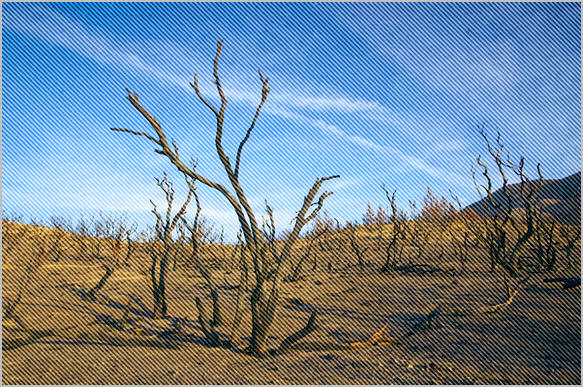 A new study has found that the current 20-year drought is the worst dry period in recorded history. Shutterstock
.
.
Click the link below for the article:
.
__________________________________________
March 8, 2022
Mohenjo
Business, Food For Thought, Human Interest, Science, Technical
amazon, business, Business News, current-events, Future, Hotels, human-rights, medicine, mental-health, research, Science, Science News, technology, Technology News, travel, vacation

Click the link below the picture
.
An invisible cloud of gas is speeding toward our Milky Way galaxy at 700,000 miles per hour. But don’t worry: It will take about 30 million years to get here.
It’s a case of “what goes up must come down,” according to Hubble Space Telescope astronomers who say the space cloud likely originated in our galaxy and is boomeranging back. When it returns, they predict “a spectacular burst of star formation, perhaps providing enough gas to make 2 million suns.”
Astronomers are aware of many space clouds, but the Smith Cloud is unique because its trajectory is well-known.
“The cloud is an example of how the galaxy is changing with time,” said Andrew Fox of the Space Telescope Science Institute in Baltimore, Maryland. “It’s telling us that the Milky Way is a bubbling, very active place where gas can be thrown out of one part of the disk and then return back down into another.
.
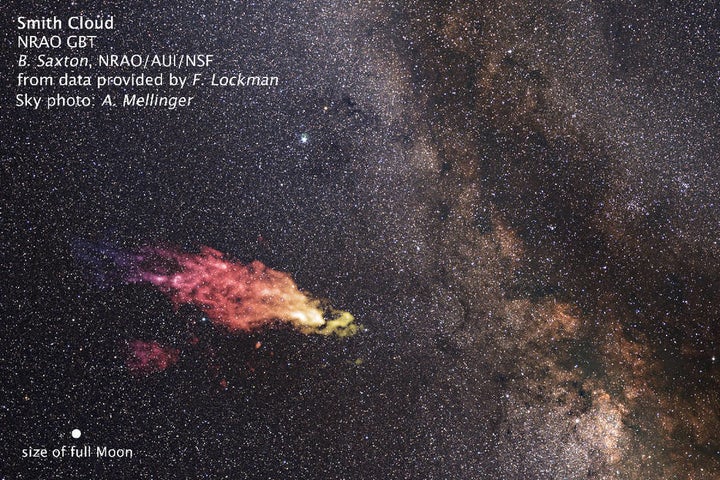
This visualization of the Smith Cloud shows its size compared to the size of the Earth’s moon. Saxton/Lockman/NRAO/AUI/NSF/Mellinger
.
.
Click the link below for the article:
.
__________________________________________
Older Entries
Newer Entries

