February 20, 2023
Mohenjo
Business, Food For Thought, Human Interest, Political, Science, Technical
amazon, business, Business News, current-events, Future, Hotels, human-rights, medicine, mental-health, research, Science, Science News, technology, Technology News, travel, vacation

Click the link below the picture
.
Across the country, there’s a silent frustration brewing about an age-old practice that many say is getting out of hand: tipping.
Some fed-up consumers are posting rants on social media complaining about tip requests at drive-thrus, while others say they’re tired of being asked to leave a gratuity for a muffin or a simple cup of coffee at their neighborhood bakery. What’s next, they wonder — are we going to be tipping our doctors and dentists, too?
As more businesses adopt digital payment methods, customers are automatically being prompted to leave a gratuity — many times as high as 30% — at places they normally wouldn’t. And some say it has become more frustrating as the price of items has skyrocketed due to inflation, which eased to 6.5% in December but still remains painfully high.
“Suddenly, these screens are at every establishment we encounter. They’re popping up online as well for online orders. And I fear that there is no end,” said etiquette expert Thomas Farley, who considers the whole thing somewhat of “an invasion.”
.

An age-old practice that many say is getting out of hand: tipping
.
.
Click the link below for the article:
.
__________________________________________
February 15, 2023
Mohenjo
Business, Food For Thought, Human Interest, Political, Science, Technical
amazon, business, Business News, current-events, Future, Hotels, human-rights, medicine, mental-health, research, Science, Science News, technology, Technology News, travel, vacation

Click the link below the picture
.
When a salmon-colored rash flared on my 3-year-old son’s tummy one afternoon in August, I shrugged it off. The next time I asked Evan to lift up his shirt to take a photo, it was gone. When he stopped sleeping through the night, I thought it was a dreadful new developmental phase. But then on a Saturday, he stopped walking and spiked a 104-degree fever. A nurse gave me clear directions: “Get in your car, and start driving to the ER.”
After days in the hospital, the doctors had ruled out a long list of infections, as well as scary conditions like leukemia. That left them circling around a rare type of childhood arthritis called systemic onset juvenile idiopathic arthritis, or sJIA, in which the innate immune system, the body’s first line of defense against pathogens, goes haywire. Young children are tormented by daily spiking fevers, a fleeting rash, and arthritis. Some develop a life-threatening immune activation syndrome. Untreated, destructive joint damage can occur. We were in shock.
But the doctors mentioned a drug that they’d probably want to try — anakinra, a biologic drug that blocks a key prong of the immune system and quells inflammation. Like most rare disease drugs, anakinra (also known by the trade name Kineret) was obscure, but I’m a health and science reporter and I’d heard of it. In 2020, I interviewed a pediatric rheumatologist, Randy Cron at the University of Alabama at Birmingham, who wanted to test whether anakinra could help people with severe covid-19.
.

.
.
Click the link below for the article:
.
__________________________________________
February 15, 2023
Mohenjo
Business, Food For Thought, Human Interest, Political, Science, Technical
amazon, business, Business News, current-events, Future, Hotels, human-rights, medicine, mental-health, research, Science, Science News, technology, Technology News, travel, vacation

Click the link below the picture
.
Muscular dystrophy came for my vision first, although I did not know it at the time. On the second Friday morning of April 2020, I realized quite suddenly I couldn’t read out of my right eye. I could see, but I couldn’t distinguish words. In the bedroom, I asked my wife to place a book I had never seen on the dresser. With my left eye covered, I turned around and: nothing. The cover was blended like the clouds of a Bob Ross painting. Four days later, an ophthalmologist examined me. I hadn’t noticed anything wrong with my left eye (yet), but he certainly did. You have cataracts, he told me, in both eyes, at age 31.
Two months later, I started feeling this immense ache up and down my arms. Then I began losing strength in my hands, which I noticed while changing the oil in my car. With the wrench in my right hand, I went to loosen the plug on the oil pan, and my wrist and fingers felt like Jell-O. When I tried to let go of the wrench, my fingers instead curled toward my palm, contorting my hand like a claw. It was the same if I tried opening a jar or turning a doorknob.
Soon after, I noticed my jaw and tongue cramped up every so often, making it difficult to speak intelligibly. For a year I saw an orthopedist, and then physical therapists at the Johns Hopkins Hospital in Baltimore who put me through a month-long regimen of stretching activities to see if that would fix the problem.
When I knew the physical therapy wasn’t working, the orthopedist ordered an electromyography exam. These are tests that measure the electrical activity in your muscles and nerves and are one way to determine if you have pinched nerves—which, for a while, I and the doctors suspected was behind my faulty grip. But when the doctor stuck a tiny needle into the skin between the thumb and wrist of my left palm, the unmistakable noise from the machine next to me was that of a dive-bombing plane. He told me it was a sign of some sort of mistake in the ions that enable muscle movement and told me I would need to see a neurologist.
.
 Illustration by GQ
.
.
Click the link below for the article:
.
__________________________________________
February 14, 2023
Mohenjo
Business, Food For Thought, Human Interest, Political, Science, Technical
amazon, business, Business News, current-events, Future, Hotels, human-rights, medicine, mental-health, research, Science, Science News, technology, Technology News, travel, vacation

Click the link below the picture
.
When it comes to cardiovascular fitness and muscle strength, the adage is true: Use it or lose it. While regular exercise can improve heart health and increase strength and mobility, taking weeks or months off can reverse many of those benefits.
That’s not to say that rest days are not important. In general, short breaks can help you physically and mentally recharge, but whenever possible, you should avoid extending your time off for too long so that hopping back on the wagon doesn’t feel too daunting or miserable.
“Your body adapts to the stimulus you provide,” said Dr. Kevin Stone, an orthopedic surgeon and the author of the book “Play Forever: How to Recover From Injury and Thrive.” “Your muscles become used to the stress and the testosterone, the adrenaline and endorphins — all the wonderful things that circulate from exercise. When you take that away, the body initiates a muscle loss program.”
.
 Melissa Schriek for The New York Times
.
.
Click the link below for the article:
.
__________________________________________
February 14, 2023
Mohenjo
Business, Food For Thought, Human Interest, Political, Science, Technical
amazon, business, Business News, current-events, Future, Hotels, human-rights, medicine, mental-health, research, Science, Science News, technology, Technology News, travel, vacation

Click the link below the picture
.
Last year, a Tennessee-based artist named Kelly McKernan noticed that their name was being used with increasing frequency in A.I.-driven image generation. McKernan makes paintings that often feature nymphlike female figures in an acid-colored style that blends Art Nouveau and science fiction. A list published in August, by a Web site called Metaverse Post, suggested “Kelly McKernan” as a term to feed an A.I. generator in order to create “Lord of the Rings”-style art. Hundreds of other artists were similarly listed according to what their works evoked: anime, modernism, “Star Wars.” On the Discord chat that runs an A.I. generator called Midjourney, McKernan discovered that users had included their name more than twelve thousand times in public prompts. The resulting images—of owls, cyborgs, gothic funeral scenes, and alien motorcycles—were distinctly reminiscent of McKernan’s works. “It just got weird at that point. It was starting to look pretty accurate, a little infringe-y,” they told me. “I can see my hand in this stuff, see how my work was analyzed and mixed up with some others’ to produce these images.”
Last month, McKernan joined a class-action lawsuit with two other artists, Sarah Andersen, and Karla Ortiz, filed by the attorneys Matthew Butterick and Joseph Saveri, against Midjourney and two other A.I. imagery generators, Stable Diffusion, and DreamUp. (Other tools, such as DALL-E, run on the same principles.) All three models make use of LAION-5B, a nonprofit, publicly available database that indexes more than five billion images from across the Internet, including the work of many artists. The alleged wrongdoing comes down to what Butterick summarized to me as “the three ‘C’s”: The artists had not consented to have their copyrighted artwork included in the LAION database; they were not compensated for their involvement, even as companies including Midjourney charged for the use of their tools; and their influence was not credited when A.I. images were produced using their work. When producing an image, these generators “present something to you as if it’s copyright free,” Butterick told me, adding that every image a generative tool produces “is an infringing, derivative work.”
.
 Illustration by Nicholas Konrad / The New Yorker; ; Source photographs from Getty
.
.
Click the link below for the article:
.
__________________________________________
February 13, 2023
Mohenjo
Business, Food For Thought, Human Interest, Political, Science, Technical
amazon, business, Business News, current-events, Future, Hotels, human-rights, medicine, mental-health, research, Science, Science News, technology, Technology News, travel, vacation

Click the link below the picture
.
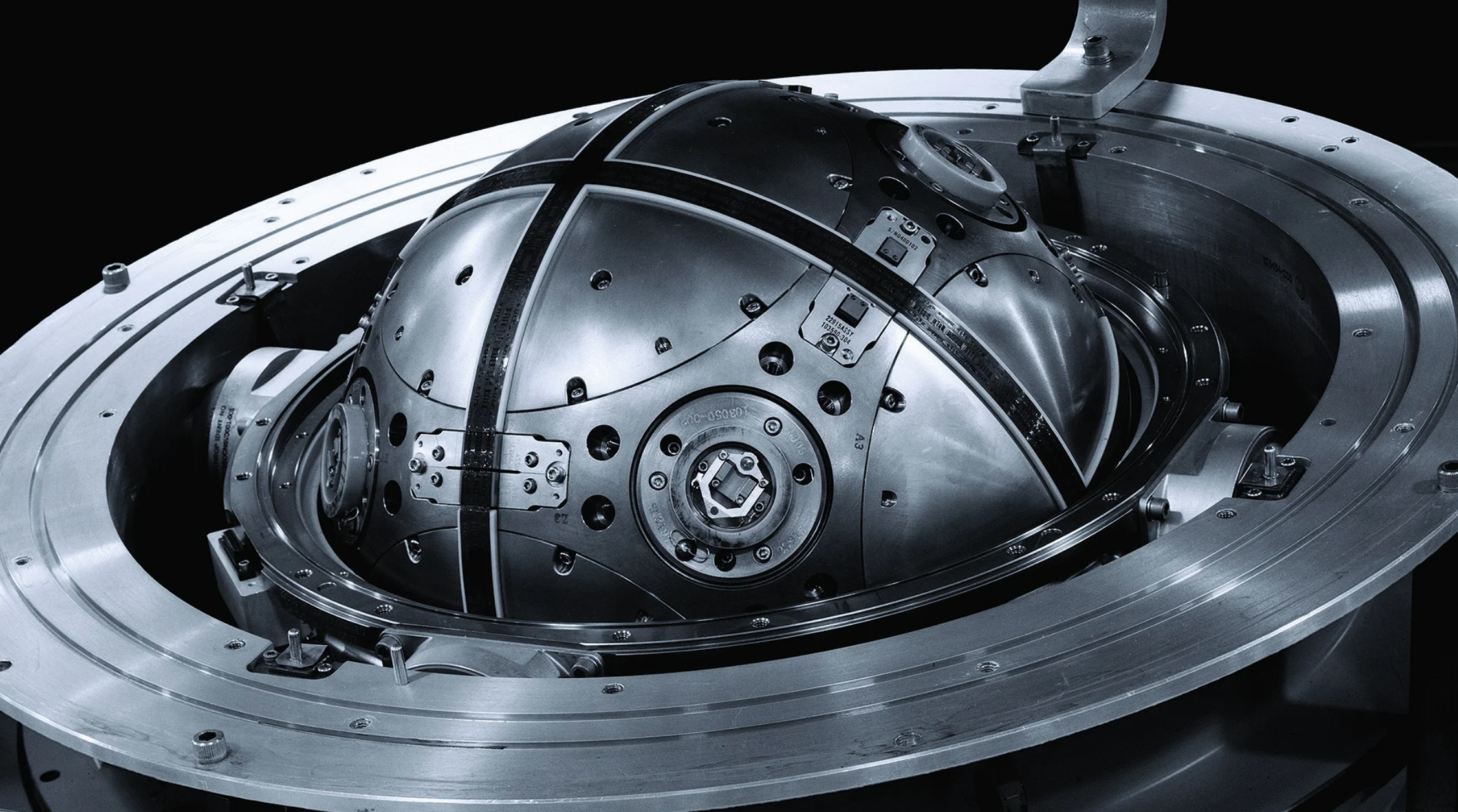
The subject in the striking image above looks like the centerpiece prop in a high-end sci-fi flick, but it is anything but. What you are looking at is the Advanced Inertial Reference Sphere (AIRS) guidance system that was designed to be used as the navigational heart of the highly-accurate LGM-118A Peacekeeper intercontinental ballistic missile (ICBM), also known as the MX (Missile Experimental). Peacekeeper represented the pinnacle of Cold War-era American ICBM technology, but it came at a very high price and with a less-than-favorable developmental timeline. Even though it dwarfed its Minuteman III stablemate, and it was advanced in many ways, AIRS was by far the most exquisite piece of technology associated with the MX/Peacemaker program. In fact, the system’s existence was a major factor in the Peacekeeper’s reason for being.
The masterful image was taken by photographer and author Martin Miller who had taken up the task of capturing Cold War weaponry in dramatic fashion. The photo seen in its entirety below was featured in Miller’s book Weapons Of Mass Destruction: Specters Of The Nuclear Age.
.
.
.
Click the link below for the article:
.
__________________________________________
February 13, 2023
Mohenjo
Business, Food For Thought, Human Interest, Political, Science, Technical
amazon, business, Business News, current-events, Future, Hotels, human-rights, medicine, mental-health, research, Science, Science News, technology, Technology News, travel, vacation

Click the link below the picture
.
While many Americans were nursing hangovers on New Year’s Day, 22-year-old Edward Tian was working feverishly on a new app to combat misuse of a powerful, new artificial intelligence tool called ChatGPT.
Given the buzz it’s created, there’s a good chance you’ve heard about ChatGPT. It’s an interactive chatbot powered by machine learning. The technology has basically devoured the entire Internet, reading the collective works of humanity and learning patterns in language that it can recreate. All you have to do is give it a prompt, and ChatGPT can do an endless array of things: write a story in a particular style, answer a question, explain a concept, compose an email — write a college essay — and it will spit out coherent, seemingly human-written text in seconds.
The technology is both awesome — and terrifying.
“I think we’re absolutely at an inflection point,” Tian says. “This technology is incredible. I do believe it’s the future. But, at the same time, it’s like we’re opening Pandora’s Box. And we need safeguards to adopt it responsibly.”
.
 Edward Tian
.
.
Click the link below for the article:
.
__________________________________________
February 12, 2023
Mohenjo
Business, Food For Thought, Human Interest, Political, Technical
amazon, business, Business News, current-events, Future, Hotels, human-rights, medicine, mental-health, research, Science, Science News, technology, Technology News, travel, vacation

Click the link below the picture
.
After losing her house to a fire, Jo Ann Ussery had a peculiar idea: to live in an airplane.
.
She bought an old Boeing 727 that was destined for the scrapyard, had it shipped to a plot of land she already owned, and spent six months renovating, doing most of the work by herself. By the end, she had a fully functional home, with over 1,500 square feet of living space, three bedrooms, two bathrooms, and even a hot tub — where the cockpit used to be. All for less than $30,000, or about $60,000 in today’s money.
.
Ussery — a beautician from Benoit, Mississippi — had no professional connection to aviation and was following the offbeat suggestion of her brother-in-law, an air traffic controller. She lived in the plane from 1995 to 1999, when it was irreparably damaged after falling off the truck that was moving it to a different location nearby, where it would have been open for public display.
.
Although she wasn’t the first person to ever live in an airplane, her flawless execution of the project had an inspirational effect. In the late 1990s, Bruce Campbell, an electrical engineer with a private pilot license, was awestruck by her story: “I was driving home and listening to [the radio,] and they had Jo Ann’s story, and it was amazing I didn’t drive off the road because my focus turned entirely to it. And the next morning I was placing phone calls,” he says.
.

.
.
Click the link below for the article:
.
__________________________________________
February 12, 2023
Mohenjo
Business, Food For Thought, Human Interest, Political, Science, Technical
amazon, business, Business News, current-events, Future, Hotels, human-rights, medicine, mental-health, research, Science, Science News, technology, Technology News, travel, vacation

Click the link below the picture
.
To begin with, Abigail Barnes loved her voice assistant. Now it lives in the drawer.
“I used [my Amazon Alexa] to turn on the lights or set a timer, and as a speaker for books and podcasts,” says the 43-year-old Londoner. “She turned my fan on and off during the heatwave and played me Christmas music in the winter.”
Ms. Barnes would ask her device to set alarms, tell her the time, or for the weather forecast.
“I kept my first Alexa in the kitchen and, a few months later, I got a second Alexa and set it up in my bedroom.”
However, Ms. Barnes fell out of love with her voice assistants when they began giving her frequent delivery notifications, asking her to review purchases, or prompting her to reorder items.
“It started giving me random updates or asking me to rate a product I’d bought last month,” she says, “which I found really irritating.”
She became concerned about conversation data “being stored in a cloud somewhere”. Then she found the voice commands became unreliable.
“I stopped asking her to turn off the lights when I went to bed, as I’d ask a number of times and then manually turn them off anyway.”
What started out saving her time, she says, quickly became something that cost time.
.
 Abigail Barnes found her voice assistant became more and more annoying
.
.
Click the link below for the article:
.
__________________________________________
February 11, 2023
Mohenjo
Business, Food For Thought, Human Interest, Political, Science, Technical
amazon, business, Business News, current-events, Future, Hotels, human-rights, medicine, mental-health, research, Science, Science News, technology, Technology News, travel, vacation

Click the link below the picture
.
OnlyFans is an online content-sharing platform that has become increasingly popular during the coronavirus lockdown. While OnlyFans creators can upload any kind of content, like photography, creative writing, or recipes, for example, the platform is particularly popular with sex workers.
During the lockdown, OnlyFans has become so popular that sex workers have found that the market is saturated, as reported by Newsweek.
Some OnlyFans creators report earning more money during the lockdown, while others report earning less money due to their fans facing financial struggles and the saturation of the market.
OnlyFans has been around since 2016 but has entered the mainstream recently, with Beyonce namedropping the site in her verse on Megan Thee Stallion’s “Savage Remix.”
However, many people may not understand how the social media platform works, who uses it, and why it is so popular.
.
 A woman tries out a Microsoft-driven Nokia smartphone next to a symbol of a cloud on March 5, 2012, in Hanover, Germany. OnlyFans is a social media platform where content creators can charge fans for exclusive access to their content. Getty/Sean Gallup
.
.
Click the link below for the article:
.
__________________________________________
Older Entries
Newer Entries
 James' World 2