
(sound on to listen)
Click the link below the picture
.
This episode is part of “The Young American Scientists,” an editorially independent project that was produced with financial support from Regeneron.
Rachel Feltman: For Scientific American’s Science Quickly, I’m Rachel Feltman. This week, we’ve been celebrating some of the winners of SciAm’s first-ever Young American Scientist awards.
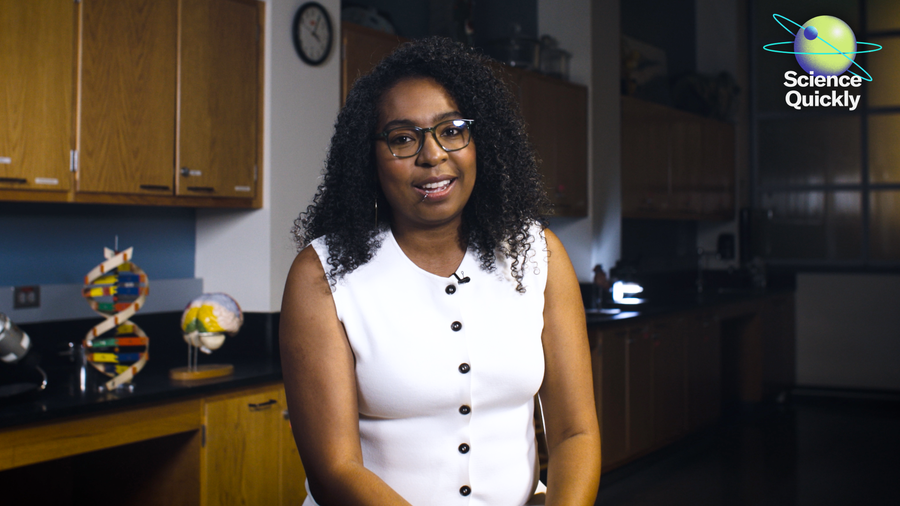
Today’s guest is Jaye Gardiner. She’s an assistant professor of biology at Tufts University, where her lab has a unique spin on cancer research.
Thanks for chatting with us, Jaye.
So a lot of scientists study the ways that viruses and cancers can interact, but the way you’re doing it is a little unconventional and might surprise our listeners. So, could you tell us more about why your perspective is so unique?
Jaye Gardiner: Yeah. So up to 20 percent of all cancers are actually caused by viruses, so if you think of things like human papillomavirus [HPV] that can cause cervical cancer, head and neck cancers, penile or anal cancers. You have the hepatitis viruses of, like, B and C, that can cause liver cancer, viruses that can cause lymphomas or leukemias.
[In] all of those, the virus changes something in the cell that’s supposed to tamp down its ability to divide endlessly. So, kind of at the heart of all cancers, or at least in the malignant cells, we’re thinking more about the cell cycle and trying to stop that from going on endlessly. The way that I’m thinking about it is more about the contributions to the environment.
So if you use an analogy like the seed and soil, so your tumor cell is the seed, the microenvironment is the soil that can either nourish it or keep it at bay. When our bodies are healthy, that soil is very dry and arid, so it doesn’t allow that seed to germinate. So I want to understand if ways that we have viral infections could cause that soil to be much more rich and fertile, giving all of the nutrients that’s needed to allow that seed to grow whenever it shows up.
Feltman: So speaking of that microenvironment that you compare to soil, uh, I know a lot of your work focuses on the extracellular matrix. Can you explain for us exactly what that is?
Gardiner: The extracellular matrix you can think of as the noncellular components, so no cells whatsoever. These are just, kind of, molecules that can make fibers and kind of create networks and support for your tissues. So things like collagen, that we hear a lot about, or hyaluronic acid, those are components of the extracellular matrix, or ECM.
A really great way to think about it…. So it’s really important for us to heal wounds, right? So if we cut open our hand, we wanna have that close up normally without having a scar. The scar, if it does happen, is an accumulation of the extracellular matrix, where those fibroblasts were there for too long, secreting the extracellular matrix for much longer than they should have. If we think about that now for an entire organ or for fibrosis, we’ll use the lung as an example, where you have to be able to inhale and exhale, your lungs have to expand. If you have scar tissue there, so all of this extracellular matrix being deposited, now that organ can’t function normally.
So you’ve made it, like, really hard and rigid. It can’t open and close. You can’t get the air in. That leads to complications for the patient. So if you think about that in any of the organs that we have, they all have very specific functions that usually require them to be a little bit flexible; otherwise, they would’ve been hard like bone in the first place.
So extracellular matrix—incredibly important, not just for your hair and fingernails and youthful-looking skin, but has a real impact in a lot of diseases as well.
Feltman: Are there any specific viruses that you’re particularly interested in?
Gardiner: So right now, my interests—we’ll start with coxsackievirus, specifically clade B. Any parent out there, you might have heard of the effects of a clade A coxsackievirus, ’cause it can cause hand, foot, and mouth disease, so something very common among children.
But clade B, [when] most people are infected with it, [it] just causes kind of like a common cold. So you wouldn’t really be able to differentiate it between a different virus that caused the cold. But the reason why I’m interested in it is that there have been some studies that showed that virus, even though it’s considered a respiratory virus, so it would primarily be in your lungs, can also infect your pancreas.
And for coxsackievirus in particular, B3, if we want to get very specific, you can actually cause both acute, so a short time to resolve, or chronic, a long time to resolve, form of fibrosis in the pancreas. And so fibrosis is a predisposition for any type of cancer, so now if we have a virus that can cause these long-term fibroses in an organ, now we’ve already set that soil up for that cancer when it takes off.
Feltman: So, as we continue to learn more about how these different viruses can affect the extracellular matrix and contribute to cancer risk, what do you think the impact of that knowledge could be?
Gardiner: I think it would probably redefine what we think of as the causes for cancer, or at least broaden our scope in how we deal and manage with colds.
.
 Jeffery DelViscio
.
.
Click the link below for the complete article (sound on to listen):
.
__________________________________________


Leave a Reply