.
There are so many benefits of walking. For starters, it’s one of the most beginner-friendly workout modalities out there—not to mention a great form of exercise all on its own. It’s also a proven way to increase cardio endurance and reduce blood pressure and cholesterol.
One thing regular ol’ walking doesn’t do, though, is drastically change the shape and size of your bum. Sure, walking works your glutes (along with your hamstrings, quads, calves, and core), but if your goal is to transform your hot girl walk into a glute-maximizing workout, there are certain tweaks you’ll have to make to your form and/or technique.
Why building glute muscles matters
“As one of the biggest muscles in your body, you want to keep your glutes strong in order to keep your overall body in alignment,” says Rebecca Louise, a mindset and fitness coach and author of It Takes Grit. “They support your lower back, especially when you’re lifting or keeping your pelvis and core stabilized.”
If your glutes aren’t strong enough, the surrounding muscles have to step in to compensate. “This puts a lot of stress on the knees, hips, and lower back,” says Peloton instructor Jess Sims, who notes that your glutes are often considered part of your core. “Your glutes allow the upper and lower extremities [of your body] to function properly.” She points to the example of running: To have proper form, it’s important to tuck your pelvis forward (or, as she likes to say, “take your butt with you”). “If you don’t do this, you might feel pain in your lower back, hips, or knees,” says Sims.
The point is: It’s important to mindfully move in order to activate your glutes and reap even more benefits of walking. Luckily, you don’t have to do anything particularly excessive in order to do so. (Cough, cough: 10,000 steps a day is a myth.) To prove it, ahead you’ll uncover the many benefits of walking and find a number of trainer-approved tweaks to make your steps especially beneficial for building tush strength.
But first, do you really need to take 10,000 steps a day?
If you’re aiming to get your 10,000 daily steps in hopes of making your butt bigger, we have some bad news for you. According to Los Angeles-based certified personal trainer, Danny Saltos, the short answer is no, walking alone won’t help build your booty muscles, despite the rising trends you may have seen on social media.
That said, the recommendation for walking 10,000 steps a day actually has nothing to do with booty size. “Most trackers have 10K as a default setting, but there’s no major significance to it,” admits NASM-CPT Susane Pata. “It’s good to have a number like 10K steps to aim for because even if you somewhat undershoot it, you can still access benefits. And whereas you don’t necessarily have to hit 10k steps to access the benefits, the more steps you perform per day, the better.”
In general, Pata says that National Academy of Sports Medicine recommends healthy adults engage in at least 150 minutes of moderate-intensity exercise per week, which can include brisk walking. “The key phrase to note is ‘at least,’ with more benefits being realized with more activity,” she adds.
Does walking make your bum bigger or smaller?
Walking is absolutely a great form of exercise, and one that doesn’t always get a ton of love because it’s so chill compared to other forms of exercise, Saltos says. But, rather than building butt muscles, walking can actually make your butt a bit smaller.
Here’s why: “Walking is a low-impact movement that offers a great way to burn calories,” Saltos explains. “When you burn more calories than you consume, you lose fat. The body doesn’t discriminate [between] the areas from where fat is lost, and one place where there is typically ample amounts of it is on our rear end.”
With this in mind, if your primary goal is to build your booty, it’s important to supplement your walking routine with effective glute exercises (including upper glute exercises to help grow that coveted shelf). “If you really want to build the size and change the shape [of your butt], you need to strength train with resistance that actually stimulates the muscles in order to really make a change in shape and possibly grow the muscles—it also depends on genetics,” Pata says. “Begin a progressive training program with key exercises like deadlifts and squats, single-leg glute bridges, hip thrusts, and curtsy lunges, among many others. One idea is to perform these exercises before a walk. That way you have activated these muscles and conditioned them and now walking can further condition them.”
Benefits of walking
While walking alone won’t drastically change the size of your booty, that’s not to say the movement is without benefits. According to Pata, walking is a great form of exercise to incorporate into your routine because:
- It’s beginner-friendly
- It burns calories (“Approximately 200 to 500 per hour, depending on walking speed, distance, weight, and walking environment,” she points out.)
- It can help reduce cholesterol
- It can help lower blood pressure
- It increases cardiovascular endurance
- It strengthens the heart
- It boosts immunity
- It can reduce anxiety, depression, and stress
- It’s a free, accessible workout
How to activate your glutes when walking
Although walking doesn’t directly create a juicy peach, there are ways to turn a simple stroll into a glute-centric workout that helps strengthen and tone your butt, along with other parts of your lower body. Yes, you can strengthen your glutes through walking, with some strategic tweaks to your daily stroll.
Like with any new fitness routine, patience and consistency is key. To see the results, Saltos recommends doing a minimum of three 30 to 45 minute butt-toning walking workout sessions per week featuring the moves below and committing to it for at least six to eight weeks, but ideally 10 to 12.
1. Hit up an incline
One tried-and-true glute-burning upgrade to a walk is to get your steps on an incline. “Walking on an incline, either on the treadmill or on a hill, is a great way to switch up regular walking and target your glute muscles,” says Louise. Start with a smaller incline and work your way up to increase the intensity.
2. Hold a high knee
For this walking workout, you’re taking four to six steps before balancing on one foot as you bring the opposite leg into a high knee pause. Squeeze the glute of the leg that’s still on the ground, push your hips forward, and draw your navel in towards your spine. “It’s so important to work our bodies unilaterally,” says Sims, referring to working one side at a time. “This helps to eliminate overcompensation and also helps your body neurologically practice balancing so that when you miss a curb or you trip, your body can minimize injury risk because you’ve introduced these balancing movement patterns.”
3. Do some ‘butt zaps’
For this walking tweak—which Sims calls a “butt zap”—simply bring awareness to your glutes by squeezing the glute of the foot that’s still on the ground. “What you’re doing is pushing your pelvis forward as you squeeze the glute,” she says. So, basically, you’re giving an extra squeeze to the side of your glutes that’s powering your base foot, and alternating as you step forward. For an added challenge, Sims recommends exaggerating your walk by putting your heel down first, rolling through the center of your foot, and as you go onto the ball of the foot, do a calf raise, and add the butt zap.
4. Take it sideways
Sims also recommends lateral step-outs, which fire up your gluteus medius, aka the part of your glutes that helps with hip movement. “Turn to the side, bend your knees a bit extra, and do sets of 10 to 20,” she suggests. Break into these after you reach certain minute or mile marks to switch up your steps.
5. Mix it up with a lateral incline
To take things up a notch, try this technique, which Saltos swears by, that puts those lateral steps on an incline. He describes it as “one of the best booty burners of your life.” Remember to take it slow as you’re starting off. And, Saltos notes it’s important to “maintain your balance by keeping your core engaged, holding an athletic and wide stance, and squeezing in your glutes.”
6. Do a lateral hill climb
This technique is similar to the previous one; the difference is you’re talking it outdoors. To really up the challenge factor, Saltos recommends turning it into a full-blown, glute-centric walking workout. Here’s the sequence he recommends: Walk in a flat area for 10 minutes. Then do five to eight sets of 12 reps of left lateral steps uphill, followed by five to eight sets of 12 reps of right lateral steps uphill. Finish with a five-minute cooldown walk in a flat area.
7. Flip it and reverse it
Another genius and highly effective hack for elevating your stroll into a butt-burning sesh is by simply walking backward, which will fire up your glutes and hamstrings. “When taking your steps in reverse, make sure to land with your toes first, a slight lean forward, and your knee over your toe,” Saltos says. “Toe to heel and repeat.” Want more of a challenge? Saltos suggests an interval reverse walk. To do it, walk at a brisk pace for one minute. Then walk in reverse at a moderate pace for one minute. Repeat the cycle for 10 to 15 rounds.
8. Do an interval reverse walk
If you really want to step up your butt-burning walk (no pun intended), you can mix the above techniques into one workout. Saltos calls it “around the world.” Start by walking forward for one minute. Then walk for one minute in reverse, followed by a one-minute walk to the left, and a one-minute walk to the right. Repeat the cycle for five to 10 rounds. You’ll be strengthening the glutes through walking in every direction.
Frequently asked questions
Is it better to walk faster or longer for glute-building?
According to Pata, walking faster can lead to more noticeable glute-boosting results. “Walking faster increases intensity and stimulates the muscles a bit more,” she explains.
Walking for longer has its benefits, too, though. “Walking longer means more time burning fat (the rate does not change, but the longer you’re at it, the more you burn, as it doesn’t happen fast—it happens with longer distances),” she says.
More than how fast or how long you walk, Pata says the terrain—meaning hills—has the biggest impact on how your stride targets your glutes. “The terrain is what can make a difference—it can serve as an added stimulus to stress the muscles,” she says. If you don’t live in a place with varying terrain, you can hop on a treadmill to enjoy incline walking (the Bowflex Tread 22, $2,599, features a whopping 20 percent incline), or you can do a few stair climbs before and after to switch it up and tap into your glutes.
How soon will I see results from walking?
It’s normal not to notice physical changes to your body during the first few weeks of walking—even if you’re tailoring your stride for glute benefits. “Physiologic adaptations to exercise occur both immediately on a cellular level and over time in strength and fitness,” Pata says. “The type and frequency of exercise you engage in will play a significant role in how your body adapts to exercise and in what time frame.” In a 2023 study published in the Journal of Exercise Science & Fitness, researchers found that, following 12 weeks of walking 10,000 steps a day, obese college-aged women experienced some weight loss, increased muscle conditioning, and most importantly, improved cardiorespiratory fitness.
Which shoes are best for glute-centric walking workouts?
The best shoes for walking are those that are cushy and cozy so that you can take your steps comfortably while wearing them. Meanwhile, the best shoes for general glute strength training tend to be flatter, as they offer more stability. That said, walking in super flat sneakers isn’t very comfortable, so opt for something cushy-yet-stable, such as the Hoka Women’s Clifton 9 ($145), Adidas Ultraboost Light Running Shoes ($190), Lululemon Blissfeel 2 Women’s Running Shoe ($128), or APL Women’s TechLoom Dream ($250). (FYI: While walking offers different benefits than running, all of these shoes are also great for picking up the pace.)
.
.
.
.







 Photo: BOKEH STOCK (Shutterstock)




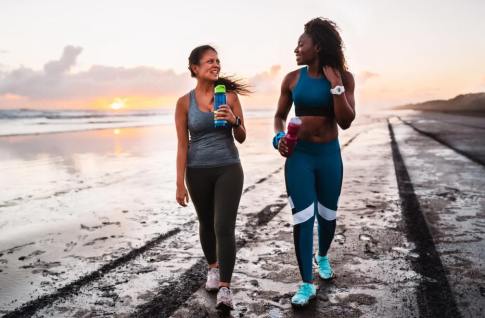 Photo: Getty Images/Nazar Abbas Photography

 James' World 2