Michael Frank ran his finger down his medical bill, studying the charges and pausing in disbelief. The numbers didn’t make sense.
His recovery from a partial hip replacement had been difficult. He had iced and elevated his leg for weeks. He had pushed his 49-year-old body, limping and wincing, through more than a dozen physical therapy sessions.
The last thing he needed was a botched bill.
His December 2015 surgery to replace the ball in his left hip joint at NYU Langone Health in New York City had been routine. One night in the hospital and no complications.
.
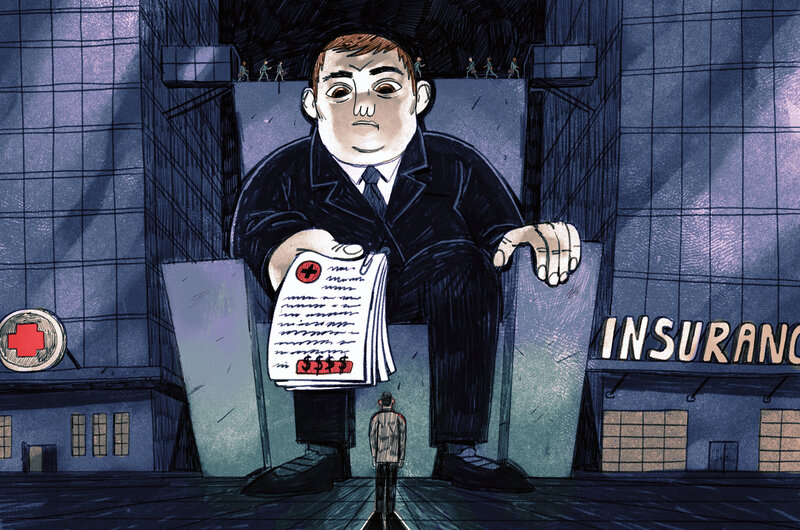
Widely perceived as fierce guardians of health care spending, insurers, in many cases, aren’t. In fact, they often agree to pay high prices, then pass them along to patients.
A mother unleashed a piercing scream as her baby was ripped from her arms during a slave auction. Even as a lash cut her back, she refused to put her baby down and climb atop an auction block.
The woman pleaded for God’s mercy, Henry Bibb, a former slave, recalled in an 1849 narrative that is part of “The Weeping Time” exhibit at the Smithsonian’s Museum of African American History and Culture, which documents the tragic history of children being separated from their parents during slavery. “But the child was torn from the arms of its mother amid the most heart-rending shrieks from the mother and child on the one hand, and the bitter oaths and cruel lashes from the tyrants on the other.”
Her mother was sold to the highest bidder.
Enslaved mothers and fathers lived with the constant fear that they or their children might be sold away.
.
Sketch of a slave auction. (Smithsonian’s National Museum of African American History and Culture)
Years ago, when my husband and I were dating, we were out at a concert when he headed to get us drinks. When I asked for an amaretto sour, I saw a shadow cross his face. A frisson of horror. A slight greening around the gills.
It turned out there had been an incident. He prefers not to speak of it, but for him, the amaretto sour would be more accurately called the Trigger Warning.
My husband is not alone. I’ve asked the question of many friends over the years, and it always brings forth a torrent of nostalgia laced with the farcical comedy of remembered shame. The question: Is there a drink that you have sworn off drinking again?
Why do corporations exist? These hierarchical, self-contained assemblies of labour, capital and know-how have been with us for so long that by now they seem almost ‘natural’. But apart from what they make or do or sell, the very structure of the company has a history.
The clearest rationale for corporations comes from the Nobel prizewinning economist Ronald Coase and his 1937 theory of the firm. Imagine you want to make money by selling widgets. What’s the best strategy: sign up talent individually and on a needs-only basis, or hire staff to do the various jobs in-house? Coase showed that it made more economic sense to incorporate as a company, because it allowed you to minimise three very important costs. The first reduction would come from resourcing: it’s less expensive to find and recruit people with the right skills and knowledge from inside the company than to look for them externally every time you want something done. The second line-item is transacting, or managing processes and resources: it’s less of an administrative burden to have teams in-house than to keep an eye on multiple external contractors. And finally there’s contracting: every time work takes place within a company, the rules and conditions are implied in the employment contract, not negotiated afresh each time. By reducing these three costs, Coase claimed, corporations are the optimal structures for increasing economic activity.
.
Going down? A businessman in the City financial district of London, UK Photo by Chris Ratcliffe/Bloomberrg/Getty
At my first sales job, I had about 25 colleagues who did the same work. After the first month, I noticed something peculiar.
Only 4 of my co-workers brought in more than half of the total sales. I was 17 years old at the time, and I had no idea why that was. These folks were the superstars on the floor — the untouchables.
Little did I know that this relation holds true for almost everything in business. It’s called Price’s square root law, and it originates from academia.
.
Example of how Price’s Law works in a field/company with 100 people
It didn’t take long for them to find her. Soon after Michele Dauber started teaching at Stanford Law School in the fall of 2001, a few female students came to her office and told her they had been sexually assaulted. After a time, she came to expect that if she kept her door open, especially in the first three months of the school year, a girl she had never met would come in, crying. “I know before she’s made it all the way through the door what she’s going to say,” Dauber said.
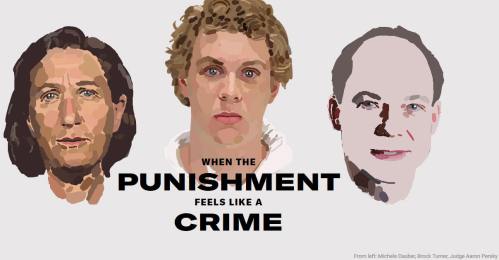
Dauber, now 53, is small and intense, with a wavy mop of graying hair. She seemed to understand the students’ distress in a way that other professors didn’t. She fought for the students in Stanford’s byzantine system; then, when recourse failed to come, she fought to change the system. The students in her class on college sexual assault, many of whom were themselves survivors, seemed “in awe” of her, a friend told me. Once, Dauber even let a student who no longer felt safe on campus live for a while in her Palo Alto home, along with her family, four chickens and a rescued cat. And then, on January 18, 2015, a friend of Dauber’s own daughter was assaulted—by a 19-year-old Stanford student named Brock Turner.
.
Brock Turner’s twisted legacy—and a Stanford professor’s relentless pursuit of justice
What started as a routine traffic stop for a broken taillight in Springfield, Massachusetts, has escalated into a succession of grisly discoveries that have shaken the blue-collar city.
Three bodies have been discovered at the home of an ex-con already at the center of a kidnapping and torture case — spurring authorities on Friday to use underground radar to search for more remains. A preliminary inspection found no additional bodies, officials said.
All three corpses were found “in and around” the home of Stewart Weldon, 40, who was arrested Sunday after the traffic stop when he bolted and led police on a chase that ended when he crashed into a patrol car, NBC10 Boston reported.
.
3 bodies found at Massachusetts home of an alleged kidnapper
Darcie Moore is an expert on cargo. Not the kind you’d find on a freight train, though—it’s the cargo you’d find in stem cells, the kind that can transform into the different types of cells your body needs in your brain, skin, hair follicles, and lots of other places. They’re especially critical when we’re developing at an early age, but adults have them, too.
As stem cells grow and replicate, they can accumulate misfolded proteins and other gunk—“cargo”—that harms their function by, in Moore’s words, “exhausting” them. Nautilus caught up with Moore, a neuroscientist at the University of Wisconsin-Madison, to talk about how she investigates stem cell exhaustion and how it contributes to the puzzle of aging.
What do stem cells have to do with aging?
The theory is that during aging, your stem cells begin to dysfunction. For example, you begin to lose the ability to make pigment in your hair with aging due to melanocyte stem cells becoming depleted. Some of the concepts that apply to stem cell aging have been initially studied quite a bit in yeast, including the work my lab does, and it’s only recently that this work has started to take off in mammalian systems.
When President Donald Trump on Thursday met with victims, families and others affected by the shooting at Santa Fe High School in Texas, which left 10 people dead and 13 wounded, at least one parent was not impressed with his demeanor, continuing a pattern of the president failing to show empathy during tragedies.
Rhonda Hart, whose daughter, Kimberly Vaughan, was among eight students who died in the shooting last month, told The Associated Press her conversation with Trump “was like talking to a toddler.”
According to Hart, Trump repeatedly brought up arming teachers, a policy proposal he has frequently promoted after school shootings.
Hart, an Army veteran, said she also suggested employing veterans as sentinels in schools. She said Trump responded, “And arm them?” She replied, “No,” but said Trump “kept mentioning” arming classroom teachers. “It was like talking to a toddler,” Hart said.
She said the president also focused on the shooter and his appearance, repeatedly describing him as “wacky.”
.
Chip Somodevilla via Getty Images
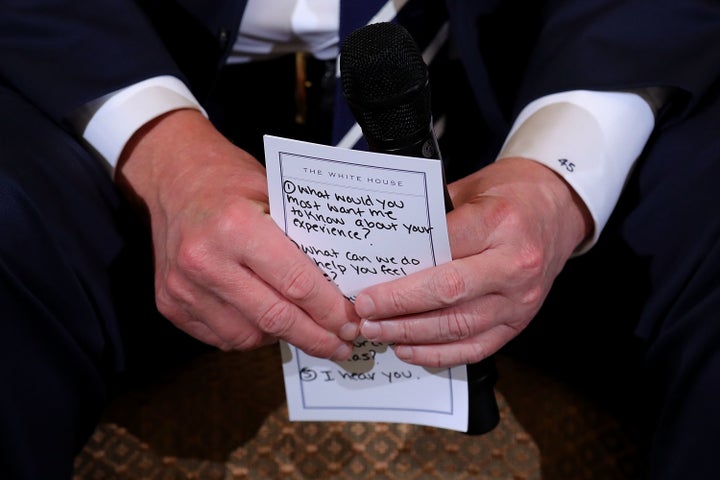
Trump received backlash after being seen holding a notecard reminding him to tell shooting victims and families that “I hear you.”
Surveillance systems that track the locations of cellphone users and spy on their calls, texts and data streams are being turned against Americans as they roam the country and the world, say security experts and U.S. officials.
Federal officials acknowledged the privacy risk to Americans in a previously undisclosed letter from the Department of Homeland Security to Sen. Ron Wyden (D-Ore.) last week, saying they had received reports that “nefarious actors may have exploited” global cellular networks “to target the communications of American citizens.”
The letter, dated May 22 and obtained by The Washington Post, described surveillance systems that tap into a global messaging system that allows cellular customers to move from network to network as they travel. The decades-old messaging system, called SS7, has little security, allowing intelligence agencies and some criminal gangs to spy on unwitting targets — based on nothing more than their cellphone numbers.
Film and Writing Festival for Comedy. Showcasing best of comedy short films at the FEEDBACK Film Festival. Plus, showcasing best of comedy novels, short stories, poems, screenplays (TV, short, feature) at the festival performed by professional actors.




 Going down? A businessman in the City financial district of London, UK Photo by Chris Ratcliffe/Bloomberrg/Getty





 .
.