Not getting enough sleep is detrimental to both your health and productivity. Yawn. We’ve heard it all before. But results from one study impress just how bad a cumulative lack of sleep can be on performance. Subjects in a lab-based sleep study who were allowed to get only six hours of sleep a night for two weeks straight functioned as poorly as those who were forced to stay awake for two days straight. The kicker is the people who slept six hours per night thought they were doing just fine.
This sleep deprivation study, published in the journal Sleep, took 48 adults and restricted their sleep to a maximum of four, six, or eight hours a night for two weeks; one unlucky subset was deprived of sleep for three days straight.
LIZ CARMOUCHE sat in her truck for 30 minutes, frustrated. She was physically and emotionally drained.
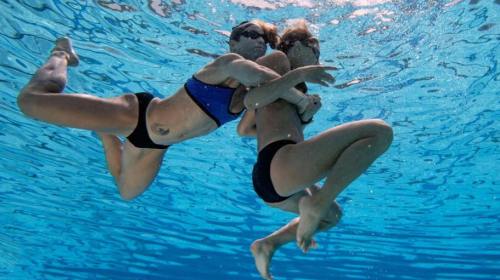
Carmouche’s MMA teammate Ilima-Lei Macfarlane had invited her to do underwater training, a program called Deep End Fitness. Carmouche, while an exceptional athlete and veteran of the U.S. Marine Corps, had never been much of a swimmer. She didn’t even know how to float or tread water in the pool.
But she attended her first session last November in Oceanside, California, anyway. It was a chance to learn something new, and she had seen Macfarlane’s improved cardio and confidence firsthand while they trained at San Diego Combat Academy.
.
UFC fighters Liz Carmouche and Ashley Yoder grapple underwater in preparation for upcoming fights. Donald Miralle for ESPN
Before practice each day, New York Jets running back Le’Veon Bell tells his defensive teammates, “Give me a little something.”
Bell, who is being held out of the preseason games as a precaution, wants to get his body acclimated to contact before making his Jets debut in Week 1 against the Buffalo Bills. So, in a very un-running-back-like move, he’s asking to be tackled.
“Go for the ball, things like that, just so I can get prepared,” Bell said Wednesday.
Most dating advice glosses over the concepts of compatibility and chemistry, assuming most people have an intuitive grasp of what they are and why they’re important. When you have chemistry with someone, you just feel it. When you’re dating someone you’re not compatible with, it’s obvious — like biting into a piece of spoiled fruit, the discomfort is impossible to ignore.
Compatibility and chemistry are mostly ignored by dating advice because they’re things that can’t be faked or changed. Instead, we spend most of our time studying self-improvement, presentation, and the technical mastery of social minutiae, all in an attempt to excel at the sales job of our romantic and sexual services to possible partners. Dating advice is designed to get that person who we feel is out of our league, to somehow trick or coax or cajole them into noticing us. The girl we’ve never had before. The man we’ve fantasized about. And if that guy or girl who’s out of our league is actually not compatible with us, well, we don’t really want to hear about it.
.
Finding the right combination of chemistry and compatibility can be challenging.
Nobody gets younger. It’s a reality all of us, especially women, will eventually have to face in the workplace. So why is it that, rather than being respected for the wisdom and experience that often comes with age, nearly two-thirds of workers aged 45 and older have seen or experienced age discrimination at work?
I’ve been working in TV news for more than three decades. I’m a reporter, a theater critic, and an anchor. I’ve covered thousands of stories and received dozens of awards, including two Emmys, one of which was just awarded this year. At 61 years old, I feel as though I am in the prime of my career. And yet somehow, at the same time, everything is now starting to unravel.
.
NY1’s Roma Torre has spent 3 decades in TV, winning 2 Emmys. But when she lost opportunities to men and younger women, she was told “That’s just the way it is.”
Swimming is one of America’s greatest pastimes, but due to their visibility, Muslim women who wear a burkini face a huge risk of harassment.
HuffPost spoke to over 30 Muslim women across the country who described a wide range of experiences swimming in America. Not all of their encounters were negative, but the vast majority of interviews uncovered a pattern: Muslim women are still fighting for their right to swim. Often they are confronted in public, humiliated and abused. They face decades of entrenched prejudice from people who view their modesty as oppressive and unfeminist.
It is not just happening in America. Three years ago, at least 20 French towns adopted a burkini ban, forbidding Muslim women from swimming in public pools and beaches if they dressed fully covered. The ban has since been overturned, but similar bans continue to happen, despite a rise in burkini sales.
.
Manar Hussein at a beach in New Jersey, June 26, 2019. This was Hussein’s first time wearing a burkini in the water. Kholood Eid for HuffPost
Just over halfway through the 2011 Kielder Marathon in Northumberland, Steve Cairns was in third place and out on his own. As he passed the 14-mile mark, he could see the two leading runners, Ricky Lightfoot and Marcus Scotney, a few minutes ahead on the trail. Behind him, just passing the 13-mile point, were the chasing pack. Cairns knew he had little chance of catching the front-runners. He was equally confident that, with a six-minute gap to close, the rest of the field had little chance of catching him. “I’m just going to enjoy this,” he decided.
Cairns held on to his position and finished the race comfortably. As he crossed the finish line, he heard his result called over the PA. “I’m thinking, did I hear that right?” he says. “Fourth?” He asked a marshal to point out who was third. Cairns recognized the man immediately. It was Rob Sloan, the winner of a 10k race held the day before. There was no mistaking him: Sloan had a mohican haircut and distinctive tattoos. Cairns had exchanged nods with him on the start line; this was the first time he’d seen him since. Cairns placed a hand on Sloan’s shoulder. “When did you pass me?” he demanded. “Out on the course,” Sloan shot back.
.
Crossing the line: These days, after almost every major race, a handful of competitors are exposed as cheats. Photo: ZamoraA/Getty Images
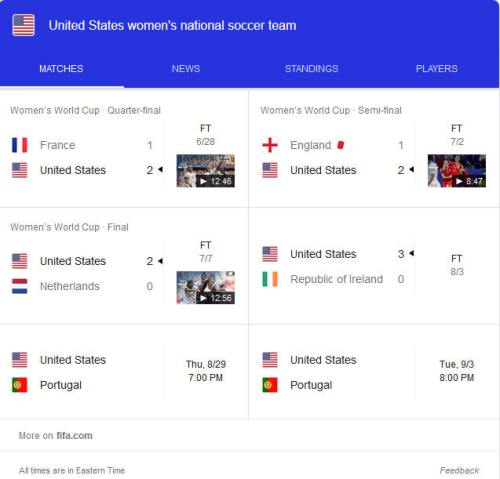
The judge in the United States women’s soccer team’s gender discrimination lawsuit has set a May 5, 2020 trial date in the case, an accelerated timeline that could see the team’s bid for equal pay become entangled with its preparations for next summer’s Tokyo Olympics.
The date, set on Monday by Judge R. Gary Klausner of United States District Court for the Central District of California, is at least six months earlier than the players and U.S. Soccer, their employer and the defendant in the suit, had requested. Both the players and U.S. Soccer, which runs the national team and pays the salaries and bonuses of its players, had sought to delay the trial until later in the year in order to avoid both the Olympic tournament and the conclusion of the players’ domestic league seasons.
Instead, Judge Klausner set a date that is 11 weeks before the opening match of the Olympic women’s tournament. The United States still has to qualify for the Games, but most believe that is a formality: the squad, the reigning World Cup champion, has reached five of the six Olympic finals and has left with the gold medal four times.
.
The world champion United States women’s team has sued U.S. Soccer for gender discrimination.CreditCreditFranck Fife/Agence France-Presse — Getty Images
Film and Writing Festival for Comedy. Showcasing best of comedy short films at the FEEDBACK Film Festival. Plus, showcasing best of comedy novels, short stories, poems, screenplays (TV, short, feature) at the festival performed by professional actors.



 .
.
 Le’Veon Bell


 NY1’s Roma Torre has spent 3 decades in TV, winning 2 Emmys. But when she lost opportunities to men and younger women, she was told “That’s just the way it is.”
 Manar Hussein at a beach in New Jersey, June 26, 2019. This was Hussein’s first time wearing a burkini in the water.