September 7, 2026
Mohenjo
Business, Food For Thought, Human Interest, Political, Science, Technical
amazon, business, Business News, current-events, Future, Hotels, human-rights, medicine, mental-health, research, Science, Science News, technology, Technology News, travel, vacation

Click the link below the picture
.
A new study led by researchers at The University of Texas at Austin takes the opposite approach. Instead of starving cancer cells, an experimental drug tricks them into burning even more sugar. Then it blocks another fuel source, fat, at the same time.
The compound, called XJ-4-85, showed promise against an aggressive form of melanoma in mice. It also killed several types of human cancer cells in lab tests, including melanoma, leukemia, breast, lung, liver, and neuroblastoma cells.
A Two-Part Attack On Cancer Fuel
The study focuses on cancer metabolism. That term describes how tumor cells gather and use energy.
Many cancer cells rely heavily on glycolysis, a process that breaks down sugar. This pattern helps tumors grow quickly, even in difficult conditions. It also gives scientists a possible weakness to target.
XJ-4-85 works in a surprising way. One part binds to PFKL, an enzyme that helps cells break down sugar. Rather than blocking this enzyme, the drug speeds it up.
At the same time, the compound releases a payload that targets CPT2. That enzyme helps cells use fatty acids for energy. By disrupting both systems, the drug places cancer cells under severe stress.
“I like to think of this technology like a two-headed dragon,” said Xiaolu (Lulu) Lim Ang Cambronne, an associate professor of molecular biosciences at UT and co-corresponding author. “We are putting one part of the cell into overdrive while simultaneously weakening another part. It appears to be extremely potent.”
Using Cancer’s Appetite Against It
The idea may sound strange at first. If cancer cells love sugar, why make them burn more of it?
The answer lies in balance. Cells survive by shifting between energy sources. If one pathway becomes strained, they often lean on another.
XJ-4-85 appears to disrupt that flexibility. It pushes sugar metabolism into overdrive while weakening fatty acid metabolism. Cancer cells lose room to adapt.
The result is a kind of metabolic trap. The tumor cell runs harder on one fuel system while losing access to a backup. Many cancer cells could not survive that pressure.
Noncancerous cells were much less affected in the mouse experiments and several lab studies. That selectivity remains an important early sign, though more testing is needed.
A Small-Molecule Alternative
The researchers compare their strategy with antibody-drug conjugates, or ADCs. These cancer drugs use antibodies to guide chemotherapy payloads toward tumor cells.
ADCs have become an important tool in cancer treatment. But they also have limits. Antibodies are large, complex and difficult to manufacture.
They usually target proteins on the surface of cancer cells. That leaves many important proteins inside cells out of reach.
“Antibodies are difficult to make, and because they’re so large they’re only able to target proteins in the surface of cancer cells,” said Ken Hsu, an associate professor of chemistry at UT and co-corresponding author. “We think of this new compound as a fully chemical counterpart to ADCs. They are much easier to manufacture. And because they are smaller, they are able to target even proteins that are inside cells.”
How The Drug Finds Its Target
XJ-4-85 targets PFKL at specific sites on the enzyme. In the study image, the protein structure shows the compound bound at K677 and K315.
Those sites help explain how the drug boosts glycolysis. When the compound binds, it helps keep PFKL in an active form. That pushes the sugar-burning pathway forward.
Researchers used cryo-electron microscopy to see the drug bound to PFKL in detail. This method can reveal protein structures at near-atomic resolution.
The team found that the compound stabilizes the enzyme in its active state. That helps explain why sugar metabolism rises after treatment.
“The way this drug works was totally unexpected,” said Xiaoding Jiang, a postdoctoral fellow in the Hsu Lab, who designed the molecule. “A lot of research was required to figure out what it was doing on the molecular level. We were also surprised to see how selectively it binds to cancer cells.”
.
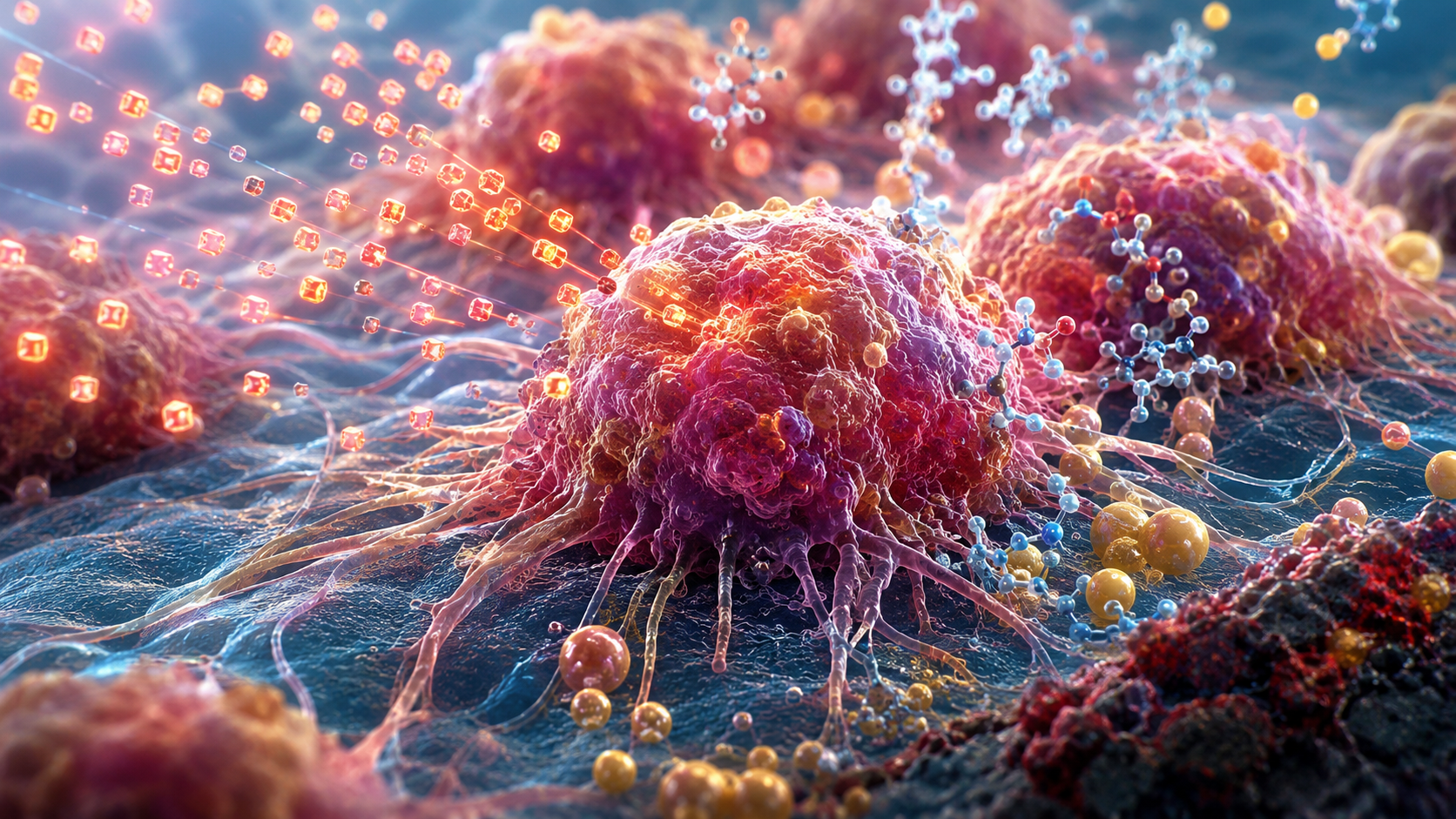 Researchers developed a small-molecule drug that tricks cancer cells into burning more sugar while blocking their backup fuel source. (CREDIT: Shutterstock)
.
.
Click the link below for the complete article:
.
__________________________________________
September 7, 2026
Mohenjo
Business, Food For Thought, Human Interest, Political, Science, Technical
amazon, business, Business News, current-events, Future, Hotels, human-rights, medicine, mental-health, research, Science, Science News, technology, Technology News, travel, vacation

Hmmmm …. Vote crazy Trump administration out!
Click the link below the picture
.
With an insulted and angry nation solidly behind him, Prime Minister Mark Carney of Canada is charging ahead in a bitter trade war with the United States, risking a further fraying of what once was one of the world’s closest friendships.
Retaliatory tariffs, set to take effect at 12:01 a.m. Eastern time on Tuesday, demonstrate Mr. Carney’s defiance toward increasing bombast by President Trump, who has been trying to humiliate Canada economically after more than two weeks of finger pointing and threats.
Mr. Carney’s response has distinguished him as one of the few world leaders standing up to Mr. Trump as he lashes out at American allies on a range of issues.
The new measures will double the rate of existing tariffs that Canadian businesses pay on imported American steel and aluminum products and affect about 700 products, including aluminum foil, railway locomotives and steel bridges.
Polls show that Canadians strongly back Mr. Carney’s decision to end trade talks with Washington last month and hit back with tariffs on about $20 billion in American products entering Canada. But there is also concern over what might happen next. Mr. Trump has repeatedly threatened another round of American tariffs if Canada follows through on its plan.
Some in Canadian industry say they are inclined to take Mr. Trump at his word, at least on this threat.
People in the Trump administration “are willing to hurt themselves, their own sectors and industries, in pursuit of their goal, however misguided I think it is,” said Flavio Volpe, the president of the Automotive Parts Manufacturers’ Association of Canada. “So they may escalate. I hope that we don’t end up in a tit-for-tat situation.”
In what appeared to foreshadow Mr. Trump’s latest intentions, he announced on Monday that Bombardier, the Montreal-based aerospace company, would be banned from selling in the American market unless it built in the United States. “They live off American Buyers, American Companies, American Airports, and American Service — All while Canada blocks our GREAT American Banks, and Companies, throughout the U.S.A.,” Mr. Trump wrote in a social media post announcing the ban.
Mr. Carney announced Canada’s new tariffs after he pulled Canadian negotiators out of talks in Washington last month — an ultimately unsuccessful attempt to stave off 50 percent American tariffs on $20 billion in Canadian exports and to reduce or eliminate tariffs of up to 50 percent on Canadian steel, aluminum and automobiles.
The Trump administration said the tariffs it imposed last month were in part a response to retaliatory tariffs Canada placed last year on some U.S. imports, particularly autos. American officials have repeatedly noted that only China and Canada retaliated against the United States since Mr. Trump began upending global trade.
Since trade tensions began to rise with Canada at the start of Mr. Trump’s second term, the United States has lashed out in ways both substantive and symbolic, including threats to block the reopening of a U.S.-Canada bridge and an executive order to rename Lake Ontario to “Lake America.”
At a news conference after a sternly worded speech announcing the tariffs, Mr. Carney declared that Canada had been attacked by the United States and that the two countries are now “at war.”
Last week, Scott Bessent, the U.S. Treasury secretary, rejected that framing, arguing that Canada is too small an economic power to battle the United States. “I don’t think you can be in a tit-for-tat with someone who’s 13 times larger than you are,” Mr. Bessent said on CNBC.
On Friday, Mr. Trump escalated his trade rhetoric even further. He said that he might “end all trade with Canada” and other countries that have trade surpluses with the United States. Mr. Trump has frequently made dramatic threats during trade negotiations that have gone unrealized, such as floating the idea of a 100 percent tariff on Canadian goods in January.
Separately, the U.S. commerce secretary, Howard Lutnick, said Mr. Carney had shut down the talks to gain “political leverage” at home, not because of what the U.S. side had offered.
.
 The Blue Water Bridge, connecting Sarnia, Ontario, and Port Huron, Mich., this month. Credit…Carlos Osorio/Reuters
.
.
Click the link below for the complete article:
.
__________________________________________
September 6, 2026
Mohenjo
Business, Food For Thought, Human Interest, Political, Science, Technical
amazon, business, Business News, current-events, Future, Hotels, human-rights, medicine, mental-health, research, Science, Science News, technology, Technology News, travel, vacation

.
.
“It is not
Necessary for a presidential candidate to be able to read or even write even a congenital idiot can run for the presidency of the United States of America and serve if you were elected “
Edgar Rice Burroughs
Proverbs 27:22
New Living Translation
22 You cannot separate fools from their foolishness,
even though you grind them like grain with mortar and pestle.
.
EVIL PEOPLE
They had been long accustomed to do evil. They were taught to do evil; they had been educated and brought up in sin; they had served an apprenticeship to it, and had all their days made a trade of it. It was so much their constant practice that it had become a second nature to them. – Matthew Henry
“When a clown moves into a palace, he doesn’t become a king, the palace instead becomes a circus. — Turkish proverb,”
Hmmmmm…History is repeating itself yet again!
Isaiah 59:14
New Living Translation
14 Our courts oppose the righteous,
and justice is nowhere to be found.
Truth stumbles in the streets,
and honesty has been outlawed.
Jeremiah 5:21
New Living Translation
21 Listen, you foolish and senseless people,
with eyes that do not see
and ears that do not hear.
.
__________________________________________
September 6, 2026
Mohenjo
Business, Food For Thought, Human Interest, Political, Science, Technical
amazon, business, Business News, current-events, Future, Hotels, human-rights, medicine, mental-health, research, Science, Science News, technology, Technology News, travel, vacation

.
This sounds just like today’s World although it was written about Israel in Babylonian captivity.
History repeats itself
Isaiah 59:9-15
New Living Translation
So there is no justice among us,
and we know nothing about right living.
We look for light but find only darkness.
We look for bright skies but walk in gloom.
10 We grope like the blind along a wall,
feeling our way like people without eyes.
Even at brightest noontime,
we stumble as though it were dark.
Among the living,
we are like the dead.
11 We growl like hungry bears;
we moan like mournful doves.
We look for justice, but it never comes.
We look for rescue, but it is far away from us.
12 For our sins are piled up before God
and testify against us.
Yes, we know what sinners we are.
13 We know we have rebelled and have denied the Lord.
We have turned our backs on our God.
We know how unfair and oppressive we have been,
carefully planning our deceitful lies.
14 Our courts oppose the righteous,
and justice is nowhere to be found.
Truth stumbles in the streets,
and honesty has been outlawed.
15 Yes, truth is gone,
and anyone who renounces evil is attacked.
The Lord looked and was displeased
to find there was no justice.
.
__________________________________________
September 6, 2026
Mohenjo
Business, Food For Thought, Human Interest, Political, Science, Technical
amazon, business, Business News, current-events, Future, Hotels, human-rights, medicine, mental-health, research, Science, Science News, technology, Technology News, travel, vacation
Click the link below the picture
.
You might find these videos enlightening!
.
 A. R. Bernard: one of many
.
.
Click the link below for the videos:
.
__________________________________________
September 6, 2026
Mohenjo
Business, Food For Thought, Human Interest, Political, Science, Technical
amazon, business, Business News, current-events, Future, Hotels, human-rights, medicine, mental-health, research, Science, Science News, technology, Technology News, travel, vacation

Click the link below the picture
.
The Trump administration has remained silent so far on vaccination recommendations as flu season approaches. But leaders of some of the country’s largest medical organizations are urging Americans to get their shots to avoid serious illness.
On Wednesday, the American Medical Association, the American Academy of Family Physicians, the American Academy of Pediatrics (AAP), the American College of Obstetricians and Gynecologists and the Infectious Diseases Society of America, as well as the University of Minnesota’s Vaccine Integrity Project, released recommendations indicating that the vast majority of people should get vaccinated against influenza, COVID and respiratory syncytial virus (RSV).
“Unfortunately, today the federal government is not fulfilling that responsibility in the way that it historically has. But the need for that work has not disappeared,” said Bruce Gellin, a member of the Vaccine Integrity Project’s board of advisers and an adjunct professor at Georgetown University, during a press briefing on Tuesday.
“Americans should have access to the best available scientific evidence and recommendations from the physicians and medical experts who care for them so they can make informed decisions about vaccination. Whatever happens to the federal vaccine policy process, we cannot lower that scientific standard,” Gellin said.
The recommendations come as an increasing number of people opt not to get themselves or their children vaccinated for various diseases. Nodding to data showing that the nation’s medical institutions are suffering from a crisis of confidence among a growing number of Americans, the consortium released summaries of research into the shots’ safety and efficacy in the Journal of the American Medical Association and online to accompany the new guidelines.
The group’s guidance acknowledges the fact that COVID is less dangerous today than it was at the height of the pandemic. But during the 2025–2026 respiratory virus season in the U.S., an estimated 15,000 to 42,000 people still died of the disease, while up to 240,000 people were hospitalized and millions more experienced less severe illness. The consortium’s research review for the COVID shots finds that they cut the risk of hospitalization for adults older than age 65 by 53 percent and reduce that risk for pregnant women by 58 percent. There are also signs that the vaccines’ benefits are passed on to the latter’s babies, who tend to have fewer COVID-related hospital visits than children of unvaccinated mothers. Adults who are immunocompromised see their risk of being put into intensive care or of dying from COVID cut by the vaccines by between 32 and 53 percent.
Influenza is the leading cause of vaccine-preventable respiratory illness. Vaccines against the illness reduce its hospitalization rate among adults older than age 65 by 31 percent and cut deaths among infants and children by 80 percent, according to the group’s research review for these shots. Meanwhile, the consortium’s review of RSV vaccines finds that they reduce hospitalization rates by up to 83 percent among people older than 60, while vaccination during pregnancy reduces hospitalization for infants by up to 70 percent.
Despite the evidence showing the vaccines are safe and effective, the Centers for Disease Control and Prevention, which usually produces an annual campaign to push people to get vaccinated against respiratory illnesses, has yet to roll out a similar effort this year. The CDC did not immediately respond to a request for comment.
The CDC recommends vaccinations against the flu and COVID for most Americans, including pregnant women and healthy children. Still, those guidelines are at odds with vaccine-skeptic statements and positions taken by Secretary of Health and Human Services Robert F. Kennedy, Jr., and other members of the administration.
Kennedy’s apparent opposition to vaccines could make access to the shots more difficult for some parents, said AAP president Andrew Racine at the same press event. Racine said it’s also unclear at this time if the CDC’s Vaccines for Children Program, which provides shots for families that can’t afford them, will cover the cost of the recommended vaccines.
“Last year Vaccines for Children covered all of the recommended vaccines that we had put in our vaccine schedule,” Racine said. “I can’t say necessarily what’s going to happen going forward, but it’s our anticipation that the federal government, with Vaccines for Children and other programs that they run, have a responsibility and an interest in making sure that children of any income get all of the care that they need in order to keep them healthy and safe.”
Still, Racine pointed out that, while there is a decline, most U.S. children are vaccinated and that polling data indicate that most families prefer to get medical information from their pediatricians.
“I’m not saying this to say that we don’t have work to do,” he said. “We do have work to do. Certainly, the trends are not moving in the direction we would like, but I do think that we have lots of advantages in our day-to-day work.”
.
 SanyaSM/Getty Images
.
.
Click the link below for the complete article:
.
__________________________________________
September 6, 2026
Mohenjo
Business, Food For Thought, Human Interest, Political, Science, Technical
amazon, business, Business News, current-events, Future, Hotels, human-rights, medicine, mental-health, research, Science, Science News, technology, Technology News, travel, vacation

Click the link below the picture
.
It’s fall migration season in the Park! A key stop on the Atlantic Flyway, Central Park welcomes more than 210 bird species each year. On this hands-on tour, you will learn the basics of bird identification while you explore the Ramble, a vibrant woodland habitat that supports a variety of NYC wildlife. Our expert Conservancy guides will share helpful tips for spotting and identifying birds. Bring your own binoculars or borrow a pair from us.
BUY TICKETS
.
 Central Park is a birding haven! Join us this season to make the most of fall migration.
.
.
Click the link below for the complete article:
.
__________________________________________
September 6, 2026
Mohenjo
Business, Food For Thought, Human Interest, Political, Science, Technical
amazon, business, Business News, current-events, Future, Hotels, human-rights, medicine, mental-health, research, Science, Science News, technology, Technology News, travel, vacation

Click the link below the picture
.
Defense Secretary Pete Hegseth decided in early 2025 to spike Gen. Christopher T. Donahue’s nomination to be the top U.S. military officer in Europe.
Mr. Hegseth believed that President Trump wanted heads to roll for the deaths of 13 U.S. service members in a suicide bombing at the Kabul airport during the U.S. withdrawal from Afghanistan in 2021. General Donahue was not responsible for security at the bombing site. But he was a top commander at the airport, and so Mr. Hegseth decided he needed to go.
It fell to Joe Kasper, Mr. Hegseth’s chief of staff, to try to convince him that he was wrong.
Mr. Kasper asked a senior Pentagon official to prepare a card with a half-dozen bullet points laying out the facts in General Donahue’s defense, current and former officials said. He took it with him in March of last year as he and Mr. Hegseth sped through traffic to the White House for a press event.
For those few minutes in the car, Mr. Kasper knew he would have his boss’s undivided attention.
Sirens were blaring. He handed Mr. Hegseth the card.
These were the facts of General Donahue’s three-decade career: He had seen more combat in his 20-plus deployments than just about any officer in the U.S. military. A star in the clandestine world of special forces, he had spent years in the shadows hunting terrorist leaders. And then as the world and warfare changed, he changed with it.
He had played a central role in the U.S. military’s efforts to help Ukraine hold off a much larger Russian force, a job that inspired his vision for a new kind of combat that married divebombing drones, robotics, and artificial intelligence.
Now his fate lay in the hands of Mr. Hegseth, a former Fox News host who had two deployments as an Army officer to Iraq and Afghanistan. Mr. Hegseth had come to the Pentagon vowing to weed out the “small” and “feeble” generals who he believed had failed in those wars.
What played out in the 16 months after the car ride was a clash between Mr. Hegseth and General Donahue’s supporters, who viewed him as a generational talent.
That clash, and its outcome, was described to The New York Times by more than 40 people at the Pentagon, in Congress and around the world, nearly all of whom spoke on the condition of anonymity to avoid retribution.
It amounts to one of the most consequential chapters in Mr. Hegseth’s campaign to drive out those he sees as out of step with his priorities, a leadership purge that his critics say is driven by ideology, identity and suspicion of those with tenuous ties to former military leaders that he does not like. And it shows the intensity of the behind-the-scenes battle to save one general.
The more General Donahue’s allies pushed, the more Mr. Hegseth’s opposition seemed to harden.
The Pentagon declined to answer questions about General Donahue, saying in a statement that all senior military leaders serve at the pleasure of the president and the defense secretary.
In the spring of 2025, General Donahue was commanding ground forces in Europe. Mr. Hegseth was new to the Pentagon. To the extent he was familiar with General Donahue, it was largely through the prism of the Afghanistan withdrawal and a grainy photo that indelibly linked the general to the war’s tragic end.
General Donahue was the last U.S. soldier to leave Afghanistan. As he stepped onto a hulking military cargo plane, an Army photographer snapped his picture using his cellphone camera and night vision device.
The green-and-black image rocketed around the world. Senior Pentagon officials said Mr. Hegseth seemed to be fixated on the photo, mistakenly referring to it as a “selfie.”
The first item on the card that Mr. Kasper handed to Mr. Hegseth in the car clarified that the photo was not a selfie and that General Donahue had nothing to do with its distribution. Other bullet points noted that Marines, not General Donahue’s paratroopers, were in charge of the gate where the suicide bombing occurred.
The defense secretary glanced at the card and passed it back to his chief of staff.
“I don’t care,” Mr. Hegseth told Mr. Kasper.
.
 Gen. Christopher T. Donahue greeted service members before the 2023 renaming of Fort Bragg in North Carolina. The general had extensive combat experience and strong support in the Army. Credit…Allison Joyce/Agence France-Presse — Getty Images
.
.
Click the link below for the complete article:
.
__________________________________________
September 5, 2026
Mohenjo
Business, Food For Thought, Human Interest, Political, Science, Technical
amazon, business, Business News, current-events, Future, Hotels, human-rights, medicine, mental-health, research, Science, Science News, technology, Technology News, travel, vacation

Click the link below the picture
.
The world is likely to overshoot 1.5°C of warming within the next few years, a report by the UN Environment Programme (UNEP) acknowledges. However, it says it is still possible to cool the planet back down to this level by the end of the century. Can it really be done? It isn’t impossible, but it certainly isn’t the most likely outcome.
The goal of limiting the increase in the average global surface temperature to 1.5°C above pre-industrial levels looked implausible even back in 2015, when it was adopted as part of the Paris Agreement. The UNEP report can be seen as an “official” acknowledgment of what many have been saying for years: that it is now certain that we are going to blast right past this limit.
But some aren’t giving up on the target. There are no good outcomes if we remain above 1.5°C, says Inger Andersen at UNEP. “Even if we exceed 1.5, let’s be very clear: that 1.5 target is still the goal. But now we need to approach it differently, from above.”
Much of the report looks at the consequences of overshooting 1.5°C and the need for adaptation to cope with the severe impacts this will bring. “We will see increased food insecurity, increased water insecurity, impacts on human health – physical and mental – danger to our homes and our infrastructure,” says Debra Roberts at the University of KwaZulu-Natal in South Africa, one of the authors of the report. “This will lead to the loss of livelihoods and certainly lives.”
The world isn’t prepared for overshooting 1.5°C, she says. “Therefore we have to advance our adaptation and development strategies to deal with those higher levels of warming, the greater range of risks and impacts… Adaptation needs to be transformational to allow us to plan for a changing world.”
There will be no going back to how things were, says Roberts. “Some losses will be irreversible, which means returning to 1.5 doesn’t mean we return back to the same world we left.”
But what exactly should we be preparing for? The report focuses on a scenario in which rapid emissions cuts and massive-scale removal of carbon dioxide from the atmosphere result in a return to 1.5°C of warming by the end of the century.
But achieving this would require limiting temperature rises to no more than 1.8°C, says Roberts. Beyond this, there will be cascading effects from all the irreversible changes that make it much harder.
However, restricting warming to this level requires a halving of global emissions by 2035, says report author Joeri Rogelj at Imperial College London. That seems highly unlikely given that emissions are still rising worldwide.
In addition to emissions cuts, the scenario envisaged in the report also requires carbon removal on a truly gigantic scale – enough not just to balance out hard-to-tackle emission sources, such as farming, and achieve net zero, but to go well beyond that to remove around 10 gigatonnes of CO2 each year. That compares with current emissions of around 40 gigatonnes.
This means scaling up carbon removal by a factor of around 100,000, says Reto Knutti at ETH Zurich in Switzerland, who wasn’t involved in the report. Cheap forms of carbon removal, such as planting forests, can’t be scaled up this much because there isn’t enough land. Direct air capture could be scaled up, but it is really expensive, he says.
Knutti thinks achieving this is technically and financially possible, but not politically plausible. “We should be honest when we talk to policy-makers and the public that this is not the thing to plan for,” he says. “I think the plan should be to adapt for at least 2 degrees, if not more.”
James Dyke at the University of Exeter in the UK is even less optimistic. “There are still no credible plans for large-scale carbon dioxide removal,” he says. “Human societies must adapt and prepare for a warmer and more dangerous world that will persist potentially for centuries.”
Konstantin Weber, also at ETH Zurich, points out that among the latest emissions scenarios that will be used by climate modellers, only two imply a return to 1.5°C before 2150. The scenario based on current policies suggests warming of around 3°C by 2100.
Until recently, overshooting and returning to 1.5°C was no more than a scientific thought experiment, says Oliver Geden at the German Institute for International and Security Affairs. Now it could become the “official” plan B for 1.5°C. “The overshoot concept may turn out to be no more than a way to mask ongoing failure,” he says.
But even if getting the temperature back down to 1.5°C isn’t likely, we have to try, says Weber. “We have to give it a shot. There’s no real alternative.”
“Now is the time to double down on climate action, not to give up on it,” says Andersen. “Every fraction of a degree avoided, every year by which overshoot is shortened, and every adaptation action taken will save lives, protect ecosystems and reduce economic losses.”
.

Fossil fuel emissions are likely to push the world past 1.5°C of warming. Blossey/imageBROKER/Shutterstock
.
.
Click the link below for the complete article:
.
__________________________________________
September 5, 2026
Mohenjo
Business, Food For Thought, Human Interest, Political, Science, Technical
amazon, business, Business News, current-events, Future, Hotels, human-rights, medicine, mental-health, research, Science, Science News, technology, Technology News, travel, vacation

Click the link below the picture
.
Key points
- Micro-nanobubble technology removes over 90% of microplastics from wastewater in lab tests.
- This method could improve wastewater treatment and potentially filter microplastics from drinking water.
- Reducing plastic use and preventing microplastics in the environment are key to protecting health and ecosystems.
Featured Story: How Nanobubbles Could Remove the Majority of Microplastics from Wastewater
Microplastics seem to be everywhere. They can make their way into our wastewater, which in turn flows into our oceans.1 Doing a load of laundry with synthetic textiles, using certain household cleaning products like sponges and using certain cosmetics can all release microplastics that end up down the drain.
Fortunately, scientists are continuing to find solutions to reduce microplastics from entering our environment. A recent study published in the American Chemical Society’s ES&T Water journal found that enhancing wastewater treatment by using microbubbles and nanobubbles significantly improved the removal of microplastics from water.
So, what are “microbubbles” and “nanobubbles” exactly? We asked study author Biplob Pramanik, PhD, to give us the breakdown.
“Microbubbles are tiny air bubbles (typically 10–100 micrometres) that provide buoyancy and lift particles to the water surface,” he explains. “Nanobubbles are much smaller (less than 1 micrometre) and have unique surface properties that enhance particle attachment and aggregation. In our approach, nanobubbles help microplastics clump together, while microbubbles float these larger particles to the surface where they can be removed. By combining both bubble types, we achieved over 90% microplastic removal in laboratory-scale wastewater treatment.”
The combined system removed up to 95% of polyethylene (a type of synthetic plastic) and 97% of polystyrene (a synthetic polymer found in packing peanuts and Styrofoam), which could further improve methods already in use by wastewater treatment plants.
While Pramanik notes that wastewater treatment plants already do a great job of filtering out microplastics from the water, this additional science can help filter wastewater more effectively.
“Due to the large volumes of wastewater processed every day, even a small amount of escaping microplastics can result in significant environmental releases,” Pramanik says. “In addition, many captured microplastics accumulate in sewage sludge, which may be reused as biosolids. Improving microplastic removal at the early stages of treatment can further reduce their release to waterways and biosolids, helping to protect ecosystems and public health.”
But wait, there’s more: while more testing is still needed, this micro-nanobubble process could potentially be used to filter drinking water, which could help significantly reduce our microplastic intake in our daily lives.
“[It] could be adapted for drinking water treatment because it is based on physical separation and flotation principles already used in water treatment facilities,” Pramanik shares. But he admits that there’s still a long way to go, as “drinking water applications would require additional testing and optimisation to ensure consistent removal of very small particles while meeting strict drinking water quality and safety standards.”
Microplastics shouldn’t be your no. 1 concern when it comes to your food and drink choices. But new technology lowering the amount of microplastics that allow themselves into our drinking water and wastewater is always good news to hear about. In the meantime, you can reduce your microplastic intake with simple steps—like swapping out plastic cooking utensils in your kitchen.
“People should be aware of microplastics rather than alarmed,” Pramanik says. “Microplastics are widespread in the environment, and research is ongoing to better understand their long-term impacts on ecosystems and human health. While many questions remain, reducing unnecessary plastic use and preventing microplastics from entering the environment are sensible precautionary measures.”
.
:max_bytes(150000):strip_icc()/Scientists-Say-This-New-Technology-Can-Remove-over-90-of-Microplastics-from-Water-4f2d108b90414b798a9643ab229af46d.jpg) Credit: Design elements: Getty Images. EatingWell design.
Credit: Design elements: Getty Images. EatingWell design.
.
.
Click the link below for the complete article:
.
__________________________________________
Older Entries
Newer Entries
 James' World 2