Tim Andrews was so close to death, he was ready to risk what little life he might have left.
The retired grocery store manager was told he would have to wait five years before reaching the top of the transplant list and qualifying for a new, life-saving kidney. He knew he wasn’t going to make it. Already, he could no longer walk or hold down food.
So last year, he volunteered for an experimental surgery at the leading edge of scientific research: He agreed to get a pig kidney to replace his own failing organ.
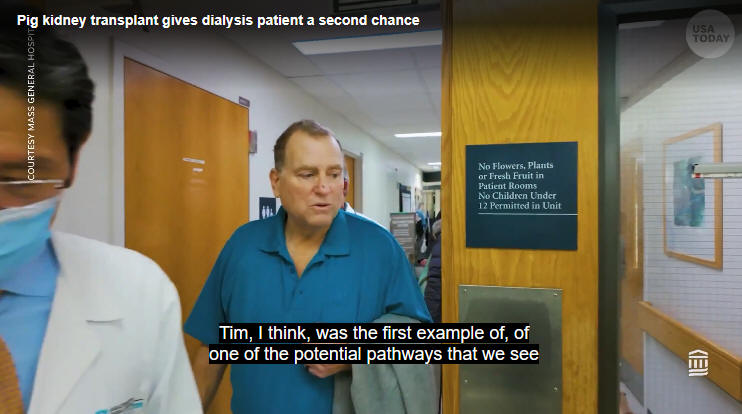
Tim Andrews, a 66-year-old resident of Concord, New Hampshire, is now the fourth person to ever have a genetically modified pig kidney transplant. Andrews previously underwent more than two years of dialysis due to advanced kidney disease, and getting a human kidney transplant would take considerably longer due to his O-group blood type. The pig kidney bought him the time he needed to wait for a human kidney to replace it.
.
“I’m gonna die anyways, why wouldn’t I do something for all these [other people with kidney disease] that are suffering?” said Andrews, of Concord, New Hampshire.
“I don’t care if I die the next day as long as you learn something,” he told his doctor.
One pig- and one human-kidney transplant later, Andrews, 68, says he is now thinking of his future in terms of decades instead of days.
“I’m laughing again,” Andrews chuckled, remembering his time as a self-proclaimed “pig man.”
In the process, Andrews has become an example of how far transplantation has come and what it could look like in the future when there are enough organs for everyone in need and when the medication that enables a transplant’s success doesn’t threaten a recipient’s long-term survival. Andrews’ success as a transplant patient represents a decades-long American journey, one of many USA TODAY is profiling as part of its coverage of the United States’ 250th anniversary year.
The first-ever successful organ transplant took place in 1954, just a few miles from where Andrews received his own. The distance the field has traveled since −and has yet to go − represents a remarkable and very American medical journey, characterized by big ideas, big risks, perseverance, and issues of fairness and eye-popping prices.
The result: Andrews is alive and much healthier than he was two years ago.
“Oh my God, I’m in a science-fiction movie!” said Andrews, chuckling again, and adding that he’s always been a sci-fi buff. “How did I end up here?”
The wait for an organ
More than 100,000 Americans now sit on an organ transplant list, and most of them are waiting for a kidney. Like Andrews, they worry they won’t last long enough to get the ultimate gift.
For kidneys and some liver transplants, live donation is possible ‒ that is, someone can donate one of their two kidneys or a part of their liver and live out the rest of their lives normally. But not everyone can find a living match among friends, relatives or total strangers.
Andrews, like many, eventually benefited from a deceased organ donor. Only about three in 1,000 people die in a way that allows them to donate an organ like a kidney, lungs, or heart.
The science is getting better, enabling more organs to be used from patients who die older, sicker, or further from a hospital.
“We’re expanding the pool by using what we used to call ‘marginal’ organs,” said Dr. Nahel Elias, surgical director for kidney transplantation at Massachusetts General Hospital, where Andrews had his surgeries. “But at the end of the day, dead people are dead for a reason. Young, healthy people don’t just drop dead.”
And there simply aren’t enough organs for the people who need them, Elias and other experts said.
That’s where the idea of using pig organs comes in. For decades, researchers have been working toward the goal of using animal organs to save people. Some view the trade as unethical, but Americans already eat more than 130 million pigs every year, and pig, cow, and even shark tissue have long been used in medical settings.
Pig organs are similar enough in size and function to humans’, but transplanting entire organs was completely out of reach until about a decade ago, when scientists began mastering gene editing well enough to breed pigs whose organs are less likely to be rejected by the human immune system.
Tim Andrews undergoes a xenotransplant procedure on Jan. 25, 2025, at Massachusetts General Hospital. Andrews received a genetically-edited pig kidney. A closeup shows the kidney in its jar before surgery. Andrews lived 271 days with the pig organ before receiving a human kidney transplant.
.
But xenotransplantation, as it is known, is still very much a work in progress, with just 10 Americans, including Andrews, having undergone a transplant. Only six are still alive. Andrews holds the record as of this writing. He lived 271 days with a pig organ.
Clinical trials started in 2026 to test pig organs in more people. The goal, doctors say, is to count their survival in years, not days.
Film and Writing Festival for Comedy. Showcasing best of comedy short films at the FEEDBACK Film Festival. Plus, showcasing best of comedy novels, short stories, poems, screenplays (TV, short, feature) at the festival performed by professional actors.





Leave a comment