
Click the link below the picture
.
After winning a Breakthrough Prize, the world’s most lucrative science award, theoretical physicist David Gross is using the moment to warn of nuclear war’s existential threat—and how we can escape it
David Gross, a celebrated U.S. theoretical physicist, calls himself an optimist—especially concerning the future of his field. He’s certain that somewhere out there lurks a final, unified theory of nature, just waiting to be discovered. But he’s pessimistic about our chances of actually discovering it; on balance, he estimates, it’s more likely that we’ll destroy ourselves in nuclear warfare first. And as the latest recipient of a $3-million Special Breakthrough Prize in Fundamental Physics, he’s using the opportunity to warn the world of this dire peril.
When Gross speaks, especially about prospects of a unified theory, people tend to listen—after all, he’s responsible for some of the biggest steps we’ve taken toward devising one.
Such a theory would, by definition, unify three known fundamental forces—electromagnetism and the strong and weak nuclear forces—with a fourth, gravity, reconciling a long-standing schism between these domains. In the early 1970s, Gross co-discovered a phenomenon called asymptotic freedom—a counterintuitive property of the strong nuclear force showing that interactions between quarks (the subatomic constituents of neutrons and protons) weaken at shorter distances and strengthen at longer ones. In other words, the farther apart you try to pull quarks, the harder they’ll resist. But if you pile them together inside a proton, they will frolic freely, almost as if they have no resistance at all.
The idea has been exhaustively confirmed in high-energy experiments, and it helped establish a theory of the strong force called quantum chromodynamics (QCD), which became a cornerstone of the Standard Model of particle physics. It also netted Gross a share of the 2004 Nobel Prize in Physics. In the aftermath of QCD’s ascendance, his quest for unification turned more speculative as he formulated foundational aspects of string theory, specifically a mathematically elegant hybrid type he co-developed in the 1980s called heterotic string theory, which mixes other types to describe fundamental particles. Unlike asymptotic freedom, however, heterotic string theory (and string theory in general) has yet to be validated by experiments.
Although the connection between these technical contributions and the existential threat of nuclear warfare may seem tenuous, Gross maintains it’s quite clear: Centuries of further theoretical and experimental progress may be required to find and verify a final theory—but planning for such a future is shortsighted when global nuclear war could effectively end human civilization itself in a single afternoon. Reducing that risk, he says, is therefore at least as important for discovering a unified theory as performing the fundamental physics work itself.
In a conversation with Scientific American, Gross discussed his Breakthrough Prize, the reasons for slow progress toward a unified theory and the folly of ballistic missile defense. And he explained why the current status quo means everyone now on Earth still faces the threat of nuclear annihilation.
You’ve won several major awards during your long career—the Dirac Medal in 1988, the Harvey Prize in 2000, and, of course, the Nobel Prize in Physics in 2004. Now you’ve won this year’s $3 million Breakthrough Prize in Fundamental Physics as well. Do you consider this the capstone?
Nothing really compares to the Nobel Prize, but this one is certainly the most lucrative. I’ve been heavily involved in raising money for my institute, the Kavli Institute for Theoretical Physics at the University of California, Santa Barbara, and for many others like it around the world. So with this Breakthrough Prize, it’s nice to finally have some money to give to other people!
You know, this is a “lifetime achievement” prize, which carries the suggestion that my lifetime is drawing to a close. So that’s a bit of a bummer. But I’m still extremely honored and pleased by it—the way these Breakthrough Prizes work is that the selections are informed by the opinions of previous recipients, and in this case, those are some of the people I respect most in my field. And this prize is more flexible and open-ended than most others; it can go to people whose work is still somewhat speculative and is as yet unconfirmed by nature.
You seem to hit both sides here, in that some of your work—asymptotic freedom in quantum chromodynamics, for example—has been well validated by experimentation, whereas other aspects, such as heterotic string theory, remain quite speculative. Is that a fair assessment?
Well, I’ve had a long life so far! I’ve seen extreme swings in fundamental physics. When I was beginning, it was during a period of experimental supremacy, with enormous discoveries being made all the time—and on the theoretical side, almost nothing was understood. That was an exciting period for a theorist. And now it’s sort of the opposite. There are a lot of great theoretical ideas and progress, but nature hasn’t been so kind with its discovery. And living through both periods—and everything in between—has, of course, shaped my work.
It used to be that the data were all there, and one tried to make predictions based on flimsy ideas. Now, new data aren’t coming, but the theory is so much more understood. So the goal now is to advance the theory and hopefully to make contact with experiment, but that’s getting harder all the time. In the past, you could make a prediction or try to calculate something and have it tested experimentally within a year! Now it’s “look, we’re planning the future of the field on a 30-to-60-year time scale.”
What’s caused that slowdown? Just things getting more expensive?
Not exactly. The projects themselves have gotten bigger, which makes them take longer. But they haven’t really become more expensive: given inflation, technological growth, and our increased understanding of the physics, we can build better machines with less money now.
What’s changed has to do with the scales of distance or energy that we’re exploring, rather than the scale of time that we usually think about when discussing our progress into the future. From the point of view of physics, the most important scale is the size, or the distance, that we can probe, with smaller distances requiring greater energies to reach.
So in the 20th century, we went from molecular to atomic to nuclear physics, to where we were studying the structure of the atomic nucleus. Across the past two centuries, we’ve progressed by roughly 15 or 20 orders of magnitude. And this enormous progress gave us a very complete “standard” theory of particle physics.
But the next scale that is suggested by experimental observation and theoretical extrapolation is many orders of magnitude removed from the current scale that we can easily explore. We seem to have another 20 orders of magnitude to go! And it gets worse: One of the major implications of asymptotic freedom in QCD and other quantum field theories is that the physics changes very slowly as we go to shorter and shorter distances. Specifically, it changes logarithmically.
Let’s compare that with another scale, which is the amount of money it takes to reach those higher and higher energies to go to those shorter and shorter distances. For this, the cost scales at least as the energy squared, if not even more. So the physics potential is increasing only logarithmically, while the cost is increasing like the energy squared—there’s an exponential difference between them. And that’s just a fact of life we’ll have to deal with if we want to understand nature at these small scales.
.
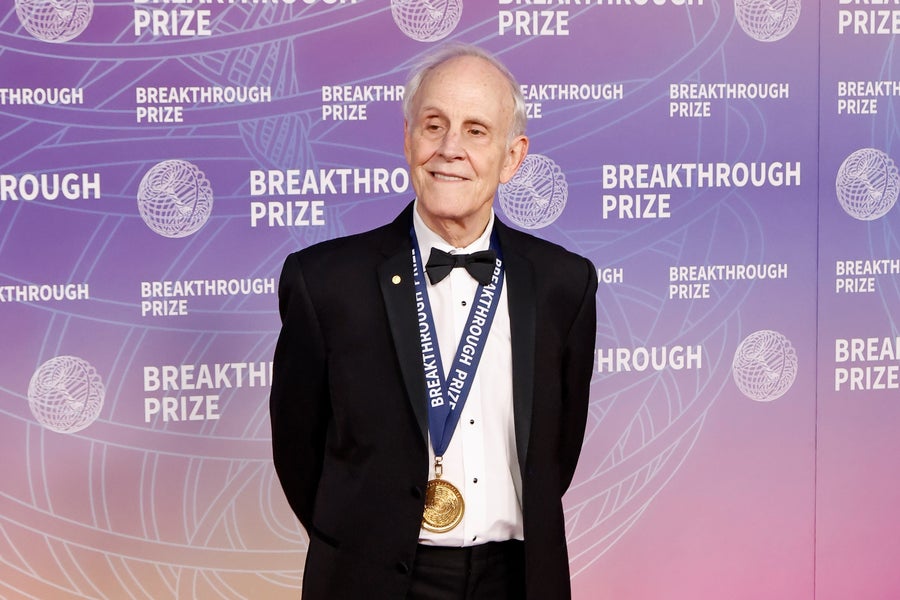
Theoretical physicist David J. Gross attends the 12th Breakthrough Prize Ceremony at Barker Hangar on April 18, 2026, in Santa Monica, Calif., where he received a Special Breakthrough Prize in Fundamental Physics. Taylor Hill/FilmMagic/Getty Images
.
.
Click the link below for the complete article:
.
__________________________________________


Leave a comment