
Click the link below the picture
.
Americans are living longer than ever but still well behind the life expectancy of other developed countries
The latest death data for the U.S. are in, and they paint an optimistic picture: The average American born in 2024 is now expected to live to age 79. That life expectancy is more than a half-year longer than it was in 2023 and great than in any prior year going back to 1900. It was still lower than that of most other developed countries, however.
The projection, released on Thursday by the National Center for Health Statistics, offers a glimmer of hope after COVID and overdose deaths pushed the U.S.’s average life expectancy down to 76.4 years in 2021, a drop of 2.4 years since 2019. Even so, there were 47,539 deaths involving COVID in 2024 and about 87,000 deaths from drug overdoses between October 2023 and September 2024, according to preliminary data from the U.S. Centers of Disease Control and Prevention.
The new report also showed a decrease in age-adjusted death rates, from about 751 deaths per 100,000 Americans in 2023 to about 722 in 2024.
“The rise in life expectancy is welcome news, and it is good to see that it was widespread across race, ethnicity and gender,” says Philip Cohen, a sociologist and demographer at the University of Maryland, College Park.
By 2024, Americans were still dying in the largest numbers from heart disease, cancer, and unintentional injuries, in that order, though suicide replaced COVID as the 10th most common cause of mortality. Still, the age-adjusted death rate for all top 10 causes of death also decreased, with the biggest drop seen for unintentional injuries—from 62.3 deaths per 100,000 Americans in 2023 to 53.3 in 2024.
Though the news may be cause for celebration, there’s plenty of room for improvement. Andrew Stokes, who studies population health and mortality at Boston University, says he’s “concerned that the post-COVID recovery creates an appearance of momentum but obscures a larger story around stagnating and decelerating improvements that became apparent in the decade prior to the pandemic.” The causes of this stagnation, Stokes explains, include cardiometabolic risk factors such as high blood pressure and obesity, whose rates will likely grow.
In most other developed countries, the life expectancy in 2024 was in the low to mid-80s, according to the United Nations. “There are still critical problems in the U.S. public health profile. It should not be big news when the life expectancy rises, which happens every year in every other developed country,” Cohen says, adding that U.S. infant mortality showed no change in 2024.
“And overall…, the U.S. has a shockingly low life expectancy,” he says. “We may be back above where we were before the pandemic, but it is too little, too late, as we were already trending much lower than countries with comparable economic profiles.”
Cohen and Stokes are both worried that U.S. health care is moving in the wrong direction, “with more people losing health care coverage and less support for basic public health among the population,” Cohen says.
.
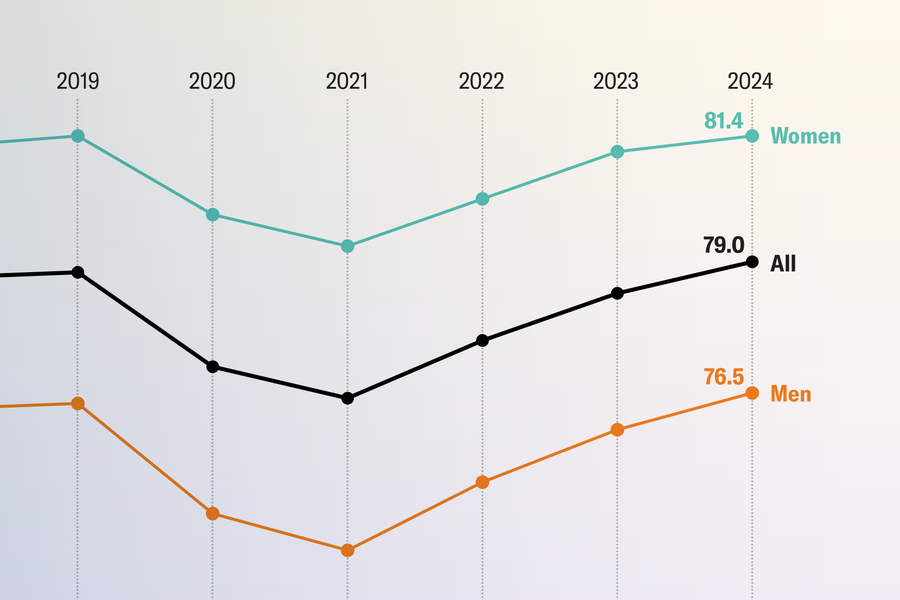 Amanda Montañez; Source: Centers for Disease Control and Prevention (data)
.
.
Click the link below for the complete article:
.
__________________________________________


Leave a Reply