
Click the link below the picture
.
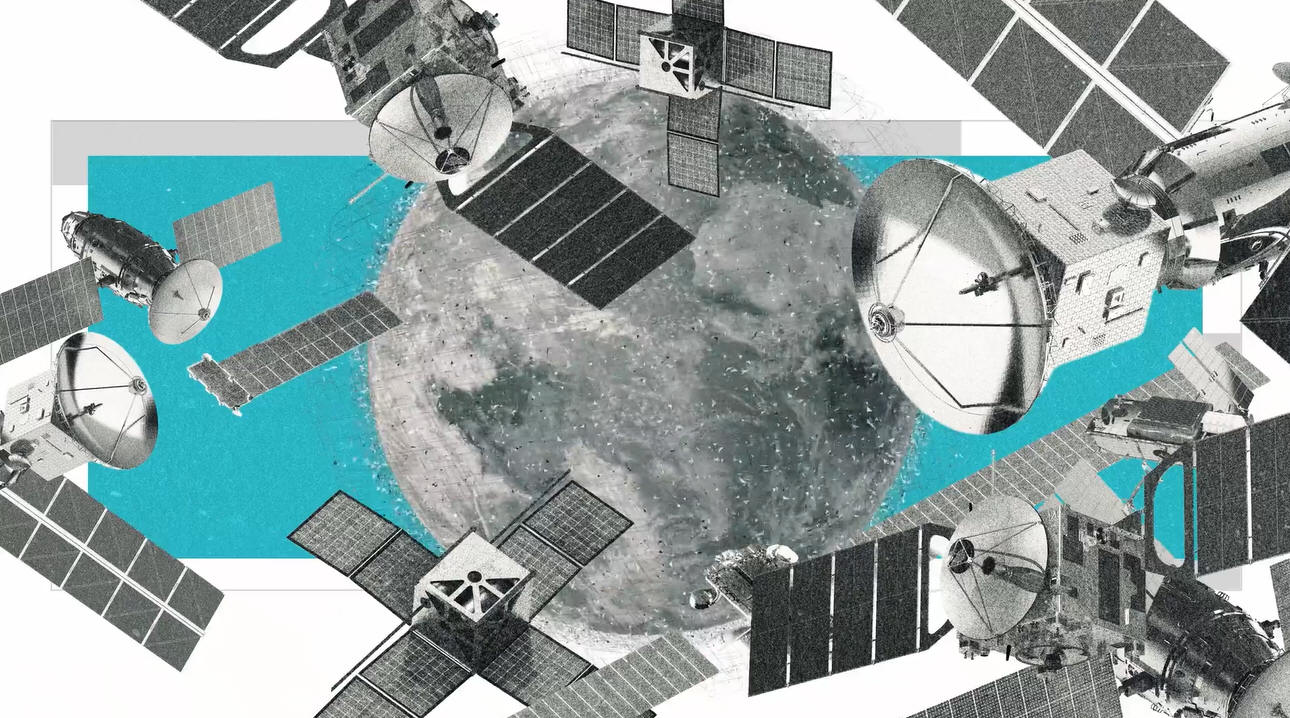
The primal human experience of gazing into an unblemished cosmos is vanishing, being replaced by a dense, industrial field of 15,000 orbiting satellites with plans for half a million more by 2040.
A few minutes after the sun retreated behind the Olympic Mountains, we spotted our first satellite. It moved across the sky with an eerie persistence, like a car on cruise control.
“That’s low Earth orbit. That’s pretty standard speed,” Meredith Rawls, an astronomer at the University of Washington and my stargazing guide for the night, tells me.
The primal human experience of gazing into a dark, unblemished night sky — something we’ve been doing for at least 32,000 years, since our ancestors carved Orion onto a mammoth tusk — is vanishing. That nocturnal vista is becoming a dense, industrial field of orbiting debris.
“I tell people, go to a dark site and see the sky now, while it’s like this,” Rawls says, gesturing to the constellations above us. She lets out a laugh. “It’s like, oh my God, what are we doing?”
The scale is hard to overstate. At the turn of the century, there were just over 700 active satellites in space. Now, with plans for hundreds of thousands more satellites — going from 15,000 today to half a million by 2040 — the new space race is not just a visual nuisance, it’s a toxic threat to our existence.
When you look up at the night sky and wonder why the stars are moving, it’s not because you’re seeing a UFO. You’re likely looking at a satellite, and two out of every three belong to Elon Musk’s Starlink.
Starlink is capable of beaming an internet connection to a dish the size of a pizza box, virtually anywhere in the world. The company’s on track for the largest initial public offering in history, largely on the back of all those satellites cruising through the skies.
When Starlink launched its first satellite in 2019, it kicked off a gold rush in space. Amazon plans to send up 60,000 of its own satellites, Chinese companies nearly 60,000 more. Everyone across the globe, it seems, wants a piece of the sky. Rwanda alone applied for 337,320 satellites. In January, Starlink filed for a million orbital AI data centers.
Spacefaring countries are technically bound by the United Nations’ Outer Space Treaty of 1967, but commercial enterprises are another story. And with space increasingly seen as a new theater of war, many nation-states are racing to launch their own mega-constellations.
In this article:
- 15,000 satellites: How we got here
- A million data centers in space?
- ‘The new theater of defense’
- What scientists are concerned about
- Earth’s atmosphere as a space dump
- Satellites maneuver to avoid collisions
- Space junk doesn’t always stay in space
- Taking out the orbital trash
- Wild West: Who is governing the satellite ecosystem?
- Why satellites are here to stay
The ripple effects are as far-reaching as they are uncertain.
Satellites are expected to disrupt the migratory patterns of birds, dung beetles, and seals, which use the stars to navigate.
Space junk from rocket launches and old satellites falls to Earth every day, increasingly through busy airspace. Last year, a piece of titanium and carbon fiber the size of a car tire landed near a school in Argentina.
Many tons of aluminum and lithium aerosols are added to the atmosphere when satellites reach the end of their lives and burn up, eating away at the ozone layer and potentially accelerating climate change.
And, ironically, they’re also threatening to halt space exploration in its tracks, as thousands of satellites zooming at 17,000 miles per hour push us toward a chain reaction known as the Kessler syndrome, an apocalyptic feedback loop in which one collision could create thousands of pieces of debris that would then lead to more collisions.
You cannot remove all these billions of small fragments from orbit. This will basically limit our access to space forever,” says Hanno Rein, an astrophysicist at the University of Toronto. “This is not going to go away. These small fragments will not necessarily deorbit quickly. They will stay there and make space inaccessible for future generations.”
As I part ways with Rawls, she seems cautiously pleased with how few satellites we saw.
“A real takeaway from our observing session is that there are not yet an overwhelming number of bright satellites,” she says. “I hope you enjoyed your relatively pristine night sky experience.”
I get the feeling that I’m being told to enjoy it while it lasts.
15,000 satellites: How we got here
The Soviet Union launched Sputnik 1, the world’s first satellite in 1957. It would take another 53 years before we passed 1,000 active satellites. Just 16 years after that, we passed 15,000.
Almost all of that growth is due to one company. When SpaceX launched its first batch of Starlink satellites in May 2019, there were only around 2,000 active satellites. It currently has more than 10,000 in orbit; the next closest operator is OneWeb, with 650. An average of 11 satellites have been launched every day in 2026, and with each one, the risk of collisions that generate dangerous space debris increases.
The causes for the prodigious satellite rise are complicated, but if I had to point to a single moment, I’d choose Dec. 22, 2015, the day that SpaceX landed its reusable Falcon 9 rocket for the first time.
.
 Tharon Green/CNET/Getty Images
.
.
Click the link below for the complete article:
.
__________________________________________


Leave a comment