
Click the link below the picture
.
In the wee hours of 31 May 2025, billions of tons of charged particles erupted from the Sun and began to hurtle in our direction. Spacecraft tracked the liftoff of that huge burst of plasma, enabling U.S. officials to predict when the eruption would strike Earth, within a 12-hour window. But a new view of the Sun’s roiling outer atmosphere could have enabled scientists to peg the solar storm’s arrival time much more precisely—to within just half an hour.
That precision comes from PUNCH, a NASA mission keeping an eye on a part of space that’s been a blind spot for space weather. Like a sensitive 3D camera whose field of view covers half the sky, it watches everything escaping the Sun’s atmosphere and traveling toward us. “We can track space weather all the way across the inner Solar System,” says Craig DeForest, the mission’s principal investigator.
He and his colleagues have now shown that based on those observations, they could have forecast within minutes when the 2025 storm would have struck Earth’s magnetic field, threatening satellites, power grids, and other technologies. NASA announced the result today; the team will elaborate on the findings at the Committee on Space Research’s meeting on 7 August.
Today’s space weather forecasts extrapolate from observations near the Sun to predict solar storms’ arrivals. But how a giant blob of plasma will travel depends on the environment it interacts with along the way. Howard Singer, chief scientist of the National Oceanic and Atmospheric Administration’s Space Weather Prediction Center (SWPC), likens the situation to observing a hurricane forming off Africa’s west coast and trying to predict when it might hit Florida. If our next observation is right before it hits Florida, instead of somewhere in between, our forecasts will provide only so much warning—and be only so precise. “That’s where we are now for something leaving the Sun,” he says.
Space weather forecasters would receive a major boost from the equivalent of the weather satellites that track weather systems moving across the globe, DeForest says. Enter PUNCH, launched in March 2025. It combines four synchronized satellites that orbit Earth some 620 kilometers up, taking pictures of a swath of sky 90° wide centered on the Sun. Its instruments remove 99% of background light to reveal the solar wind—streams of particles from the Sun—and the plasma bursts, or coronal mass ejections (CMEs), that scatter sunlight to create a visible glow. PUNCH provides “a massive increase in visibility around the Sun,” says Lisa Upton, solar physicist at the Southwest Research Institute.
DeForest and his colleagues wanted to test what all this extra visibility would do for forecasting. So in a proof of concept, they tracked the May 2025 CME as it left the Sun. Meanwhile, the team plugged PUNCH’s data into a model that uses the CME’s evolving size and shape—approximated as a “ludicrous ice cream cone,” according to the researchers’ paper—to predict its arrival time.
Traveling at an average of 1380 kilometers per second, the CME reached Earth after nearly 30 hours, causing a “G4” geomagnetic storm, severe enough to threaten infrastructure. Models using PUNCH observations could have pinpointed the arrival to between 5 and 5:30 a.m. Greenwich Mean Time on 1 June—enabling operators of satellites, electric utilities, and other systems to prepare 8 hours ahead of time. “We analyzed one event in a deliberately crude way and found this amazing result,” DeForest says.
Now comes the heavy lifting: analyzing dozens of other CMEs that PUNCH has tracked to see how precisely its data could have forecast arrival times. If PUNCH performs well, its data could be used in other research models for space weather. “You have lots of models all trying to forecast the same thing, but you need data sets to validate which is correct,” says Jamie Favors, who directs NASA’s Space Weather Program.
Already, forecasters are testing a prototype product called QuickPUNCH to gauge how much a steady stream of rapid-turnaround images of slightly lower quality can improve CME arrival time predictions. Forecasters have a winning streak they want to sustain: In 2011, modeling advances allowed SWPC to shrink its prediction error for solar storm arrival time from 15 hours down to six, according to Daniel Baker, a space physicist at the University of Colorado Boulder. “If PUNCH can help give better information about CME size and shape,” he adds, “I could imagine getting regular accuracy of
2 to 3 hours in arrival times.”It’s not just arrival time that matters. The intensity of a geomagnetic storm depends partly on the orientation of the magnetic field embedded in the plasma. If that field’s orientation is aligned with Earth’s field, Upton says, the storm’s effects will be far milder than if they’re opposed. Where things stand today, “We don’t really have that information until 30 to 40 minutes before it hits,” Singer says. But by sensing both visible light and its polarization, PUNCH can capture the front of an approaching CME in 3D, allowing researchers to model the strength and orientation of the front’s magnetic field hours before impact.
DeForest likes to emphasize that PUNCH is not just a space weather sentinel. For him, one of the mission’s most satisfying early successes is among its most profound. As PUNCH has gazed out at what he calls a “dynamic ocean of solar storms”—even spotting a comet’s tail shuddering in the solar wind, like smoke from a blown-out candle—the mission has offered an unparalleled glimpse of where we sit within the Solar System. “For the first time,” he says, “we can see our neighborhood in space.”
.
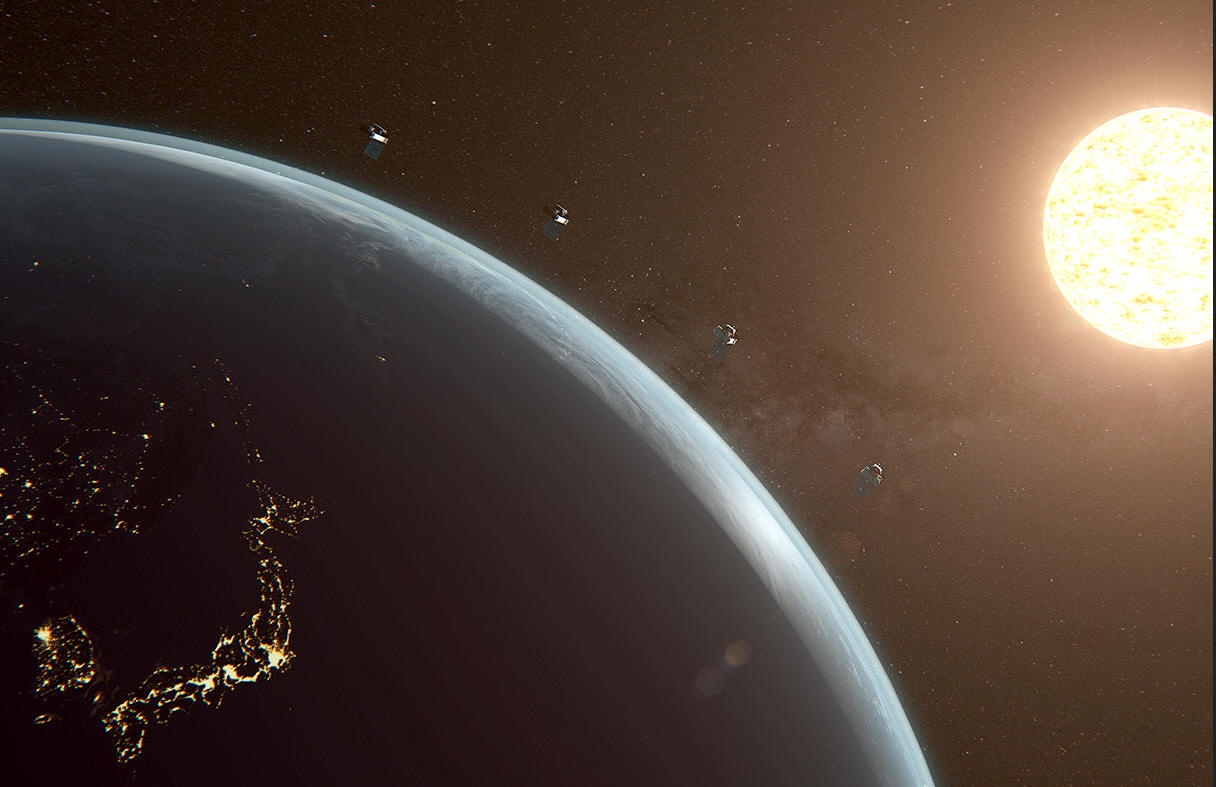 PUNCH’s four satellites in Earth orbit (seen here in an artist’s conception) observe the Sun’s atmosphere.NASA
.
.
Click the link below for the complete article (sound on to listen):
.
__________________________________________


Leave a comment