
Home

Shimon Sakaguchi Reflects on How Hunting for a Mysterious T Cell Earned Him a Nobel Prize

2 Comments

Click the link below the picture

.

In 2006, immunologist and 2025 Nobel prize winner Shimon Sakaguchi co-wrote an article in Scientific American that now feels prophetic. In the story, entitled “Peacekeepers of the Immune System,” Sakaguchi traced a time line of important studies that led to his discovery of an elusive type of immune cell he called regulatory T cells.

In the 1980s, the field had largely dismissed the existence of such a class of cells, but Sakaguchi and other scientists proved that regulatory T cells, or Tregs, are the integral “peacekeepers” that prevent the immune system from overreacting and harming the body itself. That process, known as peripheral immune tolerance, stops the body’s primary defense mechanism from entering self-destruct mode, called autoimmunity.

The experiments Sakaguchi cataloged in Scientific American nearly 20 years ago were recognized last week at the 2025 Nobel award ceremony in Stockholm, where he and immunologists Mary E. Brunkow and Fred Ramsdell shared the prize in physiology or medicine for their discoveries.

“I didn’t expect it, and of course, I was very much pleased,” Sakaguchi says. “I’m happy to have this honor. But at the same time, I really appreciate the community of scientists who have worked together. The progress of this field is really due to the collective effort of many scientists and immunologists.”

In an exclusive interview, Scientific American caught up with Sakaguchi on October 7 EDT, the day after the award announcement. He discussed the crucial findings that led to the discovery of regulatory T cells and clinical trials that harness these cells to potentially treat chronic infections, cancer, and autoimmune diseases.

What was your journey into looking for cells that suppressed the immune system? What drew you to them?

I was very much interested in autoimmune diseases because our immune system normally defends our cells from invading microbes—viruses and bacteria—but sometimes it’s aggressive and destroys our body cells and causes autoimmune diseases such as rheumatoid arthritis and type 1 diabetes. So the immune system has two aspects: good and bad. What’s the mechanism behind this? If we can understand that mechanism, we may be able to treat autoimmune diseases, or the opposite: make the immune system attack abnormal cells, such as cancer cells, arising in our body.

That was my interest when I was a student in medical school, and then I became a researcher to tackle this conundrum. At that time [in the 1980s], the only available approach to study autoimmunity was the mouse model. I happened to find that newborn mice, if you remove the thymus [an organ in the chest that produces various types of T cells], they spontaneously develop autoimmunelike diseases. And then what was interesting was: if you inoculate the thymus-free mice with normal T cells from nonaffected adult mice, you can prevent disease development—meaning that in the normal collection of T cells in the thymus, there must be some cells that can prevent or suppress disease development. That was the start of my research career.

What convinced you that regulatory T cells existed when others abandoned the theory?

I was convinced that autoimmune diseases, similar to [how they can arise] in humans, can be produced in healthy animals by just manipulating the immune system, removing certain T cells. That was always a very solid phenomenon for me. If other hypotheses or other ideas could explain what we saw, I would follow that concept or idea. I always compared what I believed and what [other theories] showed—which one had better explanatory powers. Our results were not so bad—and were even better—so that was the reason that I continued my research on regulatory T cells. It is really a key issue in modern immunology: How can we realize or understand why the immune system does not react with ourselves?

In 2006, you wrote an article for Scientific American entitled “Peacekeepers of the Immune System.” How did you come up with the name “peacekeepers” for the cells?

That was coined by my colleague and co-author of that article, Zoltan Fehervari—he’s now an editor of Nature. At that time, we talked about how we can name them and make them more relatable. And then he came up with that idea: “peacekeeper.” It was a really nice name because, later on, we gradually realized that regulatory T cells not only are immunosuppressive but also have various other functions, such as promoting tissue repair. So they are peacekeepers for many things.

You essentially documented in the article how pivotal this work was nearly two decades ago. Did you think back then that your research would be recognized for a Nobel Prize?

Actually, I didn’t. I really hoped that we could have a better understanding of immunological self-tolerance. It’s a long-standing, important question in immunology. Even the 1960 Nobel awards were awarded to Peter Medawar and Frank Macfarlane Burnet, who showed that immune tolerance is acquired, not innate. Well, that’s really interesting, but how does it happen? There have been several theories, including clonal deletion: deleting the dangerous self-reactive clones [of T cells]. They are eliminated when they are immature and being produced in the immune system. But that couldn’t explain how usual autoimmune diseases happen—for example, type 1 diabetes or rheumatoid arthritis. So it is really a key issue in modern immunology: How can we realize or understand why the immune system does not react with ourselves?

Are there any therapies or applications of your work that are close to making it to the clinic?

What is fascinating about regulatory T cells is that they are specialized for immune suppression, and so this means that if you strengthen their functions or increase their numbers, it could be a good way to treat autoimmunity or allergies, or various diseases. On the other hand, if you reduce the number of these cells or make their function weaker, then the immune response can be enhanced. So it could be good for cancer immunity. We are pursuing both directions, our team and many others. There are many, many trials underway—at the Nobel announcement, the chairperson told us that more than 200 clinical trials are ongoing now.

.
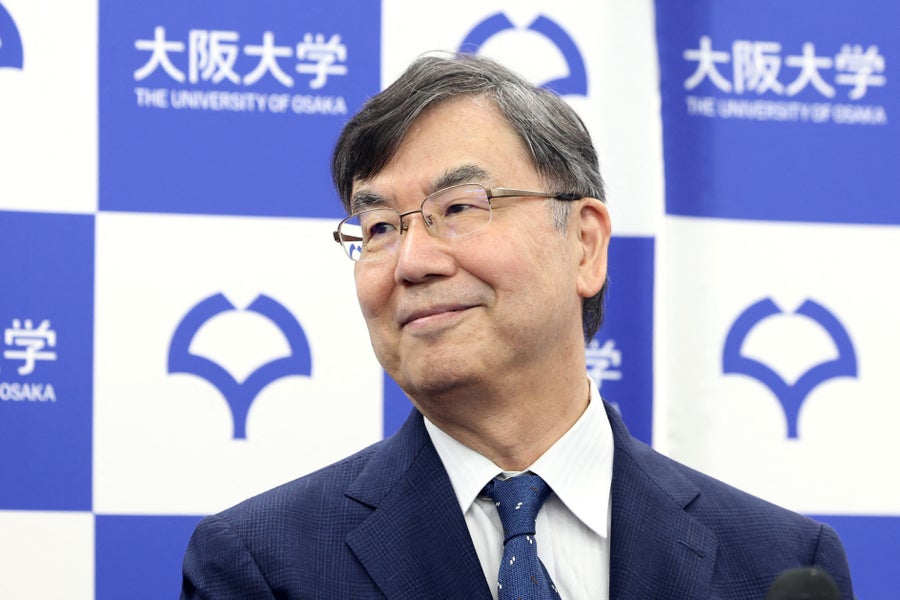
https://static.scientificamerican.com/dam/m/7d70a340b844fa7a/original/shimon_sakaguchi.jpg?m=1760373923.323&w=900

Shimon Sakaguchi, an immunologist and a distinguished professor of Osaka University, attends a press conference after winning the 2025 Nobel Prize in medicine, in Suita, Osaka prefecture, on October 6, 2025.  Paul Miller/AFP via Getty Images

.

.

Click the link below for the complete article:

https://www.scientificamerican.com/article/nobel-prize-winner-shimon-sakaguchi-reflects-on-how-he-discovered-regulatory/?_gl=1*1mp2vnq*_up*MQ..*_ga*NDg2MTUxNzEyLjE3NjA1MTQxMzg.*_ga_0P6ZGEWQVE*czE3NjA1MTQxMzckbzEkZzAkdDE3NjA1MTQxMzckajYwJGwwJGgw

.

__________________________________________

2 Comments (+add yours?)

  1. Myrela Sarajevo's avatar myrelar
    Oct 16, 2025 @ 12:31:43

    Truly impressive! 🧬🏆 Discovering regulatory T cells as “peacekeepers” of the immune system shows how persistence and dedication in science can lead to amazing results 💡🔬. Inspirational for anyone exploring and seeking answers to complex questions in biology and medicine.

    Liked by 1 person

    Reply

Leave a Reply

This site uses Akismet to reduce spam. Learn how your comment data is processed.

Moara de Vânt

Să facem glume, nu război

🇲🇲Dear all peace-loving people around the world🇲🇲

In the world, human beings are facing various problems. People who are full of greed, anger, and ignorance are seen to be fighting with each other in words and deeds. As the fighting continues, various problems such as civil wars, wars of aggression, and wars of aggression are occurring. As world peace is being destroyed, humans are facing unbearable problems. Innocent children and women are not getting the rights they deserve and deserve. I can't think of one thing every time. What is it? The United Nations. If we look at the responsibilities and duties of the United Nations, I think it is not suitable for solving the problems that are happening in the world today. In fact, the United Nations and the World Security Council, such an organization must rule the world, must be able to give orders, and must have various ways to obey orders. There must be no organization that can influence more than that organization. There should be experts from each country. They can even dominate the superpowers like the US, China, and Britain. Only then will global peace be achieved quickly. Now, if a country with power develops more militarily, economically, or socially than its own country, then powerful countries will jealously seek out enemies and wage war. Or they will attack with fighter jets. In this, innocent people are losing their lives. No one understands the value of a life. You should think about how to achieve global peace by controlling these. If the US continues to be the permanent president of the UN, world peace will never be achieved. If you think carefully, no one sees that they are working for the common good, but for their own benefit, for the benefit of their own country. The permanent president of the UN and the Security Council has rejected this, As a young Rohingya, I have come to realize that only by electing the president and secretary from among the countries in the world through a secret ballot system and governing the world fairly can we achieve global peace. The United Nations and the Security Council are organizations in which any country must govern, give orders, and make them obey their orders. For example, only when a defendant is tried in court can we hold the leaders of the countries in check and control them, can we achieve global peace smoothly. Otherwise, it will not be easy for powerful countries to use various excuses to end this war every year, every year, for the benefit of themselves and their countries. No country's leaders pay any attention to the words of the United Nations and the Security Council. If we look at it in practice, look at the Rohingya issue. Myanmar is a small country. Even that country has been under siege for 8 years. What action can be taken? Why is the UN and the Security Council Powerless? Without such Power, how can the organization bring about global peace? Everyone should think about it. Whether there is a veto or a strong one, all countries in the world can only achieve global peace if they are subject to the UN and the Security Council. Seek peace in the quiet embrace of nature. Peace is an indispensable need of the human race. It is not as if one person can kill another person, and it is as if one country can attack another country, but instead of trying to build peace, we must try to destroy the peace now, and the world is getting hotter and is on the verge of collapse. I especially appeal to all the world experts to urgently try to bring about peace in all parts of the world. Mr, Noor Muhamed Arkhan Rohingya Youth Myanmar

Gazeta cuiburilor de cuc

Publicație umoristică dedicată glumeților de pretutindeni

JaZzArt en València

Faith saved us from the savages that we were, losing faith makes us savages again

PeopleTalky

Where Trends Meet Truth

MRS. T’S CORNER

https://www.tangietwoods

Srikanth’s poetry

Freelance poetry writing

MediaNegy

Zalai Betti

INOVATION BLOG AND NEWS

INOVATION BLOG PEOPLE AND NEWS

szigetingy | budapest

Németh György

PT. LPPL Lombok

Konsultan Lingkungan Hidup di Lombok - NTB

Idézetek – LeaArt21

Lea Krasznai (LeaArt21) – Idezetek (Idézetek) WordPress (Budapest, Hungary)

danielecolleoni

Appunti, spunti e passioni in liberta'

تعلم وعلم، ادخر،سافر واستجمم .

تعنى بتقديم نصائح للمعلمين المبتدئين، والطلبة الممتحنين، ومشاركة الاخرين تجربة الادخار في المال، بترشيد الاستهلاك المنزلي، وترتيب البيت، والحفاظ على البيئة، وتشجيع السيارات صديقةالبيئة، والسياحة والاسفار، ونماء رؤوس الاموال، والطب البديل وتشجيع التعليم الرقمي والذكاء الاصطناعي، والعناية بالنحل وتربية الاسماك، والاسثمار في رؤوس الاموال، الزراعة العضوية، والعناية باسنان الرضع، و صحة الحوامل، وتفسير القران

scientifique

apprendre pour évoluer

In Between the Lines

Thoughts on books, language, meaning, and the culture around it.

Great Lakes Mindset

Outdoor Recreation & Adventure in the Great Lakes Region

Nelsapy

News, Info, Bio, Articles, Reviews, Lyrics, Technology, Science, Inspiration, Motivation, Philosphy and many more...

Becoming HIS Tapestry

Christian Lifestyle Blogger

Joe Mullins Commissioner

CEO and president of The Mullins Companies

The Luttie Board

Two Cultures. One Life. Endless Stories

Charles Maxwell DeCook

Real Estate Development Specialist

amorentreestrellas.wordpress.com/

¡Bienvenido de vuelta viajero!

Heart of Loia `'.,°~

so looking to the sky ¡ sing and from my heart to YOU ¡ bring...

Michael Ciullo

CEO and Founder of Nsight Health

Nelson MCBS

Catholic News, Prayers, HD Images, Rosary, Music, Videos, Holy Mass, Homily, Saints, Lyrics, Novenas, Retreats, Talks, Devotionals and Many More

global geopolitics

Decoding Power. Defying Narratives.

Talk Photo

A creative collaboration introducing the art of nature and nature's art.

Movie Burner Entertainment

The Home Of Entertainment News, Reviews and Reactions

C r i s t i a n a' s Fine Arts ⛄️

•Whenever you are confronted with an opponent, conquer him with love.(Gandhi)

TradingClubsMan

Algotrader at TRADING-CLUBS.COM

Comedy FESTIVAL

Film and Writing Festival for Comedy. Showcasing best of comedy short films at the FEEDBACK Film Festival. Plus, showcasing best of comedy novels, short stories, poems, screenplays (TV, short, feature) at the festival performed by professional actors.

Bonnywood Manor

Peace. Tranquility. Insanity.

Warum ich Rad fahre

Take a ride on the wild side

Madame-Radio

Découvre des musiques prometteuses (principalement) dans la sphère musicale française.

Ir de Compras Online

No tiene que Ser una Pesadilla.

Kana's Chronicles

Life in Kana-text (er... CONtext)

Jam Writes

Where feelings meet metaphors and make questionable choices.

emotionalpeace

Finding hope and peace through writing, art, photography, and faith in Jesus.

Essu Center

Eyasu The Wonderful