
Georgette M. Norman (1946- ) First Director of Troy University Rosa Parks Museum
Assorted human interest posts.
June 13, 2026

The federal procurement system is one of the most powerful engines of wealth generation on earth, distributing nearly $834 billion annually in economic infrastructure. Yet, a stark and unyielding baseline persists: year after year, Foundational Black American (FBA) owned businesses are restricted to receiving just 1.2% to 1.5% of total federal contract dollars. This static, […]
The 1.5% Cap: Why Elon Musk-Style Federal Spending Will Never Reach Parity with Foundational Black Americans
June 12, 2026
Business, Food For Thought, Human Interest, Political, Science, Technical amazon, business, Business News, current-events, Future, Hotels, human-rights, medicine, mental-health, research, Science, Science News, technology, Technology News, travel, vacation 2 Comments

Click the link below the picture
.
Where children live and what their household’s socioeconomic status is leaves a mark on their brains, a new study in Science finds. The results suggest that the fewer opportunities a child’s zip code affords, the more tired and stressed their brain appears—and that socioeconomics by far outweighs hundreds of other possible environmental factors in determining a child’s brain function and structure.
“Socioeconomic came out ahead by like a million miles,” says Nico Dosenbach, the study’s senior author and a professor of neurology at the Washington University in St. Louis. Other factors generally thought to be important to child brain development, such as a child’s culture and overall health and their caregivers’ parenting style, didn’t rise above the fold at all, he adds.
Dosenbach and his colleagues used a dataset from the Adolescent Brain Cognitive Development (ABCD) Study, a long-term investigation of brain development and child health in the U.S. Using thousands of children’s brain scans, the scientists made maps of each child’s brain function and structure and then weighed them against 649 variables.
These variables included IQ and cognitive test measures, demographic and cultural information, and mental and physical health records, as well as the child’s score on a measure called the Child Opportunity Index (COI). The COI measures and maps the quality of resources such as safe housing, food access, and schools nearby. Then the researchers looked for patterns in the brain maps that could reveal which factors were most associated with significant changes in the brain. The researchers compared what they were seeing with another, totally unrelated adult sample—the U.K. Biobank—and found that the same patterns persisted.
“A lower socioeconomic brain—so a child who grows up at the lower end, their brain looks more tired and stressed out,” Dosenbach says. “It doesn’t look dumber. The pattern of association completely spares the cognition areas of the brain.”
That’s important, Dosenbach stresses: past research has suggested that socioeconomic status is linked to IQ and cognitive scores, but the new results indicate the reason may be entirely to do with how sleep-deprived and stressed a child is when they are tested—not their basic cognitive ability. That finding came as a shock to Dosenbach and the study’s first author, Scott Marek.
“At the very least, I thought there would still be something there,” says Marek, an assistant professor of radiology at Washington University School of Medicine. Instead, the researchers found that any associations between cognition and the brain disappeared after they adjusted for socioeconomic status. “Place matters a lot for pretty much everything in our lives, so why not the brain as well?” Marek says. “It literally is the factor that permeates all brain behavior association studies.”
Dosenbach says the results have challenged his assumptions about standardized testing for kids—and about screen time. One of the less prominent but still significant variables the team found to have some effect on brain function was how much screen time a child got. He points to journalist and psychologist Jonathan Haidt’s book The Anxious Generation, which argues that screen time is causing a mental health epidemic in kids. Dosenbach didn’t buy Haidt’s argument because it was based on correlations, he says, but he feels unable to argue with his data. “My daughter was about to get her [first] real cell phone, and I pulled the plug on it,” he says.
More broadly, the findings underscore the importance of early childhood circumstances on the developing brain. They do not, however, suggest that a child’s zip code determines their destiny. Marek says he hopes his team and other researchers can work toward developing interventions to combat sleeplessness and stress. Importantly, most of the changes associated with socioeconomic status that the researchers found were in brain function, as opposed to structure, indicating they may not last if those pressures are addressed.
In an accompanying article also published in Science, University of Pennsylvania neuroscientists Lucinda Sisk and Theodore Satterthwaite write that the findings “highlight the need for societal-level policies that provide early support for families.”
The study does have some key limitations, Marek says. For one, it isn’t clear how early in life children’s environment begins to weigh on their brains. The study also included ABCD data from just two time points in children’s lives, so it’s unknown whether the changes the team saw stick around through their teenage years or if they change with age.
The study also doesn’t account for the children’s genetics, such as by calculating and factoring in their polygenetic risk scores, says Torkel Klingberg, a professor of neuroscience at the Karolinska Institute in Sweden, who was not involved in the new study. These are measures that estimate a person’s genetic predisposition to a disease or a trait, such as educational attainment.
“Environment is super important for the brain development, for cognitive function, but so is genetics,” he says. “In order to draw firm conclusions, you really need to consider the effect of genetics.”
Marek says that at the time they did the analysis, the ABCD dataset didn’t include that information. The study does account for genetic ancestry, and it finds no correlation between that and a child’s brain.
“The story is fundamentally about place, right? It’s not race; it’s fundamentally about where you live. Doesn’t matter what color your skin is, what your family history is. The zip code is the thing that matters,” he says. At the same time, Marek and Dosenbach argue that trying to make sure kids are getting enough sleep and are less stressed in their immediate environment are relatively achievable and inexpensive interventions—and could have significant impacts on brain development.
“America as a country is extraordinarily rich,” Marek says, “and I think the hopeful message here is that, yeah, a lot of these effects seem like they are reversible, and they’re not set in stone.”
.
 metamorworks/Getty Images
.
.
Click the link below for the complete article:
.
__________________________________________
June 12, 2026
Business, Food For Thought, Human Interest, Political, Science, Technical amazon, business, Business News, current-events, Future, Hotels, human-rights, medicine, mental-health, research, Science, Science News, technology, Technology News, travel, vacation Leave a comment

Click the link below the picture
.
Key Takeaways
- Rebellious behavior in teens is common and normal—but should you ever be worried if your teen displays defiant behavior?
- Sometimes, defiant behavior in teens can be a cover for more serious emotional issues, like insecurity or anger.
- Experts recommend that parents pay close attention to their teens’ patterns of behavior, so they can spot any changes, and have deeper talks with them about their feelings when tempers have cooled.
I have two teenagers, and so I am very familiar with teenage defiance. Talking back, arguing, not listening to reason or rules – I’ve seen it all. The other day, one kid blew a fuse after I asked him the simple question of what he wanted for lunch. The day before that, we had a heated argument after I reminded him to charge his school iPad. And don’t even get me started on the daily screaming match that happens when I remind him to leave the house on time to catch his morning bus.
I know this is normal behavior for teenagers, but I often ask myself if there is something deeper going on. What emotions might be underlying these behaviors? A few of my close friends have recently confided in me that their teens’ defiant behavior often gets exacerbated when they’re experiencing low self-esteem or feeling inadequate. That got me wondering: Is defiance in teens ever a sign of underlying insecurity? Could it ever be a symptom of another underlying intense emotional state?
To answer my questions, I connected with two therapists to help unpack what defiance in teens really means, and whether it ever is a sign of insecurity.
Is Defiant Behavior in Teens a Sign of Insecurity?
While defiant behavior in teenagers can happen for many different reasons, underlying insecurity is certainly among them.
“When a teen is insecure, they look for ways to find belonging, which can be modeling other teens who are defiant,” says Allison Guilbault, LPC, licensed therapist and founder of the Yes, I Am Too Much™ Revolution. Additionally, “if they think they are not valuable, or struggle with a deep inner critic, they can become defiant as a way to almost double down on how they believe they are perceived,” says Guilbault.
In other words, a teen might be thinking, “If I am not lovable or worthy anyway, may as well go all the way,” Guilbault says. And that thinking transforms outwardly into defiant behavior.
Defiant behavior might also be a way for teens to overcompensate for feeling small or insecure, says Jerry Weichman, Ph.D., clinical psychologist and founder of The Weichman Clinic. “This is an example of ‘the best defense is a strong offense’ mindset that a teen or anyone, for that matter, subconsciously establishes to protect him or herself from emotional pain, embarrassment, judgment, and or disappointment,” he describes.
Is Defiance a Sign of Any Other Concerning Emotions?
Of course, defiant behavior isn’t always a sign of insecurity. There are many other emotions that may cause a teen to break rules and rebel against their parents.
“As a cognitive behavioral therapist who specializes in teens, I always believe that our thoughts dictate our emotions and our emotions dictate our behavior,” says Guilbault. “So if a teen’s emotions are unregulated, that will almost undoubtedly affect behavior negatively.”
Challenges like anxiety, depression, or negative self-talk can increase defiant behaviors, according to Guilbault.
Any teen who is living with strong feelings of hurt and pain—that could be trauma involving school or another family member or stress around academics or romantic relationships—may be prone to increased defiant behavior, too.
“The teens I’ve worked with over the past two and a half decades who have the most common profile associated with oppositional behavior are the teens who have incurred a lot of emotional hurt and pain in their lives,” says Dr. Weichman.
And healing their mental health might be far more than a parent is equipped to handle, which might mean reaching out to mental health experts for therapy or other resources. In situations of more extreme mental health issues, teens may not have the tools to navigate difficult feelings and instead, repress and compartmentalize their feelings as a way to cope.
In addition, teens who are dealing with intense emotions that are hard to cope with are often hot-tempered and easily irritated.
“This unresolved emotional hurt and pain then turns into anger over time,” Dr. Weichman shares.
“As a result of the buildup of emotions, they have a very short fuse and are quick to snap,” says Dr. Weichman. “When they do snap, it’s typically a much bigger reaction than the actual situation may warrant.”
.
:max_bytes(150000):strip_icc()/GettyImages-2234370267-483c848a08624a27b24f9f70922bf999.jpg) Teenagers
Teenagers
.
.
Click the link below for the complete article:
.
__________________________________________
June 12, 2026
Business, Food For Thought, Human Interest, Political, Science, Technical amazon, business, Business News, current-events, Future, Hotels, human-rights, medicine, mental-health, research, Science, Science News, technology, Technology News, travel, vacation Leave a comment

Click the link below the picture
.
After a night of storms, both political and meteorological, workers began removing President Trump’s name from the white marble facade of the John F. Kennedy Center for the Performing Arts early on Saturday morning, responding to a federal judge’s ruling that its rebranding was unlawful.
The letters began coming down just past 3 a.m., after the center sought an extension of a midnight deadline. Matt Floca, the center’s executive director, asked a federal district court for 12 more hours to certify that it had complied with the order, attributing the delay to a cluster of summer storms.
Workers spent about eight hours on Friday building towering scaffolding in front of the section of the facade bearing Mr. Trump’s name. Then, in the early hours of Saturday, they hung heavy white tarps from the structure. It obscured views of the removal, which was a significant symbolic victory for opponents of Mr. Trump’s takeover of an iconic performing arts center.
But a gap in the tarps allowed a New York Times photographer to observe a worker pulling the letter “A” from the wall. There was no sound of power tools; the letter appeared to come off by hand.
For all of Friday, lawyers for Mr. Trump and the center had been seeking legal intervention to keep his name on the marble as they pursue an appeal.
But after both the district court and a federal appeals court denied their requests for an immediate stay on the ruling, workers began erecting scaffolding in earnest to reach the letters. A rowdy audience of a few hundred people gathered to watch.
The center’s Trump-allied board voted to add the president’s name to the institution nearly six months ago, causing an uproar in Washington and a crisis within the city’s pre-eminent art center. At an institution that had already been rocked by the president’s takeover, the 18 new letters affixed to the building — less than a day after the board vote — increased the temperature even further.
Democratic legislators condemned the move as an act of “narcissism”; a series of artists canceled engagements at the center; and Representative Joyce Beatty, an ex officio member of the center’s board, filed a lawsuit calling the move a “flagrant violation of the rule of law.” Ms. Beatty was on hand for the operation on Saturday morning, remaining on the plaza outside the Kennedy Center even after the work crew departed around 4 a.m.
The ensuing debate over the appropriateness of the renaming led to a bizarre scene in Washington, where, for two days, the arts center on the Potomac River has seen a flurry of visitors, not there for a symphony or ballet, but to see whether the president’s name would be detached from the marble. While onlookers kept watch, a steady drumbeat of legal developments drove a sense of uncertainty over whether the removal would happen at all.
On Thursday, one of the first signs of movement came when security guards erected black bike racks to close off the main drive and walkway near the front of the building. Passers-by quizzed volunteers and guards inside the center about when the letters would come off, with little success.
A short walk from the Kennedy Center, residents of the Watergate were planning impromptu house parties at the sprawling condominium complex. Two volunteer organizations, Hands Off the Arts and Free the Kennedy Center, coordinated to livestream the signage on the building from a webcam situated on a balcony at the Watergate.
Christine Lienert and Debra Wilfong kept their celebratory champagne on ice until 10:30 p.m. on Thursday. As news emerged that Mr. Trump’s name would not be coming off the building that night, they slipped the bubbly back into the fridge
On Friday, Ms. Lienert reloaded the cooler and joined the throng awaiting the letters’ removal. But after news spread that Mr. Trump’s name might not be removed for hours, she packed up her champagne, the ice in her cooler having long since melted.
Not everyone who milled around the Kennedy Center was opposed to keeping Mr. Trump’s name on the building. Jeanette Mercado and her husband, Bert, had traveled to Washington from Wasco, in California’s Central Valley, to see the capital’s monuments and came upon the scaffolding and the gathering crowd.
“I like Trump, I like what he’s doing for our country, I think he’s a blessing for our country, and I don’t see anything wrong with his name being added,” Ms. Mercado said, her voice almost drowned out by chants of “take it down.”
Mr. Mercado, who said he was a Trump supporter as well, took a different view. “There should be a sense of continuity here — why are you going to interject your name?” he said.
In December, the Kennedy Center board voted to put Mr. Trump’s name on the building in recognition of what officials have described as his dedication to the institution and his help in securing $257 million to finance what officials said was a much-needed renovation.
.
 On Friday night, workers constructed scaffolding near President Trump’s name on the facade of the John F. Kennedy Center for the Performing Arts. Credit…Pete Kiehart for The New York Times
.
.
Click the link below for the complete article:
.
__________________________________________
June 12, 2026

You laboriously construct an online identity of substance and achievement, yet in the real world, you remain a hollow shell of performative fiction. This desperate obsession with crafting an idealized facade only highlights your fundamental inability to exist authentically. While you solicit validation from strangers for the life you pretend to lead, your actual reality […]
True me.. Tap-2524..
June 11, 2026
Business, Food For Thought, Human Interest, Political, Science, Technical amazon, business, Business News, current-events, Future, Hotels, human-rights, medicine, mental-health, research, Science, Science News, technology, Technology News, travel, vacation Leave a comment
Click the link below the picture
.
If you’ve never heard of arbuscular mycorrhizal (AM) fungi before, I wouldn’t blame you—unless you happen to be a ficus. With symbiotic trade relationships spanning roughly 70 percent of plant species on Earth, these charismatic topsoil denizens should be on the radar of any self-respecting photosynthesizer. Yet although AM fungi haul roughly four billion metric tons of carbon from plants into the soil each year, there’s still a lot we humans don’t know about this type of fungus, starting with how much of it there actually is.
Until now: in a new paper published in Science, researchers combined data from more than 300 studies to estimate the total global biomass of AM fungi. The task is deceptively difficult. Biomass depends in part on the thickness of fungal filaments, meaning that even small errors in estimating their average diameter can dramatically affect the final calculation. To illustrate the challenge, co-author Justin D. Stewart, a data scientist at the Society for the Protection of Underground Networks (SPUN), offers an analogy: Imagine lying beneath a tree and trying to determine the average width of all its branches. Some are long and incredibly thin, while others are short and thick.
To tackle the problem, the team used a custom-built robot named Prince, which captured more than 300,000 measurements of growing fungal networks. (For those interested, other robotic residents of the lab include Donna Summer and Aretha Franklin.) Combined with mathematical modeling and published data from around the world, those measurements let the researchers estimate global fungal biomass and, with data visualizer Moritz Stefaner, create an interactive mycorrhizal infrastructure map covering Earth’s landmasses down to each square kilometer.
“We’re surrounded by numbers and data,” says Stefaner, who was immediately drawn to the aesthetic qualities of the dataset. “Everybody wants to make sense of it. Everybody wants to see the big picture.”
So, how much of this type of fungus is there?
The answer is simultaneously more and less than you might expect. By biomass, the world’s AM fungi weigh roughly five times as much as all humans combined. That’s substantial but not nearly as much as many researchers anticipated.
“I was kind of surprised that the numbers weren’t higher,” says Kyra Skye Gibson, a postdoctoral researcher at Northern Arizona University, who was not involved in the study.
Stewart says the research team felt much the same way. “When we first calculated how heavy these fungi were,” he says, “I think we spent two or three weeks recalculating it to make sure we weren’t missing zeros.”
Perhaps mass is the wrong way to think about it. In terms of length, the numbers become genuinely absurd. Earth’s topsoil contains an estimated 110 quadrillion kilometers of AM fungi laid end to end— enough to stretch from Earth to our neighboring star Proxima Centauri and back or to reach the 11.9 light-years to Tau Ceti, the setting of Andy Weir’s sci‑fi hit Project Hail Mary.
Yet despite such staggering numbers, Stewart is just as eager to discuss what the researchers haven’t found. “We’re treating these maps as living documents, not static images,” he says, emphasizing the importance of the nearly 200 researchers working with SPUN to fill in the remaining gaps. To help identify those gaps, the team created supplemental “maps of ignorance” that highlight where the estimates are most uncertain.
“I’m very comfortable with uncertainty, as long as we quantify what type of uncertainty it is and how large it is,” Stewart says. “These maps of ignorance are also treasure maps of where we need to go sample data in the future.”
.
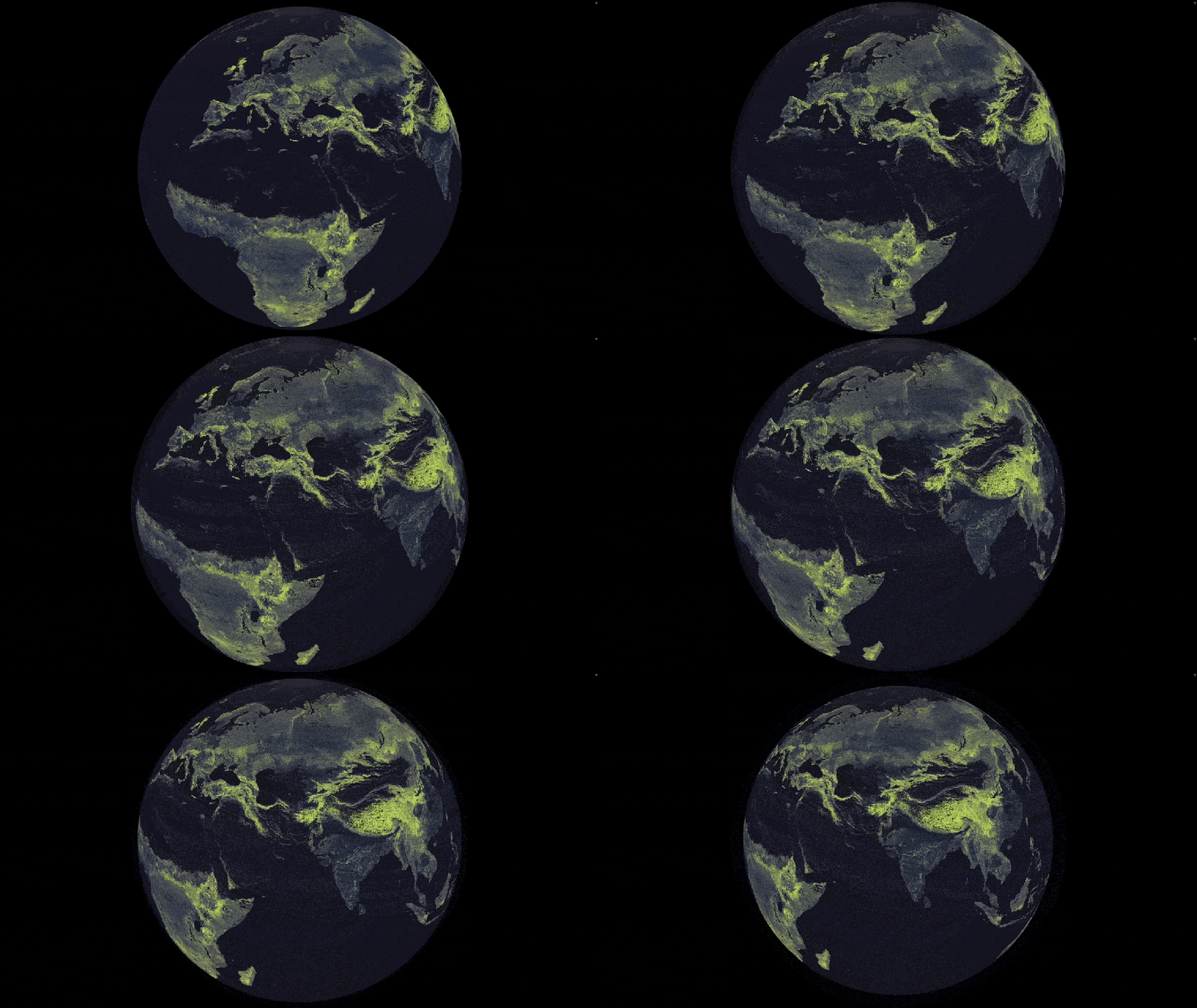
Researchers and data visualization experts plotted the dense map of arbuscular mycorrhizal fungi around the world, down to each square kilometer. Moritz Stefaner – Truth & Beauty/Society for the Protection of Underground Networks
.
.
Click the link below for the complete article:
.
__________________________________________
June 11, 2026
Business, Food For Thought, Human Interest, Political, Science, Technical amazon, business, Business News, current-events, Future, Hotels, human-rights, medicine, mental-health, research, Science, Science News, technology, Technology News, travel, vacation Leave a comment

Click the link below the picture
.
El Niño, the climate phenomenon that supercharges weather around the world, has officially arrived and could intensify to historic levels in the fall, US officials said on Thursday.
US National Oceanic and Atmospheric Administration (Noaa) forecasters confirmed the formation of El Niño in the warmer than usual Pacific Ocean near the equator, which affects global weather patterns.
Scientists have previously advised that this year’s El Niño could be the strongest of the century. António Guterres, the UN secretary-general, described El Niño as an “urgent climate warning”.
There was a 63% chance that the El Niño will get so intense this late fall and early winter that it “would rank among the largest El Niño events in the historical record going back to 1950”, according to Noaa.
In the US, El Niño has been associated with stormier weather in the south, increased risk of high tide flooding, algal blooms on the west coast, and changes to migratory patterns of marine life. But the conditions affect weather across the world by altering jet streams and changing rain patterns, which can lead to more severe storms, increased temperatures, and drought.
“Every El Nino is not the same; each one is unique with its own imprint on our weather,” Ken Graham, the director of Noaa’s National Weather Service (NWS), said in a statement. “Advanced monitoring and an improved understanding of El Niño patterns allow the NWS to better predict and better prepare the public and our core partners for what is to come.”
It affects weather patterns by bringing “a lot of extra heat to the surface, fueling a lot of extreme events for a lot of places around the world”, said Abby Frazier, a Clark University climate scientist.
She said, “it can get dire very quickly”, especially in the Pacific.
Effects vary by region. El Niño often dampens – but does not eliminate – Atlantic hurricane season activity, but increases it in the Pacific. So while the US east and Gulf coasts may get a break, Hawaii and other islands are more in danger, Frazier said. It typically leads to a wetter winter in California.
The drought-stricken Middle East could benefit, climate scientists said. Other places are looking at more danger. Parts of western South America – where the first El Niños were noticed decades ago – often get heavy rain and floods, along with an extra warm summer. India faces more intense heatwaves, while drought, wildfires, and heat threaten Australia.
North-eastern Africa is probably going to get weather whiplash from intense drought to dangerously heavy rains, said Muhammad Azhar Ehsan, a Columbia University climate scientist and El Niño expert.
El Niños can benefit the US agriculture industry, said Jon Gottschalck, operational branch chief at Noaa’s Climate Prediction Center.
Michael Ferrari, meteorologist and head of research at the investment research firm Moby, said conditions for grains and seed, especially soybeans, look favorable in 18 major growing states, but are more mixed when it comes to dairy and cattle.
.
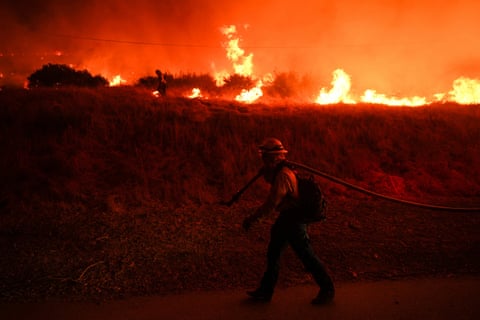
A firefighter monitors flames caused by the Hughes fire in Castaic, California, on 22 January 2025. Photograph: Jae C Hong/AP
.
.
Click the link below for the complete article:
.
__________________________________________
June 11, 2026
Business, Food For Thought, Human Interest, Political, Science, Technical amazon, business, Business News, current-events, Future, Hotels, human-rights, medicine, mental-health, research, Science, Science News, technology, Technology News, travel, vacation Leave a comment

Click the link below the picture
.
Claiming there was progress in the peace negotiations, President Trump said he had canceled his next wave of planned attacks after two days of U.S. airstrikes.
Here’s the latest.
After two days of pounding Iran with airstrikes, President Trump on Thursday promised to hit Iran hard again for a third day and mused about invading a strategic island — then abruptly called off the attacks.
Mr. Trump said in a social media post that he changed his mind because progress had been made in peace negotiations with Iran. While he claimed that the discussions had “been brought to the highest level of Iranian leadership and approved,” Iran’s leadership did not immediately confirm any progress. Earlier this week, Mr. Trump had claimed a peace deal was imminent, but hours later, the two countries attacked each other.
Shortly before he called off strikes on Iran on Thursday, President Trump spoke to the Pakistanis, who have been mediating with the Iranians. The Pakistanis told Trump that “we have a deal” with Iran, according to a senior administration official. We have yet to independently confirm this with the Iranians, and it’s unclear what, if anything, has been agreed. International oil prices fell more than 3 percent, below $90 a barrel, after President Trump said he had canceled planned strikes against Iran.
In a social media post, President Trump said that he had “cancelled the scheduled strikes and bombings against Iran” that he had threatened for later this evening. The president said he had canceled the attacks because of progress on a peace deal. He said that discussions “have been brought to the highest level of Iranian leadership” and approved. The president said the naval blockade would remain and suggested, without further explanation, there would be a “signing” announced soon.
Trump has repeatedly claimed over the last several months that a peace deal was imminent, often threatening escalating strikes against Iran soon after. Iranian officials, in turn, have often denied Trump’s claims that they have agreed to terms of a potential peace deal.
The commander of Iran’s military headquarters warned on Thursday that any new U.S. attack would draw a “response harsher than before” that would make the war “broader and more widespread,” the country’s state broadcaster reported.
The commander also appeared to issue a veiled threat against other countries’ energy exports, saying that in light of recent U.S. threats against Iran’s oil infrastructure, “either everyone” will be able to export oil and gas, “or no one will.”
The State Department said on Thursday that it was speaking with the Indian government after officials in Delhi summoned the top U.S. diplomat in India at the moment to denounce what appears to be U.S. involvement in a strike on a commercial oil tanker near Oman that left three Indian sailors dead. “The Department of State is in direct contact with the government of India regarding this matter,” the agency said. India summoned the diplomat, Jason P. Meeks, the deputy chief of mission at at the U.S. Embassy in Delhi, on Wednesday. The U.S. ambassador, Sergio Gor, is out of the country. “We condemn the attack on the commercial vessel Settebello off the coast of Oman,” the Indian ministry of external affairs had said on Wednesday.
Data from Kpler, a global-ship tracking firm, shows one vessel has crossed the Strait of Hormuz so far on Thursday, and another one crossed on Wednesday, as military clashes between the United States and Iran have heightened tensions in the vital waterway. Those crossing numbers are down from earlier in the week; six ships crossed on Tuesday, and eight on Monday, Kpler found.
The data might not reflect the full number of crossings, because ships can turn off or misdirect their location signals to avoid being tracked. In a report published Thursday, Kpler found that non-Iranian crude oil shipments have picked up since Tehran initially closed the strait — but the vast majority of that traffic has been through dark transits or other workarounds.
Iran’s speaker of Parliament, Mohammad Bagher Ghalibaf, warned on Thursday that further escalation by the United States could threaten energy infrastructure and global markets.
“Wrong strategies and impulsive decisions will reset the entire board for the worse,” Ghalibaf wrote on social media, adding that the United States would see “a different Iran.”
.
 Tehran on Monday.Credit…Arash Khamooshi/Polaris for The New York Times
.
.
Click the link below for the complete article:
.
__________________________________________
Find the Best Forex Broker for Your Trading Success
AS HUMILDES OPINIÕES DE UMA MULHER DE CORAGEM QUE DIZ SIM À VIDA!
Să facem glume, nu război
In the world, human beings are facing various problems. People who are full of greed, anger, and ignorance are seen to be fighting with each other in words and deeds. As the fighting continues, various problems such as civil wars, wars of aggression, and wars of aggression are occurring. As world peace is being destroyed, humans are facing unbearable problems. Innocent children and women are not getting the rights they deserve and deserve. I can't think of one thing every time. What is it? The United Nations. If we look at the responsibilities and duties of the United Nations, I think it is not suitable for solving the problems that are happening in the world today. In fact, the United Nations and the World Security Council, such an organization must rule the world, must be able to give orders, and must have various ways to obey orders. There must be no organization that can influence more than that organization. There should be experts from each country. They can even dominate the superpowers like the US, China, and Britain. Only then will global peace be achieved quickly. Now, if a country with power develops more militarily, economically, or socially than its own country, then powerful countries will jealously seek out enemies and wage war. Or they will attack with fighter jets. In this, innocent people are losing their lives. No one understands the value of a life. You should think about how to achieve global peace by controlling these. If the US continues to be the permanent president of the UN, world peace will never be achieved. If you think carefully, no one sees that they are working for the common good, but for their own benefit, for the benefit of their own country. The permanent president of the UN and the Security Council has rejected this, As a young Rohingya, I have come to realize that only by electing the president and secretary from among the countries in the world through a secret ballot system and governing the world fairly can we achieve global peace. The United Nations and the Security Council are organizations in which any country must govern, give orders, and make them obey their orders. For example, only when a defendant is tried in court can we hold the leaders of the countries in check and control them, can we achieve global peace smoothly. Otherwise, it will not be easy for powerful countries to use various excuses to end this war every year, every year, for the benefit of themselves and their countries. No country's leaders pay any attention to the words of the United Nations and the Security Council. If we look at it in practice, look at the Rohingya issue. Myanmar is a small country. Even that country has been under siege for 8 years. What action can be taken? Why is the UN and the Security Council Powerless? Without such Power, how can the organization bring about global peace? Everyone should think about it. Whether there is a veto or a strong one, all countries in the world can only achieve global peace if they are subject to the UN and the Security Council. Seek peace in the quiet embrace of nature. Peace is an indispensable need of the human race. It is not as if one person can kill another person, and it is as if one country can attack another country, but instead of trying to build peace, we must try to destroy the peace now, and the world is getting hotter and is on the verge of collapse. I especially appeal to all the world experts to urgently try to bring about peace in all parts of the world. Mr, Noor Muhamed Arkhan Rohingya Youth Myanmar
Publicație umoristică dedicată glumeților de pretutindeni
Faith saved us from the savages that we were, losing faith makes us savages again
Where Trends Meet Truth
https://www.tangietwoods
Freelance poetry writing
Zalai Betti
INOVATION BLOG PEOPLE AND NEWS
Németh György
Konsultan Lingkungan Hidup di Lombok - NTB
Lea Krasznai (LeaArt21) – Idezetek (Idézetek) WordPress (Budapest, Hungary)
Appunti, spunti e passioni in liberta'
Gyorgy Nemeth
تعنى بتقديم نصائح للمعلمين المبتدئين، والطلبة الممتحنين، ومشاركة الاخرين تجربة الادخار في المال، بترشيد الاستهلاك المنزلي، وترتيب البيت، والحفاظ على البيئة، وتشجيع السيارات صديقةالبيئة، والسياحة والاسفار، ونماء رؤوس الاموال، والطب البديل وتشجيع التعليم الرقمي والذكاء الاصطناعي، والعناية بالنحل وتربية الاسماك، والاسثمار في رؤوس الاموال، الزراعة العضوية، والعناية باسنان الرضع، و صحة الحوامل، وتفسير القران
apprendre pour évoluer
Thoughts on books, language, meaning, and the culture around it.
Outdoor Recreation & Adventure in the Great Lakes Region
News, Info, Bio, Articles, Reviews, Lyrics, Technology, Science, Inspiration, Motivation, Philosphy and many more...
Christian Lifestyle Blogger
CEO and president of The Mullins Companies
Two Cultures. One Life. Endless Stories
Real Estate Development Specialist
¡Bienvenido de vuelta viajero!
so looking to the sky ¡ sing and from my heart to YOU ¡ bring...
CEO and Founder of Nsight Health
Catholic News, Prayers, HD Images, Rosary, Music, Videos, Holy Mass, Homily, Saints, Lyrics, Novenas, Retreats, Talks, Devotionals and Many More
Decoding Power. Defying Narratives.
A creative collaboration introducing the art of nature and nature's art.
The Home Of Entertainment News, Reviews and Reactions
•Whenever you are confronted with an opponent, conquer him with love.(Gandhi)
Algotrader at TRADING-CLUBS.COM
Film and Writing Festival for Comedy. Showcasing best of comedy short films at the FEEDBACK Film Festival. Plus, showcasing best of comedy novels, short stories, poems, screenplays (TV, short, feature) at the festival performed by professional actors.
Peace. Tranquility. Insanity.
Take a ride on the wild side
Découvre des musiques prometteuses (principalement) dans la sphère musicale française.
No tiene que Ser una Pesadilla.
Life in Kana-text (er... CONtext)
Where feelings meet metaphors and make questionable choices.
Finding hope and peace through writing, art, photography, and faith in Jesus.

