
Click the link below the picture
.
El Niño, the climate phenomenon that supercharges weather around the world, has officially arrived and could intensify to historic levels in the fall, US officials said on Thursday.
US National Oceanic and Atmospheric Administration (Noaa) forecasters confirmed the formation of El Niño in the warmer than usual Pacific Ocean near the equator, which affects global weather patterns.
Scientists have previously advised that this year’s El Niño could be the strongest of the century. António Guterres, the UN secretary-general, described El Niño as an “urgent climate warning”.
There was a 63% chance that the El Niño will get so intense this late fall and early winter that it “would rank among the largest El Niño events in the historical record going back to 1950”, according to Noaa.
In the US, El Niño has been associated with stormier weather in the south, increased risk of high tide flooding, algal blooms on the west coast, and changes to migratory patterns of marine life. But the conditions affect weather across the world by altering jet streams and changing rain patterns, which can lead to more severe storms, increased temperatures, and drought.
“Every El Nino is not the same; each one is unique with its own imprint on our weather,” Ken Graham, the director of Noaa’s National Weather Service (NWS), said in a statement. “Advanced monitoring and an improved understanding of El Niño patterns allow the NWS to better predict and better prepare the public and our core partners for what is to come.”
It affects weather patterns by bringing “a lot of extra heat to the surface, fueling a lot of extreme events for a lot of places around the world”, said Abby Frazier, a Clark University climate scientist.
She said, “it can get dire very quickly”, especially in the Pacific.
Effects vary by region. El Niño often dampens – but does not eliminate – Atlantic hurricane season activity, but increases it in the Pacific. So while the US east and Gulf coasts may get a break, Hawaii and other islands are more in danger, Frazier said. It typically leads to a wetter winter in California.
The drought-stricken Middle East could benefit, climate scientists said. Other places are looking at more danger. Parts of western South America – where the first El Niños were noticed decades ago – often get heavy rain and floods, along with an extra warm summer. India faces more intense heatwaves, while drought, wildfires, and heat threaten Australia.
North-eastern Africa is probably going to get weather whiplash from intense drought to dangerously heavy rains, said Muhammad Azhar Ehsan, a Columbia University climate scientist and El Niño expert.
El Niños can benefit the US agriculture industry, said Jon Gottschalck, operational branch chief at Noaa’s Climate Prediction Center.
Michael Ferrari, meteorologist and head of research at the investment research firm Moby, said conditions for grains and seed, especially soybeans, look favorable in 18 major growing states, but are more mixed when it comes to dairy and cattle.
.
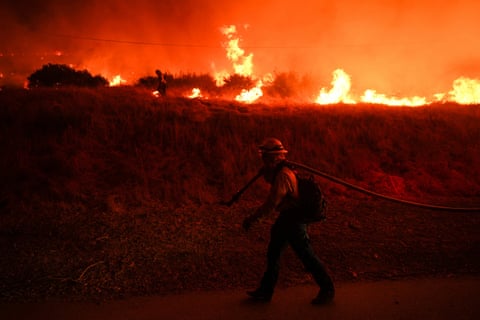
A firefighter monitors flames caused by the Hughes fire in Castaic, California, on 22 January 2025. Photograph: Jae C Hong/AP
.
.
Click the link below for the complete article:
.
__________________________________________


Leave a Reply