It’s no secret that the Earth is in dire straits. Photos of the waterways in Rio de Janeiro, still reeking of sewage despite a years-long cleanup plan ahead of this summer’s Olympics, prove just how difficult it can be to fix what humanity has fouled.
The human toll of all this pollution and destruction is vast. A report released Tuesday by the World Health Organization links nearly 13 million deaths worldwide to preventable environmental factors. The study found that nearly 1 in 4 deaths in 2012, the most recent year cited in the report, had to do with surroundings made unhealthy by air pollution, poor water quality and other environmental factors. More than 1 in 4 deaths of children under the age of 5 were linked to the same sources.
“A healthy environment underpins a healthy population,” Margaret Chan, director-general of WHO, said in a statement. “If countries do not take actions to make environments where people live and work healthy, millions will continue to become ill and die too young.”
.
Manish Swarup/Associated Press
A new study has linked unhealthy environments, like those caused by dirty cookstoves, to millions of preventable deaths worldwide.
The World Health Organization announced Monday that cured and processed meats like bacon, sausage, hot dogs and ham cause cancer, adding the foods to a top-tier list of carcinogenic substances that includes alcohol, cigarettes, asbestos, and arsenic.
Processed meats can be bundled with these threatening carcinogens because of their link with bowel cancer, according to a report from WHO’s International Agency for Research on Cancer, though their inclusion doesn’t mean that bacon causes cancer at the same rate as, say, smoking.
“For an individual, the risk of developing colorectal (bowel) cancer because of their consumption of processed meat remains small, but this risk increases with the amount of meat consumed,” IARC epidemiologist Dr. Kurt Straif said in a statement.
An experimental vaccine tested on thousands of people in Guinea exposed to Ebola seems to work and might help shut down the ongoing epidemic in West Africa, according to interim results from a study published Friday.
There is currently no licensed treatment or vaccine for Ebola, which has so far killed more than 11,000 people in West Africa since the world’s biggest outbreak began in the forest region of Guinea last year.
“If proven effective, this is going to be a game-changer,” said Dr. Margaret Chan, Director-General of the World Health Organization, which sponsored the study. “It will change the management of the current outbreak and future outbreaks.”
.
Doctor Francis Kateh, right, from Redemption Hospital volunteering to receive a trial vaccine against Ebola at Redemption Hospital on the outskirts of Monrovia. ZOOM DOSSO / AFP – Getty Images file
When Dr. Ian Crozier was released from Emory University Hospital in October after a long, brutal fight with Ebola that nearly ended his life, his medical team thought he was cured. But less than two months later, he was back at the hospital with fading sight, intense pain and soaring pressure in his left eye.
Test results were chilling: The inside of Dr. Crozier’s eye was teeming with Ebola.
His doctors were amazed. They had considered the possibility that the virus had invaded his eye, but they had not really expected to find it. Months had passed since Dr. Crozier became ill while working in an Ebola treatment ward in Sierra Leone as a volunteer for the World Health Organization. By the time he left Emory, his blood was Ebola-free. Although the virus may persist in semen for months, other body fluids were thought to be clear of it once a patient recovered. Almost nothing was known about the ability of Ebola to lurk inside the eye.
.
Before he contracted Ebola, Dr. Ian Crozier had two blue eyes. After he was told he was cured of the disease, his left eye turned green.Credit Emory Eye Center
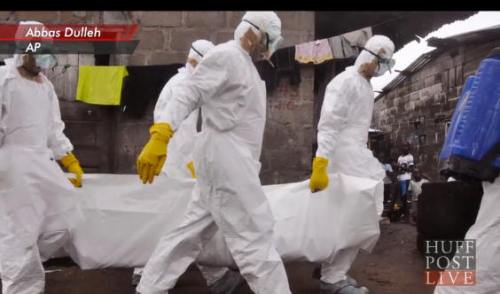
New guidelines for the personal protective equipment that wear have on when treating Ebola patients make clear that what you wear counts — but even more important is how you put it on and take it off.
And the guidelines that the World Health Organization updated Friday suggest only highly trained medical professionals should be taking on the dangerous job of caring for Ebola patients, say the country’s leading doctors at the National Institutes of Health.
“Anybody could do this, but the training process is something that takes a lot of time,” Dr. Francis Collins, who heads the National Institutes of Health, told NBC News in an interview.
The number of Ebola cases could start doubling every three weeks in West Africa, the World Health Organization said Tuesday, warning that the outbreak will cost nearly $1 billion to contain so it does not turn into a “human catastrophe.”
Even as President Barack Obama is ordering the deployment of 3,000 U.S. military personnel to help provide aid in the region, Doctors Without Borders said the global response to Ebola has been far short of what is needed.
“The response to Ebola continues to fall dangerously behind,” Dr. Joanne Liu, president of the medical charity, told a U.N. special briefing on Ebola in Geneva. “The window of opportunity to contain this outbreak is closing. We need more countries to stand up, we need greater deployment, and we need it now.”
The United States’ top disease detective calls Ebola a “painful, dreadful, merciless virus.”
The World Health Organization has declared the outbreak in West Africa an international emergency, killing more than 900 people and spreading.
That’s scary and serious. But it also cries out for context.
.
This undated photo made available by the Antwerp Institute of Tropical Medicine in Antwerp, Belgium, shows the Ebola virus viewed through an electron microscope. The World Health Organization on Friday, Aug. 8, 2014 declared the Ebola outbreak in West Africa to be an international public health emergency that requires an extraordinary response to stop its spread. (AP Photo/Antwerp Institute of Tropical Medicine) | ASSOCIATED PRESS
The worst outbreak of Ebola virus in history — happening now in West Africa — has claimed more than 700 lives, according to the latest count from the World Health Organization. The deaths occurred in Sierra Leone, Liberia, Guinea and Nigeria.
“This outbreak is moving faster than our efforts to control it,” Margaret Chan, chief of the World Health Organization, said at a meeting, as reported by Reuters.
For the first time ever, the World Health Organization on Monday declared the spread of polio an international public health emergency that could grow in the next few months and unravel the nearly three-decade effort to eradicate the crippling disease.
The agency described current polio outbreaks across at least 10 countries in Asia, Africa and the Middle East as an “extraordinary event” that required a coordinated international response. It identified Pakistan, Syria and Cameroon as having allowed the virus to spread beyond their borders, and recommended that those three governments require citizens to obtain a certificate proving they have been vaccinated for polio before traveling abroad.
“Until it is eradicated, polio will continue to spread internationally, find and paralyze susceptible kids,” Dr. Bruce Aylward, who leads WHO’s polio efforts, said during a press briefing.
Worldwide elimination of malaria would save hundreds of thousands of lives each year, according to the World Health Organization (WHO). But eradication remains elusive, because the parasite that causes the disease can evolve to withstand the effects of new malaria drugs and become drug-resistant.
Researchers, however, now believe they have discovered a way to track the spread of drug-resistant malaria, and this discovery may help to finally eradicate the disease. Their study was recently published in the journal Nature Genetics.
“We’ve seen past cases of (malaria) drug resistance spread in a specific pattern,” said study author Nicholas White from Mahidol University in Bangkok, Thailand, and the University of Oxford in the UK. “It starts in Cambodia, spreads across Southeast Asia and crosses over to Africa, killing millions of children in the process.”
Film and Writing Festival for Comedy. Showcasing best of comedy short films at the FEEDBACK Film Festival. Plus, showcasing best of comedy novels, short stories, poems, screenplays (TV, short, feature) at the festival performed by professional actors.








 James' World 2