It took Microsoft three tries, but it finally scored a hit with the Surface Pro 3, which the company touts as the “tablet that can replace your laptop.”
Now, three former Google engineers are running with that idea in the Android arena.
The Remix tablet, unveiled on Wednesday at CES 2015 by Chinese company Jide, looks a lot like one of Microsoft’s Surface devices. It’s about the same size with an 11.6-inch screen, and the edge has a similar trapezoid shape that makes it suited to sitting at an angle. The Remix also has both a kickstand and a magnetically attached keyboard — two Surface hallmarks. Even the volume control feels the same.
The iPhone’s answer to the BlackBerry keyboard, the Ryan Seacrest-backed Typo, is back. Like the first model, the Typo 2 turns your Apple smartphone into one with a QWERTY keyboard.
But the second version is a bit different — and this makes sense, considering Typo was hit with a lawsuit and pulled off the market for having a design too close to BlackBerry’s existing keyboard.
Seacrest and Typo cofounder Laurence Hallier developed the concept after realizing how some people lug around two phones: one for typing and correspondence and an iPhone for most everything else. The two developed the case for BlackBerry fans who’ve resisted switching to the iOS because of loyalty to a physical keyboard.
In the space between somewhat practical vehicles like the Segway and completely fad-driven curios like the Tamagotchi, there exists a middle ground of outlandish gadget that almost seems to make sense, but is weird enough that you might be too embarrassed to use it in public.
It’s still early days, but that appears to be the case with Acton’s RocketSkates, which look like a joint creation by the art departments of Judge Dredd and Willy Wonka & the Chocolate Factory. Offering to motorize your feet, they are a recent Kickstarter success story. And depending on your temperament, the RocketSkates either look like a glimpse at the future, or an expensive prank.
Do they work as described? A demonstration video indicates that, yes, you can use the RocketSkates to traverse the city at fairly rapid speeds. But there are limitations.
Ian Burkhart had barely finished his freshman year of college when he broke his neck.
Standing on top of a cliff in North Carolina’s Outer Banks, which overlooked an orange sandbar jutting into the Atlantic Ocean, he dove hands-first toward the deceptively shallow water below.
“It happened so fast. There was this loud snap,” he says.
The impact with the sandbar broke his vertebrae at what’s called the C5 level, paralyzing his body from the elbows down. He spent the next four months recovering. Doctors told him he’d never be able to use his arms again.
.
Image: The Ohio State University
Ian Burkhart shares a smile with Chad Bouton, research leader from Battelle. Bouton and his team at Battelle pioneered the Neurobridge technology, working closely with doctors from The Ohio State University Wexner Medical Center, which allowed Burkhart to become the first patient ever to move his paralyzed hand with his own thoughts.
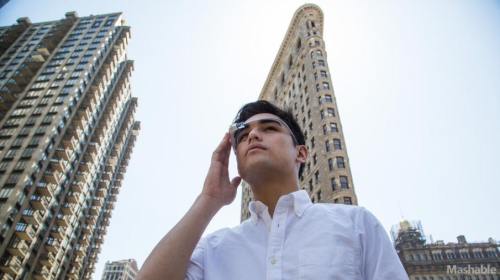
Wearable technology is perhaps the most prolific trend in the tech industry today.
From activity-tracking fitness bands to Google Glass and Oculus Rift, big names are getting involved in the once-niche technology — and they’re getting involved in big ways.
You probably wouldn’t have guessed that the tech behind wearable computing devices finds much of its history in attempting to cheat casinos. Inventors built some of the first wearables in the 1960s and ’70s to count cards and improve a gambler’s odds at the roulette table.
A new portable charging system aims to put on-the-go power in your pocket, boasting a set-up that reportedly doesn’t compromise on power or portability. Modulo, developed by Barcelona-based tech company Idapt, is a credit card-sized gadget that claims to power any USB device, wherever you go.
“All our lifestyle now goes to electronics — it’s portable, really portable,” Idapt CEO Jacques Giribet told Mashable. “We have designed a battery that is as small as possible, taking into account that we want it to give you the same power as the original battery.”
We’ve already read about 3D-printing liquid metal. Now, a new patent awarded to Apple hints at the possibility of the company introducing liquid metals to the mobile market.
Apple is looking to incorporate 3D-printing liquid metal into its products, with the help of partner company Liquidmetal Technologies, whose patented fabrication processing rights were bought by Apple in 2010. The tech giant therefore holds the exclusive license for the development and sale of the processed liquid alloys.
According to Electronista, “The material is a group of alloys that have an atomic structure more similar to glass, with an amorphous quality.” This means the alloy can be molded into very complex shapes, all while maintaining strength.
Your next iPhone, iPad or even iWatch could potentially be encased in this printed alloy. As the technology develops, it’s possible that Apple may apply the material to even larger objects.
When it comes to technology, Silicon Valley remains a metonym for the industry as a whole. Small tech startups often open up shop in the area — if only to make a name for themselves — and many of America’s greatest tech companies and venture capitalists reside there as well.
But technology hubs can be found beyond the rolling green hills of the South Bay. As the industry continues to grow at an economy-defying rate and venture capitalists pour millions into burgeoning niches like the education-tech sector, new firms no longer feel the need for an office with a San Francisco or San Jose zip code.
Film and Writing Festival for Comedy. Showcasing best of comedy short films at the FEEDBACK Film Festival. Plus, showcasing best of comedy novels, short stories, poems, screenplays (TV, short, feature) at the festival performed by professional actors.


 BlackBerry Type keyboard for iphone


 Image: The Ohio State University




 James' World 2